
Electric Vehicle Batteries
Electric vehicle batteries
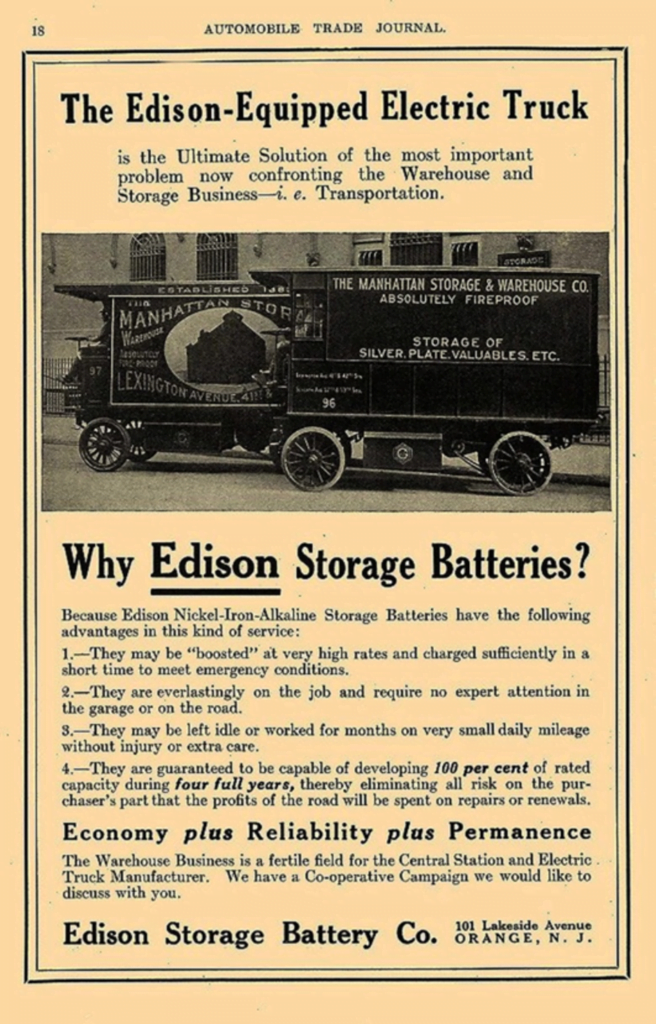
Electric vehicles were commonly used from 1880 or so. Their increased use was limited by inefficent electric vehicle batteries. This also limited speed to only 35 km/h (22 mph). Their range was about 100 km (62 mph). It also awaited adequate control technology. (See also Electric Vehicle History)
Pic: Edison Battery Archives
From 1970 onward, technology improved dramatically. AGM batteries increased driving range slightly. Otherwise, electric vehicle batteries remained almost unchanged. Most provided about 33 watt-hours per kilogram.
Nickel Hydride
In 1991, the USA launched its Advanced Battery Consortium. This resulted in the nickel hydride (NiMH) battery. This initially doubled energy – to 68 Wh/kg. That has since doubled.
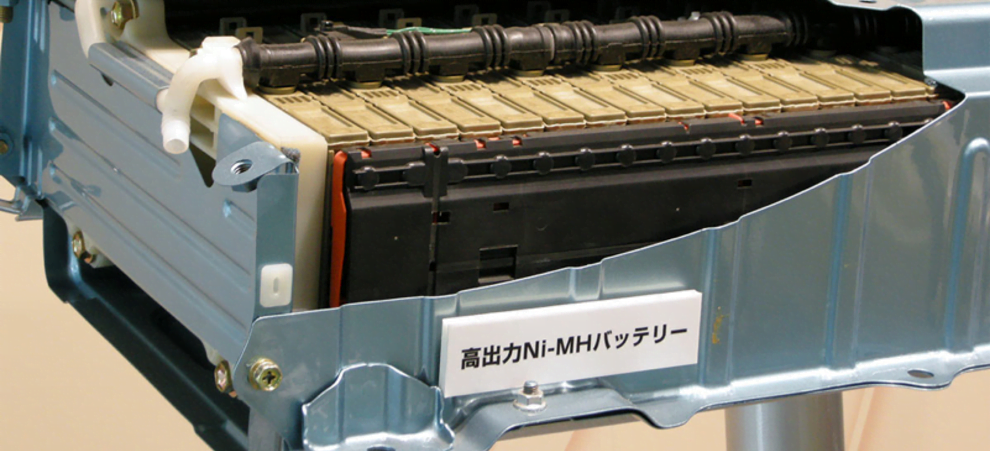
Early nickel hydride (NiMH) battery. Pic: ecomento.com
While having greater energy density, NiMH’s have low charging efficiency. Moreover, they are costly. Furthermore, they tend to self-discharge. There is also hydrogen loss. Nevertheless, they still power hybrid vehicles. Honda and Toyota use them. read more…

Electric Vehicle Home Charging
Charging your electric car at home or work
Electric vehicle home charging for small electric cars is feasible at home or at work from a 15 amp power point. A power cable plugs into the car’s on-board charger. Most such vehicles have a charging unit inbuilt.

Pic: https://cleantechnica.com/
Some electric car dealers include a home charging assessment price and/or a consultation with a licensed electrical contractor as part of the car’s purchase price.
A typical electric of hybrid used for typical commuting (of 40-50 km a day) uses 2.5-5.0 kilowatt/hours. This, often called one ‘unit’, usually costs less during off-peak periods .
This guide gives some indication of how many kilometres you can drive when charging typical electric cars from a home or similar supply at their maximum rate via that inbuilt charger.
| Type: | Maximum charge (kW) | km per hour of charging |
|---|---|---|
| BMW i3 | 7.4 | 25 |
| Chevy Spark EV | 3.3 | 11 |
| Fiat 500e | 6.6 | 22 |
| Ford Focus Electric | 6.6 | 22 |
| Kia Soul EV | 6.6 | 22 |
| Mercedes B-Class Elec. | 10 | 29 |
| Mitsubishi i-MieEV | 3.3 | 11 |
| Nissan Leaf | 3.3 – 6.6 | 11 – 22 |
| Smart Electric Drive | 3.3 | 11 |
| Tesla Models S & X | 10 – 20 | 29-58 |
Charging is readily done overnight but solar captured during the day can be sold to the electricity supplier.

All electric vehicle efficiency & emissions
All Electric Vehicle Efficiency & Emissions
This article, by Collyn Rivers, discusses electric vehicle efficiency and emissions. All road vehicles emit pollution (and are health issues). Emissions are in two main forms. One includes haze and particulate matter. The other are ‘greenhouse gases’, These include carbon dioxide and methane.
Vehicle pollution – 2019. Pic: Original source unknown
Particulate matter from tyres
Tyres constantly shed particulate matter. It is mainly soot and styrene-butadiene. The smaller particulates are airborne. They are a minor cancer risk. https://ncbi.nlm.nih.gov/pmc/articles/PMC1567725/.
The larger particles are washed into lakes and rivers etc. Related data, however, is scarce. Sweden, calculates tyre particulates as about 150 tonnes yearly. Battery-electric vehicles are heavier than those fossil-fuelled. Their tyre emissions accordingly increase.
Particulate matter from brake linings
Brake linings cause particulate emissions. These were initially asbestos cadmium, copper, lead, and zinc. All are now banned. They are now fibres of glass, steel and plastic. There are also antimony compounds, brass chips and iron filings. Also steel wool to conduct heat. These particulates disperse directly into the air. Their antimony (Sb) content may increase cancer. Most electric vehicles reduce speed by regenerative braking. This reduces brake lining emissions.
Regenerative braking
Many hybrid and most electric cars have regenerative braking. When needing to slow or stop your car’s drive motor acts as a generator. This charges the vehicle’s batteries.
Regenerative braking assists thermodynamic efficiency in all electric vehicles. Not just hybrids. It also reduces braking emissions.
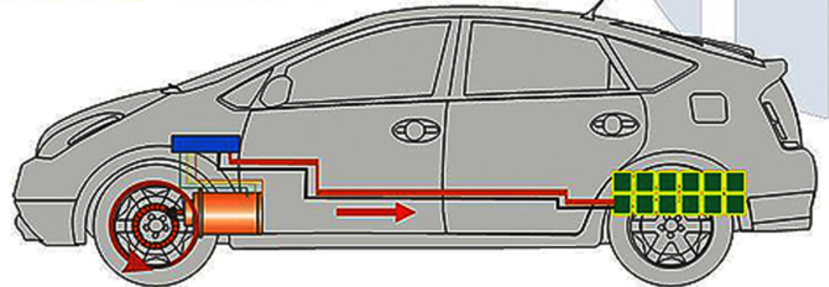
Regenerative braking: whilst braking the drive motor acts as a generator, thereby charging the vehicle’s batteries. By doing so the vehicle’s kinetic energy is saved and stored for propulsive use. Pic: reworked from a concept of the Porter & Chester Institue, Connecticut, USA.
Tailpipe emissions
Electric vehicles produce negligable direct emissions. Hybrids produce no tailpipe emissions in electric mode. They have evaporative emissions, mainly during refueling. Their overall emissions are lower than those of 100% fossil-fuelled vehicles.
Indirect emissions from fossil-fuelled power stations

An Australian electricity power station. Pic: SMH.com.au.
Electric vehicles run from grid power must include power station emissions. Most of Australia’s power stations are fossil-fuelled. At an averaged 920 kg CO2-per megawatt/hour, ost are below average global efficiency. None rivals China’s 670–800 kg per megawatt/hour. India has many inefficient fossil-fuelled power stations, but is the world-leader of large-scale solar power. No fossil-fuelled power station, however, converts more than 40% of heat into electricity.
Some 78% per cent of the electricity generated by Australia’s power stations is from coal. Gas accounts for just under 10%. The remaining 12% or so is from hydro, wind and solar.
Due to Australia’s power stations emissions, it seems pointless to use an electric car powered via the grid network. When battery capacity permits, however, it makes sense to go all electric. This particularly if charged via solar. Or possibly via hydrogen fuel cells.
Future power stations
Australia is unlikely to build efficient fossil-fuelled power stations. Even reducing their existing pollution is enormously costly. Their output will inevitably be undercut by renewable energy. Wind plus solar and hydro systems are cheaper and simpler. Furthermore, (once apart from manufacturing and erecting) wind, solar and hydro is pollution free.
Quantifying petrol vehicle emissions
Oil-well to vehicle emissions must include extracting, refining and distributing. Furthermore, fossil fuel powered vehicle engines are about 25% or so efficient. The remaining 75% of the energy is lost.
Overall, every litre of burned petrol causes in 3.15 kg of CO2 emissions. About 81% is caused in burning the petrol, 13% by extraction and transportation, and around 6% from refining. Burning petrol’s released nitrous oxide has 300 times the global warming potential of CO2.
A typical fossil-fuelled Australian passenger car uses about 9.0 km/litre. Driving just one kilometre generates close to 350 grams of CO2 equivalent being emitted into the atmosphere. This is about 4.8 tonnes of CO2 equivalent emissions per car per year.
European disgrace
Some major European vehicle makers disgracefully concealed their diesel engine emissions. They included software that detected the vehicle’s emission were being checked. That software changed the engine’s operating mode accordingly to indicate reduced emissions.
Huge technical efforts have since been made to legimately limit fossil-fuel powered vehicle emissions. It is now, however, recognised it is not feasible to reduce them any further. This is particularly so of diesel. Reduced vehicle weight and performance assists but vehicle makers globally are now (2020) accepting their post-2030 products will be all-electric.
Current battery technology restricts range between charging. All-electric cars are fine for typical commuting to and from work. For general use right now however, hybrids make more sense.
Most cars are driven about 14,000 km/year. They emit about 4.8 tonne/year. The Toyota Prius hybrid averages just under 30 km/litre. It emits 31% CO2 (about 1.5 tonnes a year). That is 3.3 tonnes less than a comparable petrol-powered car.
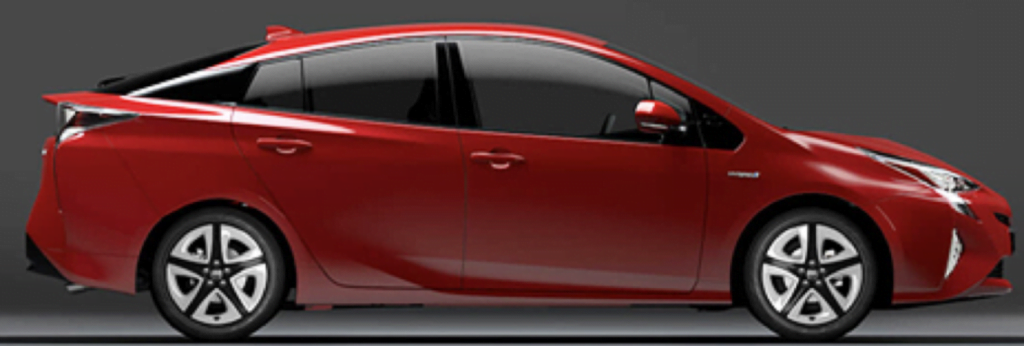
Toyota Prius Hybrid. Pic: Toyota
Hydrogen
An increasing possibility is that hydrogen may replace oil as a global source of fuel. It can and is already being produced from fossil fuel. It can be done (and on a large scale) by passing an electric current through water. This now includes sea water. This enables it to be produced via both solar, wind-power and wave-power.
A so-called fuel cell enables hydrogen to be re-converted to electricity stored in so-called fuel cells. The fuel cell can then power an electric vehicle. This is not just conjecture. Many such vehicles now exist – mainly in California and Norway.
Australia’s main power stations – ages and emissions
Those known in terms of year built, and kilograms of CO2 per megawatt/hour (MWh) actually produced.
Stanwell (1996): 969 kg per MWh.
Bluewaters (2009): 982 kg per MWh.
Muja CD (1985): 982 kg per MWh.
Mt Piper (1996): 997 kg per MWh.
Collie (1999): 1004 kg per MWh.
Eraring (1982): 1011 kg per MWh.
Vales Point (1979): 1018 kg per MWh.
Callide B (1989): 1019 kg per MWh.
Bayswater (1986): 1031 kg per MWh.
Gladstone (1976): 1052 kg per MWh.
Lidell (1973): 1066 kg per MWh.
Muja AB (1969): 1285 kg per MWh.
Worsley (1982): 1324 kg per MWh.
A few of the above have now been (or soon will be) closed down.
The Electric Vehicle Series
This is a part of a series of articles about the history and technology involved in electric vehicles.
Electric Vehicle Motors
Electric vehicle motors
AC/DC
Electric vehicle motors use one or other of the two main kinds of electricity: alternating current and direct current. Both are effective as electric vehicle motors.
Alternating Current (AC) is where electric current constantly reverses its direction. It is that used in grid power supplies. In Australia and many other countries it cycles at 50 times a second. In America it cycles at 60 times a second.
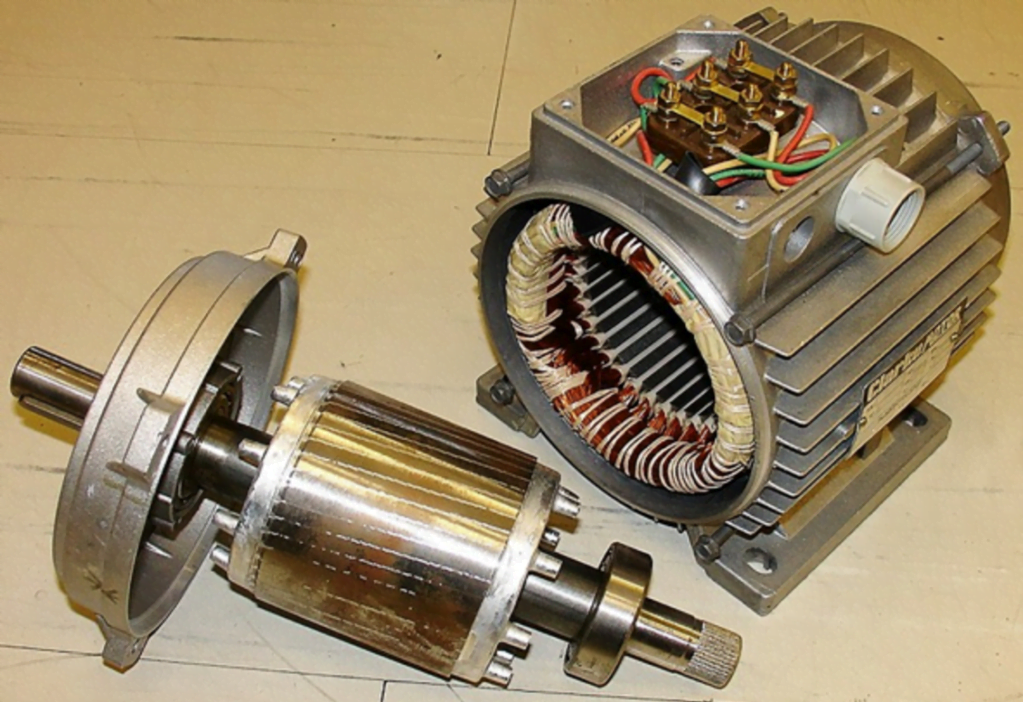
Tesla Roadster AC motor. Pic: Tesla.
The AC induction motors used in a few electric vehicles have a stator (stationary coils of wire). When AC current flows through it, the stator generates a rotating magnetic field. That in turn causes a rotatable armature to revolve. It rotates at the rate of the AC current: i.e. at 50 or 60 times a second.
The relationship between AC voltage and its frequency enables changes in vehicle speed. The batteries’ DC output is converted to AC by an ‘inverter’. All that required is an inverter that has variable frequency. This is effective, but not that efficient.
AC induction motors are often used in hybrid vehicles. These use electric drive for limited commuting. Efficiency and range are not seen as major factors. There is however an increasing trend to direct current (DC) motors for electric vehicles.
Electric Vehicle Motors – Direct Current (DC)
Direct current (DC) is a flow of electrons in one direction. Edison is often credited as conceiving it. It was, however, initially conceived (in 1800) by Alessandro Volta. The term ‘Volt’ commorates his name.
A basic DC motor has fixed external magnets. These surround a revolving armature that is an electromagnet. It also doubles as the drive shaft. Direct current is fed to this electromagnet via a commutator.
Electric Vehicle Motors – commutators & brushes
The commutator is a basic DC motor’s weak point. It is a small ‘drum’ made of an electrically-insulating material. This drum has a number of copper segments. Carbon brushes, that conduct the DC current, are sprung against these segments.
The direct current is fed to the revolving armature via those brushes. This creates a magnetic field in the armature. The magnetic field causes the armature to spin through 180 degrees. A further mechanism causes the current fed to the brushes to reverse the DC’s polarity for the second 180 degrees. And so on.
While these motors work well, the carbon brushes sprung against rotating segments, wear out. They also constantly spark. This is a potential fire hazard. Moreover, it causes electrical ‘noise’ that must be suppressed.
A few electric vehicles use basic DC motors originally designed for other purposes. There are, however, many variants that combine the benefits of both AC and DC.
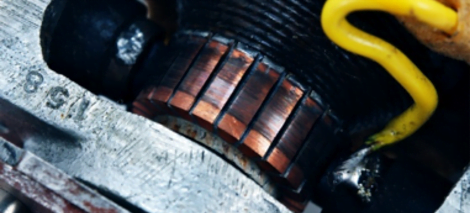
A DC electric motor’s commutator. One carbon brush is attached to the yellow lead. A second (out of sight) is on the left.
Brushless DC motors
A Brushless DC motor (BLDC), is in effect a DC motor turned inside out. It has permanent magnets on the rotor that generate a rotatable magnetic field on its outside. An electronic sensor monitors the angle of the rotor. Then, via high power transistors, it applies current to generate an external electromagnetic field. That field creates a turning force.
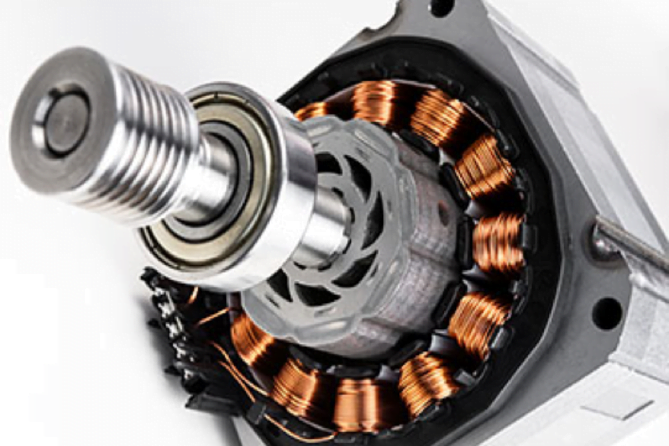
Brushless DC motor – Pic: original source unknown
Maximum torque at zero speed
Brushless DC motors develop maximum torque at zero speed. They are efficient electrically. Moreover, they have no brushes that wear out, and no need for internal cooling. Furthermore, this enables its internal bits and pieces to be free of contamination.
These motors produce far more torque than fossil-fuelled motors of comparable size and/or weight. They can rotate at far greater speed. They are relatively light and compact. Their available power is primarily limited by heat.
BLDC motors have minor downsides. They cost more to make than their brushed counterparts. Furthermore, d at present, the permanent magnets field strength is not adjustable. Work is in progress to make it so. Once achieved that will enable increasing maximum torque at low speeds when required. This is likely to be done by using neodymium (NdFeB) magnets.
Brushless DC motors cost more than most electric motors but are nevertheless proving commercially successful. They are used for Tesla’s Model 3. It seems likely they will dominate the market.
The Electric Vehicle Series
This is a part of a series of articles about the history and technology involved in electric vehicles.
Electric and Hybrid Vehicles
Electric Vehicle Batteries
Electric and Hybrid Vehicles
As of 2021, it is becoming increasingly clear that reducing fossil-fuelled vehicles (particularly diesel) to a truly safe level is impossible. Hence the trend to electric and hybrid vehicles. Many countries are already banning (or will ban soon) the sale of fossil-fuelled cars. These include France, Canada, Costa Rica, Denmark, Germany, Iceland, the Netherlands, Norway, Portugal, South Korea, Spain, Sweden, and the U.K. Twelve American states adhere to California’s Zero-Emission Vehicle (ZEV) Program.
The USA’s Trump administration eased the requirement. It reduced it from the mandated 5% a year – to 1.5% a year. Environmental bodies, led by California, challenged Trump’s backward step. Unless Trump is (improbably) re-elected, this situation is likely to change.
In the first year of the current regulation, carmakers must cut emissions by 10% more than Trump required. They would then have to make 5% yearly reductions.
Administration officials say the rule would save drivers money at the pump. It would decrease fuel consumption by about 200 billion gallons over four years. Furthermore, the standards would prevent an additional 2 billion metric tonnes of carbon pollution from being released into the atmosphere.
The proposal postpones ongoing arguments over how much to restrict vehicle emissions in 2027 and beyond. In the August 2021 executive order, the President directed agencies to begin work on the next standards.
John Bozzella, CEO of the Alliance for Automotive Innovation, called on Congress and state legislatures to invest in the infrastructure needed for the increase in electric and hybrid vehicles.
In a joint statement, Ford, General Motors, and Stellantis (the merger of Fiat Chrysler and French carmaker PSA) declared their ‘shared aspiration’ to make 40% to 50% of new vehicle sales electric by the end of the decade.
Environmental advocates cheered President Biden’s administration’s pledge to cancel the Trump regulations. Many, however, say the administration’s proposed replacement does not go far enough. In a letter to the President, they called for a 60% cut to vehicle emissions by 2030. This goal would be difficult to meet under the administration’s proposed pollution rules. Furthermore, environmentalists are wary of car companies’ ongoing promises to phase out internal combustion engines. ‘Today’s proposal relies on unenforceable voluntary commitments from unreliable carmakers to make up to 50% of their fleets electric by 2030’, says Dan Becker, director of the Center for Biological Diversity’s Safe Climate Transport Campaign. ‘Global warming is burning forests, roasting the West, and worsening storms. Now is not the time to propose weak standards and promise strong ones later,’ he said.
Becker and others said that auto companies already have the technology to meet tougher standards than those being proposed by the Biden administration, but rarely use it in the USA. Automakers argue they’re unable to meet stricter standards because Americans prefer larger, less fuel-efficient vehicles.
In recent years, some automakers have been able to meet federal standards. They do so, however, not by producing cleaner cars, but by cashing in credits earned by making a few electric and hybrid vehicles.
The proposed regulations are part of the administration’s efforts to push Americans to buy more electric and hybrid vehicles. Biden has asked Congress for hundreds of billions of dollars to make the vehicles more affordable through tax credits. Also to electrify 20% of the nation’s school buses by 2030.
At stake in that bill is the President’s ability to eliminate greenhouse gas emissions by 2050. Environmentalists say the only way to meet that goal is to mandate that all new cars be emissions-free by 2035.
So far the US federal government has announced its new rules to finalize fuel consumption and emissions standards; they’re in effect for the 2021–2026 model years. Fuel consumption and emissions must be reduced by 1.5 percent each year. The original proposal froze the standards at 2020 levels. California and other states continue to wage a lengthy legal battle to overturn all this.
Relaxed fuel-economy rules are now in effect. For new cars built over the next six years, automakers must still increase efficiency and lower carbon dioxide emissions each year but at a lower climb than the original regulations.
The new rules affect new cars and light-duty trucks from 2021 through 2026 model years. Fuel consumption and emissions must each drop by 1.5% annually as compared to the 2012 ruling’s 5% annual decreases. The 2018 draft proposal froze the 2020 model-year standards and applied them through 2026. The previous rule required an industry fleet-wide average of 54.5 mpg by the 2025 model year. This was later amended to 46.7 mpg. The final rule is 40.4 mpg. That rule ups the USA’s estimates of emissions and fuel consumption by up to two billion barrels and 923 million metric tons of CO2.
President Biden says the future of the auto industry ‘is electric and there’s no turning back. The question is whether we’ll lead or fall behind in the race for the future.’ His administration also unveiled a plan for new, stricter fuel economy and emission standards, which would be legally binding. Furthermore, they will be the most stringent such standards ever set – and followed by even stricter rules. Transportation is the USA’s largest source of greenhouse gases. Moving to electric and hybrid vehicles is seemingly the President’s central plank to fight climate change.
Ford, General Motors, and Stellantis, which make Jeep, Ram, and Chrysler vehicles, all issued statements expressing support for a 40% to 50% target of vehicle electrification. This is roughly in line with President Biden’s executive order. BMW, Honda, Volkswagen, and Volvo also said they supported it.
Currently, electric and hybrid vehicles account for about 2% of new car sales in the United States. A 40% to 50% target by 2030 is ambitious but the global auto industry has embraced electrification. Most automakers had already announced similar or more ambitious targets independently. Volvo, for instance, plans to be entirely electric by 2030.
‘These sales targets are certainly not unreasonable, and most likely achievable by 2030 given that automakers have already baked in large numbers of electric and hybrid vehicles into their future product cycles,’ noted Jessica Caldwell, an analyst at the USA car data site Edmunds. ‘Regardless of who has been in the White House, automotive industry leaders have seen the writing on the wall for some time now when it comes to electrification’.
Pic: www.drivespark.com
Apart from minor rubber tyre particles, electric vehicles are virtually emission-free. They are also about 80% efficient. If, however, their electricity is from fossil-fuelled power stations, their emissions are similar to year-2020 petrol-fuelled (or hybrid) vehicles.
Dirty Power Stations
Electricity vendors promote grid energy as ‘clean’. At present, however, that applies only to its usage. Worldwide, its generation is mostly filthy. In many countries, they generate about one–third of all carbon monoxide emissions.
Fully electrically-powered vehicles are virtually non-polluting. Most are over 80% energy efficient. If, however, the electricity they use is from most current power stations, their emissions are no lower than of a 2021 model petrol or hybrid vehicle. It thus makes little environmental sense to use an electric-only vehicle unless that electricity is wind or solar-generated. In many parts of the world is feasible (for commuting at least) to charge an electric vehicle by using solar energy at your home or place of work.
Electric and hybrid vehicles – the energy required
Most electric cars use about 1.0 kW/h to travel about 5 km. An electric vehicle (used as above) thus uses about 8 kWh of electricity/day. Grid electricity, on long-term contracts, costs about 20 cents per kW/h. If so the fuel cost is a mere A$1.60 daily. However, using grid power results in no overall fall in emissions. Unless you can solar-generate about 8 kW/h for daily commuting, it is better to use a hybrid as a typical hybrid generates less pollution than an electric-only vehicle run from our existing power stations. Hybrids, however, are being progressively being phased out globally.
Charging from home solar
For those with ample home or business solar, it is readily feasible to charge the battery (or fuel cells) from that source. Such charging can even be done overnight by selling daytime solar energy to a grid supplier. You then repurchase it (often at low off-peak rates) at night. Or, to have ample solar energy available where the vehicle is parked during the day. Where ample sun access is available, there is a business opportunity for parking stations to provide vehicle battery charging.
Battery Technology
Mainly retarding electric-car development is the ultra-slow improvement of rechargeable batteries. The first-known lead-acid was invented by Gaston Planté (in 1859). In 1881, Camille Alphonse Faure’s improved version (of a lead grid lattice and a lead oxide paste) enabled higher and flexible performance. It was also easier to mass-produce. Sealed versions later enabled batteries to be used in different positions without failure or leakage. That apart, there were no significant developments until the AGM (Amalgamated Glass Matt) version initially developed for the U.S. military around 1980.
The next major development was the lithium-ion battery. This reduced battery weight and volume by over three times. It enabled charging and discharging at far higher rates. But while a significant battery breakthrough, its energy storage of 0.5 MJ per kilogram is tiny. That of petrol and diesel’s is 45 M.J. per kilogram: that of hydrogen’s is 142 MJ per kilogram.
The latest major development (late-2020) is graphene-based batteries. These can (potentially) provide up to 750-800 km per full charge. Graphene is a one-atom-thick composition of carbon atoms. The atoms are tightly bound in a hexagonal or honeycomb-like structure. This virtually two-dimensional structure enables excellent electrical and thermal conductivity. It also provides high flexibility and strength, and low weight.
Graphenano claims its graphene-based batteries can be fully charged in just a few minutes. Furthermore, that they can charge and discharge 33 times faster than lithium-ion. Another development, (Gelion), uses zinc-bromine chemistry in combination with advanced electrolytes. These can be all-liquid, liquid/ion gel, or all-ion/gel.
Solid-state Batteries
Samsung’s Advanced Institute of Technology’s (SAIT) revolutionary solid-state battery may provide up to 1400 km (875 miles) range. They are about half the size of comparable batteries. The first commercial vehicles with such solid-state batteries are likely to be launched by 2025 or so.
SAIT is also studying lithium-air battery technology. It focuses on cathode technology, protective films for lithium metal anodes, and electrolytes for energy-density improvement, long-term reliability, and safety. This technology has the potential to provide a range of more than 800 km (500 miles) on a single charge.
Battery Prices
Battery prices, which were above $1,100 per kilowatt-hour in 2010, fell to $156 per kilowatt-hour in 2019. Research company BloombergNEF forecast that the average price will be close to $100/kWh by 2023.
Many other battery technologies are in hand – as are significant developments in fuel cells.
Hydrogen as a fuel
Worldwide, hydrogen is being seriously considered to replace petroleum products. A major benefit is that it is close to being emission-free. A downside, however, is that is very corrosive. In terms of mass, hydrogen has nearly three times the energy content of petrol: 120 MJ/kg versus 44 MJ/kg for petrol. In terms of volume, however, liquified hydrogen’s density is 8 MJ/L. Petrol’s density is 32 MJ/L.
Work is in progress to highly compress stored gas. Fibre-reinforced composite pressure vessels are capable of withstanding about 700 times the atmospheric pressure at a lower cost than before. Other ways include cold or cryo-compressed hydrogen storage, and materials-based hydrogen storage technologies. These include sorbents, chemical hydrogen storage materials, and metal hydrides.
Hydrogen can be used to power existing petrol-powered vehicles (and with only minor changes). Plans have already been drawn up to have fleets of hydrogen fuel-cell electric buses on routes in up to ten central hub locations across Australia.
Another approach (already by car makers) is electric vehicles fuelled by stored hydrogen that is converted to electricity by a fuel cell.
Hydrogen fuelling stations
According to the U.S. Department of Energy (DOE) the major hydrogen-producing states are California, Louisiana, and Texas. ‘Today, almost all of the hydrogen produced in the United States is used for refining petroleum, treating metals, producing fertilizer, and processing foods,’ the department states. However, in California, a new market for hydrogen is opening up, one driven by the demand for the gas to power fuel-cell electric vehicles. The state has been actively encouraging the growth of this market, offering carbon credits which act as an incentive to providers of hydrogen and other clean-energy technologies to establish and grow out their businesses in California.
In addition, last September, California Governor Gavin Newsom signed an executive order requiring that by 2035, all new cars and passenger trucks sold in California be zero-emission. A number of international truck manufacturing companies have already announced plans to introduce hydrogen fuel-cell powered long-haul trucks, while passenger cars fueled by hydrogen, such as the Toyota Mirai, are already on the market.
Of the 48 hydrogen fueling stations in the U.S., 45 are located in California, according to the DOE. In total, California has 50 laws and incentives related to the use of hydrogen, compared with Texas, which has seven.
Fuel cells
Fuel cell electric vehicles are fuelled by stored hydrogen that is converted to electricity by the fuel cell. They are more efficient than conventional internal combustion engine vehicles. They are almost silent. Furthermore, they produce no harmful emissions: only very pure water vapour and warm air.
These vehicles and the infrastructure to fuel them are in the early stages of being implemented. As with conventional vehicles, they take under five minutes to refuel. Currently, most have a range of about 500 km (300 miles). Fuel cell electric vehicles also have regenerative braking systems. These capture the energy lost during braking and store it in a battery.
Higher Weight – a Benefit for Towing
Lighter and more energy-compact batteries are evolving. Without a truly major change in battery technology, however, vehicles suitable for caravan towing are likely to be heavier than now (late 2021). This weight, however, is a bonus. For towing stability, the tow vehicle needs to outweigh the caravan.
The secondary source of electrical energy for RV and domestic use may well be via fuel cells, of which there is significant and ongoing international development.
Electric motor drive is ideal for caravan towing
Fossil-fuelled vehicle engines only develop their maximum torque (i.e. turning power) at relatively high engine speed. The types of electric motor used in electric and hybrid vehicles, however, develop maximum torque at zero and low speed. This characteristic is ideal for caravan towing.
Electrical and hybrid vehicles suitable for caravan towing
Many hybrid SUVs and serious off-road 4WDs are available in Australia. These include the Land Rover and Range Rover, Lexus NX and R.X, the Mercedes GLE, the Mitsubishi Outlander, Nissan Pathfinder, Porsche Cayenne and Volvo X160 and X190. Also possibly worth considering are the Rivian XIT and RIS. Scheduled now for sale in 2022, each has four electric motors totalling 550 kW of power (750 hp) and 1124 Nm of torque. These enable a claimed 0-100 km/h sprint in around three seconds, with a claimed range of over 640 km (400 miles). Why anyone needs such power, however, is unclear. One U.S. magazine suggests the Rivian ‘looks like a Ford F-150 on a gym-and-yoga regime’.
Both the R1T and R1S are underpinned by the same all-electric ‘skateboard’ platform, offering up to 644 km from a 180 kWh battery pack for the dual-cab ute, and 483 km from a single charge for the seven-seat SUV.
The Toyota Land Cruiser is already being converted to an all-electric drive (for mining applications) by the Dutch company Tembo.

The Tembo Electric LandCruiser. Pic: Tembo.
According to Japan’s Best Car Web a local company is also planning to sell electric-only LandCruisers for normal use. Toyota may offer a petrol/electric hybrid Land Cruiser in Australia. The company launched one in the USA. Sales, however, did not exceed 8000 or so. The iconic Jeep Wrangler is to be sold in a hybrid form – probably by 2022. Full details have not yet been released.
The prospects for caravanners are generally good. There are seemingly no downsides apart (and initially) a need to ensure charging facilities are available in remote areas. That, however, is cheaper and simpler than for petrol or diesel. It also offers opportunities for landowners to build solar arrays and install rapid chargers
Feasible from solar
For those with ample home or business solar, it is readily feasible to charge the battery (or fuel cells) from solar. Such charging of electric and hybrid vehicles can even be done overnight by selling daytime solar energy to a grid supplier and repurchasing it (often at low agreed-off-peak rates) at night. Or, to have ample solar energy where the car is during the day.
Electric vehicle charging
The cable, usually supplied with the vehicle, plugs into a 10-15 amp, single-phase power point. This, however, will provide only 10-15 km of range per hour that you’re plugged in. Not recommended if you want to fully charge your vehicle in a hurry.
That which is really required is a commonly called ‘fast charger. This needs from 25 kW to 35 kW (40–50 amp, three-phase). These are typically found in commercial premises, car parks and a few road-side locations. If at home, consult an electrician to see if it is feasible. It generally is, but will need specialised installation.
Once plugged in, the home installation will provide about 150 km of range per hour plugged in; the upper end can give you a full recharge in as little as 10 to 15 minutes.

A public AC charging point at a shopping centre or car park and a standard domestic AC “wall box” charger (which can be powered by renewable energy, like solar) you’d have at home are capable of charging at a rate of up to 7 kW (10-15 amp, single-phase). You can expect to gain around 40 km of range per hour plugged in, which will most likely be enough to top up your average daily use, and capable of fully charging your electric vehicle overnight.


How many electric car charging stations are there in Australia? At this stage, there’s not a whole lot spread across the map: approximately 2500, which is a drop in the ocean when you consider that China has 800,000-plus public EV chargers, having rolled out a whopping 4000 a day in December 2020 alone.
There are several EV charging infrastructure providers operating within Australia, including Chargefox (currently our biggest network), Jet Charge, Tritium, EVSE, Schneider Electric, Keba, EVERTY, NHP Electrical Engineering and eGo Dock.
In terms of where are the chargers within Australia, here’s a brief breakdown based on statistics gathered in October 2020.
NSW
153 DC chargers and 630 AC chargers for a combined total of 783 charging points (as you’d expect, the majority of these are in and around Sydney). There are approximately 4627 EVs in NSW, meaning there are only 0.17 charging stations per EV.
Victoria
86 DC chargers and 450 AC chargers for a combined total of 536 charging points. According to EV charging network provider Chargefox, an EV charging station located in the inner Melbourne suburb of Brunswick is the country’s busiest, with 725 charging sessions alone for the month of March, 2021.
QLD
Has 59 DC chargers and 336 AC chargers for a combined total of 395 charging points. Queensland also has what they call an “electric super highway” consisting of 31 fast-charging sites, allowing Queenslanders and tourists to confidently travel from Coolangatta to Port Douglas, and from Brisbane to Toowoomba in EVs.
WA
Has 25 DC chargers and 202 AC chargers for a combined total of 227 charging points. In April 2021, motoring organisation RAC Western Australia opened Perth’s first ultra-rapid charging station at its head office in West Perth, with chargers available offering 400km of range in less than 15 minutes.
SA
19 DC chargers and 216 AC chargers for a combined total of 235 charging points.
NT
Zero DC chargers and 13 AC chargers for a combined total of 13 charging points. No, that’s not a lot.
ACT
11 DC chargers and 39 AC chargers for a combined total of 50 charging points.
Tasmania
4 DC chargers and 64 AC chargers for a combined total of 68 charging points.
The future of EV charging stations in Australia
The adoption of EVs in Australia has been slow, hence a relatively low number of public EV charging stations, but the situation is improving.
There’s been an increase in federal and state governments investing in public chargers, and private companies have been building networks along highways.
Local councils are also increasingly installing chargers in public areas as demand for EV chargers from local communities increases.
In the Australian government’s Infrastructure Priority List 2022-23 (a guide to the investments required to ‘secure a sustainable and prosperous future’) – the independent advisory body (Infrastructure Australia) identified the development of a fast-charging network for electric cars as one of Australia’s highest national priorities over the next five years. Infrastructure Australia, however, cited a lack of access to charging stations as a major hindrance to the uptake of electric cars.
Furthermore, data from the Electric Vehicle Council of Australia (EVC) states that Australia currently has less than 2000 public charging stations and only 250 of those are fast-charging stations. The EVC likewise cites the lack of charging stations in Australia as hindering the uptake of electric and hybrid vehicles. Moreover, data shows that two-thirds of drivers still regard the lack of sufficient charging stations as a major barrier to buying an electric vehicle.
(Those currently existing in late 2020 are listed at https://myelectriccar.com.au/charge-stations-in-australia/red)
But what exactly is an electric car charging station? And are there electric car charging stations in Australia?
Different types of electric car recharge station
When it comes to categorising EV chargers, there are three different levels.
The bog-standard wall socket you plug your toaster and mobile phone charger into that delivers AC electricity? That’s a Level 1 charger.
A cable usually supplied with the EV plugs into the 10-15 amp, single-phase power point, delivering around 10-20 km of range for each hour that you’re plugged in. Not recommended if you want to fully charge your EV in a hurry.
Level 2
A public AC charging point at a shopping centre or car park and a standard domestic AC “wall box” charger (which can be powered by renewable energy, like solar) you’d have at home are both Level 2, and these dedicated EV chargers are capable of charging at a rate of up to 7 kW (10-15 amp, single-phase).
Expect to gain around 40 km of range per hour plugged in, which will most likely be enough to top up your average daily use, and capable of fully charging your EV overnight.
Level 3
Commonly called “fast chargers” or “superchargers”, these are dedicated DC chargers that operate at power levels from 25 kW to 350 kW (40–500 amp, three-phase).
As you’d guess, DC chargers deliver electricity a whole lot faster than AC chargers, and they are typically found in commercial premises, car parks, and roadside locations.
Once plugged in, the lower end of this method will add about 150 km of range per hour plugged in; the upper end can give you a full recharge in as little as 10 to 15 minutes.
Tesla has its own network of DC Superchargers in Australia – there are close to 40 spread around the country, with more on the way – but despite being the world’s fastest chargers, they’ll only work with Teslas and no other EV models.
Electric car charging stations in Australia
As of late 2021, Australia has less than 2500 public car charging stations. proximately 2500, which is a drop in the ocean when you consider that China has 800,000-plus public EV chargers, having rolled out a whopping 4000 a day in December 2020 alone.
There are several EV charging infrastructure providers operating within Australia, including Chargefox (currently our biggest network), Jet Charge, Tritium, EVSE, Schneider Electric, Keba, EVERTY, NHP Electrical Engineering and eGo Dock.
In terms of where are the chargers within Australia, here’s a brief breakdown based on statistics gathered in later 2020.
NSW
153 DC chargers and 630 AC chargers for a combined total of 783 charging points (as you’d expect, the majority of these are in and around Sydney). There are approximately 4627 EVs in NSW, meaning there are only 0.17 charging stations per EV.
Victoria
86 DC chargers and 450 AC chargers for a combined total of 536 charging points. According to EV charging network provider Chargefox, an EV charging station located in the inner Melbourne suburb of Brunswick is the country’s busiest, with 725 charging sessions alone for the month of March, 2021.
QLD
Has 59 DC chargers and 336 AC chargers for a combined total of 395 charging points. Queensland also has what they call an “electric super highway” consisting of 31 fast-charging sites, allowing Queenslanders and tourists to confidently travel from Coolangatta to Port Douglas, and from Brisbane to Toowoomba in EVs.
WA
Has 25 DC chargers and 202 AC chargers for a combined total of 227 charging points. In April 2021, motoring organisation RAC Western Australia opened Perth’s first ultra-rapid charging station at its head office in West Perth, with chargers available offering 400km of range in less than 15 minutes.
SA
19 DC chargers and 216 AC chargers for a combined total of 235 charging points.
NT
Zero DC chargers and 13 AC chargers for a combined total of 13 charging points. No, that’s not a lot.
ACT
11 DC chargers and 39 AC chargers for a combined total of 50 charging points.
Tasmania
4 DC chargers and 64 AC chargers for a combined total of 68 charging points.
The future of EV charging stations in Australia
The adoption of EVs in Australia has been slow, hence a relatively low number of public EV charging stations, but the situation is improving.
There’s been an increase in federal and state governments investing in public chargers, and private companies have been building networks along highways.
Local councils are also increasingly installing chargers in public areas as demand for EV chargers from local communities increases.
Infrastructure Australia has called for the Australian government to, over the next five years, ‘develop a network of fast-charging stations on, or in proximity to, the national highway network to provide national connectivity’: and ‘developing policies and regulation to support charging technology adoption’.
Read more about electric cars
Electric Hybrid Vehicles
Electric hybrid vehicle
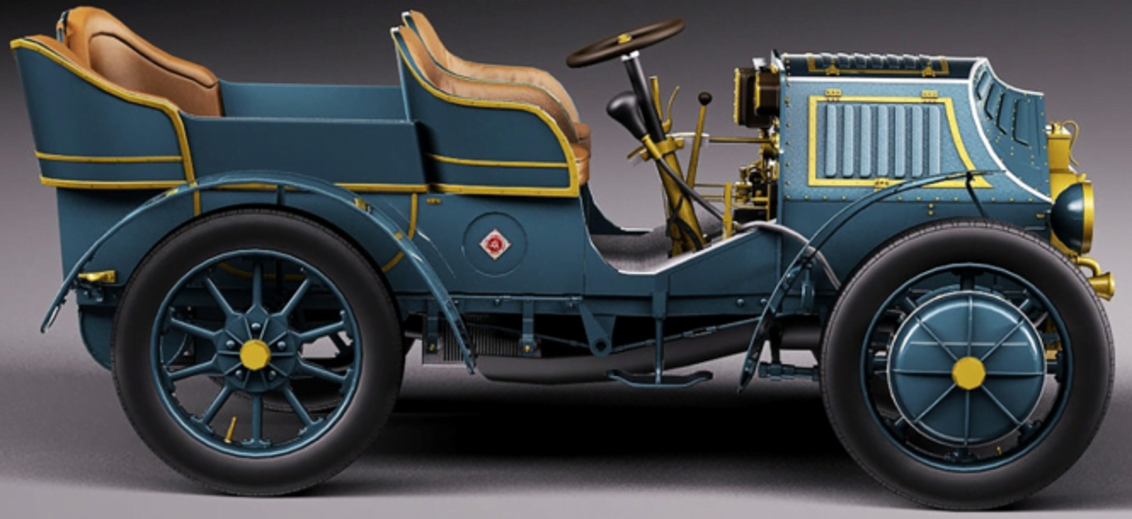
Electric hybrid vehicles are powered by either or both electricity and fossil fuel. They are far from new. In 1898, Ferdinand Porsche developed a hybrid car (the Lohner-Porsche). Its petrol engine ran a generator powering electric motors in its front wheels. The car had a range of 60 km (about 37 miles) from batteries alone.
The 1898 Lohner-Porsche- the first hybrid car. Pic: Original source not known.
In 1905, American H. Piper applied for a patent for a petrol-electric hybrid vehicle. It was claimed to reach 40 km/h (25 mph) in ten seconds. The patent took a long time before granting. By the time it was, petrol-fuelled vehicles achieved similar performance.
Woods Motor Company Dual Power
The best-known early hybrid is the Woods Dual Power Model 44 Coupe. It was made from 1917-1918. The vehicle had four-cylinder 10.5 kW petrol engine. This coupled to an electric motor. The motor was powered by 115 Ah lead-acid batteries. Below 24 km/h (15 mph) the car ran from electricity. Above that, the petrol engine took over. Maximum speed was about 55 km/h (34 mph). Much like today’s hybrid cars, it had regenerative braking. Reversing was by causing the electric motor to run backwards.
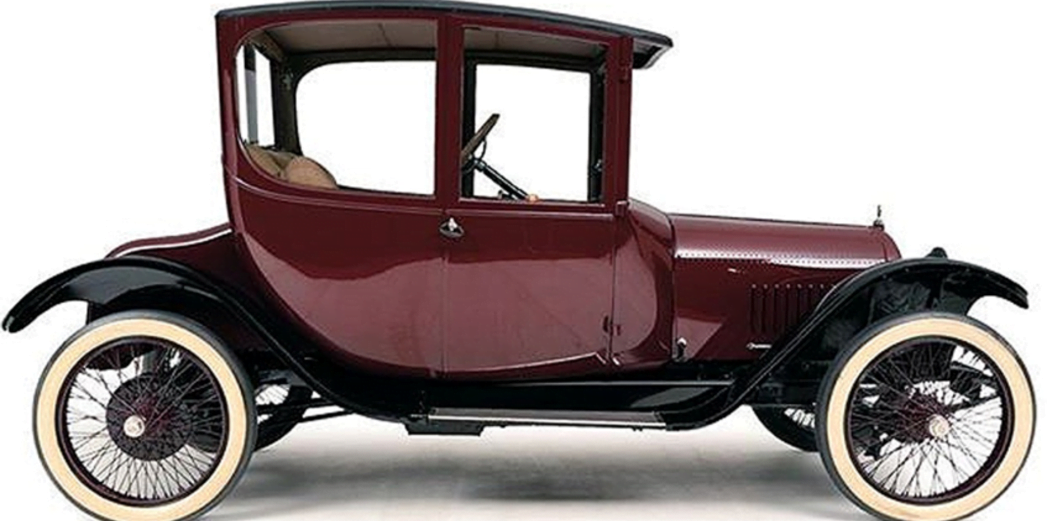
The Woods petrol-electric hybrid. Pic: courtesy of Petersen Automotive Museum Archives
The Woods car was promoted as having unlimited mileage, adequate speed and great economy. Also that it was faster than most electric cars. It was very costly. Only a few hundred were sold.
The first era of electric cars was ending. Whilst quieter, none could compete with Ford’s petrol Model T. Furthermore, battery development was static. Moreover, there was thus little incentive to develop electric motive power.
Hybrid revival
Hybrid development re-arose in the USA and Japan. Due to increasing air pollution, in 1966 the U.S. Congress recommended electric-powered vehicles. One (in 1969) was General Motors’ experimental hybrid. It used electric power to 16 km/h (10 mph). It then used electric and petrol power until 21 km/h (about 13 mph). From thereon it ran on petrol. Its maximum speed was about 65 km/h (about 40 mph).
The Arab oil embargo (1973) increased interest in electric powered vehicles. One result was Volkswagen’s experimental petrol/ battery hybrid. It was not, however, mass-produced. Another was the US Postal Service trialled battery-powered vans.
In 1976, the USA encouraged developing hybrid-electric components. Furthermore,Toyota built its first (experimental) hybrid. It used a gas-turbine generator to power an electric motor.
In 1980, lawn-mower maker Briggs and Stratton developed a hybrid car. It was driven by a twin cylinder 6 kW engine. It ran on ethanol, an electric motor, or both. Twin rear wheels bore 500 kg of batteries. It could travel 50 to 110 km (31-70 miles) in electric mode, and about 320 km in hybrid. The car was a promotion for the maker’s lawn-mowers. To put it mildly, its adverse power/weight limited performance. Its reported time to reach 80 km/h (50 mph) in combined mode was 35 seconds. By comparison, even today’s slowest cars need only a few seconds.
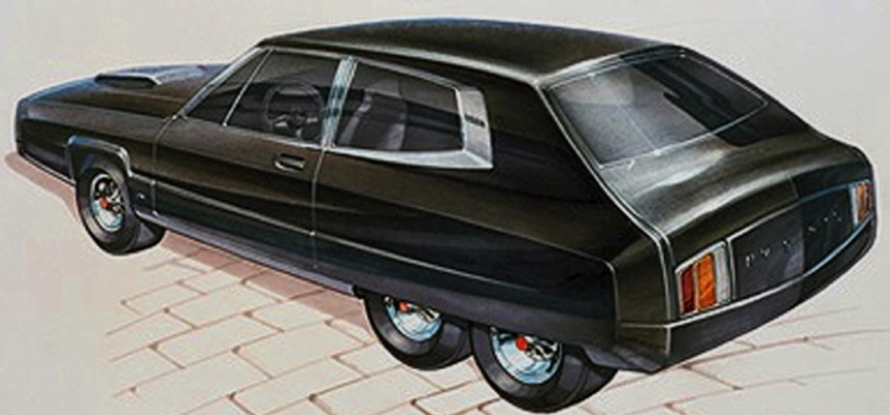 The Briggs and Stratton hybrid. Impressive visually –but seriously underpowered.
A battery boost
A major boost for hybrid vehicles was the USA’s (1991) ‘Advanced Battery Consortium’. It aimed at producing a compact battery. The US$90 million cost resulted in nickel hydride batteries. These had about three times the capacity of comparable lead-acid batteries. This was still less than needed. It did, however, enable a new generation of electric vehicles. Hybrid and otherwise.
Toyota’s ‘Earth Charter’
In 1992 Toyota outlined its ‘Earth Charter’. Its intention was to develop and market vehicles with minimal emissions. Also that year, the USA sought low emission cars. The aim was fuel usage under 3.0 litres/100 km. Three prototypes (all hybrids) resulted. For likely political reasons, Toyota was formally excluded.
That decision back-fired. It prompted Toyota to create the Prius. That car initially went on sale, in Japan, in December 1997.
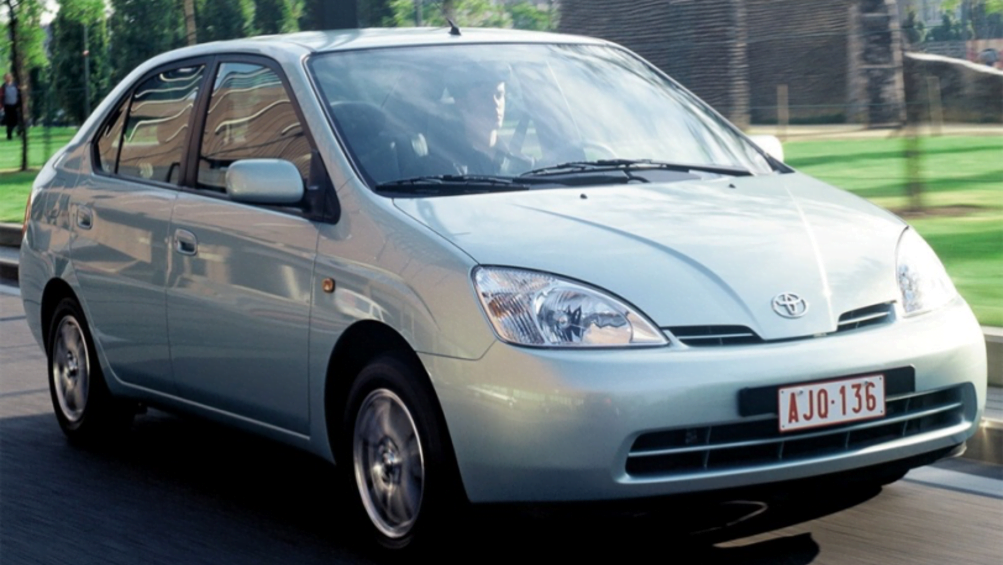
The original (1997) model NHW10 Toyota Prius. This initial model was sold only in Japan. Some, however, were imported privately into many countries. Pic: Original source unknown.
The initial version’s petrol engine produced 43 kW. Its electric motor produced 29.4 kW. It was powered by nickel-metal hydride batteries. Torque (at zero rpm) was 305 Nm. Later models had a larger petrol engine. It produced 53 kW and 115 Nm torque.
The car was an instant success. Some buyers waited six months for delivery. The Toyota Prius was launched in Australia in 2001.
European hybrids
In 1997, Audi mass-produced a hybrid. It was powered by a 67 kW 1.9-litre turbo-diesel engine. It also had a 21.6 kW electric motor. This was powered by a lead-acid gel battery. The car, however, failed to attract buyers.
Audi’s experience caused Europe to concentrate on reducing diesel emissions. Doing so, however, had ‘limitations’. Because their emissions fell far short of EU requirements, some makers illegally disguised the true levels.
Meanwhile, most electric and hybrid development was in the USA and Asia. Progress in Europe was initially slow. Now, however, (2020) there are many European electric and hybrids.
Owned by BMW, the first Mini hybrid had a 1.5-litre three-cylinder petrol turbo engine. Its electric motor had 65 kW of power and 165Nm of torque. It was powered by a 7.6kWh lithium battery. BMW claims it can travel to 40 km (about 25 miles) on electric power. A later version has a claimed 47 km (29.3 miles) range. Fuel economy is claimed to be 2.1 litres/100km. CO2 emissions are claimed to be 49 g/km.
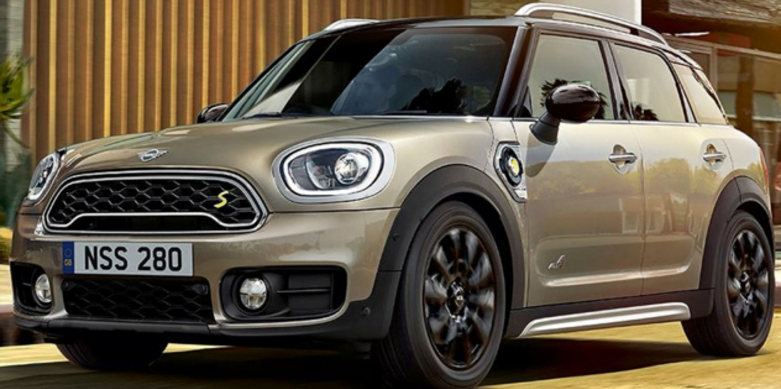
Mini hybrid –the Countryman S E ALL4. Pic: https://www.mini.co.uk
BMW’s own hybrid initially used a 0.65 litre petrol engine to charge the drive battery (if needed). The car has since been replaced by an all-electric version. The 42.2 kWh battery enables a claimed range of 310 km (194 miles).
Porsche has two hybrids. The 2019 Cayenne E-Hybrid has a 3-litre turbocharged petrol engine. It is claimed to produce 250 kW and 450 Nm torque. An electric motor adds an additional 100 kW. Plus 400 Nm torque.
The Porsche Panamera 4 (hybrid) is much as the Cayenne hybrid. Its Turbo S E-Hybrid has a twin-turbo 4.0-litre V8 petrol engine. It develops over 505 kW and 850 Nm. Its claimed all-electric range is 22.5 km (14 miles). Furthermore, it is claimed to use 4.9-litre of petrol per 100 km (62 miles).
Volvo’s aim is to have either ‘mild’ hybrids, plug-in hybrids or battery electric cars by 2021. It plans to sell one million hybrids. Its V40 model will have a choice of engines, plus a rear axle-mounted electric motor.
Hybrid off-road vehicles
Hybrid drive works well off-road. The electric motor increases power. The fossil-fuelled motor extends range. Few however, meet 2020 Euro 7 emissions requirements. Fortunately, many have ample space for batteries. This eases their possibly legally required future conversion.
One example is the Lexus RX 450h. It retains its 3.5-litre V6, but has three electric motors energised by a 123 kW battery. This only marginally increases power (i.e. from 221 kW to 230 kW). It does, however, reduce fuel consumption. That claimed is from 9.6 litres/100 km (62 miles), to a commendable 5.7 litres/100 km.
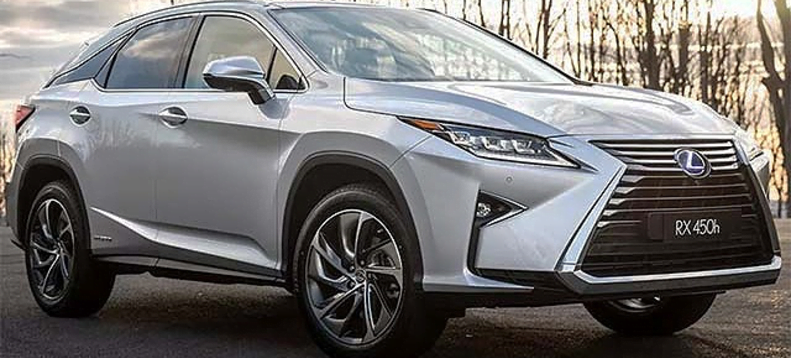
Lexus 450h. Pic: Toyota
The Mitsubishi Outlander LS and Exceed have a two-litre petrol engine and twin electric motors. They can travel up to 55 km on their lithium batteries. Their claimed fuel usage is 1.7 litres per 100 km (62 miles).
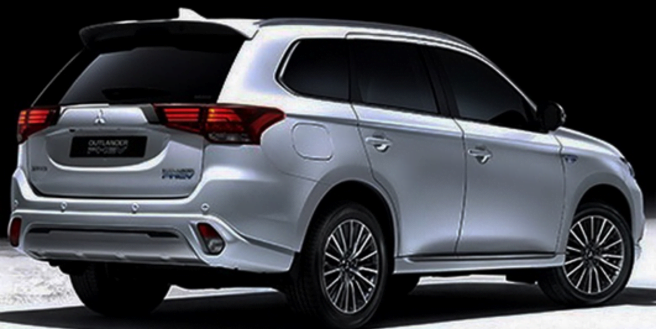
Mitsubishi (2019 Outlander hybrid. Pic: MitsubisiNissan’s
The Nissan Pathfinder Hybrid is available in 2WD or 4WD. Each has a 2.5-litre cylinder supercharged petrol engine of 201 kW and 330 Nm. Its 12.3 kW electric motor is powered by lithium batteries. These are charged by the engine’s alternator, and regenerative braking. Fuel use is a claimed 8.6 litres per 100 km. The battery packs are under the forward-most part of the boot floor.
Subaru’s XV Hybrid uses a 2.0-litre, flat-four direct-injection petrol engine producing 110 kW of power (down from 115kW in the rest of the range) at 6000rpm and 196Nm of torque at 4000rpm. It has a lithium battery and electric motor to assist the petrol engine. It can be driven as electric only, electric motor assist or petrol engine only driving modes.
The Range Rover hybrid has all-new light alloy monocoque construction. It is unusual in being diesel-electric. The 2020 PHEV P400e’s combined power is 297 kW. The maker claims a range of up to 48 km (30 miles) in electric mode. Regenerative braking assists charging.
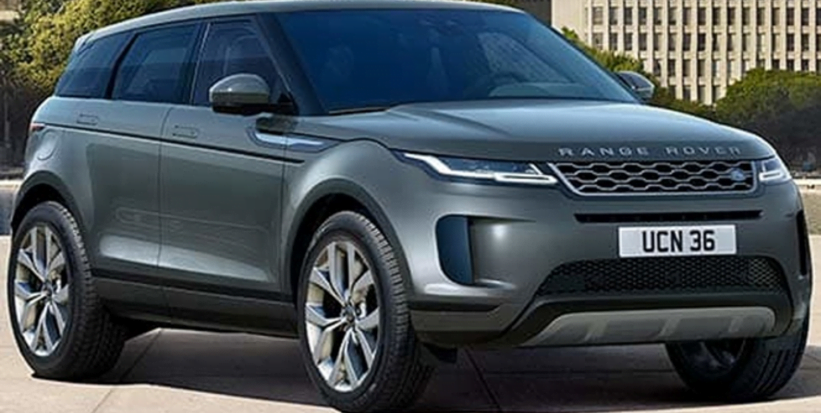
The Range Rover Evoque hybrid. Pic: landrover.com
The Land Rover is (now) much the same vehicle. It is, however, marketed as a more serious 4WD. It is, however, not necessarily cheaper. A few models (e.g. the LR4 HSE LUX) are more costly than Range Rovers.
Hybrid vehicles and emissions
When comparing emissions, fossil-fuelled power station efficiency needs taking into account. Most convert about 38% of their fuel into usable energy. Petrol burned by cars converts only 25%.
Energy is also lost in producing petrol and diesel. It is also lost in conveying electricity from power station to electric outlets. Furthermore, in charging electric (and hybrid) car batteries.
The National Transport Commission report assesses CO2 emissions intensity of passenger cars and light commercial vehicles in Australia. The data shows average CO2 emissions of all new cars sold in Australia during 2019 was 180.5 g/km. This is far higher than for new passenger vehicles in Europe. There, (using provisional European data) it was 120.4 g/km. Moreover, corresponding figures in Japan and the USA were 114.6 g/km and 145.8 g/km, respectively, in 2017. As that if latest available data, such emissions are almost certainly now even lower.
The National Transport Commission report reveals that Australia’s result is largely due to the increased popularity of dual cab utes and SUVs. These are three largest CO2 contributing vehicle segments. Furthermore, there are also few Australian government incentives for lower emissions vehicles. Moreover, Australia’s fuel prices are low compared with Europe.
In 2019 Suzuki is reported as having the lowest average emissions intensity (128 g/km). Ford is reported as having the highest (210 g/km). A Prius Hybrid emits 107 gram of CO2 per km.
Emissions: petrol versus diesel
On average, the CO2 emissions of diesel cars (127.0 g CO2/km) are now very close to those of petrol cars (127.6 g CO2/km). Moreover, that difference, of only 0.6 g CO2/km, was the lowest observed since the beginning of the monitoring. Diesel emissions, however, are more harmful. Furthermore, they are all-but impossible to reduce much further.
The majority of new SUVs registered are powered by petrol. Their average emissions are 134 g CO2/km. This is around 13 g per CO2/km higher than the average emissions of new petrol non-SUV passenger cars.
See also Electric Vehicles – Thermodynamic Efficiency & Emissions.
Solar-powered electric vehicles
If adequate solar energy is available an all-electric car is virtually non-polluting. There is a minor emission of rubber particles from the tyres. However, there is no equivalent of ‘tailpipe’ emissions.
Battery making, however, is seriously polluting. It is common to hybrid and all-electric cars – excepting that the latter have larger capacity batteries. See also Solar Charging Your Electric Car at Home.
An initially promising all-terrain electric car (the Tomcat) was designed and built in Australia in 2012. The first 100 sold out almost immediately. High manufacturing costs (and investor concerns) resulted in the company entering voluntary administration in February 2018.
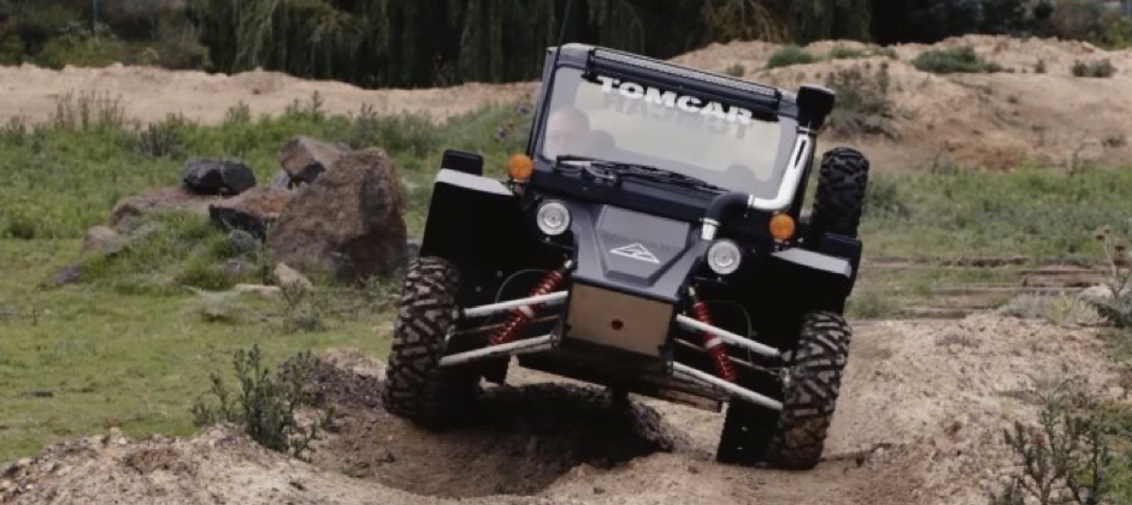
The all-terrain electric Tomcat – sadly no more. Pic: Tomcat
The Electric Vehicle Series
This is a part of a series of articles about the history and technology involved in electric hybrid vehicles.
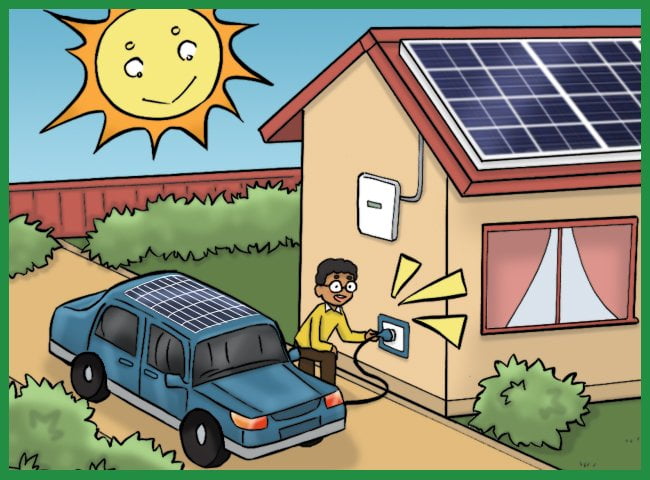
Solar charge your electric car at home
Update 2020
Solar charge your electric car at home
Solar charging your electric car at home or work is totally feasible. This article explains how. Many people already do so. Small electric cars require only a 15 amp power point. The associated cable plugs into the car’s onboard charger.
Virtually all electric vehicles have a charging unit inbuilt. Consult the vendor about charging options.
Pic: SolarQuotes
If used for commuting 40-50 km a day, re-charging requires 2.5-5 kilowatt/hours. One kilowatt hour is often called ‘one unit’. During off-peak periods it may cost less.
Here’s a guide to how many kilometres you can drive before recharging.
| Type | Maximum charge (kW) | km/hour of charging |
| BMW i3 | 7.4 | 25 |
| Chevy Spark EV | 3.3 | 11 |
| Fiat 500e | 6.6 | 22 |
| Ford Focus Electric | 6.6 | 22 |
| Kia Soul EV | 6.6 | 22 |
| Mercedes B-Class Electric | 10 | 29 |
| Mitsubishi i-MieEV | 3.3 | 11 |
| Nissan Leaf | 3.3 – 6.6 | 11 – 22 |
| Smart Electric Drive | 3.3 | 11 |
| Tesla Models S & X | 10-20 | 29-58 |
Solar charge your electric car at home – how to do it
Solar charging your electric car at home or work is feasible. Many existing grid-connect solar systems have excess capacity. You capture solar during the day and sell the excess to the electricity supplier. Then charge the car at off-peak rates at night
Most Australian suppliers ask for about 25 cents per kilowatt-hour (off-peak). That is only slightly less than buying it back off-peak. It pays to shop around. All that’s needed is a quote from one supplier. Armed with that, most existing suppliers will reduce that for a two-year contract. If not, change suppliers. Unlike most products, grid electricity is standardised.
Daytime solar can be re-drawn at night to charge at off-peak rates. Many owners do this. Such charging permits charging overnight, with top-ups as required. Furthermore, it also extends battery life. All dislike ongoing deep discharging.
Using grid power costs only a dollar or two to commute. This is far less than for petrol-fuelled cars. Most use about 7 litres per 100 km. That typically costs (in 2020) about $9/day.
Economy electricity tariffs
Electric cars can be charged on economy electricity tariffs. Charging this way requires a dedicated charging point. This costs about A$1,750. A basic electric car charging unit costs about A$500. More advanced units cost up to A$2500. A licensed electrical contractor will advise re this.
If your charging rate exceeds fuse or circuit breaker rating, they must be upgraded. The cost is not high. Moreover, you save money by switching to such tariffs for charging overnight. You need, however, to install a dedicated charging point. So-using a standard electrical power point is illegal.
Another meter may be needed for the charging tariff. If so, that can be set up by your electrical contractor. Dealers may include an electrician’s advice in the car’s price.
You can reduce costs much further if you charge from a solar PV system. Furthermore, this also reduces carbon dioxide emission.
Charging at public outlets
Fast and super-fast chargers charge at up to 135 kW. They fully recharge an electric vehicle battery in 30 minutes. Owners use these only during long drives. They rely on routine charging at home and at work. Electric car vendors have charging services.
Fast charging facilities exist around Australia. They are even across the Nullabor Plain. See: Charge Stations in Australia (https://myelectriccar.com.au/charge-stations-in-australia). Or ChargePoint. Prices vary from state to state etc.
Electric Vehicle Battery Life
Battery technology is changing fast. Currently, most vehicle batteries’ life depends on their routine depth of discharge. Fully charge the batteries each night and they will live longer.
Most electric and hybrid car makers guarantee batteries for eight years. Nissan allows for 160,000 km, and capacity loss for 5 years or 96,500 km. Australians typically drive 14,000 kilometres a year. This necessitates battery replacing after about eight years. Outright failure, however, is improbable.
Summary
It is already totally feasible to charge cars from home and office solar. Moreover, it is done by many owners right now.
The Electric Vehicle Series
This is a part of a series of articles about the history and technology involved in electric vehicles.
Electric Vehicles Energy Use
Electric vehicles energy use
Regardless of its type of fuel, the energy drawn by any road vehicle is a function of three main factors: air drag, accelerating and braking, and rolling resistance. Electric vehicles energy use is no exception.
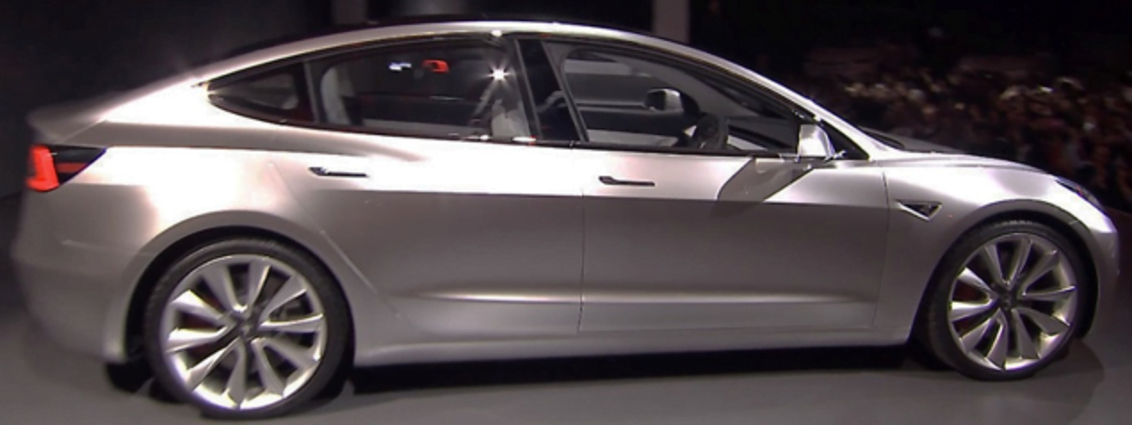
The Tesla 3. Pic: Tesla
Air drag
This relates to frontal area and aerodynamics, and particularly to speed. The reason speed so matters is that energy use rises with the cube of the speed). It is thus also affected by driving into prevailing wind. This is not usually a major factor in most countries. It is, however, very much so on Australia’s 1675 km (141 miles) Eyre Highway. Often called the Nullarbor, the highway links South and Western Australia. It is very close to the ocean for much of the way. That wind tends to be either from in front or behind, and can be as high as 30-40 km/h. If driving into the 30 km/h wind at 90 km/h, for electric cars that’s a battery flattening equivalent 120 km/h.
Wind resistance is a powerful reason for driving anticlockwise around Australia. One drives north around September, around the top during winter, then back down the west coast and to where one started in late summer. This should result in a following wind for the west and east crossings.
Electric-only vehicles of today are most suited to urban driving. As battery technology inevitably advances, and charging facilities increase, these will be decreasing issues.
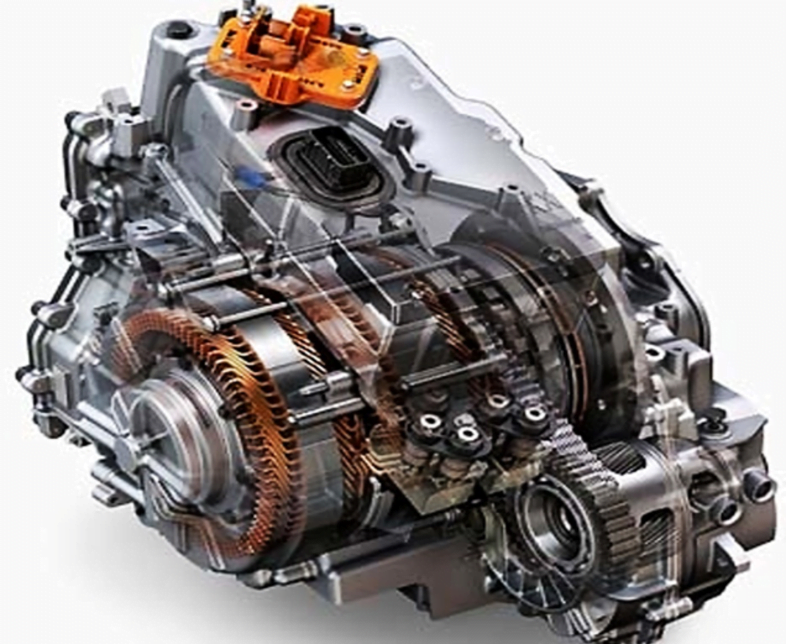
The (2016) Chevrolet Voltec electric vehicle motor and transmission. Pic: Chevrolet.
Acceleration & braking
The energy involved in acceleration and braking relates substantially to the laden weight of the vehicle. Existing batteries are far heavier than their range-equivalent petrol or diesel. An electric vehicle motor and transmission, however, is simpler and lighter. Moreover, it is also 80% to 90% efficient (a fossil-fuelled engine is only 25%).

BMW i3 ultra-light carbon-fibre body shell saves weight. Pic: BMW.
Body shells can be made much lighter: BMW’s i3 electric car has an ultra-light carbon-fibre body shell. This cancels out much of the battery weight. That extra battery weight, however, is expected to be a short-term issue. As our article Electric Vehicle Batteries notes, huge efforts are in progress worldwide to reduce the weight of rechargeable batteries. This will also enable a longer range between recharging.
Rolling resistance
Rolling resistance is directly proportional to minor friction losses, minor heat loss due to tyre wall deflection (<3%), and speed. That of fossil-fuelled,and an electric vehicle’s rolling resistance, is thus the same. There is, however, one considerable energy advantage of electric (and hybrid) vehicle over internal-combustion engined vehicles. It of simple and effective regenerative braking. This recovers the kinetic energy that would be otherwise lost in heat-generating braking. It works by an electric car’s motor momentarily acting as a generator and charging the batteries.
Stop/starting in traffic
In recent years, petrol and diesel engine cars have a (usually optional) engine stop/starting system for use in congested traffic. Whilst this saves fuel, electrical energy is used for each restart. Moreover, electric cars will have a considerable edge as no energy is drawn whilst at rest, nor extra when restarting.
The Electric Vehicle Series
This is a part of a series of articles about the history and technology involved in electric vehicles.
Electric Vehicle History
Electric vehicle history
Electric vehicles have existed for longer than most people think. They long pre-date petrol and diesel. This electric vehicle history by Collyn Rivers is an overview.
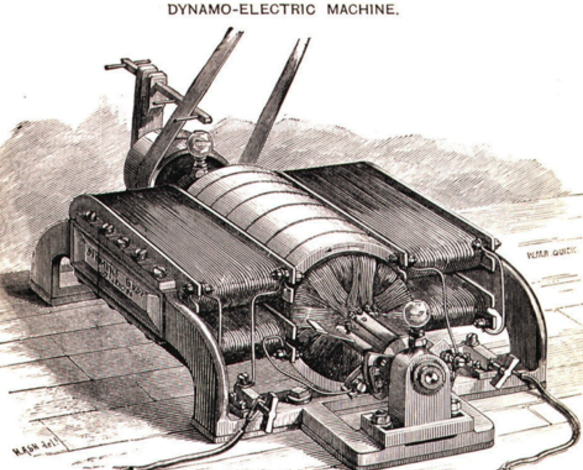
The first dc electric motor (1866). Pic: Siemens UK.
The electric battery was invented by Allessandro Volta in 1800. In 1820, Christian Oersted showed electricity could produce a magnetic field. William Sturgeon, (in 1825) invented the electromagnet. Inventors worldwide sought to build an electric motor. They used two main approaches. These were: rotating, or reciprocating (i.e. like early steam engines).
In 1834, Moritz Jacobi invented the first (realistically powerful) electric motor. By 1838 it was improved. It propelled a 14-passenger boat. Meanwhile (1835), Sibrandus Stratingh and Christopher Becker developed an electric motor. It drove a small model carriage. The first electric motor patent was granted to USA’s Thomas Davenport. Many US sources credit Davenport as ‘inventing’ the electric car. It was, however, only a small model. It had negligible power. In 1866, Werner von Siemens developed the basic DC motor. It was this that enabled the first electric cars. DC motors are used to this day.
Electric vehicles were also hampered by lack of stored energy. The only realistic source required constantly supplied diluted acid. These ‘batteries’ were like today’s fuel cells. They combined hydrogen and oxygen to produce electricity. Such batteries worked. There is no record, however, of their powering electric vehicles.
The first lead-acid batteries
In 1859, Gaston Plante developed practical lead-acid batteries. They were bulky and heavy. Nevertheless, they made electric vehicles practical. Their first known usage (1897) was in New York’s electrically-powered taxis.
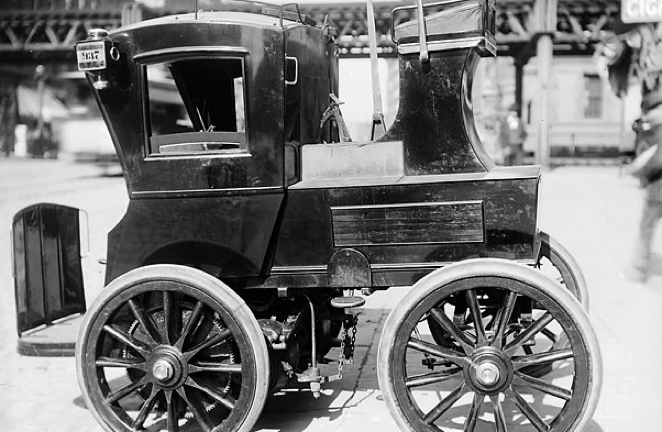
The first electric powered taxi – New York late 1890s. Pic: taxifarefinder.com
Electric cars’ original acceptance was thus near the end of the 1800s. Most were quieter and smoother than early petrol-fueled cars. Electric cars started instantly. They needed no ‘warming. No gear changing was required. There were even hybrids. In 1916, the Woods Motor Vehicle Company developed a car with both petrol and electrical engines. See Electric Vehicles – Hybrids.
The electric vehicle market was primarily the USA. There was, however, some usage in Europe. London had electrically-powered taxis from 1897. They became known as ‘Hummingbirds’ – due their curious sound.
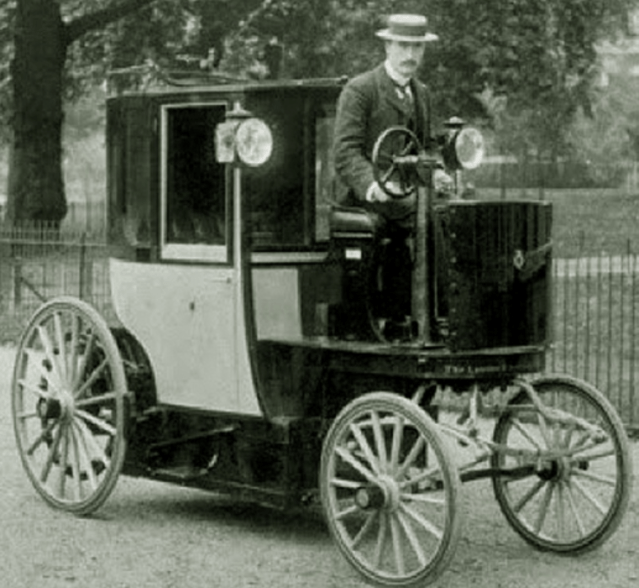 A London Hummingbird electric taxi – in use from 1897 for many years. They were designed by Walter Bersey.
End of an era
Electric vehicles of that era lacked adequate control technology. This limited speed to about 30 km/h (about 19 mph).
By 1920 or so, road structures (particularly the USA’s) had massively increased. This was particularly inter-city. This required a vehicle range beyond that from batteries. These, however, remained similar in weight and size as 80 years before. Moreover, recharging facilities were inadequate beyond urban areas.
Meanwhile petroleum became increasingly plentiful. This enabled it to power vehicles cheaper and further than electrically. Furthermore, mass production made them affordable. The result was Henry Ford’s (1908) mass-produced model-T. It killed sales of electric cars. Thereon, electric vehicles were used only where limited range was required. It was nearly 40 years before electric cars re-appeared.
In the late 1950s, Henney Coachworks and Exide Batteries developed an electrically-powered Renault Dauphine. It attracted some sales. It could not, however, compete in price with conventional cars. Production ceased in 1961.
General Motors EV1
In 1990 California’s Air Resources Board briefly re-ignited interest in electric cars. Its mandate required U.S. major vehicle makers to have 2% of their products totally emissions-free if used in California. This resulted in General Motors producing its EV1. It was an electric-ony car.
Early EV1s had 16.5–18.7 kWh lead-acid batteries. Later EV1s had 26.4 kWh Nickel Metal Hydride (NiMH) batteries. The car was produced from 1996 to 1999. It was the first mass-produced and purpose-designed electric vehicle of the modern era.
Usage was by leasing only. Customers liked the EV1, but General Motors saw electric vehicles as unprofitable. It sought to cease production. In 2002 EV1 usage was ceased. General Motors repossessed all of them. Most were crushed. A few were given to museums, but with deactivated motors. The Smithsonian Institution has the only intact EV1.
Major US car makers then legally questioned California’s emissions requirement. This resulted in relaxed obligations. That, in turn, enabled developing and producing low emissions vehicles. These included natural gas and hybrid engines, but not (then) electric-only.
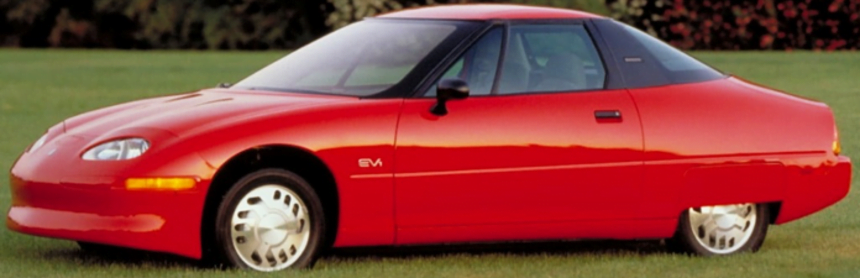
The General Motors EV1. Pic: Wikipedia
The right concept at the wrong time
The electric car (and truck) back then was the right concept. But at the wrong time. It awaited control technology, and lighter and smaller batteries.
Control technology then improved dramatically. That of rechargeable batteries, however, did not. Moreover, the size, weight and energy stored in lead-acid batteries remained much as 100 years before.
In 1996, the University of Texas conceived the lithium battery. These store three to four times the energy as lead-acid batteries the same size and weight. They charge quickly and can release huge amounts of energy over a short time.
Now (late 2020), lithium batteries enable electric-only cars to travel 350-550 km (about 220-345 miles) between charges. This is still borderline. It is inevitable, however it is inevitable that battery technology will advance. One thousand kilometres (625 miles) is now seen as feasible. Moreover, so too are electric off-road vehicles.
Further information
It is feasible to use home and other solar (with or without grid-connect) to charge electric cars. For details on using solar to charge electric cars click here. Furthermore, articles on all aspects of electrics cars are being progressively published on this website. Moreover, these will include ongoing details of technology and charging.
The Electric Vehicle Series
This is a part of a series of articles about the history and technology involved in electric vehicles.
Baghdad battery myth
The Baghdad Battery
Was the battery invented over 2000 years ago? The Baghdad Battery remains controversial.
In the 1930s, German archaeologist Wilhelm Koenig was excavating an archaeological dig near Baghdad (Iraq). While doing so, he claimed to uncover a small clay jar. It had a plug that sealed the opening. That plug had a copper tube with an iron rod inserted into it. If filled with an acidic liquid, it functioned as a basic battery. Koenig and others made similar versions that generated up to two volts per unit.
Baghdad battery myth – Koenig’s paper
Koenig is variously claimed to have published a paper on the now-called ‘Baghdad battery’ in a 1938 issue of the German journal Forschungen und Fortschritte. That journal, however, ceased publication in 1967. Digitized (alleged copies) were then posted on several Internet sites. However, no evidence exists of anyone claiming to have read the original paper (if one actually existed).
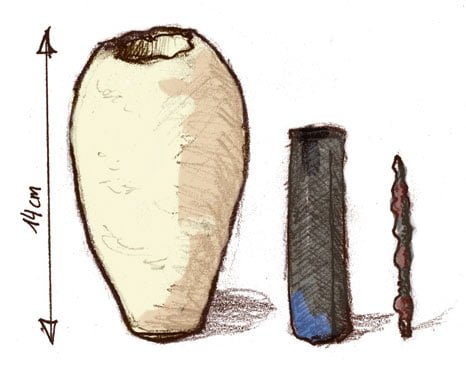
A drawing of the Baghdad Battery
Koenig’s alleged paper resurfaced in the late 1960s following Erich von Däniken’s controversial book: Chariots of the Gods. This book triggered claims that ‘ancient Mesopotamians had developed batteries.’ Furthermore, that those batteries were used for everything from electroplating jewelry, to powering electric light globes inside Egypt’s pyramids and the lighthouse at Alexandria. The book also led to claims that, since the Mesopotamians did not know how to make a battery or use electricity, they must have obtained this information from someone else. Later speculation, however, suggests he read about it in a paper in the Museum’s archives.
Is the Baghdad battery a myth? – what Koenig described
Koenig described the ‘battery’ as being a flat-bottomed clay jar about 5.5 inches tall, a little over 3 inches across at its widest point, and about 1.25 inches wide at the opening. The jar’s neck was broken off, and there were bits of asphalt adhering to the inside of the rim, indicating the opening had been sealed up. Inside the jar was a hollow cylinder made from a thin sheet of copper. The cylinder’s bottom was covered by a small circle of copper sheets sealed into place by asphalt.
A severely rusted iron rod, about 3 inches long, was inside this copper cylinder. At the top end was a plug of asphalt which fitted into the opening of the copper cylinder. The iron rod projected about half an inch beyond this plug.
Koenig also describes similar clay jars found during excavations near the ancient city of Seleucia. Several clay jars of similar size were found that contained hollow copper cylinders.
These cylinders were sealed at both ends. No iron rods were found with them, but archaeologists found the remains of plant fibers, probably papyrus remnants. The cylinders were found next to a piece of bronze rod and pieces of iron wire.
One clay jar contained a small flask made only of glass. Similar remains had also been found in excavations near Baghdad.
Koenig only suggested these remnants may have been old batteries used for electroplating. He urged that further research be carried out.
This issue then became increasingly improbable. Many ‘paranormal researchers’ took Koenig’s speculation and extended it way beyond what seems reasonable. It was even suggested that technologically advanced extraterrestrials had visited the Earth in ancient times.
Most archaeological studies conclude that the ‘battery’ is simply a (decayed) papyrus scroll. Such scrolls were commonly wrapped around an iron or wooden rod and placed inside a sealed copper tube or glass flask. The now wrapped scroll was then stored inside a clay jar. The jar was then plugged with asphalt to protect it from water and weather.
Koenig’s Baghdad Battery ‘scientific paper’ is hard to take seriously. Some accounts state that Koenig excavated the battery from a site at Khujut Rabu (near Baghdad). Others, however, state that Koenig found the ‘battery’ in storage at the Museum in Baghdad.
Another account suggests the ‘battery’ was found in the ruins of a Parthian (middle Eastern) village dating from 250 BCE. Yet others classify the jar as typical of the Sassanid period – several hundred years later. It is unclear how many ‘Baghdad Batteries’ exist. Most accounts mention just one. Others, however, assert that ten or more have been found.
The object found is a flat-bottomed clay jar. It is about 5.5 inches tall, a little over 3 inches across at its widest point, and about 1.25 inches wide at the opening. The jar’s neck is broken off and has bits of asphalt adhering to the rim’s inside, indicating the opening had initially been sealed.
Inside the jar is a hollow cylinder made from a thin sheet of copper (3.8 inches long and 1 inch wide). The cylinder’s bottom is covered by a small circle of copper sheeting sealed by an asphalt coating. An iron rod (now badly rusted) about 3 inches long is held in place by an asphalt plug. The rod projects about half an inch beyond this plug.
Koenig describes similar clay jars found during excavations at Tel Omar, near the ancient city of Seleucia. Here, several clay jars of similar size were found containing hollow copper cylinders.
These cylinders, Koenig noted, had been sealed at both ends. Archaeologists later found the cylinders had remains of plant fibers, probably the remnants of papyrus. No iron rods were found with them. There were, however, a piece of bronze rod and three pieces of iron wire. One clay jar contained a small flask made of glass but no metal.
Koenig later noted that similar clay jars with copper cylinders and iron rods had been found in excavations by the Berlin Museum near Baghdad, in sites identified as Sassanid. These other finds seem to have become confused by later writers with Koenig’s ‘battery,’ thereby producing confusion about what culture and period the ‘battery’ comes from and how many were found.
Replicas of the Baghdad’ battery’ have been built by several researchers. They typically produce a small electric current (usually between 0.5 to 2.0 volts).
Koenig seems to have wrongly assumed that some ancient metal objects were electroplated – a process using mercury.
The British Museum’s Paul Craddock, however, advises that ‘examples we see from this region and era are conventional gold plating and mercury gilding.’ He states there’s no irrefutable evidence to support the electroplating theory.
Furthermore, David A. Scott, senior scientist at the Getty Conservation Institute, states: ‘There is a natural tendency for writers dealing with chemical technology to envisage these unique ancient objects of two thousand years ago as electroplating accessories, but this is untenable, for there is absolutely no evidence for electroplating in this region at the time.’
These battery-like artifacts may have been storage for important scrolls. They need to be totally sealed. If exposed to the elements for any significant length of time, papyrus or parchment inside would completely rot away – possibly leaving a slightly acidic residue.
Professor Elizabeth Stone of Stony Brook University is an expert on Iraqi archaeology. She states that she does not know a single archaeologist who believes these artifacts were batteries.
The BBC’s MythBusters program built replica jars to see if they could have been used as batteries for electroplating or electrostimulation. One episode had 10 terracotta jars to simulate batteries using lemon juice as the electrolyte. This activated a four-volt electrochemical reaction between copper and iron plates. The show emphasized no archaeological evidence existed for connections between the jars. These are necessary to produce the required voltage for electroplating.
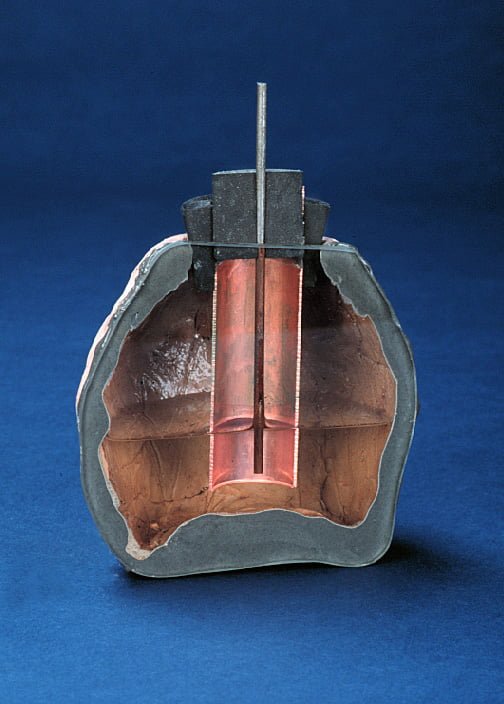
Koenig’s reconstruction of the ‘Battery.’ Pic: Original source unknown.
Other researchers, too, built replicas. If filled with an acidic liquid like grape juice, the ‘batteries’ produced a small electric current of between half a volt and two volts. That has led to several speculations about how the ‘batteries’ could have been used.
One is that the ‘battery’ was connected to small iron statues inside temples. If touched by a worshipper, they would produce a seemingly supernatural tingling that would show the gods’ spirits’ power.
It is known that ancient Greek temples used technological tricks to produce effects, such as doors that opened by themselves or statues that moved to awe worshippers. But there is so far no archaeological evidence that this sort of thing was done in either the Parthian or Sassanid cultures.
There are also problems with constructing the presumed battery. To function as such, it would need to be filled with an acidic liquid. This liquid would need periodic topping up, or be replaced. The jars, however, were sealed with asphalt. Moreover, the copper tube on the inside was sealed at either end. Such construction makes it hard to top up the liquid electrolyte.
The presumed ‘battery’ has no terminals and the iron rod projects beyond the asphalt plug. The copper tube, however, does not. It was thus not possible to connect wires to make an electrical circuit.
It has been suggested that such ‘batteries’ were series-connected (i.e., end to end) to produce a high enough voltage for electroplating. Electroplating, however, is done by placing the metal objects in a liquid through which an electric current is passed. Doing so deposits a thin coating of another metal onto the object.
Such metal coating can also be done by mercury gilding. Gilding involves coating an object with a mixture of gold, silver, and mercury. When heated, this causes the mercury to vaporize. That, in turn, deposits a thin layer of bonded gold or silver onto the intended object. All of the gold or silver plated items found from this period, however, show mercury vapor chemical signature. None exhibit the characteristics of electroplated coatings.
Constructing the presumed batteries presents few problems. Clay jars have existed in the area for thousands of years. Asphalt is readily available in the area. Tar and oil bubble to the surface and have long been used for waterproofing. Copper tubes were often used as protective covers for papyrus scrolls. Iron was a common material for the time. There is nothing unique about the materials used. No advanced technical knowledge is needed to build them.
What was the Baghdad discovery if not a battery?
Archaeologists who study the putative ‘battery’ conclude it is simply a now-decayed sacred papyrus scroll wrapped around an iron or wooden rod. It had been placed inside a sealed copper tube (or sometimes a glass flask). This rod was then stored inside a clay jar and plugged with asphalt to protect it from water and weather. The consensus is increasing that the ‘Baghdad Battery’ is not a battery, but more probably a storage jar for a valued scroll.
Nevertheless, the Baghdad Battery continues to be a source of myth and story. The original, allegedly found by Koenig, was said to have been stored in the Baghdad Museum archives. If, however, it existed, its present whereabouts are not known. It was looted from the museum in Baghdad—along with 15,000 other antiquities—in the chaotic (2004) aftermath of the U.S. invasion of Iraq.
Motorhome Basics
by Peter Manins
Motorhome Information: The Basics
Motorhome basics for those who are occasional motor-homers, who live in a built-up area, and are considering changing to a different motorhome, or who are considering making some improvements to their present one.
Introduction
Here is some information for those who are occasional motor-homers, who live in a built-up area, and are considering changing to a different motorhome, or who are considering making some improvements to their present one. It would have helped me greatly if I had had such a summary a few years ago. Australian Design Regulations (ADR, Ref 1 ) Australian Vehicle Standards Rules (AVSR, Ref 2) and Australian Road Rules (ARR, Ref 3) for motor vehicles are the primary sources, since these are uniform (Ref 1) for Australia or are model rules (Refs 2, 3) adopted by the states and territories. It is also important to observe that a plethora of Australian Standards may also impact on changes you are considering.
Driver’s Licence
Your normal driver’s licence (‘Class C’) allows you to drive vehicles up to 4.5 tonnes gross vehicle mass (GVM, the maximum recommended weight a vehicle can be when loaded). A Light Rigid ‘Class LR’ licence is required for a vehicle with a GVM of more than 4.5 tonnes but not more than 8 tonnes. There are also ‘Class MR’ and ‘Class HR’ licences for even larger vehicles. See e.g. Ref 4.
Comment: To use a normal driver’s licence, the motorhome must not have a GVM of more than 4.5 tonnes. You should know the GVM of your vehicle, and the actual laden weight established by taking it to a weighbridge when set up for typical travel. The handling and safety of a vehicle is greatly affected by its weight, particularly its ability to stop quickly. In the event of an accident your insurance would likely be void if it was found that the vehicle was overweight. Driving a larger vehicle also requires enhanced skills such as correct selection of gears going up and down hills, and tracking around corners — not hard to learn, but essential for safe travel.
Street Parking

Figure 1.
There are significant parking restrictions for larger vehicles and those over 4.5 tonnes. Division 6, Part 12 of Ref 3 notes for Rule 200: (2) The driver of a heavy vehicle, or long vehicle, must not stop on a length of road in a built-up area for longer than one hour, unless the driver is permitted to stop on the length of road for longer than one hour by information on or with a traffic control device, or is permitted to do so by the council.| (3) HEAVY VEHICLE – means, a vehicle with a GVM of 4.5 tonnes or more; LONG VEHICLE – means, a vehicle that, together with any load projection, is 7.5 metres long, or longer; ROAD – does not include a road related area, but includes any shoulder of the road. ‘Built-up area’ is defined in the dictionary. There are restrictions in parking in a Built-Up Area.
Comment: This is a good reason to keep the GVM of the motorhome to no more than 4.5 tonnes: you can legally park it in the street of your suburb and in other towns. Annual registration and third party insurance costs increase considerably for larger vehicles.
Width

Figure 2.
Rule 43/01, Sec 43.4.5.1 of Ref 1 notes (1) A vehicle must not be over 2500 mm wide (including any load projection). (2) For subclause (1), the width of a vehicle is measured without taking into account any anti-skid device mounted on wheels, central tyre inflation systems, lights, mirrors, reflectors, signalling devices and tyre pressure gauges. Overall vehicle width includes ‘load projections’ such as awnings but not mirrors. Comment: Not all motorhomes on Australian roads begin their life complying with this requirement. See also ‘Load Projection’.
Load Projection

Figure 3.

Figure 4.
Rule 43, Sec 43.5.1 of Ref 1 also notes For vehicles any ‘Equipment’ shall not project more than 1200 mm from the ‘Front End’ or ‘Rear End’. Defining Load Projection at the front (from Ref 5, © VicRoads with permission). From Ref , anything added to increase the overall width of the vehicle must be less than 150 mm in width. This Rule is an extension of AVSR (Ref 2) and has been adopted by most Jurisdictions. Defining Side Load Projection (from Ref 5, © VicRoads with permission).
Comment: A common problem here is that an awning mounted on the side of a large motorhome takes it over the legal width of 2500 mm. A Porta Bote, mounted on the side of my Ducato motor camper, projects less than 140 mm (including brackets), and the overall width is still less than 2500 mm, so is legal. Figure 6 shows the rig on tour.
Rear Overhang

Figure 5
Rule 43/03, Sec 6.2.3 of Ref 1 states: 6.2.3. For all other motor vehicles and trailers (other than ‘Semi-trailers’) the ‘Rear Overhang’ must not exceed 60 per cent of the distance from the centreline of the front ‘Axle’ to the line from which ‘Rear Overhang’ is measured, or 3.7 metres whichever is the lesser. The Load Projection (if any) is included in this calculation. . Defining Rear Overhang (R/OH) relative to Wheelbase (WB) (from Ref 5, © VicRoads with permission).
Comment: This requirement causes lots of grief for those wanting to mount tool boxes or motorcycle carriers on the back of motorhomes that already have substantial rear overhang (let alone the structural engineering issues). A carrier must either be folded into a vertical position or removed entirely when not being used to carry a bicycle or motorcycle and any loading ramp must only deploy to the left hand side of the vehicle. For my Ducato, the wheelbase is 3700 mm so the maximum legal overhang is 2220 mm. The overhang of the body is 998 mm, so the maximum overhang of any additional equipment is restricted to the Load Projection Rule of 1200 mm. My bicycle mounting method complies: the bicycles overhang by 920 mm and the carriers fold up when not in use. My A’van Applause on Ducato with side load and rear loads.
Visibility of Number Plate

Figure 7.
The following Figure (Fig 7) and Clause are from Ref 6. Clause 61(2)(c) of Schedule 2 of the Regulation requires that a number-plate must be visible at a distance of 20 metres from it and within all the areas described by an arc extending at an angle 45° above the top of the number-plate and 45° forward of its edges. Number plate visibility requirements (from Ref 6, NSW Roads and Maritime Services with permission). Comment: The number plate must not be hidden by bicycles etc., mounted on the back of the motorhome. My rig is compliant with one bicycle mounted, but perhaps not so with two (see Figure 6); a bicycle rack number plate may be necessary.

Figure 6.
Bull Bar

Figure 8.
Adding a bull bar to a motorhome is a popular modification, but is fraught with problems. As explained in the Queensland regulations, Ref 7 Bull bars must be free of sharp protrusions and all exposed sections of the bull bar and fittings must be radiused and deburred. Forward and side members should be designed to reduce the risk of injury to any person who may come into contact with the bull bar. A potentially dangerous bull bar on a vehicle in St George, Q’ld (7 Oct 2011). Vehicles fitted with an airbag or manufactured to comply with ADR 69 – Full Frontal Impact Occupant Protection or both ADR 69 and ADR 73 – Offset Frontal Impact Protection, can only be fitted with a bull bar which: • has been certified by the vehicle manufacturer as suitable for that vehicle or • has been demonstrated by the bull bar manufacturer to not adversely affect compliance with the ADRs or interfere with the critical airbag timing mechanism, as the case may be. Comment: A bull bar is commonly fitted to protect the vehicle against animal strikes. It is far more important not to compromise the safety of the vehicle and occupants in the event of a crash. Finding a bull bar that is certified as compatible with the airbag timing mechanisms of a modern vehicle is a challenge! The danger from a bull bar to pedestrians is also important.
Gas and Electrical changes
Rule 44/02 of Ref 1 states (Clause 44.8.2) that …liquefied petroleum gas installations in motorhomes and caravans shall comply with the requirements of “Code Governing the Installation in Caravans of Liquified Petroleum Gas Equipment and Appliances”, issued by the Australian Liquified Petroleum Gas Association. The Rule gives legal force to the relevant parts of Standard AS/NZS 560.2.2010 – Gas Installations. Changes to the electrical installation are also subject to Australian Standards. In some States these are mandated with legal force. From Ref 8 The electrical installation in your motorhome or caravan must be undertaken and certified by a registered electrical worker in accordance with Australian Standard 3001 and issued with a Certificate of Compliance. Comment: There appears to be some confusion in some jurisdictions (Victoria in particular) about the legal force behind Australian Standard 3001 for motorhomes and caravans. For safety’s sake, there should be no doubt!
Motorhome basics comment
If you want to read more about my experiences with my Ducato A’van Applause 500 motor camper, see http://manins.net.au/motorhome/sitemap.html. Happy travelling!
Words, photographs and illustrations, except as otherwise credited, by Peter Manins.
Article: copyright 2012, Peter Manins.
References
1. Australian Vehicle Design Regulations, https://www.infrastructure.gov.au/infrastructure-transport-vehicles/vehicles/vehicle-design-regulation/australian-design-rules
2. Australian Vehicle Standards Rules, http://ntc.wdu.com.au/filemedia/Reports/AVSRs8thPkgExplanationDoc.PDF
3. Australian Road Rules, http://ntc.gov.au/roads/rules-compliance/about-the-australian-road-rules/
4. Australian driver’s licenceshttp://www.rms.nsw.gov.au/roads/licence/index.html
5. vrpin01833.pdf which is linked from http://www.vicroads.vic.gov.au/Home/Moreinfoandservices/ HeavyVehicles/InformationBulletins/RearOverhangLimitsforCarsTrucks.htm
6. http://www.rms.nsw.gov.au/documents/roads/safety-rules/standards/vsi-58-number-plate-visibility.pdf
7. pdf_modification_motor_vehicles2.pdf linked from http://www.tmr.qld.gov.au/Safety/Vehicle-standards-and-modifications/Vehicle-modifications/Light-vehicle-modifications.aspx
Truck wind forces on caravans
by Rob Caldwell
Truck wind forces on caravans
This paper explains how overtaking a fast moving truck, or being passed by one can exert dangerous truck wind forces on caravans.
The original of this paper ‘Caravans and Trucks Sharing Roads in Australia’ by Rob Caldwell MITE (Life) MAITPM (of Caldwell Consulting) was published in 2012. This is Mr Caldwell’s 2014 updated version. (Minor typographical changes have been made to suit the webpage format.)
Truckies are working in a high pressure transport industry, trying to maximize their efficiency by traveling at near the speed limit, right on the speed limit, or creeping just over the speed limit. Their workplace is on the road, and a major part of their profession is to tolerate traffic situations and share the road with others. Truckies have regulated work hours and can work up to 12 hours a day, with 7 hours of stationary rest.
Caravanners are on holidays, either touring or heading to a long stay vacation at their favourite [caravan park]. They are generally not in a hurry, and tend to travel considerably under the speed limit, and therefore, at a considerably slower speed than the trucks. They usually travel for 4 to 6 hours in a day and have 16 to 18 hours of stationary rest
It is a pretty big conflict of interest on our roads, and this conflict is probably a major contributing factor in caravan crashes.
Every caravan tow vehicle (tug) driver has a responsibility to share the road with others, particularly in the area of co-operation with the truckies and helping them to share the road.
How caravanners can help
The first recommendation to caravan tug drivers is to acquire a UHF radio and use it to communicate with the truckies (ie Channel 40 and 29…not 18). If this can be achieved nationally and quickly, the traditional bad language could diminish considerably, and may even disappear if the women in caravans can make their presence heard. The truckies will quickly learn of the benefits of communication with caravanners if the actions set out in this document are adopted by caravanning road users.
Meeting trucks on the road
A truck [in Australia] can have a maximum width of 2.5 metres (8 ft 3 inches.) Caravans can also be up to 2.5 metres, and tow vehicles are usually less than 2.0 metres wide.
A truck passing a caravan, with a metre (about 3 ft 3 inches) between them will require a 6 metre (20 ft) wide road surface. Most rural two lane highways built in Australia up to the 1960’s had a maximum width of bitumen of 6.1 metres, or 20 feet. Most rural main roads had a width of only 5.5 metres (18 ft). Many shire roads that were sealed in the 50’s and 60’s had a bitumen seal width of only 4.9 metres (16 ft). Many outback roads, when they were first sealed had a seal width of only 3.66 metres (12 ft).
Many of these roads in Australia have not been widened, even though the maximum allowable width of vehicles increased from 2.4 metres to 2.5 metres in the mid 1970’s. So, we must learn how to drive on these roads and share them with others, including the monster trucks. Of course some major roads have been widened to 7 or 8 metres, and some of them now have sealed shoulders.
The wind that the trucks push is a hidden force
All caravanners will have experienced the buffeting wind that comes from a passing truck, either in the opposite direction, or when the truck is overtaking your caravan. Cab- over or flat fronted trucks produce a stronger “bow wave” of wind than trucks with long bonnets over the engine and some trucks may have more than one “bow wave”, depending on their configuration and load. For example, a low loader with rear ramps in their upright position and no load, can produce a “bow wave” from the ramps, and likewise, a road train with a high load on the rear trailer.
The force of wind can be so strong that it affects the line of travel of your rig. Over- correcting in these situations can lead to loss of control, a collision with the truck, or jack- knifing, possibly ending in vehicle roll-over, on or off the road.
Understanding the dynamics of these instances, and knowing how to apply remedial action can avoid a disastrous event.
The on-coming truck
If the road is line marked with only a centre line, (ie, no edge lines), the road may not be wide enough for the truck and car to pass without one vehicle or the other having to drive with left wheels on the shoulder. The caravan should slow down and very gradually move to the left so that the left wheels are off the bitumen, then, after the truck has passed, wait until there is a smooth path back on to the bitumen, and very gradually move back on.
Any sharp change in direction or speed whilst the left wheels are off the bitumen can lead to instant loss of control. Do not brake hard in this situation because your right wheels will have more effective braking ability, resulting in the vehicle veering sharply back onto the road and into the path of the truck.
If there is no centre line, the bitumen road width is likely to be only 4.9 metres (16 ft.) (4.9 metres), or even 3.7 metres (12 ft.). Call the truckie on your UHF40 and tell him to “STAY ON” as you are going to slow down and pull off the road. That way you will not only gain appreciation from the truckie, but you will avoid being showered with rocks and gravel which would happen if the truck had to leave the bitumen.
If the road is line marked (in accordance with Australian Standard AS1742) with a centre line and, edgelines on both sides, it will be wide enough for the truck and the caravan to pass without any wheels leaving the bitumen.
Apart from driving as far to the left as possible, the caravan towing driver must be prepared for the wind forces that will be exerted by the truck. It is a good idea, if, when you are travelling on an empty road (no other vehicles behind, in front or coming towards you) to practice, using your left side mirror, to drive so that the caravan wheels are just touching the edgeline. You can then establish a relationship between the left front of your vehicle, and the edgeline so that you can drive as close as possible to the edge of the road, without having the caravan wheels drop off the bitumen.
A bit of practice and you will be in the best position without having to glance across to the mirror.
So, when the front of the approaching semi-trailer is passing the tow vehicle, you will feel the buffeting of the bow wave of air that the truck is pushing at 100 km/h. Your vehicle has wheels on each corner and the force of the wind should not affect the stability or direction of travel. When the bow wave hits the front of the caravan, as shown in Diagram 1 [shows] the force will have a severe effect on the stability of the caravan, The van is connected to your vehicle at the towball, which is a single pivot point, or fulcrum. The caravan’s wheels are in the middle of the van and therefore the centre of the axle(s) is another pivot point.
Diagram 1. The force of the bow wave will push the front of the van towards the left side of the road, pivoting at the towball and the centre of the van’s axles. This subsequently creates a force at the front of the tow vehicle towards the truck. Added to this is the suction of air, back in towards the prime mover’s driving wheels, the ‘eddy’, or ‘vortex’ behind the bow wave.
As the bow wave passes the van’s axles, (Diagram 2), the pressure on the side of the van will push the back of the van towards the edge of the road, with subsequent forces pushing the front of the van towards the truck, (aided again by the suction of the eddy) and the front of the tow vehicle towards the left. If not counteracted by the driver, this could develop into a harmonic motion of opposite direction swaying, which can increase to a point of total loss of control, jack-knifing and then roll-over. End of holiday!
Hold the steering wheel firmly with both hands tightly, the left hand at ’10 o’clock’ and the right hand at ‘2 o’clock’. Compensation for the changes in force that contribute to the bow wave of the truck are by pressure only…..do not attempt to steer in the opposite direction to that of the force.
Remember a truck travelling towards you can be doing 100 km/h and if you are doing 90 km, the closing speed is 190 km/h. The truck will take only 0.2 seconds to pass you and you won’t have time to compensate for the change in forces anyway.
If your rig does start a harmonic motion, take your foot off the accelerator and slowly apply the brakes of the caravan. If you don’t have an electric brake controller with a manual over-ride, gently apply your foot brake, keep the tow vehicle pointing straight ahead and keep slowing until the rig is stable. Don’t try to accelerate away from the sway and don’t hit the brakes hard.
The overtaking truck
This can be a much more dangerous situation for the Caravan and I believe it may be a major contributory factor in the occurrence of jack-knifing and rollovers involving caravans. If you are travelling at 90 km/h, and a 25 metre long B-Double is travelling at 100 km/h, you will be subjected to the forces of truck generated winds for some 21 seconds, until the back end of the truck has passed the front of your vehicle. (Note: the times are measured from when the front of the 25 metre B-Double is 10 metres behind your 13 metre long rig, until the rear of the B-Double is 10 metre clears of the front of your tug.). If the truck is a 55 metre long, four trailer road train, as you would encounter on the Great Northern Highway (WA) or the Stuart Highway (SA & NT), it will take 32 seconds to pass.
If you are on a two way road and you see the truck approaching from behind, call him up on Channel 40 and tell him that, ‘As soon as you’ve pulled out, I’ll back off’ . Do not back off until the whole of the truck is ‘out’ in an overtaking position. When the rear of the truck has cleared the front of your vehicle, flash your lights or call “You’re clear’ on the radio. This will gain a lot of appreciation from the truckie as, if you can slow to 80 km/h it will reduce the overtaking time by half, to 10.5 seconds. The truckie will thank you, either by calling on the radio, or by flashing his right turn indicator light, and then the left turn indicator light. At 80 km/h, you will be in a better position to handle the forces of the truck’s bow wave, eddy and following turbulence.
[The following diagrams and pictures show the sequence.]
Diagram 3.
Diagram 4.
As the front of the truck reaches the rear side of your van, the bow wave will push the back of the van towards the edge of the road (Diagram 3), and the front of the van will be pushed towards the truck, pivoting at the van’s axles. (This will be more pronounced with a single axle caravan). The front of your tug will feel as though it is veering to the left. Do not try to turn the steering wheel to the right to compensate.
As with the approaching truck, keep your hands firmly at “ten and two” and concentrate on keeping a straight course. You will feel the pressure of the “force to the left” but your firm grip will compensate for the pressure. Next you will feel pressure to the right as the bow wave hits the front side of the van, pushing the A frame towards the left. (Diagram 4) The eddy, (or vortex) behind the bow wave, will tend to “suck” the rear of the van towards the truck, and this will exacerbate the forces. The front of your tug will feel as if it is veering to the right, towards the front of the truck.
You will next feel the bow wave hit the rear side of your tug (Diagram 5) and the eddy will draw the front side of the van towards the truck.
Diagram 5
Diagram 6.
The bow wave will then force the front of your tug to the left (Diagram 6) and the van will tend to be sucked towards the truck by the eddy. As the front of the truck passes the front of your tug, you will feel as though you are being sucked towards the bogey wheels of the truck. (Diagram 7.) This again is the force of the eddy behind the bow wave.
Diagram 7.
Finally, as the rear of the truck’s trailer passes, (Diagram 8), you will feel the buffeting of the “wake” and turbulence. This again will tend to pull the van towards the truck, but the forces will not be as great as they were in Diagrams 3 and 4.
Diagram 8. The forces exerted by the winds of an overtaking truck can set up an harmonic motion which could end up in a situation as shown in the following photograph.
This scene was on the Pacific Highway near Coolongolook.
In this instance the momentum that could have contributed to the disaster would be exacerbated by the weight of the large outboard motor, spare wheel, and generator attached to the rear of the van and, the distance between this weight and the centre of the van’s axles.
The swaying in harmonic motion produces an inertia about the centre of the van’s axles. Inertia is measured by multiplying the weight (of the attachments) by the square of the distance between the attachments and the axles of the van. So, if the spare wheel was there when the caravan was purchased, and weighs 40 kg (88 lb) and is mounted 3 metres to the rear of the centre of the axles, the inertia is 360kgm2. If the outboard motor weighs 50 kg (110 lb) and the generator 25 kg (55 lb) and the mounting hardware 15 kg (33 lb)., the combined weight is 130 kg (285 lb). The centre of this mass has probably moved to 3.2 metres from the centre of the axles and the resulting inertia is a massive 1331 kgm2.
I have heard some say that they have added weight on the A frame to ‘balance’ the rig and keep 10% of the GTM [Gross Trailer Mass] on the tow ball. For example, a folding boat trailer, jerry cans and boat fuel tanks. Well, this again is adding weight at some 3 – 4 metres away from the axle pivot point. This will add to the inertia when the van begins swaying.
The caravan rig overtaking a truck
Occasionally, there may be a need for vehicle towing a caravan, to overtake a truck. This manoeuvre has the potential for an even more disastrous result, simply because the caravan rig must travel faster than the truck. The wind forces are a mirror image of the overtaking truck situation described before.
Event No. 1. Tug enters vortex and is drawn towards the truck.
Event No. 2. Tug hits bow wave with forces to the right, and front of caravan is in vortex, drawing towards the truck, setting up the harmonic motion.
Event No.3. Bow wave hits front of caravan and rear of caravan is drawn into vortex, exacerbating the harmonic motion.
Event No. 4. Rear of caravan hit by bow wave forcing it violently to the right.
Event No. 5. Caravan releases from bow wave, swinging back towards the front of the truck.
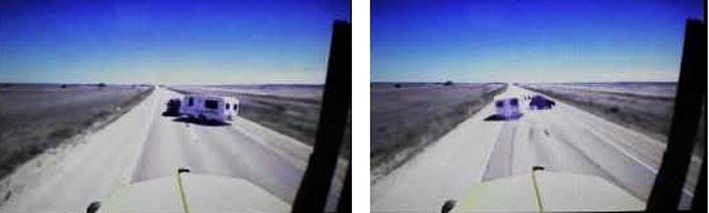
Event No. 6. Harmonic motion swings van from side to side. The black skidmarks are from the car braking hard. There are no caravan braking skidmarks, only yaw marks as the caravan swings back to the left. Driver has totally lost control.
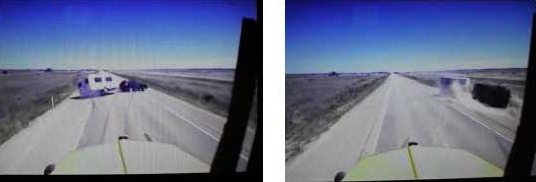
Event No. 7. Tow vehicle braking skid marks turn to yaw marks. Left wheel of caravan starts yaw mark. Car broadsides off road, left wheels drop down embankment, digging in and causing vehicle to roll, caravan roll follows.
On a flat, straight stretch of outback highway, (possibly with a speed limit of 110 km/h), the truck is probably travelling at 100 km/h. It is estimated that the caravan rig is about 10.5 metres in overall length. It took the rig two seconds to pass a reference point on the truck. (ie, 5.25 m/sec faster than the truck). The calculations show that the caravan rig was travelling at 119 km/h. as it passed the front of the truck. If the truck was doing 95 km/h, the caravan rig was doing 114 km/h.
In reality there were two ways to avoid this crash:-
- Don’t try to overtake a truck at high speed….stop and have a cup of tea! and,
- If you must attempt to overtake, make sure you have electric brakes fitted to the caravan, with a manual override – do not apply the car brakes if swaying commences. Activate the caravan brakes manually, and steer your car straight ahead until the rig has stabilized. By this time the truck will have most likely continued on, and you will need to stop and have a cup of tea!
On multi-lane roads, caravan rigs will often have to pass trucks and, of course, the same truck wind forces will be experienced. On these roads the lanes may be a little wider and the shoulders are usually sealed. This gives the Caravan the opportunity to pass with a larger gap between the truck and the caravan, thereby reducing the impact of the wind forces.
Harmonic motion can affect other things too
A most graphic display of wind force setting up increasing harmonic motion, or oscillations, was the spectacular destruction of the Tacoma Narrows bridge in Washington State, USA in 1940. There are many photos and films of this event and it is certainly worth a Google – Just type in ‘Tacoma’ and have a look. The contributory factors were given as :-
- Random Turbulance
- Periodic vortex shedding and,
- Aerodynamic instability.
Perhaps we have a correlation here, with the random turbulence being the bow wave, and eddy (or vortex behind the bow wave) and the periodic vortex shedding being the effect of the truck wind forces on the side of the van. The aerodynamic instability, or what I have referred to as harmonic motion, is probably related to the fact that the towing vehicle has 4 wheels, each near a corner of the vehicle, and the single pivot point connection to a van that has the wheels in the centre of the vehicle.
Perhaps caravan manufacturers should be looking at building a van that has a front and rear axle, like the dog trailers behind tip trucks. The example below may be very difficult to control direction when reversing. [Please see Editor’s note at the end of this article re the believed source of this caravan.
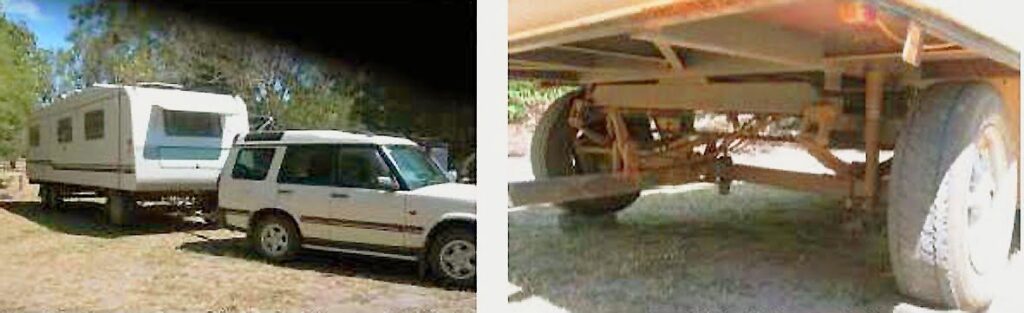
A 4-wheel caravan with axles fore and aft. The steering may be difficult to control when reversing.
To my knowledge, there has not been any scientific studies made to analyze the forces of deflected wind created by an overtaking truck, yet, the situation arises more frequently on our roads as old two-way highways are replaced by divided roads. How often do we hear that traffic on the freeway has come to a standstill because a car and caravan has jack-knifed?
Whilst truckies must have a special heavy vehicle driver’s licence and must undertake mandatory training in handling their rigs, car drivers who are towing caravans have not had any training in handling their rig, unless they have attended a towing course of their own choosing and expense. Most simply assume that as they are licenced to drive a car, they are capable of towing a caravan. To my knowledge, towing courses do not address the issue of wind forces from trucks and the subsequent potential of harmonic motion causing loss of control.
There are several towing guides, brochures and booklets published by road authorities, motoring organizations, insurance companies, and caravan magazines, very few of which address the issue of wind forces from trucks.
An exception to this is the NRMA’s ‘Towing in Australia – Pain or Pleasure’ (about 1983) booklet which contains the following advice on the last page:-
”Caravan stability is also seriously affected when the combination is passed or being overtaken by larger tankers or semi-trailers.
Wind forces from the front of large vehicles strike the side of the caravan and force it to the side of the road. Alternatively, when being overtaken, and the large vehicle passes the centre of the caravan, suction from the rear of the passing vehicle will tend to draw the caravan to the centre of the road. This causes the caravan to oscillate about its centre of gravity and applies forces to the tow ball, making the car become unstable. In really serious cases, this can cause the trailer combination to go completely out of control and jack-knife. To reduce this dangerous tendency, try to increase the distance between the caravan combination and the passing vehicle.
Tests show that for two vehicle passing at 80 km/h. suction force on the caravan is reduced two-and-a-half times when the clearance between the two vehicles was increased from hald a metre to two metres. On seeing that you are likely to be overtaken, maintain the current line of direction on the trafficable portion of the carriageway until the approaching vehicle has commenced overtaking, then reduce speed and move as far to the left as possible. . . . “
![Truck wind forces on [cara_s] - electric vehicle batteries,book on batteries,electric car batteries,lithium ion batteries for electric cars,electric car battery technology,how long do electric car batteries last,electric vehicle battery life](https://rvbooks.com.au/wp-content/uploads/2020/03/NRMA-Towing-in-Australia-Pain-or-Pleasure.jpg "Truck wind forces on [cara_s] 63")
This section needs to be updated to reflect the higher speed (100 km/h) of heavy vehicles, the size of the vehicles, especially the “Cab-over” flat fronted trucks, and the available lateral road space available. There is no mention of electric brakes, anti sway control and, the last line is certainly not appropriate when the speed is 100 km/h.
The Caravan and Camping Industry Association of NSW, in their publication, ‘The National Caravan and Recreational Vehicle Towing Guide’ does raise the issue, but only recommends that: ‘if these forces are noticeable after fitting an appropriate weight distribution hitch, an added sway control unit should be fitted’.
There is a clear need across all levels of Government, the media, and all organizations associated with caravanning, to provide education, training and re-training of drivers who are towing caravans and camper trailers. There has been many fatalities, serious injuries and family trauma resulting from ignorance and lack of knowledge in caravans and trucks sharing the road.
Rob Caldwell ( MITE(Life), MAITPM) – Traffic Engineer. August 2010 (Updated August, 2014).
Footnote: I do not know the persons who are responsible for the photos in this report, but I thank them, as it is hoped that this report will make a contribution to greater safety.
RV Books thanks Mr Caldwell (and Caldwell Consulting) for enabling this paper to be reproduced. Caldwell Consulting can be contacted at P.O. Box 476, Nelson Bay, NSW 2315.
NOTE from Collyn Rivers, RV Books
The ratio of caravan side area front/rear of the caravan rear axle can affect this issue profoundly (some caravan owners will experience it more than others but the effect always presents risk). This issue was well understood by legendary caravan builder Barry Davidson. His Phoenix series had sloping sides at the front. That and well set-back rear axle/s resulted in one of the most stable caravans yet built.
(The dog axle [cavaran] pictured is understood to have been built by Spaceland (any more information appreciated).
Collyn Rivers.
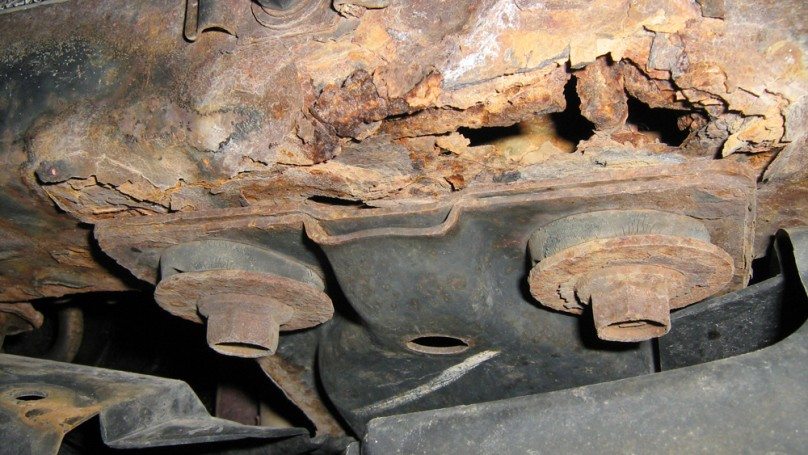
Warning for Potential Caravan Buyers – how to buy a caravan
Warning for Potential Caravan Buyers
Caravan industry insiders express concern that too many manufacturers and importers compete in a limited and highly competitive market, hence this warning for potential caravan buyers – how to buy a caravan. RV Books shares this concern.
Potential buyers need to ensure their proposed caravan complies with Australia’s safety regulations. These are currently (early 2021) in the Australian Design Rules. The Federal government’s Vehicle Safety Standards branch, however, recognises there are problems in Australia’s caravan industry. Its new Road Vehicle Standards Act is effective from July 2021. This Act replaces the 1989 Motor Vehicle Standards Act.
The effect of inadequate rust protection.
Road Vehicle Safety Standards Act
The 2021 Road Vehicle Safety Standards Act allows larger caravan companies a lengthy period to meet the new requirements. Hence, it is likely the new law’s intended benefits will not become apparent until mid-2022.
The caravan industry veterans warn there are non-compliant caravans. The new regulations, however, do not guarantee all future caravans will be fully compliant. Nor do these regulations apply to manufacturers and importers. Some companies that produce caravans in small numbers will be exempt. So will be industry newcomers.
Not all makers have the resources and experience essential to manufacturing safe, high-quality caravans. Also lacking are standard professional after-sales service and repair facilities.
Unfortunately for owners of defective or non-compliant caravans, the new Act is not retrospective. Affected owners can only continue to pursue action against the selling dealer. Not the maker.
Australian Consumer Law
Australian Consumer Law protects customers who bought unsatisfactory or unsafe products. Dealers, however, may attempt to avoid their responsibilities. Some advise buyers to seek redress from the caravan maker. If that happens, consult a lawyer. Whoever sold you the caravan is legally liable.
It is vital that potential buyers do their homework thoroughly before deciding on a particular make and model.’ Furthermore, ‘that a salesperson does not persuade them to buy a better (i.e. higher-priced) caravan, which may or may not, live up to promises made.
How to buy a caravan
Buying a caravan is a significant investment. Make the purchase on a practical basis, not emotional. Moreover, sales staff are professionally trained to sell. Caravan buyers, however, are not trained to buy. As a result, buyers are likely to suffer remorse when they realise their purchase lacks expectations.
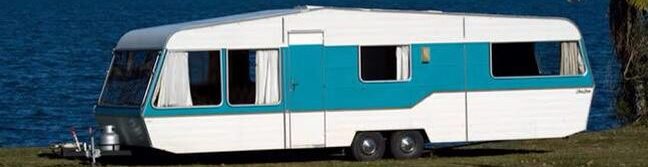
Caravan Length and Stability
Caravan Length and Stability
Caravan length and stability interrelate. The tow vehicle should weigh at least the same as the caravan. Excess caravan weight is undesirable. Excess caravan length, however, is more significant. Limit caravan length, and weight at either end.
Extreme caravan rear-end weight is particularly undesirable. Many caravans have about 110 lbs (about 50 kg) of spare wheels on their rear wall. The effect of that weight when pitching or swaying is many times more. If at all feasible, relocate those spare wheels onto a cradle underneath the caravan‘s chassis, or carry in the tow vehicle. Also, why two spare wheels? Tow vehicles normally have only one.
Caravan length and stability interact
A caravan towed via an overhung hitch is fundamentally unstable. Ample tow ball mass (e.g. 10%) is vital. There is nevertheless a speed at which caravans will sway. Friction and other mechanisms dampen that sway. They may not do so sufficiently in an emergency swerve to prevent the rig jack-knifing. This is particularly an issue in the USA. People there claim to tow long and heavy ‘travel trailers’ behind often lighter vehicles. Some do so at a claimed 160 km/h (100 mph). That is virtually a recipe for swaying. Or worse.
Caravan length and stability – how to ensure it first and every time
It is possible to design (and load) a caravan such that it will normally only sway at speeds as high as 160 km (100 mph) but that speed is better avoided. All this, and a great deal more is explained in RV Books’ top-selling Why Caravans Roll Over – and how to prevent it .
RV Books also publishes How to Choose and Buy an RV, Caravan & Motorhome Electrics, The Camper Trailer Book, Solar That Really Works (solar power for RVs) and Solar Success (for homes and properties).
Making stable caravans – here’s how and why to do it
by Collyn Rivers
Making stable caravans
Making stable caravans is readily possible by design, loading, and tow vehicle use and choice. This article by Collyn Rivers explains how. It also provides practical guidelines for buying a caravan and tow vehicle, their loading, and their on-road usage. For a full technical explanation of why rigs can be unstable please see my Caravan and Tow Vehicle Dynamics/. See also Why Caravans Roll Over/
Making stable caravans is always desirable. For Australian (and USA) caravans it is essential. Such trailers are increasingly heavier and (worse) longer, yet tow vehicles are increasingly lighter. Accidents have escalated since 2014.
According to one major insurer loss of control accounts for over 90% of all rollovers. ‘ In all cases’, stated that insurer ‘the caravan began to fishtail and the driver was unable to bring it back under control.’ Such ‘loss of control’ appeared due to various causes. These include incorrect loading, inadequate tow vehicle weight, excess caravan weight, excess hitch overhang, driver error. And particularly speed. It did, however, overlook that most were long twin-axle units.
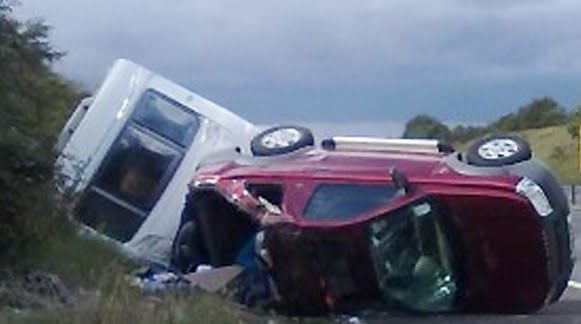
An only too typical caravan roll-over. Pic: original source unknown.
Making stable caravans – weight
Many caravans built since 2015 are over 6.5 meters. They weigh well over 2000 kg (4400 lb). Some are 7-9 meters and weigh over 3500 kg (7700 lb). A few are over 4000 kg (8800 lb). Many are towed by vehicles far lighter than the trailer. And at 100-110 km/h (plus 60 mph). Worse, an Australian caravan magazine stated that many caravans reviewed were heavier than their makers claimed.
Before finalizing payment for any caravan, weigh it on a certified weighbridge. Never assume the claimed Tare Mass is correct. Few are. That weight is as the unit left the factory. It does not include water. Nor (usually) optional extras originally ordered. Any weight over its actual Tare Mass reduces that for personal effects pro-rata.
Overall length
Whilst excess weight is undesirable the major factor determining a caravan‘s stability is its length. In particular the distance from its tow hitch to its axle/s. Known as the ‘radius of gyration’, the greater that is the better. Also assisting stability is the tow vehicle’s wheelbase (i.e. the distance between its front and rear axle). Here, the longer the better. By and large, however, it is excess caravan length and where weight is distributed along that length that is now the major issue,
Weight distribution truly matters
That not generally understood is that towing stability is substantially related to a caravan‘s length. In particular, where weight is distributed along that length.
A dangerous assumption (still found on RVs forums) is that as long as recommended nose mass is retained, a caravan can be loaded as wished. An extreme example, seen at a camp-site, had a motorcycle on its rear. The motorcycle was ‘balanced’ by 200 kg (440 lb) of barbell weights on the trailer’s A-frame. Another was a widely spread article suggesting that tow ball mass be adjusted via sandbags at the trailer’s front end – a seriously bad way of adjusting tow ball mass.
The ideal caravan has its axle/s set way back. Then laden with everything heavy as close to the axle/s as possible.
Never locate anything heavy (particularly high-slung spare wheels) at a trailer’s extreme rear. Locating a tool-box on a rear bumper is an absolute no-no. At the front, for stability, the longer the A-frame the better.
Tow ball mass
For a trailer towed via an overhung hitch, to be stable it must be nose heavy. There is a known relationship between its nose weight and speed. The lower that nose weight the lower the safe speed.
Australian trailer makers initially recommended a nose mass of about 10% of the laden weight. Ongoing emission legislation, however, causes vehicle makers to reduce their products’ weight. As a result, trailer makers reduce their nose mass recommendations. Or, and increasingly, do not advise it. While that 10% is still really required, that often now exceeds current tow vehicles’ ability to support it.
The average maker-recommended tow ball mass of typical 2020 Australian-built caravans is now 5%-7%. One is a mere 4.0%. Only a few remain at 9% to 10%. Some makers suggest towing with the water tanks empty. That seemingly negates having them.
European caravans are about 40% lighter (per metre) than most local products. There, 7% has long been seen adequate (and still is).
Legal reasons preclude suggesting anything other than: ‘follow what the caravan maker recommends’ re tow ball weight. RV Books does not, however, endorse such recommendations.
Hitch overhang
Another major factor in trailer stability is the length from the tow vehicle’s rear axle to the overhung tow ball. The less that overhang, the less a caravan‘s tendency to pitch and yaw. The average overhang of Australian tow vehicles is 1.24 metres. The longest (well over 2 metres) are mostly extended chassis dual-cab utes. It is not a coincidence that many roll-overs involve such vehicles.
When making stable caravans, the tow hitch too should have the minimum possible overhang. Reducing that alone assists stability.
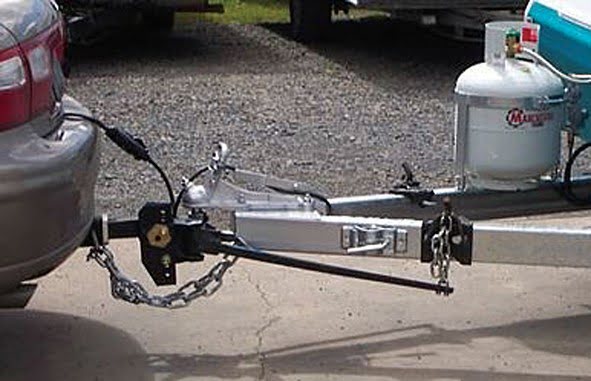
Excess hitch-shank length like this should be avoided. Some hitches have adjustable shanks. If yours is like this, fit one that is shorter. Or have an engineer drill a new hole.
Weight Distributing Hitches
The heavy tow ball weight imposed on an overhung hitch pushes down the rear of the tow vehicle. It acts as a lever. As with a heavy person at one end of a see-saw, it levers up the front wheels of the tow vehicle. A weight distributing hitch is simply a springy lever. Its effect is to force those wheels back down.
This effect is often misunderstood. A WDH cannot reduce the side forces resulting from cornering or yaw. Adding a WDH always reduces the required understeer. Such understeer ensures the tow vehicle automatically increases turning radius if cornering too fast. See pics below. Why caravans roll over.
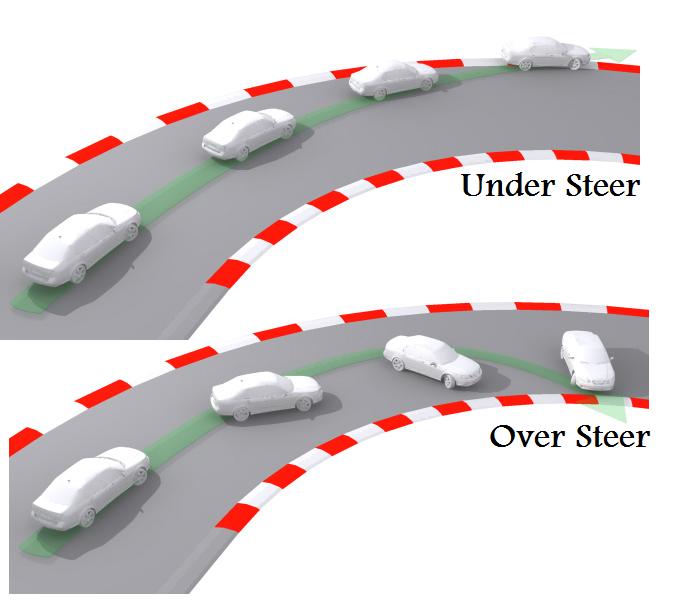
Understeer and oversteer. Original pic – source unknown.
A heavy caravan‘s nose weight imposed on lighter tow vehicles is often more than its rear tires can withstand. This necessitates the use of a weight distributing hitch (WDH). These hitches are semi-flexible springy beams that, by using the tow vehicle’s rear axle as a pivot, shift part of that imposed weight to the front wheels. In doing so, however, removing that weight reduces the rear tires cornering power.
Major WDH maker Cequent (parent of Hayman Reese) advises restoring no more than 50% of the ‘lost’ front axle load. This usually results in the laden trailer’s nose being down by about five centimeters. Better by far, however, is to have a rig that has no need for a WDH. Doing so has long been routine in Europe.
Sway control systems
Any trailer towed via an overhung hitch has a natural tendency to sway. With well-designed and laden trailers towed by a suitable vehicle, such swaying normally dies out within two/three cycles. It is mildly annoying but harmless.
After-market sway control systems usefully and effectively control low-speed swaying. They introduce friction that dissipates sway energy as heat. That seemingly overlooked is a basic law of physics. That frictional force is a constant – but sway force increases with the square of the speed. At 100 km/h a friction hitch is close to useless. Its damping is down to 1% or so.
So-called dual cam systems ‘lock’ the caravan and tow vehicle together in a straight line. Normal cornering is enabled by tire distortion. The cams release for tight cornering, but also when sway forces are excessive and that control is most needed.
Both are effective at low speed. But, if fitted to a trailer that is otherwise unstable, these devices mask a dangerous underlying condition. They are akin to pain killers instead of medical treatment. Sway control is routinely included with some UK/EU caravans – but only as an aid to low-speed comfort.
Electronic stability control
Europe’s IDC, and AL-KO ESC activate when caravan sway exceeds about 0.4 g (an uncomfortable level). Or four repeated at about 0.2 g. They then automatically apply caravan braking. The Al-KO does so for one to three seconds at 75% of full braking. This reduces the sway, and particularly, reduces speed below the critical level. They can only be fitted to trailers that use the maker’s respective brakes.
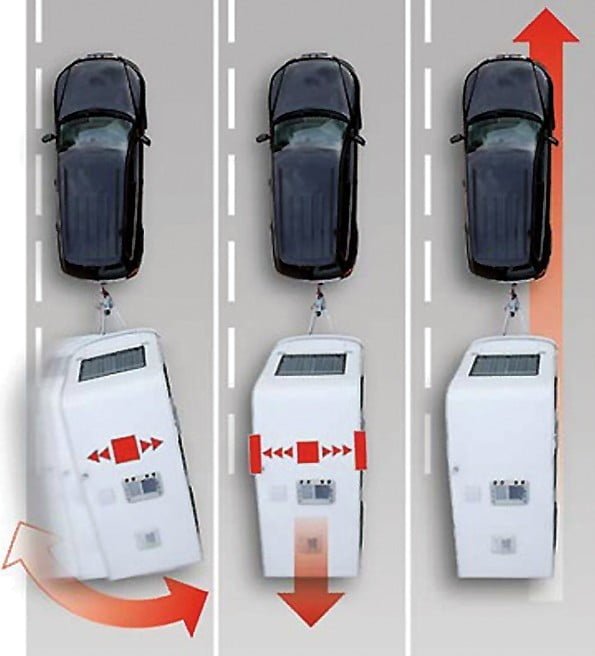
How the AL-KO system works
The US products (from ALKO/Dexter) operate at lower levels of sway acceleration (about 0.2 g). They brake each caravan wheel at whatever level is deemed optimum. The makers claim they can be fitted to trailers with any form of braking. Either system is worth fitting. They do not, however, substitute for making stable caravans. When these systems are triggered they do not initially reduce sway. They reduce speed.
If using such systems never engage cruise control. That attempts to accelerate the rig to its preset (and previous) speed.
Manufacturers stress that such products cannot overcome the laws of physics. With that presumably in mind, most test them at under 100 km/h (about 60 mph).
The tow vehicle
For truly making stable caravans the tow vehicle must be heavier than the trailer. The more so the better.
Recommendations about trailer/tow vehicle weight stable stem from the 1930s. Caravans back then had an interior length of 4-5 metres. They weighed about 1000 kg (2200 lb). Most were towed by cars heavier than that 1000 kg (2200 lb). Few exceeded 80 km/h (about 50 mph).
Most EU/UK caravan bodies now recommend laden trailer weight should not exceed 85% of the tow vehicle’s unladen weight. They suggest that experienced owners may go up to 100% of the car’s unladen weight. Germany legislates that such trailers may not exceed 0.8 times the tow vehicle’s unladen weight.
Whilst the UK’s and European towing legislation has been updated, Australia’s has not. It relates only to maximums. A review is long overdue. The Caravan Council of Australia suggests that ‘for added safety and peace of mind’, the laden caravan should not exceed about 77% of the laden weight of the tow vehicle. That recommended 77% is less stringent than that of the UK and Germany – where towing speed limits are 20 km/h lower. Despite that, this recommendation was greeted by caravan-owner and industry rage. See Caravan Council of Australia. Few Australian caravan tow vehicle combinations meet these independent recommendations.
It is also becoming necessary to stress that limiting caravan length is even more important than weight.
Whilst environmentally unsound, when making stable caravans, for any over 2200 kg (4850 lb) laden, or over 6 or so metres, buy the heaviest tow vehicle you can find. See below for the minimal hitch overhang.
Braking and accelerating
A major towing risk is driving fast down a hill that has bends or changes in road camber. Particularly if braking, gravitational forces at the rear of a swaying trailer increase that sway. This is a particular risk on long winding motorway downgrades. And even more so in strong side winds. This mainly affects end-heavy trailers. To reduce risk, keep the speed below 70 km/h. Never brake (the tow vehicle) hard when descending a hill. It may cause the trailer to sway.
Advice on forums is that accelerating corrects sway. Whilst true – it is safe only at low speed. Accelerating whilst swaying at higher speeds may cause the rig to exceed the critical speed at which sway suddenly escalates. In that event jack-knifing is likely. If your system permits, a safer way is by gently braking the caravan alone.
The effect of speed
Any given combination of the tow vehicle and caravan has a unique critical speed. Above that speed, any sufficiently strong disturbing force may trigger it into non-recoverable jack-knifing. This typically results in the rig overturning.
That critical speed is determined by a number of factors. Tests in the UK show that optimally locating typical personal effects alone, can affect it by as much as 25 km/h. See Caravan and Tow Vehicle Dynamics for a full technical explanation.
In Australia is that (excepting WA’s limit of 100 km/h) caravans under 4.5 tonne can legally be towed at up to 110 km/h. This is a speed limit, however. It is not a ‘recommended’ speed. Many drivers resent being held up by slow traveling vehicles. Towing a trailer that is heavier than the tow vehicle at speed, however, is risky. An emergency swerve, or strong side gust can trigger irreversible snaking. Most owners never experience this. But some do.
Making stable caravans – various aids
There is no stability benefit in having dual axles unless caravan weight demands. If anything the opposite is so – they add weight and (worse) length.
Follow European practice by not carrying anything heavy on the A-frame. Locate gas bottles (if used) in a ventilated centrally located locker – or as close to the axles as possible.
When designing a caravan, set the axle/s as far back as you can – yet maintaining a tow ball weight that the tow vehicle can realistically handle.
This well-balanced 1998 Phoenix’s set-back axles resulted in almost legendary stability. Pic: Caboolture Caravan Repairs.
The side-wall area to the rear of the axle/s needs to be marginally greater than in front of the axle. This reduces sway caused by a side-wind gust and by long trucks passing, or passed, at speed. The 1990s Phoenix shown above has diagonally sloping walls at its front. This ensured the set-back axles did not result in excess side (frontal) area. It is still respected for its excellent stability.
How can I tell if my rig is unstable
No trailer pulled via an overhung hitch can ever be 100% stable. If the trailer sways, that automatically causes the tow vehicle to sway in the opposite manner. And vice versa. Nose mass and correct weight distribution assist to limit this. So does a tow vehicle much heavier than the trailer.
A rig is likely to be acceptably safe if minor sway automatically dies out (without driver correction) after two or three cycles. It is mildly uncomfortable but not necessarily dangerous. EU designed trailers often have sway damping as standard. But makers first ensure sway is addressed as described above.
Long end-heavy trailers with substantial nose mass typically feel ultra-stable on tow. That high nose mass reduces the effect of sway forces. Problems occur however if that trailer begins to yaw. Then, that very mass that normally keeps it so stable will overcome the tow vehicle’s ability to control it. The trailer will begin to fishtail, and this may cause the rig to jack-knife.
The most common statement made by the driver following such an incident is: ‘It always felt so stable up until then’.
Making trailers more stable – further information
This topic is far too big to cover fully in article form. For full details see Caravan and Tow Vehicle Dynamics
The UK article www.caravanchronicles.com/guides/understanding-the-dynamics-of-towing/ by Simon P Barlow. is a generally similar and very down-to-earth approach. It is accurate and eminently readable but relates mainly to the much lighter UK and EU caravans.
If you liked this article you will like my books! All are written in a similar manner. Why Caravans Roll Over – and how to prevent it covers stability issues in depth. So too does the Caravan & Motorhome Book. My other books are The Camper Trailer Book, Caravan & Motorhome Electrics, and Solar That Really Works! (for cabins and RVs). Solar Success relates to home and property solar.
Solar regulators with current shunts – how to fix misleading readings
by Collyn Rivers
Solar Regulators with Current Shunts

Pic: Plasmatronics
If connected incorrectly, solar regulators with current shunts can register twice your true solar input. This article explains why. Moreover, how you can fix it.
Some years ago a magazine article outlined a solution to a non-existent problem. The article claimed that Australia’s sun may produce excess output. Furthermore that it can overheat solar regulators. It quoted a Plasmatronics 20 amps regulator as indicating 36 amps. The solar array, however, was only 18 amps.
The article misrepresented that happening. It wrongly assumed 36 amps output was feasible. It also advised adding a fan to cool the regulator. In reality, that system’s actual 16-18 amps were registered twice. Once as it flowed through the solar regulator. Then again. It flowed through a current shunt. That shunt’s output also, was to that regulator.
Solar in areas close to a large expanse of water or sand may produce freak high voltages. This happens if direct irradiation is reflected back to light scattered clouds. Then down again. Solar voltage may thus briefly escalate. Their output current, however, is limited automatically.
Solar regulators likewise block excess current. That is necessary for small capacity lead-acid batteries. AGM and lithium batteries, however, accept high currents without harm.
RB Books advises you to use a cooling fan for a solar regulator in tropical areas where airflow is also limited. You do not need one otherwise.
Battery return connection
For solar regulators with inbuilt monitoring, battery positive and negative returns must be direct to that battery. If you include a current shunt, your battery return must bypass that shunt. Unless you do, the solar current is recorded twice. Details vary between regulators.
It is not feasible to show how to do this in article form. Full details, however, are in Solar That Really Works! (for cabins and RVs). Also in Solar Success (for home and property systems). Furthermore, in Caravan & Motorhome Electrics.
Our other books are the Caravan & Motorhome Book, the Camper Trailer Book. For information about the engineer/technical author please Click on Bio.
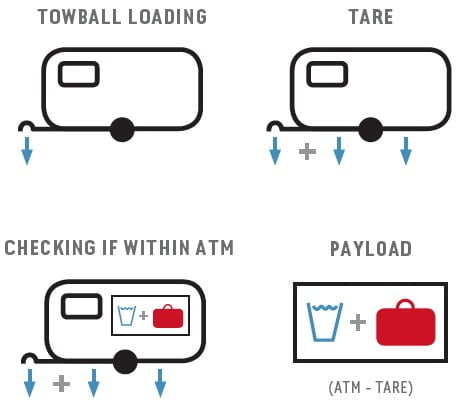
Australian RV and towing rules and regulations – a general guide
by Collyn Rivers
Australian RV and towing rules
The current (February 2018) Australian RV and towing rules and regulations are outlined here. There will be changes, but not until (a probable) 2024.
Caravans – including fifth wheel caravans, camper trailers, and their tow vehicles
Tare Mass (weight)
This is the total mass of the trailer when not carrying any load, but ready for service, with all fluid reservoirs (if fitted) filled to nominal capacity except for fuel (as say for a diesel heater), which shall be 10 litres only, and with all standard equipment and any options fitted. This includes any mass imposed onto the tow vehicle when coupled to the resting on a firm and flat surface. It includes one 9 litre LP gas bottle, but not its gas content. It does not include any water.
Tare Mass is not defined as its weight ‘ex-factory’. It may be that, but if any specified ‘options’ are subsequently fitted or provided prior to the owner taking delivery, they too are legally part of the Tare Mass. This should thus be included as Tare Mass on the compliance plate, but that cannot be relied upon. Always, accordingly, insist on the trailer being weighed in your presence on a certified weighbridge, prior to final payment. Take this seriously: there are many confirmed reports of declared Tare Mass being well below the actual weight at the time of delivery.
Aggregate Trailer Mass (ATM)
This is an obligatory rating set by the trailer maker. It is its maximum legally allowable laden weight when standing on a level surface. It includes the weight carried by the tow bar of the towing vehicle. For caravans and camper trailers, the ATM includes personal effects but there is no legally obligatory allowance – only an industry recommendation. That (in 2018) is 250 kg (550 lb) for single axle caravans and 330-450 kg for two-axle caravans. Custom-made caravans, however, usually have more and the amount desired should be pre-agreed and included in the purchase contract.
Pic: courtesy of caravanbuyersguide.com.au
Gross Vehicle Mass (GVM)
Applicable primarily to the tow vehicles is a manufacturer-set rating that must not be exceeded. It is the vehicle’s permitted maximum loaded mass – defined as its Tare Weight plus the load and specified by the vehicle manufacturer. If subsequently modified, it is that mass shown on a modification plate attached to the vehicle.
Gross Combination Mass (GCM)
This is a maximum permissible weight rating (specified by the tow vehicle maker). It is of the tow vehicle’s total laden mass, plus the laden mass of anything it may tow. The GCM rating is particularly a trap for buyers of dual-cab utes. Many such vehicles are promoted as having a towing capacity of 3500 kg, but as their GCM is typically around or under 6000 kg if towing that 3500 kg, this limits the tow vehicle’s laden weight to 2500 kg. Such a combination is unsafe.
Tow Ball Mass
There are no legal requirements, but general engineering consensus is that a typical Australian-made caravan needs about 10% of its full laden weight as tow ball mass. The typically lighter EU/UK products require 6%-7% of the fully laden weight. The typically shorter (about 4 metres) camper trailers require 5%-7% but more is not a problem. Fifth-wheel caravans too are not that critical: 10%-25% is fine.
Legal Maximum Towing Weights
In Australia, for tow vehicles under 4.5 tonne, the maximum laden trailer weight is (currently and legally) the lesser of that allowed by the tow vehicle, tow hitch, or the maximum trailer mass. This overrides earlier legislation limiting towed weight to 1.5 times the tow vehicle’s unladen weight. Many believe these limits are too high for current caravan weights and towing speeds: see https://rvbooks.com.au/caravan-and-tow-vehicle-dynamics/
Trailer Dimensions – conventional trailers
Centre-axled trailers (legally known as ‘pig’ trailers) must not exceed 12.5 metres overall. The maximum distance from tow hitch to centre-line of the axle/s must not exceed 8.5 metres. The rear overhang must not exceed the lesser of 3.7 metres, or the length of the load-carrying area (or body) ahead of the rear overhang line.
Trailer Dimensions – fifth wheelers
The distance from the towing pivot point to the rear of the trailer must not exceed 12.3 metres. That from the towing pivot point to the rear over-hang line must not exceed 9.5 metres. The rear overhang must not exceed the lesser of 60% of the former dimension or 3.7 metres. The maximum forward projection must not exceed a 1.9-metre arc from the towing pivot. The pic below hopefully makes this clearer.
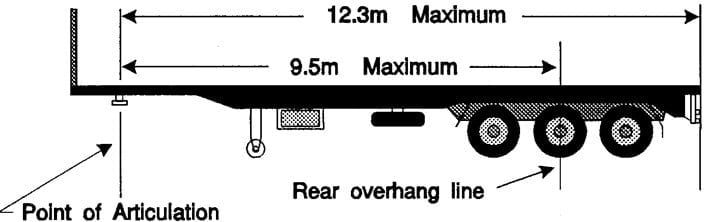
Maximum dimensions for a large fifth-wheel trailer
Compliance Plates
Australian RV and towing rules stipulate that caravans and camper trailers less than 4.5 tonnes must have a compliance plate (currently) self-certified by the manufacturer or importer. It confirms the vehicle complies with the Motor Vehicle Standards Act 1989. The plate must specifically show the manufacturer’s or importer’s name, trailer model, vehicle identification number (17-digit), date of manufacture and Aggregate Trailer Mass. It must also include this statement. ‘This trailer was manufactured to comply with the Motor Vehicle Standards Act 1989’.
All information on the compliance plate (and/or otherwise supplied) must be true and correct for that specific vehicle. It should reasonably be expected this information to be accurate but this cannot be taken for granted. Discrepancies related to declared mass occur because some makers produce only standard products. If the declared tare mass is that ex-factory (see above) it may not include dealer-supplied and installed optional extras. If this arises, contact your state or jurisdictions equivalent of NSW’s Department of Fair Trading if the discrepancy seriously prejudices the RV’s usability (measuring errors of a few kgs, however, are inevitable.
NOTE: The above-noted self-certification is likely to be changed under the new legislation. This will be notified when more information becomes available.
Tyre Placard
This too is legally required (section 20.1 of VSB1). It must include the manufacturer’s recommended tyre size, tyre load rating, speed rating, cold inflation pressures and either the statement: ‘the tyres fitted to this vehicle shall have a speed category not less than ‘L’ (120 km/h)’. Or if the recommended maximum vehicle operating speed is less than 120 km/h, ‘the tyres fitted to this vehicle shall have a speed category at least equal to the recommended maximum vehicle operating speed, i.e. ‘ . . . ‘km/h.’, where ‘…’ is the vehicle manufacturer’s recommended maximum vehicle operating speed. This data may be included in the Compliance plate or on a separate plate – that is in a ‘prominent position’.
RV and towing rules – light (powered) vehicles (under 4.5 tonne GVM)
These are covered under the Vehicle Standards Bulletin 14 National Code of Practice for Light Vehicle Construction and Modification. There are minor differences from state to state – covered in each state’s version of Vehicle Standards Bulletin 06 (VSB 06).
Tare Mass
Far simpler than for trailers, this is the mass of any vehicle likely to be converted or made as a campervan or motorhome. It applies to the vehicle when ready for service, unoccupied and unladen. It requires all fluid reservoirs to be filled to nominal capacity except for fuel (10 litres only). It includes all standard equipment and any options fitted.
Gross Vehicle Mass (GVM)
The GVM must include 68 kg for each of two front-seat occupants, plus, if the designated ‘Seating Capacity’ is five or more, 68 kg for a rear ‘Seat’ passenger. Apart from that, it must include a personal effects allowance of 60 kg for each of the first two sleeping berths, and 20 kg per berth thereafter. This ‘allowance’ applies to everything carried. This includes pets, goods, bedding, food, cooking utensils and luggage.
Manufacturers are obliged to provide only that amount. Most owners find that to be far too low. If you need more (and you will), specify by how much, and in writing, when ordering. If you do not, dealers and manufacturers are likely to insist it is ‘not their problem’.
If self-converting an existing vehicle to a campervan and motorhome (under 4500 kg [9920 lb]), see VSB 14. This provides nationally acceptable technical specifications to ensure the result complies with Australian Design Rules (ADRs), and the Australian Vehicle Standards Rules (AVSR). Compliance with VSB 14 helps to ensure the result satisfies the regulatory requirements.
Heavy vehicles (exceeding 4.5-tonne GVM)
The rules and regulations for large motorhomes/coach conversions are covered in the National Code of Practice for Heavy Vehicle Construction and Modification. The dimension and weight requirements are prescribed in the Heavy Vehicle (Mass, Dimension and Loading) National Regulation 201. Dimensional limits are in VSI No. 5.
Main dimensional limits are length (rigid trucks) 12.5 metres (coaches) 14.5 metres. Width must not exceed 2.5 metres except for lights, mirrors, reflectors, signalling devices etc. Exclusions are explicit: e.g., they do not extend to awnings etc. Maximum allowable height is 4.3 metres. Rear overhang must not exceed the lesser of 60% of the wheelbase or 3.7 metres. The maximum combination length (if towing a trailer) is 19 metres.
These are overall measurements; they specifically include bicycle racks, bull bars, toolboxes and spare wheels etc. The weight limits are complex and apply in all states. (www.legislation.qld.gov.au/LEGISLTN/CURRENT/H/HeavyVehMDLNR.pdf.)
Motor vehicles and trailers over 4.5-tonne rating have a Compliance Plate issued by the Federal Vehicle Safety Standard (VSS). It provides proof-of-compliance with the applicable Australian Design Rules following VSS’s engineering inspection and approval.
The main reference, Vehicle Standards Guide (VSG5) sets out the safety requirements. It summarises the most common modifications. It shows how they must be done to comply with the Heavy Vehicle National Law and other legislation and regulations. Some vehicles need certifying by an Approved Vehicle Examiner. It is advisable to consult an Examiner before starting work – especially if the GVM has to re-rated.
An excellent reference source is the Vehicle Standards Guide 5 (VSG-5) Converting a vehicle into a motorhome Revised June 2018.
Electrical
The legal requirements for 230 volts are set out in AS/NZS 3000:2007 and AS/NZS 3001:2018. These apply to 230 volts regardless of its source (e.g. solar or generator etc) even if there is no intent or provision for grid supply.
Most states require Electrical Certification but (for reasons unclear) Energy Safety Victoria declares RVs are not ‘electrical installations’ – but ‘appliances’. Therefore (it claims) they are exempt. It requires RVs to meet AS/NZS requirements re 230 volts but installation need not be done by licensed electricians. Nor is Electrical Certification required.
There are no legal requirements for an RV’s 12/24 volt dc wiring, excepting that relating to obligatory separation from 230-volt wiring (avoided if wished by using 230-volt cable for the 12/24 volt system). For vehicles over 4500 kg, however, all 12/24 volt dc wiring must accord with the Heavy Vehicle (Vehicle Standards) National Regulation, Schedule 2, Part 2. Section 17.
With minor exceptions, the above electrical requirements apply also to RVs used in New Zealand.
Solar
Solar must comply with AS/NZS 5033. If it does not exceed 60 volts DC or 35.4 volts AC, there is no requirement that it be done by a licensed electrician. RV Books recommends using a nominally 12 or 24-volt system for RV use.
LP gas
LP gas installations (Australia-wide) must meet the requirements of AS/NZS 5601.2:2013 in detail. In addition, some states/territories have marginally different requirements. The only way to ensure compliance is to obtain the certificate from a licensed gas fitter. For imports see: https://rvbooks.com.au/imported-rvs/
RV construction
Apart from chassis and related issues, there is no current RV industry ‘standard’ for any aspect of caravan or motorhome construction. This varies from excellent to cynically dreadful. A few companies nevertheless have established a good reputation. Caravan forums provide advice – but some posts are blatantly promotional.
Obligatory on-road lighting etc
Vehicle lights and reflectors must meet legal requirements relating particularly to specific functions. Requirements relate, for example, to defined viewing angles (horizontally and vertically) and lighting intensities. Those approved for RVs in Australia carry an E-mark or a CRN. The E-mark is a capital ‘E’, with a circled sub-script number plus an embossed approval number. Those sold only in Australia must have a CRN (component registration number).
Hints for home building
Weigh the bare vehicle prior to starting work. Then weigh and keep a running total of everything you include. It is very easy to underestimate the total weight. If the RV has a toilet or shower, it must be in working order when you present it for registration. If it is not, leave the space, as ‘that’s where I am going to add a cupboard’. (Hint: that ‘cupboard’ does not need to be in place for rego purposes.)
Every aspect of building an RV is covered in the Caravan & Motorhome Book. For solar and electrics see Caravan & Motorhome Electrics. For in-depth coverage of solar in RVs see Solar That Really Works!
Driving licence requirements
A C class licence is required for vehicles under 4.5 tonne (including with seating for up to 12 adults). Such licence includes towing a caravan as long as the GCM is not exceeded. (This now includes the ACT). An LR licence is needed for vehicles exceeding 4.5 tonnes and less than 8 tonnes. An MR or HR licence is needed thereon. This requirement relates to the potential carrying capacity. If the GVM is 5.5 tonne but has an on-road weight of only 4.4 tonnes you still need an LR licence.
Parking issues
In most parts of Australia, it is illegal to park a vehicle of 4.5 tonnes or more in built-up areas for over one hour. This applies also to a tow vehicle and trailer over 7.5 metres. An exception, however, is where a sign or traffic control device allows otherwise. It is legal to do so for dropping off or picking up goods but for no longer than necessary. If longer is needed, ask the local council to grant an exemption.
References
Australian RV and towing rules and regulations for large motorhomes/coach conversions are covered in the National Code of Practice for Heavy Vehicle Construction and Modification. Dimension and weight requirements are prescribed in the Heavy Vehicle (Mass, Dimension and Loading) National Regulation https://www.nhvr.gov.au/files/201402-0113-general-dimension-requirements.pdf.
Further information about AVEs and heavy vehicle modifications can be found at https://www.nhvr.gov.au/safety-accreditation-compliance/vehicle-standards-and-modifications/heavy-vehicle-modifications.
See also https://rvbooks.com.au/articles/ and https://rvbooks.com.au/imported-rvs/
See also the associated caravan-and-motor-home-compliance/
Our more technically in depth books are the Caravan & Motorhome Book, the Camper Trailer Book, Caravan & Motorhome Electrics, Solar That Really Works! for RVs and Solar Success for home & property systems. All are available from all main bookshops throughout Australia and New Zealand.
To assist others please Link to, or mention this article on related forum issues.
Australian RV and Towing Rules and Regulations – references
Australian Design Rules (ADRs) – https://www.infrastructure.gov.au/infrastructure-transport-vehicles/vehicles/vehicle-design-regulation/australian-design-rules
Heavy Vehicle National Law, Heavy Vehicle (Vehicle Standards) National Regulation, Heavy Vehicle (Mass, Dimension and Loading) National Regulation – www.nhvr.gov.au/hvmodifications
Vehicle Standards Bulletins(VSBs) – https://www.infrastructure.gov.au/infrastructure-transport-vehicles/vehicles/vehicle-design-regulation/rvs/bulletins
Further information
https://rvbooks.com.au/caravan-and-tow-vehicle-dynamics
https://rvbooks.com.au/articles
For issues relating to imported RVs see https://rvbooks.com.au/imported-rvs/
For issues relating to imported RV electrics (particularly compliance) see https://rvbooks.com.au/imported-rvs/
See also the associated https://rvbooks.com.au/caravan-and-motor-home-compliance/
Virtually every issue relating to RV is covered in Caravan & Motorhome Book. Full details of RV electrical requirements, installation are in Caravan & Motorhome Electrics. Solar books are: Solar That Really Works! (for RVs) and Solar Success for home & property systems. For information about the author – click on Bio.
To assist others please Link to, or mention this article on related forum issues.
Caravan and tow vehicle dynamics
by Collyn Rivers
Caravan and tow vehicle dynamics
The complex interactions of caravan and tow vehicle dynamics are described here by Collyn Rivers. It is a precis of the rvbooks.com Why Caravans Roll Over – and how to prevent it.
In the early 1900s, trailers with central axles, towed by trucks with overhung hitches, were unstable. This escalated as towing speeds increased. Around 1920, Fruehauf (USA) realised hitch overhang caused (not just allowed) trailers to yaw anti-clockwise. And vice versa. Furthermore, the longer the hitch overhangs the greater extent of and the lower the road of its onset.
To this day, this is an inherent problem with conventional caravans. In the 1970s studies plus practical testing revealed the causes. These include excess trailer length, inadequate nose weight, poor weight distribution and incorrect axle positioning. Tow vehicle tyre pressure and side-wall stiffness too affect stability. Furthermore, such causes interact.
It was initially believed that excess trailer weight relative to the towing vehicle was the major concern. It is, however, increasingly realised that excess caravan length (and excess speed) are more the cause.
An otherwise stable vehicle towing an equally stable caravan will normally stay in a straight line. A side wind gust, however, may deflect it.
Acceleration relates to change in a mass’s rate of movement. It may be positive (e.g. increasing speed). Or negative (e.g. when braking). It is measured by dividing velocity (metres per second) by seconds. The unit is often shown as ‘G’ (but correctly as ‘g’). A driver cornering at an advised road sign speed will experience about 2 g.
Caravan and tow vehicle dynamics – tyre behaviour
Horse-drawn carriages had pivoted front axles. This ensures their wheels aligned with the pulling force. But if cornered too fast, the carriage’s inertia overwhelmed the horse’s grip. They would lose control. The carriage’s momentum, however, would cause it to keep moving. Then often overturn.
Tyres back then had to revolve, but not sink nor fail under load. Their marginal grip only partly resisted sliding. Braking was by ordering the horses to slow down. Also levering against a tyre to prevent it rolling. The main forces: for traction, steering and slowing, were external, via animal power.
A powered vehicle has similar limitations, but with a major difference. Forces for moving, braking and steering are applied and reacted only by its tyres.
A caravan’s tow vehicle acts physically much as those horses. The caravan depends on the stability of whatever pulls it – as did horse-drawn carriages. This is often overlooked.
Early pneumatic tyres
The pneumatic tyres used on early cars were like oversized-bicycle tyres (and solid tyres). They rolled more or less where pointed. When forces exceeded their grip, such tyres slid progressively and predictably.
Then cars became heavier and faster. Tyres became balloon-like. Owners sought a softer ride. Doing so, however, caused them to handle poorly. And often unpredictably.
By the mid-1930s it was understood how suspension and tyre interaction dictates handling. This particularly applies to caravans and tow vehicles. Their ultimate behaviour is dictated by their suspension and tyres. Not all caravan makers and caravaneers know this. Let alone how.
Tyre basics
An inflated tyre does not roll over a surface. It has a caterpillar-like action. It lays down and picks up an elongated oval of tread (called its footprint). That footprint’s stability is determined by tyre construction and air pressure.
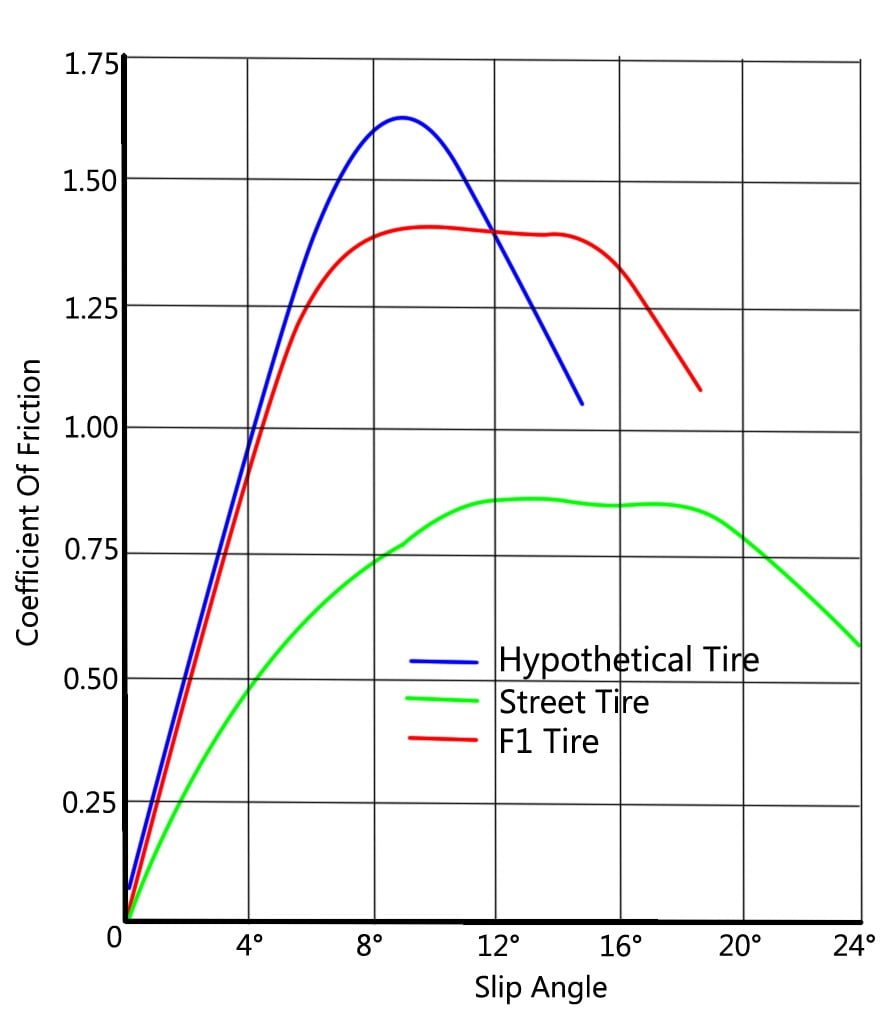
A typical tow vehicle tyre (green) increases ‘cornering power’ as its slip angle increases. It then levels off and starts falling away sharply. The latter introduces major and possibly terminal oversteer. It can result in jack-knifing.
Slip angles
Steering a tyre is like twisting a rolling balloon. Torque is applied, via the wheels’ rims, to the tyres’ sidewalls. The sidewalls flex, and via their stiffness and air pressure, cause the footprint to distort as directionally required. That footprint’s grip is partly molecular and partly frictional.
The steered footprint’s distortion creates an angular difference between where wheels point and the vehicle travels. That angular difference is called ‘slip angle’. The greater the tyre width, sidewall and tread stability and tyre pressure, the lesser the slip angle.
![[cara_up] and tow vehicle dynamics - electric vehicle batteries,book on batteries,electric car batteries,lithium ion batteries for electric cars,electric car battery technology,how long do electric car batteries last,electric vehicle battery life](https://rvbooks.com.au/wp-content/uploads/2014/10/tyres-slip_angle3.jpg "[cara_up] and tow vehicle dynamics 76")
A typical tow vehicle tyre (green) increases ‘cornering power’ as its slip angle increases. It then levels off and starts falling away sharply. The latter introduces major and possibly terminal oversteer. It can result in jack-knifing.
The term slip angle can mislead. In normal driving, the footprint does not slip. That footprint is caused (by torque applied to the tyre’s sidewalls), to stretch and distort. It is only when side forces overcome footprint grip that tyre slides.
Footprint grip is not linear with imposed weight. When cornering, weight, (or any weightless downforce such as that from the so-called ‘wind spoiler’ used at the rear of racing cars) imposed on tyres increases their cornering power. It does so, however, by only 0.8 or so of that increase in grip.
Interaction of tyre slip angles
Interacting front/rear tyre slip angles dictate vehicle handling. Passenger vehicles have front slip angles that normally exceed their rear slip angles. This effect, called understeer, causes vehicles to veer away from side-disturbing forces. (So, likewise, do correctly-trimmed yachts, and aircraft).
If cornered too fast, an understeering vehicle automatically increases its turning radius. This reduces side forces, and hence slip angles. If, however, rear slip angles exceed front slip angles, the vehicle adopts an ever-tightening spiral. This causes its rear slip angles constantly to increase. Unless the driver applies some opposite steering lock, the rear slip angles increase until their footprints lose control. The vehicle then jack-knifes or spins.
Understeer and oversteer in extreme. In mild form, understeer adds stability. If the vehicle is corned too fast, it automatically adopts a wider radius turn, thus reducing undesired forces. Too much understeer, however, can result in the (upper) example above. The above is from www.driversdomainuk.com/img/oversteer.jpg (original source unknown).
Rear tyre distortion can cause oversteer. Such distortion can result from a yawing caravan. It imposes side forces on the tow vehicle’s rear. Other oversteer causes are excess tow ball weight, or too low tow vehicle rear tyre pressures.
Neutral steer may seem desirable. It is not. Neutral steer requires constant steering correction to overcome road camber. It causes a vehicle to be demanding and tiring to drive. Neutral steering is also impossible to maintain. Even minor changes in tyre pressure, loading, or road camber will cause understeer or oversteer.
Caravan and tow vehicle dynamics – maintaining footprint balance
A rig’s dynamic behaviour depends ultimately on tow vehicle tyre behaviour. This necessitates its tyres firmly gripping the road. Despite this, some trailer makers maintain that leaf-sprung products do not need shock absorbers. They argue that inter-leaf friction provides adequate damping.
Such damping, however, only acts as the spring’s compresses. On the rebound, however, the spring leaves are no longer held in firm sliding contact. As a result, release their rebound energy instantly. That energy jack-hammers the wheel back down. As the wheel impacts the ground it imposes shearing forces on wheel studs and stub axles. This causes those studs to snap. Stub axles break. Wheel bearings needing ongoing replacing. See Wheels Falling off Trailers
Inadequate or non-existent spring damping also prejudice electronic stability systems. These rely totally on caravan braking. Brakes, however, are only effective when tyres are firmly on the ground. Without adequate spring damping, they are not.
Caravan and tow vehicle dynamics – slip angles and load/tyre pressure etc
A tyre’s cornering power decreases with load and increases with tyre pressure. Adding tow ball mass necessitates increasing (tow vehicle) rear tyre pressures to retain the required slip angles. Those rear tyres need to be 50-70 kPa (7-10 psi) higher when towing. Never increase tow vehicle front tyre pressure.
If a vehicle’s front/rear weight balance is unchanged, it’s front and rear slip angles increase proportionally while cornering. The vehicle’s balance is maintained. But if its rear tyres loading only increases (as when a caravan yaws), front/rear slip angles change accordingly. If that induces oversteer, the rear tyre footprint may lose all grip. If that happens the rig is instantly triggered into a rig jack-knifing sequence.
Adverse effects of tow vehicle suspension changes
The relative tyre loading front/rear (and hence slip angles) is not just a function of weight distribution. It depends on how the suspension resists roll.
Never stiffen rear suspension without stiffening the front proportionally. Stiffening the rear alone causes more of the vehicle’s resistance to roll to be borne by its outer rear tyre whilst cornering. That increases its slip angle. If that footprint collapses or slides jack-knifing is likely. This is not just theory. It happens.
Minor spring rate changes are rarely detectable in normal driving. This is why many claim it’s safe. But by stiffening rear springing alone a strong yaw force can trigger that vehicle into sudden and terminal oversteer.
If a vehicle’s suspension needs upgrading it’s being overloaded. Suspension changes require serious expertise. Not buying airbags on eBay.
Caravan and tow vehicle dynamics – tow ball weight
To keep a caravan straight, front end weight is essential. That in Australia has long since been taken as 10% of gross trailer weight. Now (2020) many have as little as 4%. The British, whose caravans are 40% lighter (per metre) opt for 6-7%. Americans may use as high as 14%.
Basing a trailer’s tow ball weight on a percentage of caravan weight has long been routine. What matters far more, however, is a caravan’s length. Furthermore, where mass is distributed along that length. Because of this, even 10% may be too low for a long end-heavy caravan. This is an ever-increasing problem. Vehicle makers continue to reduce tow ball weight limits. And tow vehicle weight decreases.
Australian-made caravans typically need 250-350 kg nose weight. Such weight, however, thrusts the tow vehicle’s rear downward. As with pushing down on the handles of a wheel-barrow, that nose weight causes the vehicle’s front to lift. This undesirably shifts weight from the tow vehicle’s front (steering) tyres.
Weight distributing hitches
Developed initially in Australia (in 1950, but adopted almost immediately in the USA) a weight distributing hitch (WDH) forms a semi-flexible springy beam between tow vehicle and trailer. This reduces the weight otherwise imposed on the tow vehicle’s rear tyres. It also restores some of the otherwise reduced weight on its front tyres.
A WDH, however, only counteracts downforces on the tow vehicle’s rear tyres. Although the downforces on those rear tyres are reduced by the WDH, those tyres are still carrying much of the tow ball mass. They must still resist caravan yaw forces, but a WDH cannot reduce those yaw forces.
Weight distributing hitch drawbacks
That not realised by almost all caravan owners and makers is that a WDH inherently reduces a rig’s ultimate cornering ability, typically by about 25%. This issue is recognised and addressed by the US Society of Automobile Engineers in its current SAE J2807 recommendations. These recommendations are now followed by all US (and the top three) Japanese vehicle makers.
That (SAE J2807) recommendation includes advising to adjusting a WDH to correct no more than 50% of the tow vehicle’s rear end droop. Never the full amount. It suggests correcting 25% of that rear end droop is better. Such advice has long been given by Cequent in the USA. (Cequent owns Hayman Reese). Hayman Reese locally used historically to advise levelling the rig. It now follows the Cequent (USA) advice.
A WDH is only required when the download on the tow vehicle’s rear tyres is not acceptable. If it is acceptable you can readily compensate for that weight shift. To do so, increase tow vehicle rear tyre pressures by 50-70 kPa (7-10 psi).
Caravan independent suspension has next to no benefit
Passenger car independent (front) suspension stems from the 1930s. It resulted from a buyer demand for softer suspension. Softening and increasing spring travel, however, resulted in beam front axle wheel ‘tramping’. The wheels would alternately jump up and down and swing violently from lock to lock. This particularly happened with poorly damped and/or soft suspension long-travel suspension.
Around 1934, General Motor’s Maurice Olley established this was a ‘gyroscopic precession’. You can experience this by holding a bicycle’s front wheel off the ground, spinning it and then swinging it in an arc. It imposes an unexpected swaying effect. This can also be shown via a gyroscope.
Here, (US) teacher Gary Rustwick demonstrates the effects of gyroscopic precession. He swings the spinning wheel in an arc whilst standing on a free-moving turntable. As he does so precession forces cause the turntable to rotate.
Wheel precession is dangerous. If it builds up, the vehicle becomes unsteerable. Worse, reducing speed (as one must) decreases the tramping frequency but increases the amplitude.
Need for steered wheel stability
In the early 1930s, General Motors’ Maurice Olley realised precession was only totally preventable by ensuring steerable wheels rose and fell vertically. Not forced to move in an arc created by a tilting beam axle. Achieving this required steered wheels to be suspended independently.
This concept was not new. It was used on a road-going steam locomotive in the late 1800s. Lanchester used it in 1901, Morgan in 1911, Lancia and Dubonnet in the 1920s. But all did so to reduce unsprung mass and improve the ride. Olley knew that too. He particularly knew that independent (and vertical) front wheel travel was vital for soft suspension.
Non-steerable wheels are subject to the same forces. As they cannot swivel, however, such forces do not matter. This is why many cars and most trucks and 4WDs retain beam-axle rear suspension.
Caravan wheels do not steer
As caravan‘s wheels do not steer there is no need or benefit for independent suspension. Nor is there any need for suspension travel greater than that of their tow vehicles. For much of the time, a caravan rocks on an axis around its tow hitch. Many pointlessly have suspension like the wallowing US cars of the mid-1930s. Almost all currently-made cars are much firmer. They also have less suspension travel. And do not wallow.
Suspension issues
Human physiology dictates passenger vehicle suspension. The result is compromised by the brain’s response. Nausea is created if the suspension is too soft, and discomfort if too hard. Such constraints do not apply to non-human carrying trailers.
Caravans do not carry passengers. It is absurd for their makers to base the suspension on huge wallowing Chevrolets of the mid-1930s. For optimum road holding, suspension needs to be firmer. This can readily be done and with no risk to any contents.
Caravan and tow vehicle dynamics – fifth wheel caravans more stable
A fifth wheel caravan pivots from a hitch above the tow vehicle’s rear axle/s. Side-wind gusts may cause the trailer to swing slightly, but the forces are low and quickly self-damp. They do not affect the tow vehicle. Drivers are rarely aware of them. As long as a fifth wheeler’s rear wheels are well back, the weight on the tow vehicle is within that vehicles’ limits. A well-balanced fifth wheeler is stable at any speed.
Action and reaction
As described earlier in this article a hitch distanced behind a tow vehicle’s causes a trailer to yaw if that tow vehicle yaws – and vice versa. This would not overly matter if the trailer yawed in the same direction. That overhung hitch, however, causes the opposite. If the tow vehicle yaws clockwise, its overhung tow ball yaws anticlockwise. As it does, it takes the nose of the caravan with it.
Likewise, if the caravan yaws clockwise, that overhung tow ball swings the rear of the tow vehicle anticlockwise. This is the root cause of conventional caravan instability. The longer that overhang, the greater the (undesirable) effect.
At low levels, yaw interaction is mainly annoying. It is reducible (at low speed) by friction and other forms of damping. It typically dies out after two or three cycles. If it does not, it indicates instability. That needs resolving at its source. Friction damping is almost useless at speed. This is because the friction stays constant. Yaw forces, however, increase with the square of the rig’s speed.
Severe yaw is serious
If severe yawing occurs above a critical speed (specific to each rig and its loading) the yaw may self- trigger into jack-knifing. It is fuelled by the rig’s kinetic energy. Once triggered, if travelling at speed, this sequence is almost impossible for a driver to correct.
Musicians and public speakers experience a similar effect. If their microphone picks up the sound from the loudspeakers, that sound suddenly develops a full-on yowl. This is only stopped by drastically reducing the volume (akin to braking a caravan). Or by moving back from the loudspeakers (akin to reducing tow hitch overhang).
A conventional caravan and tow vehicle are inherently unstable. A sanely designed, laden and driven rig is nevertheless safe as long as the speed is not excessive for that rig.
Critical speed
Depending also on loading, every combination of tow vehicle and caravan has a so-called critical speed. Once above that speed, yawing can irreversibly escalate out of driver control.
That critical speed, and the degree of yaw, is directly associated with the tow vehicle’s mass relative to the caravan’s mass (and particularly mass distribution). It is also associated with caravan length, hitch overhang, tyre type and size, sidewall stiffness and pressure etc.
All of the above (and more) is involved. The longer and the lighter the tow vehicle (and its tow ball mass) the lower that critical speed. The onset of critical behaviour is sudden. Because of this, the still-common suggestion ‘accelerate to dampen yawing’ is risky except at low speed.
The critical speed effect does not imply that the rig jack-knifes if that speed is exceeded. If, however, a rig is travelling at or above its critical speed, a strong side wind gust, or a strong swerve puts it at risk. Few owners encounter this, so many dismiss its possibility.
A demonstration of the effect of excess rear end mass can be seen at: www.towingstabilitystudies.co.uk/stability-studies-simulator.php
Avoiding jack-knifing
When a caravan yaws, it transfers the yaw force via an overhung hitch to the tow vehicle. The transmitted forces are resisted by the tow vehicle’s weight and the grip of its tyres. Minor caravan braking assists straightening the rig. Heavy caravan braking, however, may overwhelm the caravan’s tyres as they are already stressed by yaw forces.
If the caravan yaws never apply tow vehicle braking. Doing so may trigger that tow vehicle’s already stressed rear tyres into terminal oversteer. It may cause it to spin.
Beware of cruise control
Cruise control detects the minor drop in speed when yawing occurs. It attempts to restore the set speed. Meanwhile, the tow vehicles tyres heat up and slip angles increase. While convenient, it is better not to use cruise control when towing a heavy rig at speed.
Wind effects
A further cause of major caravan instability is wind forces from fast-moving trucks. This is particularly so of those towing trailers. And even more so if the truck has a flat front (rather than a bonnet). That bluff front creates an ongoing strong bow wave plus a vortex (i.e. a rotating wind gust) along its side.
If overtaking (or being overtaken) a tow vehicle and caravan will experiences wind buffeting. As the caravan‘s tow vehicle approaches the rear of the truck cab, a side wind vortex initially causes the tow vehicle to be drawn toward the truck. As the tow vehicle draws closer to the front of the truck cab it is hit by the truck’s strong side-going bow wave. This causes the caravan to swing slightly away from the truck. The overhung hitch causes the front of the caravan to sway toward the truck. A vortex pulls it in further. This initiates a rapidly developing yaw cycle. Jack-knifing can result.
A generally similar but less common effect occurs when the truck and the caravan rig are approaching each other at speed on narrow roads.
Electronic stability systems
Electronic stability systems monitor caravan yaw. AL-KO’s applies caravan braking when it detects ongoing yaw forces exceeding about 0.2 g. The maker warns the system is an emergency aid. It is intended to prevent accidents. It does not enhance stability.
The Dexter system applies the caravan’s brakes asymmetrically (i.e. out of phase with the yaw). It does so at lower yaw acceleration levels. As testing is done at 60 mph (just under 100 km/h) the ability (except as a yaw reducer) to prevent a catastrophic incident at speeds above the critical speed is unknown. Both Dexter and AL-KO (now one company) emphasise their products cannot override the laws of physics.
Enhancing rig stability
The major factors include everything that affects front/rear tyre slip angles. Those within owner control include:
Loading and load distribution of the caravan and tow vehicle.
Excess tow ball overhang caused by unnecessary hitch bar extension.
The speed at which the rig is driven.
Fitting and use of yaw control devices, WDHs etc.
Those outside direct owner control (but subject to the choice of rig) include:
Length of the caravan, the unladen weight of the caravan.
Weight and stability of the tow vehicle.
Those determined by the caravan builder include:
Length of the caravan.
Weight of the caravan.
Distance from caravan tow hitch to axle centre/s.
Distribution of weight along the length of the caravan (particularly at its rear).
Centre of mass (i.e. weight) in both planes.
Height of the roll centre and roll axis (as imposed by the geometry of the caravan’s suspension).
Moment Arms about the roll axis, particularly at the far rear.
The magnitude of yaw inertia.
The radius of gyration.
Damping of yaw and roll.
Tyres with good sidewall stability (such as light truck tyres).
Optimising towing stability (summary)
Tow vehicle behaviour is now well understood and proven. That required is a long-wheelbase vehicle with a short rear overhang that weighs at least as much as the trailer. Towing three or more tonne behind a 2.5 tonne dual-cab ute is an accident awaiting the circumstances to trigger it.
A major undesirable factor with caravans is excess length. Excess weight matters, but excess length is now known to be a far greater issue.
Reducing caravan perimeter weight, and particularly rear-end weight, is vital. If feasible house a caravan spare wheel below the chassis and in front of or just behind the axle. Batteries are best located centrally between the axles. Water tanks should be wide but not long and located as centrally as possible.
Friction devices smooth low speed snaking, but have a negligible effect at high speed. One that works well at low/medium speeds is likely to be less than 1% effective at 100 km/h (62 mph). Elastic energy held within sprung-cam devices may suddenly be released when such devices are overwhelmed – and ‘fed into the system’.
Lateral sidewall stiffness of all tyres assists.
The major factor, however, is excess speed.
Caravan and tow vehicle dynamics – driver reaction
Most big rigs feel stable in normal driving. There is also usually sufficient stability to enable an experienced driver to cope with scary but not accident-resulting situations.
A major issue is that (particularly) with heavy rigs, unless grossly unbalanced, it is not possible for a driver to know (by feel or ‘experience’) how that rig will behave in an emergency. Most big rigs feel ultra-stable. Short vans are more stable but may feel twitchy (particularly if twin axle). The concern is how the rig behaves in situations that cause major yaw. These include sudden strong side wind gusts on a motorway, braking hard on a steep winding hill at speed, and swerving at speed.
‘My rig always seemed so stable’
Police say the most after-accident reaction is: ‘my rig always seemed so stable until it suddenly jack-knifed’. Such apparent stability is typical of container ships and car ferries, until a rogue wave or turning too sharply proves otherwise.
There is increasing evidence that the safe maximum speed for big rigs is under 100 km/h. This is related to tow ball weight. Furthermore, the lower that weight, the lower the safe speed.
Summary
The above is a precis of some of the most relevant parts of RV Books’ Why Caravans Roll Over – and how to prevent it. The book is written in plain English but has a fully referenced final technical section.
Acknowledgement
My articles in this area primarily summarise current thinking. They stem from my interest and involvement while employed by Vauxhall/Bedford’s Research Dept in the 1950s, and particularly by the influence of Maurice Olley.
Maurice Olley was born in Yorkshire in the late-1800s. Following time as Rolls-Royce’s Chief Engineer, he worked with General Motors Research Division. He later returned to Vauxhall Motors (UK). I was privileged to attend his lectures during my years at Vauxhall Motors Research Centre
His work lives on in the 620-page Chassis Design: Principles and Analysis. The book was prepared from Olley’s notes, some 27 years after his death by Milliken and Milliken.

Why the Move to Electric Vehicles
Why the Move to Electric Vehicles
Introduction to our ten part series on electric vehicles

Why the move to electric vehicles. It is largely because in the past few years there has become an increasing realisation that it is impossible to totally remove emissions from petrol engines. This applies even more so to diesel engines (although to their shame, major European car makers used fraudulent methods to cover this up). It is now all but certain that diesel cars and diesel 4WDs will cease being made after 2030. Many makers are planning an earlier date for diesel as it is becoming clear that it virtually impossible to remove the major polluting components.
As our associated article Electric Vehicle History shows, this is not so much a move to electric vehicles – but a return to them. Almost all cars in the USA were electric from the late 1800s until 1920 or so. They were rendered obsolete largely because battery technology was stagnant – and that of petrol engines was not. It is now virtually certain that about half of all cars will be electric by 2030, with the current part fossil-fuel/part electric hybrids being phased out as battery storage technology advances (to provide comparable range) and the recharge network becomes global.
There is also a strong possibility that we could see hydrogen used both as a fuel and for energy storage (it works well for both). Its only downside is that it is corrosive.
As the world seems to be increasingly taking climate change seriously the move to electric vehicles is accelerating. In July 2021, the European Commission proposed a 100 % reduction of emissions for new sales of cars and vans as of 2030. In 2021, General Motors announced plans to go fully electric by 2035. Volvo Cars announced that by 2030 it “intends to only sell fully electric cars and phase out any car in its global portfolio with an internal combustion engine, including hybrids.” It’s clear that the change is inevitable.
The Electric Vehicle Series
This is a part of a series of articles about the history and technology involved in electric vehicles.

Caravan and motorhome compliance
Caravan and Motorhome Compliance
Caravan and motorhome compliance can confuse. Imports are often not 100% compliant. This article shows what is required. Total caravan and motorhome compliance is rarely an issue with the locally-made product. It can be, however, with imported caravans. This was particularly so of fifth-wheel caravans. There can also be problems with private imports. Non-fully compliant units may legally be used, but only by the original buyer. That buyer often truly (but wrongly) believes them to be 100% compliant. They must not be sold, nor even given away unless brought to 100% compliance.
Caravan and Motorhome Compliance is written by the Caravan Council of Australia (CCA). It is published here with the CCA’s permission. It relates to RVs of all types. Similar requirements apply to boat-trailers and horse-floats. See also Imported RVs.
Note: This information is still (late 2020) mostly current but will change once the new Road Rules come into effect – probably in 2024.
Caravan and Motorhome Compliance
‘Is your camper trailer, caravan or motorhome fully compliant? Many are not, especially American fifth-wheeler and motorhomes imports.
‘It has been proven many times that declarations of compliance on many imports have been false. The Australian Federal Government even warned against this. In such cases, severe penalties can apply.
‘Many manufacturers, importers and ‘facilitators’ have been able to get away with this. When legal actions are instigated against them, or one of their vehicles is involved in an accident, serious repercussions inevitably occur. This is especially if they lead to a coroner’s enquiry. In such cases, lawyers and engineers dig deep to expose the truth.’
Motor vehicles & over 4.5 tonne trailers
‘A motor vehicle or a trailer over 4.5 tonnes will have a Compliance Plate. It is issued by the Federal Vehicle Safety Standards (VSS). The plate confirms the vehicle conforms with all applicable Design Rules. Also, that is been inspected and approved by VSS. That organisation will then probably inspect one of the subject vehicles. This is to confirm that the evidence accurately matches the vehicle’s description and specifications.
Caravans & trailers under 4.5 tonne.
‘Self-certification is currently (2020) permitted for caravans and trailers under 4.5 tonne ATM Rating. The manufacturer or importer provides a declaration on the VIN/ Trailer/Compliance Plate, that the vehicle complies with the Motor Vehicle Standards Act 1989.
‘Since that 1989 Act became legislated, all caravans and camper-trailers have been required to have a valid Trailer Plate securely affixed. As with motor vehicles, buyers and owners expect that all information on the Plate is true and correct. In many instances, this has not been the case.
Plate requirements
‘The Plate is legally required to show the following information:
- Manufacturer’s or Importer’s Name:
- Trailer Model:
- Vehicle Identification Number (17-digit):
- Date of Manufacture:
- Aggregate Trailer Mass Rating:
- The Certification Statement: ‘This trailer was manufactured to comply with the Motor Vehicle Standards Act 1989’
- Often the legally-required Tyre Placard is also included and possibly other information. Three of the items required on the Tyre Placard are: the manufacturer’s recommended tyre size: (without mentioning brand names)
- Tyre load rating
- Speed rating
- All information on the Plate, or otherwise supplied to the public, must be true and correct for that specific vehicle.
- In Australian Consumer Law became uniform legislation. The term ‘Merchantable quality’ later became up-graded to ‘Acceptable quality’. ‘Fit for purpose’ is the main consideration when issues arise. Honesty and ‘duty of care’ are also prime considerations.
VSB-1 (Vehicle Standards Bulletin No: 1) is the legal instrument that prescribes the legal requirements for caravans and trailers (under 4.5 tonne ATM Rating). This can be downloaded from https://www.infrastructure.gov.au/infrastructure-transport-vehicles/vehicles/vehicle-design-regulation/rvs/bulletins/vsb1
Ratings and masses
‘The biggest issue that leads to complaints and litigation is Ratings and Masses. This especially relates to the load-carrying capacity’ (maximum legal pay-load) of the vehicle.

Caravan Ratings – reproduced by express permission of the Caravan Council of Australia.
The ‘Tare Mass’ is legally the measured (not estimated) mass of the vehicle as it leaves the factory. The water tanks and gas cylinders are empty. All equipment and accessories that were stated on the Purchase Contract must be included. Tare Mass is not legally required to be stated on the Plate. There is, however, a strong case for being a critical duty-of-care responsibility of the vendor.
ATM
‘The Aggregate Trailer Mass defines the maximum that the trailer may legally weigh on-road. The load-carrying capacity is thus the ATM Rating minus the Tare Mass. Many complaints relate to the actual Tare Mass being significantly more than is the stated Tare Mass. Problems have arisen because dealers or owners have added equipment and accessories later, without requiring the Tare Mass being up-dated.
It is al-but vital for buyers to weigh a newly-purchased caravan or camper-trailer (new or second-hand) – to confirm the actual Tare Mass, at a certified weigh-bridge. The (empty trailer’s) ball-loading should also be accurately measured.
GTM rating
‘The GTM Rating is the maximum weight of the fully-loaded trailer that may be imposed on the trailer’s axle when it is coupled to the tow vehicle. It is thus the ATM minus the mass carried by the tow ball. The GTM is not legally required to be stated on the Plate. Despite that, some ADRs (and unique state requirements) depend on the GTM Rating. This especially applies to braking requirements above and below 2000 kg (4400 lb) of the GTM Rating. The ratings of the wheels, tyres, axle(s) and suspension must all be equal to, or greater than, the GTM Rating. It is important to note that the GTM Rating has no bearing on the ball-loading.
Other important compliance items
- Ratings and method of attachment of the coupling and the safety chains
- Braking system
- Lamps and reflectors
- Electrical wiring between the vehicle and the tow-vehicle
- Vehicle dimensions… length, width, height, rear-overhang.
‘The most critical – and potentially lethal (if not correct) – internal safety items are the electrical and gas appliances and installations.
‘These must be in strict accordance with the appropriate Australian Standards. There have been a number of cases where appliances and installations – both electrical and gas – have not been approved to Australian requirements. Some states/territories may have different interpretations and requirements. The way to best ensure full compliance is to obtain certificates from licensed electricians and gas fitters.
‘Lights and reflectors have a number of legal requirements. Each has to be designed for its particular function: e.g. a generic red light cannot be used for the rear position, end-outline, and stoplights; different lamps and reflectors have different fields-of-view (horizontally and vertically) and different maximum and minimum light intensities.
Caravan and motorhome compliance – E-mark & CRN
‘There have been numerous cases of cheap non-compliant lights being used on caravans and camper-trailers offered for sale in Australia. Those approved have either an E-mark or a CRN (see below).
- An E-mark (E for Europe) is used on many vehicle components used internationally. The mark consists of a capital ‘E’, with a small sub-script number (inside a circle) and with the approval number embossed in the plastic. Lights and reflectors that are sold only in Australia, may have an E-mark. They are however required to have a CRN (Component Registration Number). This is issued by the VSS after proof-of-compliance is provided. Such lights and reflectors must have unique identification markings so that they can be cross-referenced to the specific CRN.
- Lights and reflectors must be oriented correctly, especially front and rear reflectors (in a side view). The prescribed number of lights and reflectors must be fitted, and they must be in the specified positions. While lights and reflectors may not be as critical as brakes, couplings and tyres, they are still an important road-safety item’.
Further information
Caravan and motorhome compliance is also covered in my articles: Imported RVs, Imported RV Electrics. It is also covered in my books Caravan & Motorhome Book, Caravan & Motorhome Electrics, and the Camper Trailer Book
The full list of requirements is at:
http://media.wix.com/ugd/74afe1_3005c62231b8dbb46ad5ce8efe57bce5
Wheels falling off trailers – and how to stop it happening
by Collyn Rivers
Wheels Falling Off Trailers
Wheels fall off trailers, their wheel studs break or wheel nuts loosen. Trailer wheel bearings need ongoing replacement. Stub axles may fracture. Next to none of this, however, occurs with the tow vehicles. Here is why it happens, and how to prevent it.
That fastenings such as wheel nuts may be caused, not just permitted, to loosen is rarely covered in engineering training. The causes and prevention are, however, known. This referenced article by Collyn Rivers explains how, why and how to prevent it.
Wheels falling off trailers – and fastenings work loose
The thread of a screw fastening must have some side clearance to enable the nut (or stud) to be turned. Tightening, however, causes the stud to stretch slightly. This marginally decreases its diameter, thus increasing inter-thread clearance. Inter-thread friction normally prevents or limits sideways movement between the threads. As the thread is spiral and in tension, momentarily relaxing the frictional contact may cause the fastening to ‘ratchet’ itself undone. Overtightening worsens this as it further decreases thread diameter – thereby increasing the interthread gap. Wheels fall off trailers because of this.
To see this happens, hold (by its head and pointing downwards) a large-diameter clean dry coarse-threaded bolt, with a loose nut. While stationary, the nut (restrained by minor inter-thread friction) stays where it is. If shaken from side to side, however, gravity will cause the nut to unwind. With a similar bolt and nut under tension, repetitive sideways movement above a certain force will likewise ‘ratchet’ that nut loose.
This can happen with wheel nuts or studs. As the wheels encounter bumps and pot-holes, shock loads impact the wheel studs. Unless correctly tightened or somehow restrained, the studs or nuts may work loose.
The stub axle sheered off this tour group’s trailer on the corrugated track road to the tip of Cape York. It had no shock absorbers, nor provision for fitting them. The OKA in the distance belonged to the author. Pic: Author.
Why wheels fall of trailers – but rarely off whatever tows them
Fastenings mainly loosen where there are repeated side shocks. It also occurs where bolted assemblies bend. etc. It happens particularly with wheel studs and nuts and is usually why wheels fall off.
Far more wheels fall off caravans and camper trailers than ever from cars. Wrecked trailers with wheels torn off, or stub axles broken, litter mainly corrugated outback tracks. It does not, however, affect all trailers. If you inspect them you will find that almost all not just lack shock absorbers – most lack provision for fitting them.
The effect of not having shock absorbers
A wheel encountering corrugation (etc) is thrust upward. This compresses the spring. Inter-leaf friction absorbs a small part of the impact on the upward movement. Most, however, remains (as elastic energy) in that spring. Once over the bump, the now unrestrained spring jackhammers the wheel and axle downward. The wheel strikes the road with huge force. The resultant shock load (proportional to the wheels and axle’s mass and the square of their velocity) is now taken via the unfortunate wheel studs.
This issue is at its worst on corrugated roads. These typically have about 1100 plus corrugations per kilometre: 1000 km of corrugation imparts over one million hammer-like blows. All via those studs. Once the stud or nut works even slightly loose. Impact forces may then shear the studs in half. Such repeated shock loads also wreck wheel bearings. Furthermore, they may eventually cause stub axles to break.
This rarely happens with tow vehicles. All have shock absorbers, and even if badly worn most retain at least some damping effect. Much as firing an arrow into water, shock absorbers absorb and dissipate energy. They convert much of the springs released elastic energy into heat. The vehicle tyres also dissipate such energy.
The omission of shock absorbers on trailers (and consequent problems) is confined mostly to Australia. The above is an ultra-cheap but well-engineered Finnish garden trailer that has such large shock absorbers as standard. Pic: rvbooks.com.au.
Friction shock absorbers were fitted to cars as early as 1905. They had them despite travelling at low speed and thus incurring far lower forces. If a trailer maker says shock absorbers are not needed, buy from somewhere else.
Some trailers but rarely caravans have springs so stiff there’s little movement to dampen. The springs may not break but the trailer contents take a beating. Furthermore, wheel studs and stub axles are more likely to shear.
Correctly tightening wheel studs and nuts
1. Clean threads thoroughly. Ensure nuts are free to spin along the stud’s full threaded length. Discard any that do not. Never use a nut or stud that is or has been corroded. Studs and nuts need to be totally clean and dry.
2. Locate the wheel on the studs. Finger-tighten using a diagonal sequence. Give the wheel a few wriggles to allow correct location.
3. Tighten diagonally and progressively.
4. Use a torque wrench for final tightening and only to vehicle maker’s specifications. Never exceed specified tightness. That ‘more is better’ is counter-productive – it stretches the thread, thereby reducing its diameter – and hence the gap between the threads.
5. Recheck after 50 km and a further 100 km. If further re-tightening is needed, whatever is being clamped is under-engineered and bending. This occurs with U-bolt axle clamping plates on early OKAs. Any such issue needs urgent fixing by an engineer. If really seeking a belt and braces approach, apply Loctite 290 after the final bedding down. See below re how it works.
If employing a tyre fitter, insist beforehand that a torque wrench be used for final tightening to the vehicle maker’s specification (most include that in the instruction manual).
Never allow anyone to use a rattle gun for this: the risk of serious risk over-tightening is high. Ideally, have a high-quality torque wrench and insist on doing the final tightening yourself.
Insist on the above. Many mechanics and tyre fitters believe they can ‘feel’ correct tension. Extensive research shows that few can do so. Tests (conducted by Vauxhall/Bedfords Research) show variations of plus/minus 30%..
Loctite – and similar products
If there is no inter-thread gap, no side movement is possible. There is hence little likelihood of such threaded fastenings undoing. Rather than ‘glueing’ threads together, Loctite (and similar products) thus expand. They fill the gap between threads. This specifically precludes sideways movement – that enables, or causes, undoing.
The specialised Loctite 290 product is designed for fastenings that subsequent re-tightening (e.g. wheel and U-bolt nuts). It is applied after the initial re-tightening period. It is a self-wicking fluid that works its way between even horizontal threads. As the product effectively precludes nut unwinding, further torque checks are (claimed to be) unnecessary. It must, however, be reapplied after wheel changes.
This product is also used to prevent catastrophic failures. It is thus used in aircraft, and also roller coasters. It even prevents jackhammers from falling apart.
Even without Loctite, in over 500,000 km and fifty years of mostly off-bitumen driving, I have yet to have a wheel nut even loosen. Let alone fall off. And that includes twice across Africa, and a now fourteen return trips across Australia from Sydney to Broome, mainly on corrugated dirt tracks via Alice Springs. All I do is to tighten, via a torque wrench, to the amount the vehicle maker advises. And use truly high-quality shock absorbers.
Rattle guns are prone to over tighten, thereby stretching the stud. This reduces its diameter, thus increasing inter-thread spacing. This alone causes studs to crack and/or sheer off. The fastener and automobile industries emphasise that wheel nuts and studs must never be finally tightened by rattle guns (impact wrenches). They insist that such tightening may only be done via a high-quality torque wrench. This wrench must have known accuracy. It must tighten to vehicle manufacturer’s specified amounts.
Recheck (and tighten if necessary) after 50-100 km. And again after 1000 km. But many tyre fitters sadly ‘know better’. They use only rattle guns.
If you use a lubricant (most authorities recommend against it) you must reduce tightening torque by about 20%. Do not use anti-seize materials, for any but totally static applications. Their intended role is easing undoing.
Caravan Council of Australia
Here’s what the Caravan Council of Australia says about it.
‘The CCA continually receives reports of broken wheel studs, and loose wheel nuts… sometimes with the nuts unwinding completely off the studs.
It must be stressed that if a stud breaks, it is certainly no proof that the stud itself was faulty. There are a number of reasons for the problems.
‘All supplied instructions regarding wheels and wheel nuts must be precisely followed.
‘It is vital to ensure that if ‘van owners or dealers fit after-market wheels and nuts, they thoroughly check to ensure the replacement wheels and nuts are, in fact, completely suitable for the vehicle and axles.
Possible Reasons for Broken Wheel Studs, or Loose – and Lost – Nuts:
- The pitch circle of the studs in the (imperial) hub not exactly the same as that of the holes in some (metric) wheels, such that all studs bend when the nuts are tightened
- The angle of the taper on the nuts not the same as the angle of taper in the wheels
- Low-Grade steel studs being used
- The hole in the wheel centre not compatible with the spigot diameter of the hub
- The serrated studs not “fully driven home” when pressed into the hubs, such that they gradually “give a little”, thus causing the nuts to become loose
- Rattle-guns – set at unknown high-torque levels – used to tighten wheel nuts (rather than just undo them), causing the studs to stretch, and thus become weakened
- Nuts being tightened in a circular pattern in one action, rather than in a criss-cross pattern, using two or three (increasing) torques
- Wheel centres being highly dished, thus acting as a large spring-washer that gradually loses its tension and causes the nuts to loosen.
Clearly, all nuts must be tightened to the correct torque, and in the correct pattern, in strict accordance with the instructions provided by the wheel or chassis manufacturer.
It is strongly recommended that pencil lines are made on one face of each nut – with a mating line on the wheel – so that a quick visual inspection can detect any loosening of a nut. Clip-on plastic “indicators” – fitted to each nut, with their adjacent “arrow-heads” aligned – provide an even-quicker warning of any nut loosening.
Continual vibrations – and occasional heavy impacts – from road surfaces, inevitably have an adverse effect on the wheel assemblies.
This is severely aggravated if the tyre pressures – and the spring rates – are too high for the actual wheel-loading.
Stresses on the wheel assemblies are further increased if shock-absorbers (dampers) are not fitted.
Leaf-springs do provide some damping of vibrations, but unfortunately, it is mainly on the “bump” (up-wards) movement of the wheel, rather than on the “rebound” (down-wards) movement of the wheel… where it would be far more beneficial.’
Wheels falling off trailers – further information
Our published books are written much like this article. They are technically competent but in plain English. They include the Caravan & Motorhome Book, the Caravan & Motorhome Electrics and the Camper Trailer Book. Solar is covered in Solar That Really Works – for cabins and RVs. Solar Success is for homes and properties. For information about the author please Click on Bio.
References
Designing with Threaded Fasteners, Havil G.S, Mech. Eng., Vol 105, No 10, Oct 1983.
Medium/Heavy Truck Wheel Separations, National Transportation Safety Board, Report No. PB92-917004, NTSB/SIR-92/04, Sept 1992.
Myths That Must Be Shattered, Automotive Industries, (April, 1982) p.43.
Design Handbook, Loctite Corporation, (1968) 160 pages.
A Logical Approach to Secure Bolting, Havil, G.S. Soc. of Manufacturing Engineers Ref: AD80-329.
Fastening and Joining, Machine Design, Issue 1967, Vol 14, Penton Publishing.
The Use and Misuse of Six Billion Bolts a Year, Kerely J. J., NASA Goddard Space Centre. Delivered, 35th meeting of the Mechanical Failures Prevention Group, NBS.
Lithium battery rival
by Collyn Rivers
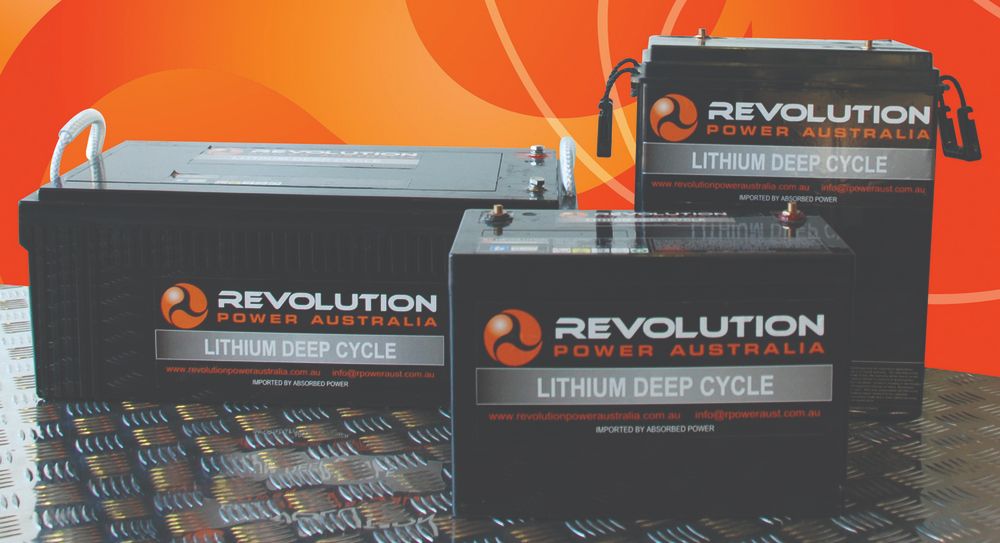
Lithium-ferro phosphate (LFP) batteries – a lithium battery rival
Lithium-ion and lithium-iron-phosphate (a lithium battery rival) are two types of rechargeable batteries. They share some similarities but differ in high-energy-density, long life-cycles, and safety. Lithium-ion is used in smartphones and laptop PCs. Lithium iron phosphate (LiFEPO4) is that used in RVs etc.
Lithium-iron phosphate is cost-effective and more stable at high temperatures. Lithium-ferro phosphate (LFP) batteries may prove a lithium battery rival. It increases the choice of chemicals for battery production. It also reduces reliance on the more expensive, and difficult to produce, lithium hydroxide.
If LFP sells as hoped, the lithium used will reduce. The lithium chemical of choice is then likely to change from lithium hydroxide to carbonate. It will also enhance flexibility in the chemicals for battery production. It will also reduce reliance on the more expensive, and difficult to produce, lithium hydroxide. The lithium used per kWh of storage capacity will reduce. Furthermore, the lithium chemical of choice will trend from lithium-hydroxide to carbonate. An even more compelling outcome is the use of lithium phosphate as a cathode powder precursor.
Lithium battery rival chemistries
Charge and discharge rates of a battery are governed by C-rates. The capacity of a battery is commonly rated at 1℃. This means that a fully charged battery rated at 1 amp-hour should provide one amp for one hour. The same battery discharging at 0.5℃ should provide 0.5 amp for two hours. At 2℃ it should provide two amps for 30 minutes.
Lithium-ion
Lithium-ion can consist of two different chemistries for the cathode: lithium-manganese oxide or lithium-cobalt dioxide. Both have a graphite anode. Lithium-ion has a specific energy of 150/200 watt-hours per kilogram and a nominal voltage of 3.6V. Its charge rate is from 0.7℃ up to 1.0 C. Higher charges can significantly damage the battery. Lithium-ion has a discharge rate of 1℃.
Lithium-iron phosphate (LiFePO4)
Lithium-iron phosphate has a cathode of iron phosphate and an anode of graphite. It has a specific energy of 90/120 watt-hours per kilogram and a nominal voltage of 3.2 -3.3 volts. The charge rate of lithium-iron-phosphate is 1℃. The discharge rate is from 1 to 25℃.
Lithium battery rival – energy level differences
There are significant differences in energy when comparing lithium battery rivals (lithium-ion and lithium-iron-phosphate). At 150/200 Wh/kg, lithium-ion has a higher energy density. This is handy for power-hungry tools etc., that drain a battery at a high rate. The available discharge rate for lithium-iron-phosphate, however, exceeds that of lithium-ion.
Lithium battery rival – life cycle differences
Lithium-iron-phosphate has a lifecycle of 1000-10,000 cycles. These batteries can handle high temperatures with minimal degradation. They have a long life for applications that need to run for a long time between charging.
For lithium-ion, the higher energy density makes it less stable. this is especially at high operating temperature environments. Heat also shortens its life cycle.
Long-term storage benefits
Both lithium-iron-phosphate and lithium-ion have good long-term storage benefits. Lithium-iron-phosphate can be stored longer as it has a 350-day shelf life. For lithium-ion, the shelf life is roughly around 300 days.
Safety advantages of lithium-iron-phosphate
Lithium-iron-phosphate has excellent thermal and chemical stability. Such batteries stay cooler in higher temperatures. It is also incombustible if mishandled during rapid charges and discharges or short circuit issues. Lithium-iron-phosphate does not normally experience thermal runaway. The phosphate cathode will not burn or explode during overcharging or overheating.
Another safety advantage of lithium-iron-phosphate involves the disposal of the battery after use or failure. A lithium-ion battery made with lithium-cobalt-dioxide chemistry is potentially hazardous. It can cause allergic reactions to the eyes and skin when exposed. Special disposal considerations must be made. Lithium-iron-phosphate is non-toxic. It can be disposed of more easily.
Applications for lithium-iron-phosphate and lithium-ion
Lithium-iron-phosphate is suitable for applications where safety and longevity are desired but do not need an extremely high energy density. Examples include solar energy storage and RVs. Such batteries are, however, slightly heavier as well as bulkier than lithium-ion.
Lithium offering a range of benefits
Advances in battery technologies have placed lithium as currently the best power source for portable high energy use devices. It’s long shelf life, and ability to provide a continuous source of power over long periods of time is why both lithium-ion and lithium-iron-phosphate are reliable alternatives.
Currently, lithium batteries cost more than nickel-metal hydride and nickel-cadmium batteries. The long life of lithium batteries, however, can equal out initial high costs. Key factors are:
- Highest energy density: lithium-ion
- Good energy density and lifecycle: lithium-iron-phosphate
- Stable chemical and thermal chemistry: lithium-iron-phosphate
- No thermal runaway and safe when fully charged: lithium-iron-phosphate
- Portability and lightweight characteristics: lithium-ion
- Long life: lithium-iron-phosphate and lithium-ion
- Low costs: lithium-iron-phosphate
The operating environment needs also to be a consideration as well as any vibration issues. For RVs, for example, the chemical stability of lithium-iron-phosphate (i.e.LiFePo4) is superior to that of lithium-ion.
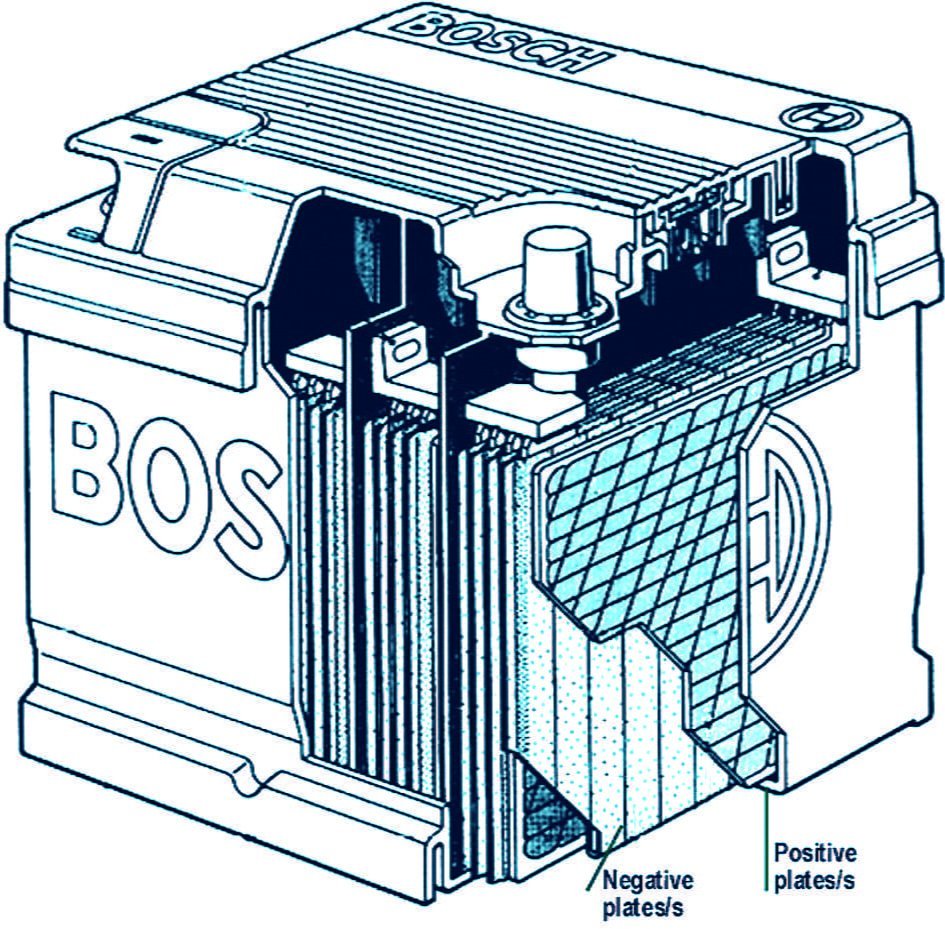
Lead acid batteries for caravans – they are still a good buy
by Collyn Rivers
Lead Acid Batteries for Caravans
A 100 amp-hour 12-volt lead acid (or AGM) weighs about 33 lbs (about 15 kg). If the caravan can cope with that weight, (and a microwave oven is not in frequent use – see below) lead-acid batteries for caravans are still a viable buy. They are made in different shapes, sizes and capabilities. All work in a basically similar way. Energy is stored within them as a result of electro-chemical reactions between lead plates and a water/acid mix (called electrolyte). They are charged by imposing a voltage across them that is greater than the voltage ‘within’ them at the time. The greater that voltage difference the quicker and deeper batteries charge. When the battery voltage reaches the charging voltage, charging ceases.
Bosch deep-cycle lead-acid battery. Pic: Bosch.
Deep cycle lead acid batteries for caravans
A lead-acid deep cycle battery is intended to supply current consistently over time, but not short term high current. Its life is shortened if discharged regularly at greater than 25% or so of its amp-hour capacity. Its name misleads as none can provide the full amp-hours claimed on the label more than a few times without serious damage.
If correctly charged (see Battery Charging and Battery Chargers), a deep cycle battery can be brought up to 100% charge. In practice, few are. Some in caravans never exceed 70%. Their makers advise not to discharge below 50%. In practice, many users ignore that advice. They routinely use the batteries until lights go dim and the beer warms (at about 80% discharge).
If treated as above, no deep cycle battery will withstand more than about 100 such cycles. If run down to about 30% remaining, they are good for 150-200 cycles. Doing as the makers advise provides 500-1000 cycles. Despite this, magazine journalists routinely state that a fridge (for example) that draws 5 amps will routinely run for 20 hours on a 100 amp hour battery. You’ll see pigs flying in formation before a 100 amp-hour lead acid battery can do that.
How low should I discharge?
Deep cycle batteries are best seen as ‘less-shallow-cycle’ batteries. Their vendors sell you amp hours. You can use a few slowly for a long time, or a lot more (and/or) quicker for a much shorter time, but that relationship is not linear. Using a lot quicker, so the battery is often deeply discharged, will cost more per amp hour. Usage is mainly a trade-off between convenience and your bank account. Unless keeping discharge to about 40% remaining, the cheaper so-called traction batteries (such as Trojan) last as long.
At too low voltage, some appliances may be damaged. Water pumps rely on water flow for cooling. They may even stall and burn out if the voltage drops too low. Fan-cooled motors are particularly affected. This is because the amount of air shifted is proportional to the cube of the fan’s rotational speed – and that is related to voltage. Most fridges have a voltage sensing cut-out that disconnects the incoming power below 11.4 or so volts. This is usually claimed to protect the battery (which it does), but its main job is to protect that fridge motor from overheating. Apart from the above, running the battery way down is unlikely to harm other electrical equipment.
Battery capacity
The ideal approach (which may require solar) is to size batteries such that they routinely charge to plus 98% and discharge only by a probable 15-20%. This way the batteries remain 85%-90% charged most of the time. Used like that they may last ten years or more.
Microwave ovens – a battery trap
A microwave oven’s rating (in watts) is a measure of the heat it produces – not the energy drawn in doing so. A typical 800-watt microwave oven draws about 1200 watts. This is about 120 amps from a 12-volt inverter. Doing this consistently will damage deep cycle batteries of less than 350-400 amp-hours. Caravans and motorhomes commonly have microwave ovens, yet may have a battery of only 150 amp-hours.
| Percentage of charge: | 100% | 90% | 80% | 70% | 60% | 50% | 40% | 30% | 20% | 10% | 0% |
| Volts: | 12.75 | 12.65 | 12.55 | 12.45 | 12.35 | 12.25 | 12.10 | 11.95 | 11.85 | 11.75 | 11.65 |
Approximate voltages of deep-cycle batteries (rested for at least 12 hours). rvbooks.com.au
Starter Batteries
Engine starting requires 300- 600 amps, typically for two-three seconds. It only seems high. It discharges the starter battery by only 2%-3%. That charge is replaced within a minute or two of the engine starting. In practice, starter batteries spend most of their life at 65%-70% of full charge. Starter motors are designed accordingly.
To provide such heavy current, starter batteries have a large number of thin plates that present a large surface area to the electrolyte. This provides heavy current for a few seconds, but such batteries withstand only a few extended discharges. Flatten most ten times and they are dead.
AGM and gel cell batteries
Absorbed Glass Mat and gel cell batteries are heavier, bulkier and costlier than conventional lead-acid batteries. They charge more readily and may be discharged deeper with less self-damage. They can provide about 70% of their nominal capacity. This compensates in part for their greater weight, bulk and cost.
Charging lead-acid batteries for caravans
Older vehicle charging systems deliberately cut back charging at 70% of full charge. Many post-2000 and almost all post-2014 have alternators that produce far too low a voltage for effective charging. For all, the dc-dc alternator charging technique is so effective it is now the only way to consider doing it.
For charging from 230 volts, use only a high-quality multi-stage charger. These are not cheap, but a 10-15 amp such unit will outperform any chain-store 30-amp charger in its ability to charge deeply, quickly and safely. If this is done the batteries will last many times longer.
Maintenance of lead acid batteries for caravans
This particularly concerns those wet’ batteries (now used mainly only in big solar systems etc) but for all, keep the terminals clean. A tablespoon of bicarbonate of soda in a bucket of water acts like a charm. Once a year disconnect the terminals and clean them until shiny on their contacting surfaces. After reconnecting, coat with Vaseline or battery protection fluid.
If relevant, check water levels at least every eight to ten weeks. A correctly charging wet battery should use some water. About 10-20 mm every ten weeks is normal in temperate climates. If less, the batteries are probably being undercharged. If much more, and unless you are in a very hot area, they are possibly being overcharged.
Avoid Christmas trees of cables hung off battery terminals. Instead, install one or more common power posts, and take a single heavy cable from there to the battery terminal.
Future of lead-acid batteries for caravans
Conventional lead-acid batteries were developed over 150 years ago. They have only barely advanced in their energy holding capacity (that is closely related to the weight of their lead plates). Despite this, they are still a good buy for caravans and motorhomes. They are likely to be used for some time to come, also in large solar systems etc.
Gel cell batteries for caravans still have a following, but AGM batteries are now more commonly used. Both are increasingly challenged by lithium-ion battery technology. There are now also other contenders.
Further information
There’s a huge amount more about batteries for caravans in my books Caravan & Motorhome Electrics, Solar that Really Works (for caravans and motorhomes) and Solar Success (for home and property systems). My other books are the Caravan & Motorhome Book, and the Camper Trailer Book.
See also article Battery Charging and Battery Chargers. For an in-depth academic (but readable view) see How Long Can Lead Acid Batteries Last.
This article is copyright RV Books, 2 Scotts Rd, Mitchells Island, NSW 2430.

Solar usage in the USA
Solar usage in the USA
Solar usage in the USA is rapidly becoming cheaper and growing increasingly faster.
In 2004, the average price of an installed 10 kilowatt rooftop solar module was about US$3.50 per watt. As of early 2021 an installed 10 kilowatt system is likely to ranges from $17,750 to $24,000 ($1.77 -$2.40 per watt).

Amount of solar energy available in the USA in a calendar year. Pic: https://www.nrel.gov/
How does system size impact the cost of solar?
Knowing the average cost per watt is helpful, but what does $1.77-$2.40 per watt actually mean for you? The cost of installing solar depends primarily on how much electricity you want to generate – a bigger system will cost more because you’ll need to buy more equipment and more labour will be needed to install it.
Solar usage in the USA – higher solar cell efficiency
This fall in price is due mainly to higher solar cell efficiency. Until recently, most high-quality solar cells were about 18% efficient. In 2020, however, the global JinkoSolar company raised that to 24.79%. The launch of those ultra-efficient modules lowered the USA’s domestic average cost of solar-produced electricity. It is now (early 2021) about US$38 per megawatt-hour (MWh). This cost is similar to that of producing electricity from newly built coal-fired power plants. Currently, the most efficient solar projects in Chile, the Middle-East and China produce electricity for under US$30/MWh. Wind power projects in Brazil, the USA and India are likewise.
The rise in production capacity and efficiency is primarily in China. It is now the centre of global solar panel manufacturing. China’s module production was 17% higher in early 2020 than in the same period of 2019. This despite exports falling slightly.
The implications of solar energy increase are immense. Overall emissions are substantially reduced. Apart from making, transporting and installing solar modules and associated electronics, it is zero thereon. Most solar modules last for at least 25 years. Meanwhile, appliance makers seek to reduce energy use.
Renewable energy tax credits
Under the Consolidated Appropriations Act of 2021, the renewable energy tax credits for fuel cells, small wind turbines, and geothermal heat pumps now feature a gradual step down in the credit value, the same as those for solar energy systems.Tax Credit:
- 30% for systems placed in service by 12/31/2019
- 26% for systems placed in service after 12/31/2019 and before 01/01/2023
- 22% for systems placed in service after 12/31/2022 and before 01/01/2024
Expires: December 31, 2023
Details: Existing homes and new construction qualify. Both principal residences and second homes qualify. Rentals do not qualify.
The USA’s solar energy market is forecast to increase. That increase is a likely (compounded) annual 17.3% throughout 2020-2025. Tax credits on renewable energy-related matters may expire in 2021. Solar power investors in solar power will expedite finishing projects. This trend may partly offset COVID-19 investment impacts.
A 30% tariff on solar module imports has already forced USA producers to become more competitive. Furthermore, to increase domestic manufacturing. Cost-effective battery energy storage technology is also needed. Significant developments are already well underway.
It is now all but sure that solar (and wind) power will continue to displace traditional base-load power sources. This will happen not just in the USA. It will be worldwide.
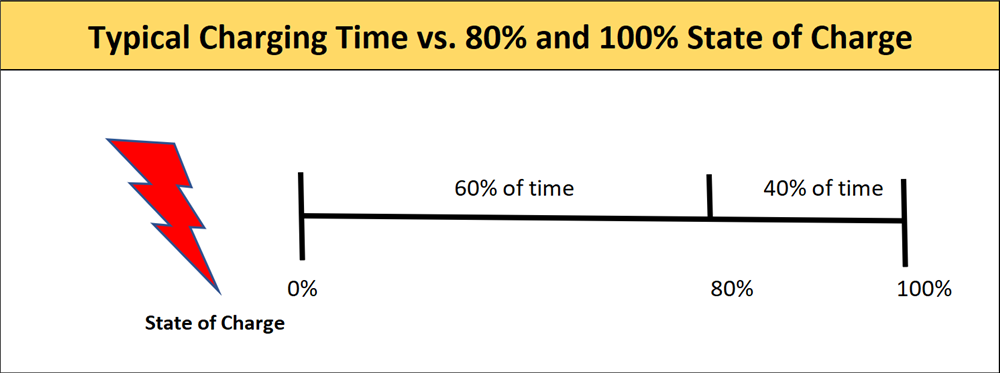
Generator Battery Charging – Quickly and Deeply
Generator Battery Charging – Quickly and Deeply
Quick and deep generator battery charging is totally possible. You must, however, know how to do it. This article reveals all. It explains why and how. The article is valid for both 120-volt and 240-volt generators.
All such generators have a 12-volt DC socket. Some generator makers label it ‘Battery Charger’. This socket, however, is intended to power small 12-volt devices, such as a TV directly. Its output is a typically unregulated 13.6-volts. It drops under load (to 12.6-volts or less). That voltage is, nevertheless, fine for running 12-volt lights and appliances.
Lead acid and AGM batteries
A generator’s typically unregulated 13.6-volts is far too low for full and speedy battery charging. It may half-charge a flat 100 amp-hour lead-acid or AGM battery within six or so hours. From there on, charging progressively reduces. It may take further 24 hours to charge it over 70%. And a week or more more to fully charge it.
The solution is simple and effective. Charge the battery via a 240-volt (or 120-volt) battery charger powered by the generator’s 240-volt (or 120-volt) outlet. The size charger required (and its safe charging rates) varies with battery capacity and types. This is particularly so for LiFePO4 batteries.
As a general guide, most lead type batteries below 180-200 amp-hour typically have a recommended maximum charging current of less than 40 amps. For these a 25-amp charger is adequate.
Charging Voltage
Recommended maximum charging voltages for most AGM or gel batteries are around 14.6 volts,but always check the manufacturer’s recommendation.
For lead-acid and AGM batteries once fully charged, to avoid overcharging and to extend battery life, the charger should drop to about 13.2-13.3 volts.
Charging in high temperatures
Battery maker charging recommendations usually for an ambient temperature of 250 C. Regardless of battery type, if charged in a high-ambient temperature environment, such as an engine bay, check the battery manufacturer’s related recommendations. Some batteries (particularly AGMs) are not suitable for engine bay installation. Some battery warranties are void if installed in engine bay temperatures. read more…
Should I grease my tow ball?
Should I grease my tow ball?
Tow ball friction plays a vital role in reducing caravan sway
Should I grease my tow ball is a question asked by caravan owners worldwide. A recent poll in Australia showed that slightly over half do so, but primarily to reduce wear.
Tow ball friction plays a vital role in reducing caravan sway. Those owners who grease them unwittingly prejudice safety for the possible need to renew the tow ball every ten or so years. In practice a non-greased tow ball has negligible wear. Even it were to need replacing, the cost to do so is a mere A$15-25.
The common advice to use grease for trailer hitch ball is misplaced. RV Books advises that you do NOT grease that tow ball – nor use any liquid or powder that may reduce that vitally needed friction. While tow ball friction is only one factor it’s one of a range of issues that factor into how to stop caravan sway.
Adding tow ball friction
The world-wide AL-KO company produce a tow ball that has four friction linings forced against the tow ball from both sides plus the front and rear. In technical terms, they exert the equivalent clamping torque of 320 Newton/metres force. In Australian terms, this is ‘b-y tight!’. Swaying or pitching movements are effectively suppressed before they become serious.
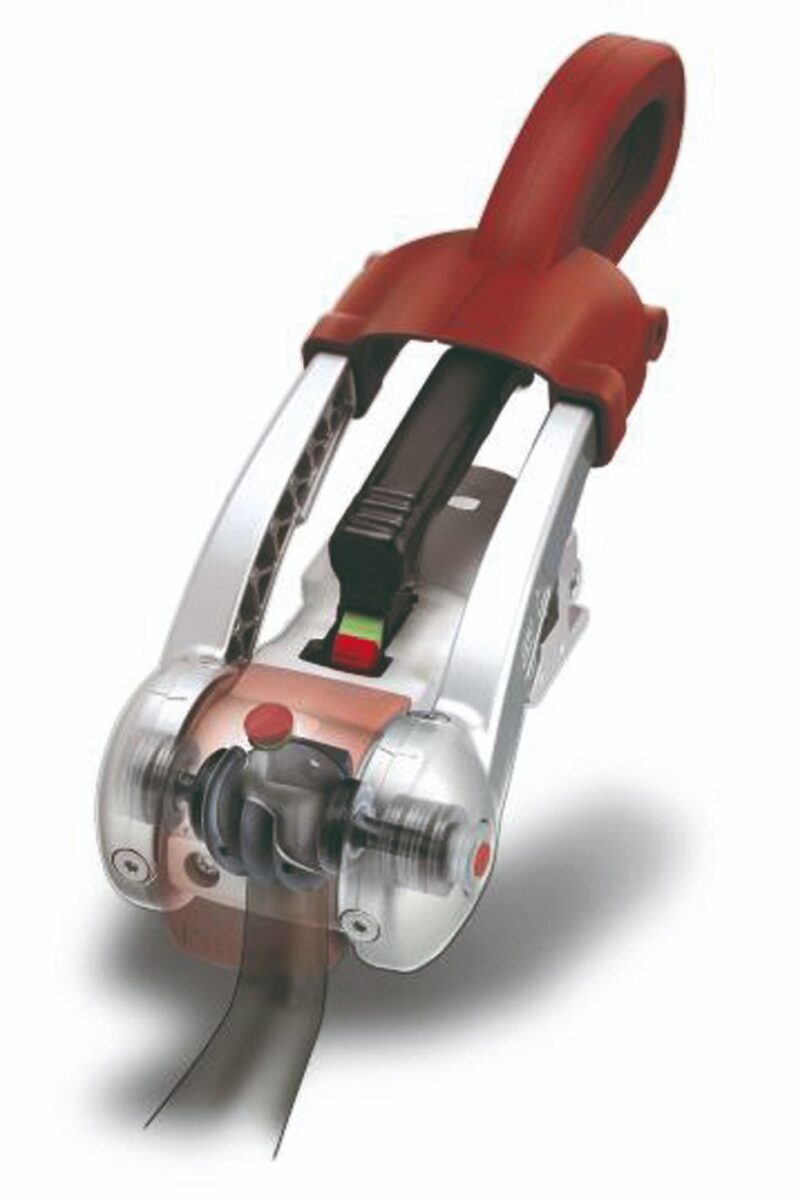
The AL-KO friction tow ball hitch.
Friction anti-sway limitations
Any hitch (or add-on friction sway control) has a fundamental limitation. This is that unless deliberately increased, frictional force remains constant. The vectored sway forces that they dampen, however, increase with the square of the road speed. Any form of friction hitch or friction stabiliser is thus only marginally effective at (say) 100 km/h (about 62 mph). This was actually confirmed (following extensive controlled testing) in a technical paper some years ago.
That any given frictional force remains a constant is why most UK/EU caravans use the friction hitch (for low/medium speed) comfort. They rely on electronic stability systems (that brake the trailer’s wheels) at high speed. Even here, the makers are cautious. They advise that while usually effective, these systems cannot overcome the more basic laws of physics. Ignore all advice to lubricate, or any friction-reducing manner a trailer tow hitch.
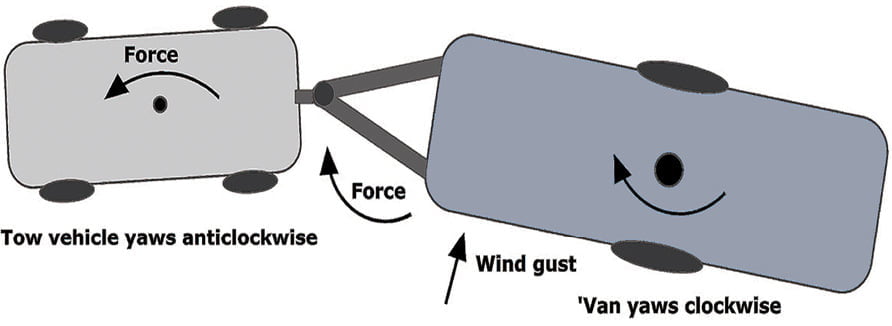
How caravan and tow vehicles interact
by Collyn Rivers
How caravan and tow vehicles interact
How caravan and tow vehicles interact is basically this. A trailer towed via an overhung hitch is fundamentally unstable. Minimising the causes ensures stability within limits.
By the mid-1920s vehicle-drawn caravans were common. From their beginning, they had handling problems. Now, (2020) reports of rigs jack-knifing and overturning still increase. Most now relate to long end-heavy twin-axle trailers towed by lighter vehicles.
Identifying the cause
In the early 1900s, central axled, heavy transport trailers towed via overhung hitches, were unstable. This worsened as towing speeds increased. Fruehauf (USA) realised hitch overhang imposed lateral forces on tow vehicles. As trailers yawed clockwise, that overhang caused tow vehicles to yaw anti-clockwise. And vice versa. The longer that hitch overhang, the greater the effect.
Figure 1. This shows the inherent problem with a conventional caravan. If one part of the rig yaws it causes the other to yaw in the opposite manner. Pic: copyright RV Books, Mitchell Island, NSW, Australia. rvbooks.com.au
Locating the hitch over the tow vehicle’s rear axle/s eliminated side forces (Figure 2) solved the problem. It led to the semi-trailer concept. The transport industry adopted it world-wide. It has used it ever since.

Figure 2. The fifth wheel concept. Yawing of one or other part of the rig barely affects the other. Pic: rvbooks.com.au
Early vehicles used for towing rarely exceeded 30-40 mph (approx. 50-65 km/h). Nevertheless, their overhung hitches caused rollovers. Curiously, early caravan makers and owners seemed unaware of this – let alone the known cause. Many still are!
Caravan and tow vehicle dynamics – early understanding
Caravan and tow-vehicle dynamics began to be understood in the 1970s. Studies, plus practical testing, revealed the causes of instability. These included trailer yaw inertia, inadequate nose weight, poor weight distribution and incorrect axle positioning. Tow vehicle tire pressure and side-wall stiffness affect stability. Furthermore, that all such causes interact.
It was initially believed that excess trailer weight relative to the towing vehicle was a major concern. It is only recently realised that excess trailer length is an even greater issue. Furthermore, poor loading and excess speed are always involved.
Caravan and tow-vehicle dynamics – terms used
Mass and weight: these are different concepts.
Mass: is the amount of matter within a body.
Weight: is a measure of the force caused by the downward pull of the Earth’s mass (gravity) on mass. It is that which keeps your feet (and an RVs tires) on the ground. For, the purposes of the article, unless stated otherwise, mass and weight can be seen as identical.
Laws of Motion: In 1668, Newton defined the laws of motion. They usefully describe caravan and tow vehicle behaviour.
Law 1. Unless influenced by an external force, mass remains at rest. If a force causes a mass to move it continues to do so at a constant speed. Unless deflected by an external side force it moves in a straight line.
An otherwise stable vehicle towing an equally stable caravan will normally stay in a straight line. A side wind gust, however, may deflect it.
Law 2. The rate of change of a masses’ momentum is proportional to any applied force. It acts in the direction the force is acting. For example, a powerful vehicle can accelerate a rig quicker than a less powerful vehicle.
Law 3. To every action, there is an equal and opposite reaction. Jump backwards off a skateboard, and that board is propelled strongly in the opposite direction.
Force: is any influence that causes a mass to accelerate. The greater the force applied, the greater the rate of change of acceleration. That rate of change is directly proportional to the force acting upon it. It is inversely proportional to the mass of that body. Force has both magnitude and direction. Describing it requires both terms.
Moment arm: A moment arm is a lever. A simple example is a wheelbarrow’s handles. Others include tow-hitch overhang and weight along a caravan‘s length.
Torque: is the effect of a force causing something to roll or rotate. It enables revolving wheels to cause a car to move. Or the action of using a spanner to tighten nuts.
The terms ‘torque’ and ‘moment arm’ means much the same. The term ‘torque’ is used where there’s some form of powered turning. An example is closing a heavy door. Pushing near its hinge requires more force but less movement. Pushing further from the hinge requires less force but more movement. The work that is done and energy exerted, however, is the same.
‘Moment arm’ relates to levers. An example is an adult and a child on a see-saw. Balance is only possible by the adult sitting closer to the pivot. Or the child sitting further away. A similar effect is a weight on a caravan‘s rear. Its effective is far greater than if close to its axle/s.
Inertia: Inertia is virtually any resistance to change. It’s a tow vehicle’s ability to keep moving at the same speed and in a straight line unless steered otherwise. Or, if jack-knifing – to be straightened.
Momentum: is a measure of the quantity of motion. A moving trailer and its tow vehicle’s momentum is its combined weight times its speed.
Acceleration: relates to change in a mass’s rate of movement. It may be positive (e.g. increasing speed). Or negative (e.g. when braking). It is measured by dividing velocity (metres per second) by seconds. In Imperial units, it is 32.2 ft/s. The unit is often shown as ‘G’ (correctly it is ‘g’). A driver cornering at advised road sign speed experiences about 2 g.
Moment of inertia: is a measure of an object’s resistance to changes in rotation. In imperial (US) units it is shown in pound-foot-second squared (lbf.ft.s2). In metric units, it is shown in kg/m².
A trailer’s such resistance to rotational change can be calculated. It is done by theoretically ‘cutting the trailer into thin slices’. Each slice has a mathematically describable shape.
The moment of inertia can also be measured. It can be done by locating the trailer on a friction-free turntable. That turntable is then rotated by about 30 degrees against the force of springs. It is then suddenly released. The time taken for the trailer to re-centre is a measure of its moment of inertia.
Radius of Gyration: this where a trailer’s centre of mass would be, were all its weight in one place. That centre of mass should ideally be just ahead of its axle/s. A caravan must never be rear-end heavy.
Work has a specific meaning. It refers to transferring energy or applying force over a distance. One example is lifting a heavy object.
Energy is the ability to perform work. It can be expressed as force times displacement in a given time. An example is stacking goods on a high shelf.
Potential Energy is the capacity of something to do work by virtue of its position or configuration. A compressed spring contains potential energy. So does the water in an elevated tank.
Kinetic Energy is associated with motion. Moving objects perform work as a result of moving. Kinetic energy is proportional to the square of a mass’s velocity. A tow vehicle and trailer at 60 mph (just under 100 km/h) have four times the kinetic energy than at 30 mph (just under 50 km/h). This is why it is dangerous to tow at excess speed. Never tow above 60 mph.
Power: is the amount of work done in a unit of time. When you tow your trailer up a hill the work done is always the same. Doing so at 60 mph, however, needs more power, but for a shorter time, than at 30 mph.
Yaw: is a rotational or rocking movement. An example is a trailer rocking around its axle/s. Many caravan owners refer to this as ‘sway’. This confuses. When a trailer sways (rolls) its centre of gravity moves sideways.
Yaw Force: is the effect of (say) a side wind gust that causes a trailer’s front or rear to be pushed sideways. The greater that force, the greater the rate of change of that movement.
Yaw Inertia: can be seen as the resistance of a caravan to yaw when subject to a side force (‘yaw’). It can also be seen as the reluctance to cease yawing once started. (It’s like staying in bed on a cold morning).
Tire behaviour
Horse-drawn carriages had pivoted front axles. This ensures their wheels aligned with the pulling force. But if cornered too fast, the carriage’s inertia overwhelmed the horse’s grip. They would lose control. The carriage’s momentum, however, would cause it to keep moving. Then often overturn.
Tires back then had to revolve, but not sink nor fail under load. Their marginal grip only partly resisted sliding. Braking was by ordering the horses to slow down. Also levering against a tyre to prevent it rolling. The main forces: for traction, steering and slowing, were external, via animal power.
A powered vehicle has similar limitations, but with a major difference. Forces for moving, braking and steering are applied and reacted only by its tires.
A caravan’s tow vehicle acts physically much as those horses. The trailer depends on the stability of whatever pulls it – as did horse-drawn carriages. This is often overlooked. Pic: courtesy of fineartamerica.com.
Early pneumatic tires
The pneumatic tires used on early cars were like oversized-bicycle tires (and solid tires). They rolled more or less where pointed. When forces exceeded their grip, such tires slid progressively and predictably.
Then cars became heavier and faster. Tires became balloon-like. Owners, particularly in the USA, sought a softer ride. Doing so, however, caused cars to handle poorly. And often unpredictably.
By the mid-1930s it was understood how suspension and tire interaction dictates handling. This particularly applies to caravans and tow vehicles. Their ultimate behaviour is dictated by their suspension and tires. Not all caravan makers and even fewer caravan owners know this. Let alone why and how.
Tire basics
An inflated tire does not roll over a surface. It has a caterpillar-like action. It lays down and picks up an elongated oval of tread (called its footprint). That footprint’s stability is determined by tire construction and air pressure.
Steering a tire is like twisting a rolling balloon. Torque is applied, via the wheels’ rims, to the tires’ sidewalls. The sidewalls flex, and via their stiffness and air pressure, cause the footprint to distort as directionally required. That footprint’s grip is partly molecular and partly frictional.
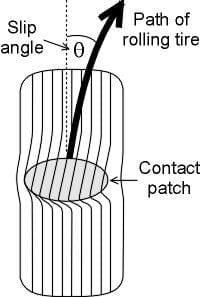
The steered tires’ footprint’s distortion creates an angular difference between where wheels point and the vehicle travels. That angular difference is called ‘slip angle’. The greater the tire width, sidewall and tread stability and tyre pressure, the lesser the slip angle.
The term slip angle, however, can mislead. In normal driving, the footprint does not slip. That footprint is caused (by torque applied to the tire’s sidewalls), to stretch and distort. It is only when side forces totally overcome footprint grip that tires actually slide out of control.
A typical tow vehicle tire (green) increases ‘cornering power’ as its slip angle increases. It then levels off and starts falling away sharply. The latter introduces major and possibly terminal oversteer. It can result in jack-knifing.
A tire’s footprint grip is not linear with imposed weight. When cornering, weight, (or any weightless downforce such as that from the so-called ‘wind spoiler’ used at the rear of racing cars) imposed on tires increases their cornering power. It does so, however, by only 0.8 or so of that increase in grip.
Interaction of tire slip angles
Interacting front/rear tire slip angles dictate vehicle handling. Passenger vehicle front tires have slip angles that normally exceed their rear tire slip angles. This effect, called understeer, causes vehicles to veer away from side-disturbing forces. (So, likewise, do correctly-trimmed yachts and aircraft).
If cornered too fast, an understeering vehicle automatically increases its turning radius. This reduces side forces, and hence slip angles. If, however, rear slip angles exceed front slip angles, the vehicle adopts an ever-tightening spiral. This causes its rear slip angles constantly to increase. Unless the driver applies opposite steering lock, the rear tire slip angles increase until their footprints lose control. The vehicle then jack-knifes or spins.
Understeer and oversteer. In mild form, understeer adds stability. If the vehicle is corned too fast, it automatically adopts a wider radius turn, thus reducing undesired forces. Too much understeer, however, can result in the (upper) example above.Oversteer (in all except rally cars) is undesirable. Once oversteer sets in, unless instantly corrected – by applying opposite steering lock – it rapidly escalates and usually results in the vehicle spinning out of control. Pic: www.driversdomainuk.com/img/oversteer.jpg (original source unknown).
Rear tire distortion can cause oversteer. Such distortion can result from a yawing caravan. It imposes side forces on the tow vehicle’s rear. Other oversteer causes are excess tow ball weight or too low tow vehicle rear tyre pressures.
Neutral steer may seem desirable. It is not. Neutral steer requires constant steering correction to overcome road camber. It causes a vehicle to be demanding and tiring to drive. Neutral steering is also impossible to maintain. Even minor changes in tire pressure, loading, or road camber will then cause understeer or oversteer.
Maintaining footprint balance
A rig’s dynamic behaviour depends ultimately on tow vehicle tire behaviour. This necessitates its tires firmly gripping the road. Despite this, some trailer makers maintain that their products do not need shock absorbers. They argue that inter-leaf friction provides adequate damping. Such damping, however, only acts as the spring’s compresses. On the rebound, however, the spring leaves are no longer held in firm sliding contact. As a result, release their rebound energy instantly. That energy jack-hammers the wheel back down. As the wheel impacts the ground it imposes shearing forces on wheel studs and stub axles. This causes those studs to snap. Stub axles break. Wheel bearings needing ongoing replacing. See Wheels Falling off Trailers.
Inadequate or non-existent spring damping also prejudices electronic stability systems. These rely totally on trailer braking. Brakes, however, are only effective when tires are firmly on the ground. Without adequate spring damping, they are not.
Slip angles and load/tire pressure etc
A tire’s cornering power decreases with load and increases with tyre pressure. Adding tow ball mass necessitates increasing (tow vehicle) rear tire pressures to retain the required slip angles. Those rear tires need to be 7-10 psi ( 50-70 kPa) higher when towing. Never increase tow vehicle front tire pressure beyond that in normal driving.
If a vehicle’s front/rear weight balance is unchanged, its tires front and rear slip angles increase proportionally while cornering. The vehicle’s balance is maintained. But if its rear tires loading only increases (as when a trailer yaws), front/rear slip angles change accordingly. If that induces oversteer, the rear tire footprint may lose all grip. If that happens the rig is instantly triggered into a jack-knifing sequence.
Adverse effects of tow vehicle suspension changes
The relative tire loading front/rear (and hence slip angles) is not just a function of weight distribution. It depends on how the suspension resists roll.
Never stiffen rear suspension without stiffening the front proportionally. Stiffening the rear alone causes more of the vehicle’s resistance to roll to be borne by its outer rear tire whilst cornering. That increases its slip angle. If that footprint collapses or slides, jack-knifing is likely. This is not just theory. It happens.
Minor spring rate changes are rarely detectable in normal driving. This is why many claim it’s safe. But by stiffening rear springing alone a strong yaw force can trigger that vehicle into sudden and terminal oversteer.
If a vehicle’s suspension needs upgrading it’s being overloaded. Suspension changes require serious expertise. Not adding airbags sourced from eBay.
Tow ball weight
To keep a caravan straight, front end weight is essential. That in Australia has long since been taken as 10% of gross trailer weight. Now (2020) many have as little as 4%. The British, whose caravans are 40% lighter (per metre) opt for 6-7%. Americans may use as high as 14%.
Basing a trailer’s tow ball weight on a percentage of caravan weight has long been routine. What matters far more, however, is a caravan’s length. Furthermore, where mass is distributed along that length. Because of this, even 10% may be too low for a long end-heavy caravan. This is an ever-increasing problem. Vehicle makers continue to reduce tow ball weight limits. And tow vehicle weight decreases.
To keep sway from building-up, Australian and US-made caravans typically need 550-770 lbs (250-350 kg (550-775 lb). nose weight. Such weight, however, thrusts the tow vehicle’s rear end downward. As with pushing down on the handles of a wheel-barrow, that nose weight causes the vehicle’s front to lift. This undesirably shifts weight from the tow vehicle’s front (steering) tires.
The Hensley hitch
In 1971, the USA’s N. Gallatin obtained a patent (US 3790191 A) for a trapezoidal trailer hitch. This hitch comprised first and second, spaced apart hitch members pivotally connected at their rearward ends to the forward end of the trailer and pivotally connected at their forward ends to the rearward end of a truck or the like. https://patents.google.com/patent/US3790191A/en. Shortly after (in 1971), the US Hensley company patented a not-dissimilar version, but not integral to the tow vehicle.
That effect of both patents was to geometrically extend the virtual tow ball further toward the tow vehicle’s rear axle. The Hensley unit became widely used. The hitch weighs about 42 pounds (approx. 20 kg [44 lb]). Most US caravans over about 20 feet (about 6 metres) use one.
Weight distributing hitches – and drawbacks
Developed initially in Australia (in 1950), but adopted almost immediately in the USA, a weight distributing hitch (WDH) forms a semi-flexible springy beam between tow vehicle and trailer. This reduces the weight otherwise imposed on the tow vehicle’s rear tires. It also restores some of the otherwise reduced weight on its front tires.
A WDH, however, can only counteract downforces on the tow vehicle’s rear tires. Although the downforces on those rear tires are reduced by the WDH, those tires are still carrying much of the tow ball mass. They must still resist caravan yaw forces, but a WDH cannot reduce those yaw forces.
That not realised by almost all caravan owners, and even some makers, is that a WDH inherently reduces a rig’s ultimate cornering ability. It does so typically by about 25%. This issue is recognised and addressed by the US Society of Automobile Engineers in its current SAE J2807 recommendations. These recommendations are now followed by all US (and the top three) Japanese vehicle makers.
That (SAE J2807) recommendation includes advising to adjusting a WDH to correct no more than 50% of the tow vehicle’s rear end droop. Never the full amount. It suggests correcting 25% of that rear end droop is better. Such advice has long been given by Cequent in the USA. (Cequent owns Hayman Reese). Hayman Reese locally used historically to advise levelling the rig. It now follows the Cequent (USA) advice.
A WDH is only required when the download on the tow vehicle’s rear tires is not acceptable. If it is acceptable you can readily compensate for that weight shift. To do so, increase tow vehicle rear tire pressures by 7-10 psi (50-70 kPa).
Trailer independent suspension can have downsides
Passenger car independent (front) suspension stems from the USA in the 1930s. It resulted from a buyer demand for softer suspension. Softening and increasing spring travel, however, resulted in beam front axle wheel ‘tramping’. The wheels would alternately jump up and down and swing violently from lock to lock. This particularly happened with poorly damped and/or soft suspension long-travel suspension.
Around 1934, General Motor’s Maurice Olley established this was a ‘gyroscopic precession’. You can experience this by holding a bicycle’s front wheel off the ground, spinning it and then swinging it in an arc. It imposes an unexpected swaying effect. This can also be shown via a gyroscope.
![How [cara] and tow vehicles interact - electric vehicle batteries,book on batteries,electric car batteries,lithium ion batteries for electric cars,electric car battery technology,how long do electric car batteries last,electric vehicle battery life](https://rvbooks.com.au/wp-content/uploads/2014/12/gyroscopic-precession-e1624597949506.jpg "How [cara] and tow vehicles interact 93")
Here, (US) teacher Gary Rustwick demonstrates the effects of gyroscopic precession. He swings the spinning wheel in an arc whilst standing on a free-moving turntable. As he does so precession forces cause the turntable to rotate.
Wheel precession is dangerous. If it builds up, the vehicle becomes unsteerable. Worse, reducing speed (as one must) decreases the tramping frequency but increases its amplitude.
Need for steered wheel stability
In the early 1930s, General Motors’ Maurice Olley realised precession was only totally preventable by ensuring steerable wheels rose and fell vertically. Not forced to move in an arc created by a tilting beam axle. Achieving this required steered wheels to be suspended independently.
This concept was not new. It was used on a road-going steam locomotive in the late 1800s. Lanchester used it in 1901, Morgan in 1911, Lancia and Dubonnet in the 1920s. But all did so to reduce unsprung mass and improve the ride. Olley knew that too, but also that independent (and vertical) front wheel travel was necessary for soft suspension.
Non-steerable wheels are subject to the same precession forces. As they cannot swivel, however, such forces do not matter. This is why many cars and almost all trucks and many 4WDs retain beam-axle rear suspension.
Caravan wheels do not steer
As caravan‘s wheels do not steer there is no inherent need or benefit for independent suspension. Nor is there any need for suspension travel greater than that of their tow vehicles. For much of the time, a caravan rocks on an axis around its tow hitch. Many, for seemingly marketing reasons, have ultra-soft suspension like some American cars of the mid-1930s. Almost all currently-made cars are much firmer. They also have less suspension travel. And do not wallow.
The US-made Airstream is an exception. Right from its beginning in the early 1930s, its pre-tensioned rubber suspension provides a firm but adequately-soft ride. The suspension is independent.
Suspension issues
Human physiology dictates passenger vehicle suspension. The result is compromised by the brain’s response. Nausea is created if the suspension is too soft, and physical discomfort if too hard. Such constraints do not apply to non-human carrying trailers. It is thus absurd for their makers (particularly in Australia) to base the suspension on huge US cars (such as Chevrolets) of the mid-1930s. For optimum road holding, caravan suspension needs to be firm. This can readily be done and with no risk to any contents.
Fifth-wheel trailers more stable
A fifth-wheel caravan pivots from a hitch above the tow vehicle’s rear axle/s. Side-wind gusts may cause the trailer to swing slightly, but the forces are low and quickly self-damp. They do not affect the tow vehicle. Drivers are rarely aware of them. As long as a fifth wheeler’s rear wheels are well back, the weight on the tow vehicle is within that vehicles’ limits. A well-balanced fifth wheeler is stable at any speed.
Action and reaction
As described earlier in this article a hitch distanced behind a tow vehicle’s causes a trailer to yaw if that tow vehicle yaws – and vice versa. This would not overly matter if the trailer yawed in the same direction. That overhung hitch, however, causes the opposite. If the tow vehicle yaws clockwise, its overhung tow ball yaws anticlockwise. As it does, it takes the nose of the trailer with it.
Likewise, if the caravan yaws clockwise, that overhung tow ball swings the rear of the tow vehicle anticlockwise. This is the root cause of conventional trailer instability. The longer that overhang, the greater the (undesirable) effect.
At low levels, yaw interaction is mainly annoying. It is reducible (at low speed) by friction and other forms of damping. It typically dies out after two or three cycles. If it does not, it indicates instability. That needs resolving at its source. Friction damping is almost useless at speed. This is because the friction stays constant. Yaw forces, however, increase with the square of the rig’s speed.
Severe yaw is serious
If severe yawing occurs above a critical speed (specific to each rig and its loading) the yaw may self-trigger into jack-knifing. It is fuelled by the rig’s kinetic energy. Once triggered, if travelling at speed, this sequence is almost impossible for a driver to correct.
Musicians and public speakers experience a similar effect. If their microphone picks up the sound from the loudspeakers, that sound suddenly develops a full-on yowl. This is only stopped by drastically reducing the volume (akin to braking a caravan). Or by moving back from the loudspeakers (akin to reducing tow hitch overhang).
Critical speed
Depending also on loading, every combination of a tow vehicle and caravan has a so-called critical speed. Once above that speed, yawing can irreversibly escalate out of the driver’s control.
That critical speed, and the degree of yaw, is directly associated with the tow vehicle’s mass relative to the trailer’s mass (and particularly mass distribution). It is also associated with trailer length, hitch overhang, tyre type and size, sidewall stiffness and pressure etc.
All of the above (and more) is involved. The longer and the lighter the tow vehicle (and its tow ball mass) the lower that critical speed. The onset of critical behaviour is sudden. Because of this, the still-common suggestion ‘accelerate to dampen yawing’ is risky except at very low speed.
The critical speed effect does not imply that the rig jack-knifes if that speed is exceeded. If, however, a rig is travelling at or above its critical speed, a strong side wind gust, or a strong swerve makes jack-knifing more likely. Few owners encounter this, so many dismiss its possibility.
Avoiding jack-knifing
When a caravan yaws, it transfers the yaw force via the overhung hitch to the tow vehicle. The transmitted forces are resisted by the tow vehicle’s weight and the grip of its tires. Minor trailer braking assists straightening the rig. Heavy trailer braking, however, may overwhelm the trailer’s tires as they are already stressed by yaw forces.
If a caravan yaws never apply tow vehicle braking. Doing so may trigger that tow vehicle’s already stressed rear tires into terminal oversteer – such that it spins.
Beware of cruise control
Cruise control detects the minor drop in speed when yawing occurs. It nevertheless attempts to restore the set speed and the tires slip angles increase. While convenient, it is thus better not to use cruise control when towing a heavy trailer at speed.
Wind effects
A further cause of major caravan instability is wind forces from fast-moving trucks. This is particularly so of trucks towing trailers; and even more so if the truck has a flat front (rather than a bonnet). That bluff front creates an ongoing strong bow wave plus a vortex (i.e. a rotating wind gust) along its side.
If overtaking (or being overtaken) a tow vehicle and caravan will experiences wind buffeting. As the trailer’s tow vehicle approaches the rear of the truck cab, a side wind vortex initially causes the tow vehicle to be drawn toward the truck. As the tow vehicle draws closer to the front of the truck cab it is hit by the truck’s strong side-going bow wave. This causes the trailer to swing slightly away from the truck. The overhung hitch causes the front of the trailer to sway toward the truck. A vortex pulls it in further. This initiates a rapidly developing yaw cycle. Jack-knifing can result.
A generally similar but less common effect occurs when a truck and a caravan rig are approaching each other at speed on narrow roads.
Electronic stability systems
Electronic stability systems monitor trailer yaw. AL-KO’s applies caravan braking when it detects ongoing yaw forces exceeding about 0.2 g. The maker warns the system is an emergency aid. It is intended to prevent accidents. It does not enhance stability.
The Dexter system applies the caravan’s brakes asymmetrically (i.e. out of phase with the yaw). It does so at lower yaw acceleration levels. As testing is done at 60 mph (just under 100 km/h) the ability (except as a yaw reducer) to prevent a catastrophic incident at speeds above the critical speed is unknown. Both Dexter and AL-KO (now one company) emphasise their products cannot override the laws of physics.
Enhancing rig stability
The major factors include everything that affects front/rear tyre slip angles. Those within owner control include:
Loading and load distribution of the trailer and tow vehicle.
Excess tow ball overhang caused by unnecessary hitch bar extension.
The speed at which the rig is driven.
Fitting and use of yaw control devices, WDHs etc.
Those outside direct owner control (but subject to the choice of rig) include:
Length of the trailer, the unladen weight of the trailer.
Weight and stability of the tow vehicle.
Those determined by the trailer builder include:
Length of the trailer.
Weight of the trailer.
Distance from trailer tow hitch to axle centre/s.
Distribution of weight along the length of the trailer (particularly at its rear).
Centre of mass (i.e.weight) in both planes.
Height of the roll centre and roll axis (as imposed by the geometry of the trailer’s suspension).
Moment Arms about the roll axis, particularly at the far rear.
The magnitude of yaw inertia.
The radius of gyration.
Damping of yaw and roll.
Tires with good sidewall stability (such as light truck tires).
Optimising towing stability (summary)
Tow vehicle behaviour is now well understood and proven. That required is a long-wheelbase vehicle with a short rear overhang that weighs at least as much as the trailer. Towing three or more tonne behind a 2.5-tonne dual-cab ute is an accident awaiting the circumstances to trigger it.
A major undesirable factor with caravans is excess length. Excess weight matters, but excess length is now known to be a far greater issue.
Reducing trailer perimeter weight, and particularly rear-end weight, is vital. If feasible house a trailer spare wheel below the chassis and in front of or just behind the axle. Batteries are best located centrally between the axles. Water tanks should be wide but not long and located as centrally as possible.
Friction devices smooth low speed snaking, but have a negligible effect at high speed. One that works well at low/medium speeds is likely to be less than 1% effective at 100 km/h (62 mph). Elastic energy held within sprung-cam devices may suddenly be released when such devices are overwhelmed – and ‘fed into the system’.
Lateral sidewall stiffness of all tires assists.
The major factor, however, is excess speed.
Driver reaction
Most big rigs feel stable in normal driving. There is also usually sufficient stability to enable an experienced driver to cope with scary but not accident-resulting situations.
A major issue is that (particularly) with heavy rigs, unless grossly unbalanced, it is not possible for a driver to know (by feel or ‘experience’) how that rig will behave in an emergency. Most big rigs feel ultra-stable. Short vans are more stable but may feel twitchy (particularly if twin axle). The concern is how the rig behaves in situations that cause major yaw. These include sudden strong side wind gusts on a motorway, braking hard on a steep winding hill at speed, and swerving at speed.
‘My rig always seemed so stable’
Police say the most after-accident reaction is: ‘my rig always seemed so stable until it suddenly jack-knifed’. Such apparent stability is typical of container ships and car ferries, until a rogue wave or turning too sharply proves otherwise.
There is increasing evidence that the safe maximum speed for big rigs is under 60 mph (about 100 km/h). This is related to tow ball weight. Furthermore, the lower that weight, the lower the safe speed.
Trailer and tow vehicle dynamics – Summary
The above is a precis of some of the most relevant parts of RV Books Why Caravans Roll Over – and how to prevent it. The book is written in plain English but has a fully referenced final technical section.
Acknowledgement
My articles in this area primarily summarize current thinking. They stem from my interest and involvement while employed by Vauxhall/Bedford’s Research Dept in the 1950s, and particularly by the influence of Maurice Olley.
Maurice Olley was born in Yorkshire in the late-1800s. Following time as Rolls-Royce’s Chief Engineer, he worked with General Motors Research Division. He later returned to Vauxhall Motors (UK). I was privileged to attend his lectures during my years at Vauxhall Motors Chaul End Research Centre
Upgrading solar system has unexpected traps
Upgrading solar system
Upgrading solar system has unexpected traps. It is often better to scrap, use elsewhere, or attempt to sell that existing, and install a new one. This is particularly so with grid-connect systems and doing so with stand-alone systems is still tricky.
The Broome pool. The four 120 watt solar array can just be seen low down at the far (northern) end of the pool. The water nearby is a todal lagoon – that further back is the Indian Ocean. (The auto water level pipe is at pool right.) Pic: Author 2007.
The water pump for this 30,000 litre swimming pool is powered by four 100 watt solar modules. Pic. Solar Books.
Retaining or selling older solar modules is often possible. Good quality solar modules have a working life of 25-30 years (with only marginally less output). They are, however, likely to be incompatible with new ones. This is because solar module electrical characteristics have changed. It may be possible to overcome this – but too costly to be worthwhile. There can also be re problems with upgrading in that a number of legal (and Standards-related) requirements have changed. This relates also to the ways solar is installed.
A further reason for upgrading is that gas prices have escalated. It is now far cheaper to heat a home by using reverse-cycle air-conditioners in their heating mode. The top models now use only a quarter of the power of the same nominal wattage as an electric radiator or gas fire. This may seem impossible but is really so!
With grid-connect systems, in most areas, it now pays to install more solar than you use yourself. This increases feed-in rebates. It will also produce more power during times of lower solar input. Upgrading an existing solar system, however, has unexpected traps. There may, for example, be a limit on the excess amount. if so, the maximum is likely to be 6 -6.6 kW. Your installer can advise. read more…
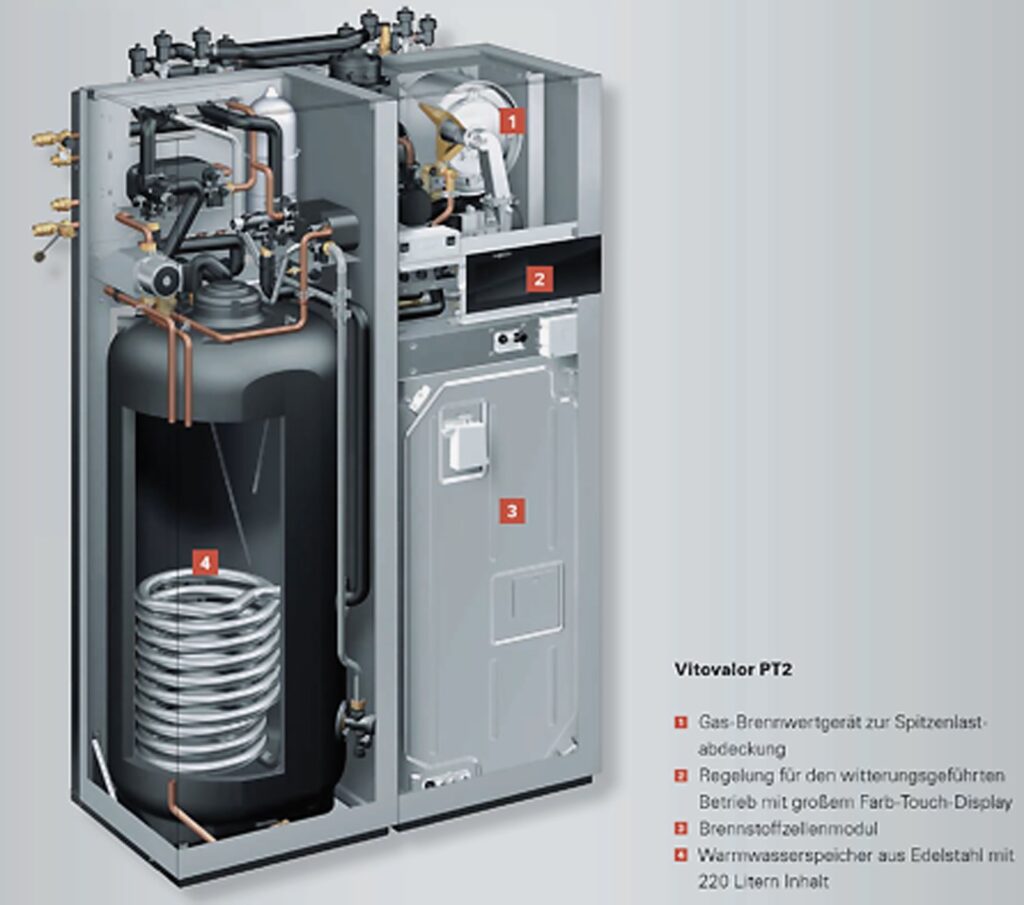
Fuel cells for homes and properties
Fuel cells for homes and properties
Fuel cells for homes and properties provide clean silent electricity. High current prices hinder their acceptance, but this may soon change. Fuel cells enhance solar. Furthermore, they may all but eliminate our need for battery storage. Fuel cells hugely reduce harmful emissions.
Fuel cells for homes and properties provide clean quiet electricity. This article explains how, why and when they will be used. Fuel cells for homes and properties may all but eliminate battery storage. Moreover, fuel cells slash harmful emissions. This is a major bonus for all-electric cars.
The Panasonic fuel cell in the German Vitovalor product. Pic: Viessmann.
In 1839 Sir William Grove invented the first fuel cell. Petroleum was then found in abundance, resulting in fuel cells being overlooked. NASA later revived them.
Fuel cells for homes and properties – how fuel cells work
Fuel cells generate electricity. They do so via hydrogen reacting with oxygen. Heat, electricity and ultra-clean water-vapour results. Fuel cell chemistry is complex, but having no moving parts is a bonus. Fuel cells are easy to use, ultra-reliable and silent.
Hydrogen that fuel cells does not exist in free form. It can be produced from water, biomass, minerals and fossil fuels. Furthermore, it is readily produced from solar energy. Moreover, hydrogen is an energy multiplier and carrier. So, rather than using batteries, hydrogen can alternatively store energy. This is already being exploited (see below).
Fuel cells for homes and properties – hydrogen (how safe)
All fuels store energy. They have to be volatile. But unlike most fuels, hydrogen is not toxic. Furthermore, spilled hydrogen quickly evaporates. It leaves only tiny amounts of ultra-pure water.
Some quote the Hindenburg disaster. This airship used a huge volume of hydrogen contained within the airship’s outer skin. That skin was cellulose nitrate plus aluminium flakes. Rocket fuel uses the same products. That of the Hindenburg’s finally ignited.
Commercial hydrogen is stored in strong tanks. These are tested and certified accordingly. The risk is no higher than if containing any other fuel. read more…

Convert to your own all solar home
Convert to your own all solar home
This vital easy to read guide shows you how to convert to your own all solar home at minimal cost. You can readily do this between 50-degree latitudes north/south. This easy to read article shows that to to convert to your own all solar home can save you thousands of dollars.
This article shows how to convert to your own all solar home. Do that and you can slash your power bills to virtually zero overnight. Our current home north of Sydney (Australia), when bought in 2000, drew over 35-kilowatt/hours a day. Whilst over twice that typical it did not worry us. We knew how to slash that by 30% or more overnight at zero cost. How you can do this too is outlined below. It is your first step to having your all solar home. It needs only a tiny, but vital, change in what you and your family do but it can save you thousands of dollars! From there you continue to reduce energy use – and only when that is done do you start thinking of how much solar you need.
Our all-solar home in Church Point, NSW. Pic. rvbooks.com.au
The above is not how professional solar installers work. They may suggest a change to LEDs but otherwise calculate the energy you use, add a bit on top, and advise solar capacity accordingly. It is a quick and easy approach, but you will need a huge amount of solar to avoid paying power bills.
Convert to your own all solar home – wall warts suck!
Wall warts are those little grey or black boxes plugged into your power outlets. They enable you to turn off your lights, radio, TV etc by their remote controls. A typical home has 20 to 40 of them. Each draws only a tiny amount of power but do that day and night. Many draw far more power than whatever they control.

These wall warts typically suck a third or so of total electricity usage! Fixing the issue is simple. Turn off everything at all switch – never by the remote control alone.
Convert to your own all solar home – change the light globes
A further major energy user is incandescent light globes. They create a great deal of heat and some light. Many countries ban their sales. Fluorescent globes draw less, but the latest LEDs (Light Emitting Diodes) use only 20% or so of the energy of those incandescent globes and 50% of fluorescent globes. They cost more initially but have a far longer lifespan – typically many years. Many directly replace your existing globes. Almost all are available in warm white as well as the cooler light often used in kitchens. You can use some with existing wall dimmers. You can buy LEDs in Edison screw as well as for bayonet fittings.

This Philips 230 volt Edison screw LED produces 4-5 times more light than its incandescent predecessor.
Changing the light globes should be your next step when you convert to your own all solar home. You do need to spend money to do, but that which you saving over time is huge. Hint: You can often buy LED globes in bulk at a major discount.
Convert to your own all solar home – heating
Many homes have gas or electric radiator heating. It is far more efficient to heat your home by using reverse-cycle air-conditioners, using their heating cycle. By utilising so-called ‘latent heat’ this provides up to four times more heat for the same amount of electricity as electric radiators of the same nominal wattage.
Reverse-cycle air-conditioners vary in efficiency. All reveal their so-called CoP (coefficient of performance): in effect, the amount of cooling or heating (in watts) for the watts actually drawn. Top units (such as Daiken) have a CoP of about 4.0. The higher the CoP the more efficient it is.
If your home has heavy walls, heat it during the day (if/when solar is available). Reduce the heat setting during the evening.
Convert to your own all solar home – refrigerators
Refrigerator efficiency improved considerably from 2000 onward – and in many cases dramatically around 2014. Consider replacing any made prior to 2014 and do replace if pre-2000.
Be aware that the larger the fridge the more efficient it is (pro rata its volume). For this reason, never have two small fridges. One of that same total volume will use only a quarter to a third more electricity – not twice.
Swimming pool pumps
A typical swimming pool pump uses a huge amount of power. Here too, you can make truly major savings. If you have ample sun, consider installing a small stand-alone (48-volt dc) solar array directly running a 48-volt input dc brushless dc pump. You usually need no batteries as ample water is circulated whenever there is some sun. How to do this is explained in our book Solar Success.
Irrigation
You can save power used for pumping by knowing that water truly resists being pumped. Doubling pipe size costs little – but reduces the energy used by the pump no less than five times. This can make a huge difference even with small irrigation systems. Here again, see Solar Success.
Our present home
Our present home has 6 kilowatts of solar plus a 14 kilowatt/hour Tesla battery. The solar array produces 20 to 45 kilowatt/hours a day- and we currently use only 9-11 kilowatt/hours a day. The surplus is sold to the electricity grid (for 20 cents per kilowatt/hour – about A$730 a year). (We plan later to buy an all-electric Mercedes car and use that surplus to run it.)
See also: our previous -self-designed and built stand-alone system in Australia’s remote north-west Kimberley at https://rvbooks.com.au/ensuring-successful-solar/
About our books
Our books include Solar Success (for home and property systems), Solar That Really Works! (for boats, cabins, caravans and motorhomes), and Caravan & Motorhome Electrics (that covers all aspects in depth). They are available in both digital and printed form.

Overweight RVs – a police point of view
by Collyn Rivers
An interview with Sergeant Graeme Shenton
Overweight RVs – a police point of view is a précis of my discussion with Sergeant Graeme Shenton about a major roadside check of the extent of overladen RVs. Most rigs checked were caravans.
RV Books: Do RV owners see overloading as a safety issue?
Sgt. Shenton: Caravan owners appear to accept overweight caravans are a risk. They also accept that police should actively check offenders.
RV Books: Is there not a further problem that vehicles used to tow caravans are far too light? They have increasing power, but lighter construction?
Overweight RVs – a police point of view –caravans too heavy
Sgt. Shenton: Caravans have become larger. Many 3.5 tonnes or more. The vehicles used to tow them are too light to tow such weight. In my opinion, the ‘tail wagging the dog’ effect contributes to caravan instability. It causes crashes and roll-overs.
RV Books: Do you have any data about the number of accidents resulting in caravan rollovers?
Sgt. Shenton: Of ‘rollovers’ alone, one insurer (that has 30% of the market) advises it has had well over 100 claims a year during the past 4.5 years. If ‘loss of control’ accidents is included, it’s multiple thousands.
RV Books: When did you start publicising details of weighing – was there any negative reaction?
Sgt. Shenton: The concept of what became overweight RVs – a police point of view was in May 2016 and related to rigs being checked at the Cann River weighbridge. There were no negative reactions. Photographs taken there [by Martin Ledwich] were viewed many thousands of times for months thereafter. It was very gratifying as it focused attention on safety issues.
Overweight RVs – a police point of view – overweight issues
RV Books: I recollect your later check (January 2017 in East Gippsland) resulted in some surprises. This because many of those attending had been invited. They knew their rigs would be weighed.
Sgt. Shenton: Indeed! It surprised us too! We had made it widely known that our check was being made. Also that its aim was to gather information. We weighed 71 rigs. Of those, 41 were overweight in one (or more ratings). A surprise was that most owners had some idea of their legally maximum weight. Only three, however, knew what their rigs actually weighed. Only two knew all the applicable ratings.
RV Books: For overweight RVs – a police point of view – were many seriously overweight?
Sgt. Shenton: Five (caravans) were overweight by more than 20%.
Overweight RVs – a police point of view – owner reactions
RV Books: What reaction did you receive when owners were made aware of their caravan and tow ball weight?
Sgt. Shenton: Surprise at the actual weight. Also that they had so substantially underestimated it.
RV Books: Again for overweight RVs – a police point of view did you also check the tow vehicles?
Sgt Shenton. No, it was felt better to weigh as many caravans as possible. It was clearly obvious, though, that many of the tow vehicles too were overladen. We advised owners of how to reduce that weight. We also advised of the [adverse] effects of weight, and its distribution, on stability.
RV Books: The results seem to indicate that many RV owners have no idea what their rig weighs!
Sgt. Shenton: It certainly showed their knowledge of weights and (legal) ratings to be minimal. Also that this lack of knowledge, and its safety implications, requires further attention. It is of major concern that most drivers have little idea of what their rigs actually weigh.
There’s also a problem, primarily with caravans. The Compliance plate does not always show the true Tare weight. That can lead owners into loading their RVs beyond the legal maximum.
RV Books: To what extent do you feel that such overloading is causing RVs to be unsafe?
Sgt. Shenton: It is difficult to quantify. It seems logical exceeding permitted limits will increase the possibility of having an accident. It will also increase its severity.
Owner reactions
RV Books: Did you experience any hostility to Overweight RVs – a police point of view operations?
Sgt Shenton: Next to none. RV owners seemed keen to know about matters vital to safe usage. Not just for themselves but to pass on to others.
RV Books: We believe tow courses for new caravan buyers towing drivers should be obligatory. Do you have any views about this?
Sgt. Shenton: Yes, very much so. Such courses are commercially available. They are supported by the Australian Government. Furthermore, it is a nationally recognised qualification.
RV Books: Any further recommendations for our readers?
Sgt. Shenton: I feel that education is more important than enforcement. I’d like to see more use of transport authority weighbridges – but many are closed much of the year. Also, that driver education is encouraged by caravan dealers.
Also important is that RV vendors stop declaring incorrect Tare Mass on compliance plates.
RV Books: Thank you very much for making this invaluable information available. It is greatly appreciated.
NOTE
Sergeant Shenton was an Acting Sergeant when the original inspections were conducted. He was subsequently promoted. His work is being extended to other states and jurisdictions. They have generally similar results.
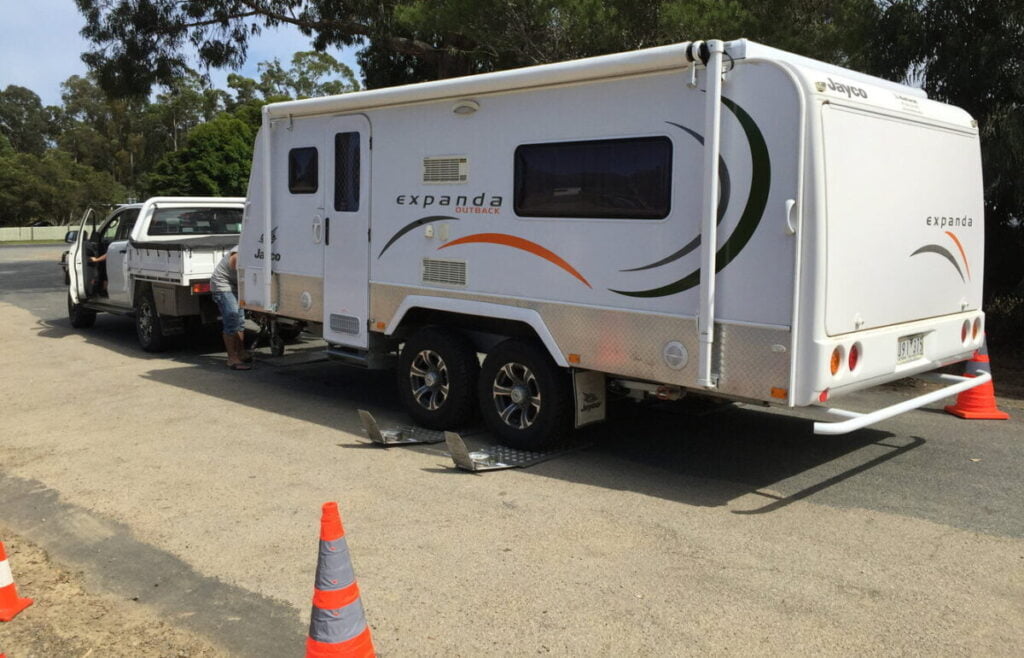

Have portable solar in your rented home
Have portable solar in your rented home
You can easily have portable solar in your rented home. Here’s how to do it simply, safely, legally and cheaply using readily bought parts.
You can easily have portable solar in your rented home. Here’s how to do it simply, safely, legally and cheaply using readily bought parts. Doing so requires space that faces the sun for some daylight hours year-round. It works best within 50 degrees latitude north or south. Use high efficiency (plus 20%) solar modules to maximise input. You must not connect the system to any fixed mains wiring. This precludes using existing lighting. Use portable light fittings instead. Also, slash lighting cost by fitting LEDs. You take all that when you leave.
Here’s how
Group electrical units that you use at much the same time. Examples include a home office, child’s study or entertainment centre. Depending on individual needs, make-up one or more systems, each accepting solar input. You can do this by using readily available portable inverter/chargers and battery packs. Grouped electrical devices connect to a multiple power board that can switch each socket individually. The solar unit then powers that board. If solar is adequate it can be used to power a second or more system.
Where and what you can use
Top solar modules produce about 180-200 watts a square metre. In most cases, your solar input is thus limited to about 500 watts. This will be a probable 1500 – 3000-watt hours/day if north facing. This runs computer systems plus LED lights, and good LED TVs up to 60 cm or so. It will not run air con, nor heating/cooking appliances.
All that’s needed is stocked by solar equipment suppliers. The parts needed are used also in caravans and motorhomes. They readily interconnect. As pictured above, inverter-chargers combine all required apart from the battery. They are often buyable secondhand at bargain prices.
My books Solar That Really Works! and Solar Success provides ample background for people considering this.
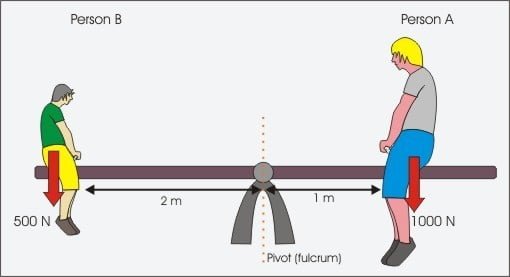
Caravan nose weight – it’s vital for safe towing
by Collyn Rivers
Caravan Nose Weight
Optimising caravan nose weight is vital for safe towing. RV Books’ Collyn Rivers shows why, and how to know what it should really be.
A billiard cue thrown light-end first rapidly changes ends. It becomes heavy-end first. Likewise, unless caravans are nose-heavy, they try to do the same.
Caravan nose weight, however, levers up the front of the tow vehicle. This reduces weight on its front tyres, that reduces their ‘cornering power’, i.e, it tends to oppose it moving in any but a straight line. This, (to put it mildly) is not desirable. It is even less so if needing to swerve to avoid a collision.
Caravan nose weight
Early Australian-made caravans were typically 4-5 metres long. They weighed 1000-1200 kg. Most had centre kitchens and thus (usefully) centre-heavy. Few were towed above 80 km/h. Keeping them reasonably stable required a nose weight of 7%-10%.
Particularly from 2015, tow vehicles of 2-2.5 tonne led to maker producing longer and heavier twin-axle caravans. Many such caravans well exceed their tow vehicle’s weight. Furthermore, many are towed at well over 100 km/h.
Caravan length
Within reason, a caravan‘s weight is less of an issue than its length. And particularly where weight is distributed along that length. The closer that weight is to the axle/s the better. Ideally, the A-frame should carry no load. Furthermore (and vital) nothing heavy should be at its rear. In addition, personal loading should be likewise. If your caravan is like that, a nose weight of 7% should suffice.
The effect of weight depends on where it is located. Pic: original source unknown.
The ongoing quest for reducing emissions includes reducing vehicle weight. That, as a result, reduced their allowable hitch weight. UK and EU caravan makers accordingly produced lighter caravans. Most weigh about 40% less per metre than the local product. They have minimal rear-end weight. Most have a nose weight of around 5%. European research, however, indicates that 6-7% is preferable.
In Australia, despite now lighter towing vehicles, most new caravans remain 6-7 metres long. They typically weigh 2 to 2.4 tonne unladen. To enable them to be towed by vehicles typically much lighter, unladen nose weights are, however, now around 4%.
This now very low nose weight is of concern. This is because there is a long-proven correlation between a caravan‘s nose weight and the road speed at which it is likely to sway. The lower the nose weight, the lower that speed.
What makers suggest
Some caravan makers have ceased recommending nose weight. Many quote the unladen tow ball weight only. Notwithstanding that such weight may be well below optimum, it is only possible (legally), to advise buyers to follow maker recommendations. RV Books, however, does not necessarily endorse such recommendations.
Where no maker recommends otherwise, and where the tow vehicle allows it, use 8%-10% nose weight. For EU-style caravans use 6%-8%.
Off-road caravan nose weight
It is very rare to see a heavy ‘off-road caravan‘ being driven truly off-road. Many Caravans, however, buy such caravans assuming that they are better made. Some such caravans, however, weigh over 3.5 tonne. These really do need at least 2500 kg (5500 lb) nose weight (and preferably 3500 kg [7715 lb]). If buying, I recommend one no longer than 5 metres.
It is not feasible to suggest an off-road caravan‘s nose weight – except it should as much as the tow vehicle, caravan and tow hitch maker allows. Or, if lower, not towed above 80 km/h.
Weight Distribution Hitches (WDHs)
Unless towed by a vehicle that’s heavier, a WDH is usually required. Adjusting this to correct only 50% or so of nose weight assists towing stability. See weight-distribution-hitch-setting-up.
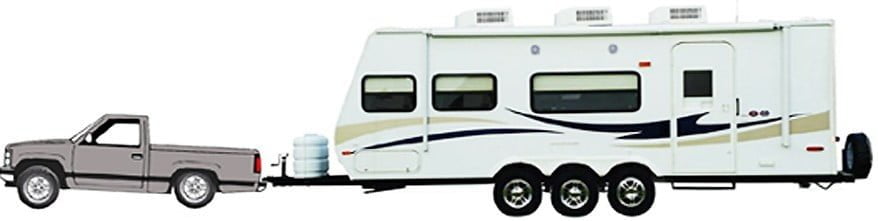
‘You want your money back!?’ – I told you it could be towed by your pick-up truck. I never said you should! Pic: agcoauto
How to measure caravan nose weight
Bathroom scales typically weigh up to 185 kg. To weigh more than that (using such scales) see: https://hildstrom.com/projects/2011/07/tonguescale/index.html
Note: It is technically correct to refer to nose mass (rather than weight). For the purposes of this article, however, the two may be seen as identical.
For an overall view see also:
https://rvbooks.com.au/reducing-caravan-sway/
https://rvbooks.com.au/making-caravans-stable/
https://rvbooks.com.au/caravan-and-tow-vehicle-dynamics/
https://rvbooks.com.au/fifth-wheel-caravans-safer/
Collyn Rivers’ in-depth books cover every aspect of camper-trailer, caravan and motorhome buying, design, building and use. They include the Caravan & Motorhome Book, the Camper Trailer Book and Caravan & Motorhome Electrics, Solar is covered in Solar That Really Works, for cabins and RVs. Solar Success is for homes and properties.
The Caravan & Motorhome Book covers caravan stability in depth.
If you find this article of value, please assist others by posting this Link on related caravan forum queries.
My articles in this area primarily summarize current thinking. They stem from my interest and involvement while employed by Vauxhall/Bedford’s Research Dept in the 1950s, and particularly by the influence of Maurice Olley.
Maurice Olley was born in Yorkshire in the late-1800s. Following time as Rolls-Royce’s Chief Engineer, he worked with General Motors Research Division. He later returned to Vauxhall Motors (UK). I was privileged to attend his lectures during my years at Vauxhall Motors Chaul End Research Centre.
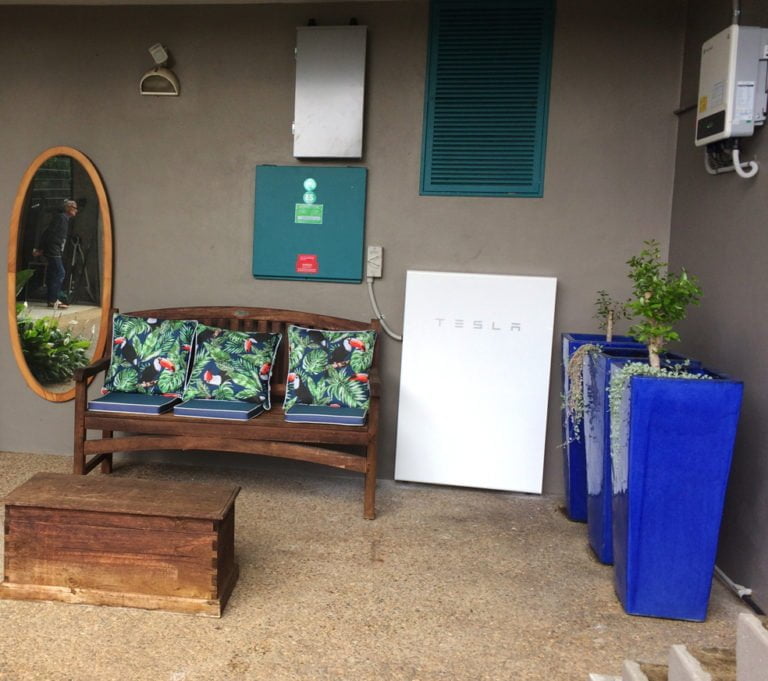
How to stop paying for electricity
How to stop paying for electricity
How to stop paying for electricity is easy. This article shows how. Going almost totally off-grid is more affordable than ever. Now the electricity provider pays us. You can do the same – here’s how.
Solar is now cheap
We always wanted to stop paying for electricity, and now we virtually have. It is getting easier to free yourself from dependence on the grid.
Many governments subsidise home solar. Most buyers, however, purchase only small systems: typically 1.5 or 2.4 kW (kilowatts). These, in Australia in early 2019 cost A$2500 -A$3000 installed. This helps reduce existing bills, but increasing solar capacity is truly worth considering.
Our (NSW government) subsidised 6 kW system cost us A$4350. It produces an average of 25-40 kilowatt hours a day. We initially paid the electricity supplier A$ 0.27 per kW/h for about three hours each night. We sold the daytime surplus (of an averaged 17 kWh/day) for a contracted 20 cents per kilowatt-hour for two years. This brought in about A$1200 a year. The initial cost of installation was A$4500. The result was then free power plus an increasing yearly income inside four years.
How to stop paying for electricity – adding battery backup to our solar array
As with many others, we prefer not to totally rely on grid-power – even as a back-up. Having self-built our own 3.8 kW stand-alone system in Australia’s Kimberley, we knew that do this is totally feasible. But unless electricity exceeds about $1 a kilowatt/hour it is currently not a money-saving thing to do. Whilst going totally off-grid still appeals we settled on a compromise that is proving very satisfying. read more…
Inverters for Homes and Properties
Inverters for Homes and Properties
How to choose inverters for homes and properties. Inverters convert the solar battery output into 110 or 230-volt alternating current. It is all-but-essential to use one. Using only 12-48 volts is too limiting for all but basic cabins.
Two Outback Power inverters are interconnected. Pic: Outback Power
User only inverters marketed as sine-wave (not modified sine wave etc). High-quality sine-wave inverters produce electricity that is ‘cleaner’ than the average grid supply. Other types do not. They may wreck sensitive electronics. There are two main types of sine-wave inverter:
Transformer-based inverters
Those transformer-based are bulky and heavy. This is rarely an issue for homes and properties. Their major plus is inherent overload capacity. Tools and domestic appliances draw two/three times they’re running current whilst starting. Transformer units handle this with ease. Some produce twice or more their output rating for 30 minutes or so.
Transformer-based inverters up to 1500 watts will run from 12 volts. Those for up to 3000 watts require a 24-volt inverter. Anything over that needs 48 volts.
Only a few (e.g. Outback Power units) can be parallel-connected to increase output. This ability is uncommon. If you need, obtain written assurance of feasibility.
Switch-mode inverters
Switch-mode inverters are smaller and lighter. Few, however, have overload capacity. Most only sustain their rated output for a few seconds. The better quality units sustain 80% (of rated output) for constant use. Some, however, may only sustain 50%. Switch-mode inverters work best for loads that draw no excess starting energy. These are rare. Air-compressors draw many times they’re running current whilst starting.
In Solar Books opinion, the best inverters for home and properties are those transformer-based.
Inverters involve complex technology. Our book, Solar Success explains inverters for homes and properties. Solar That Really Works! does likewise for boats, cabins and RVs. The top-selling Caravan & Motorhome Electrics covers inverters in detail. All our books are in digital or print versions. Digital ones can be bought right now. Click on a title (above). Print versions are stocked by all Jaycar stores in Australia and New Zealand and most Australian book shops. They are also available via email (and post) from booktopia.com.au
Grid connect solar problems – what vendors may not reveal
Grid connect solar problems
Grid connect solar problems include, false promotion and vendor claims, incompetent installation etc. Here’s what vendors may not tell you.
Q. Must solar panels be at an exact angle?
A local installer says my existing 1.5 kW system’s modules must be at exactly the same angle as my latitude. They are only a few degrees out). He say he can fix them for $1000 – so most days they’ll produce a lot more. Is this a scam?
A. Yes. He’s after your money!. In most areas plus/minus 5º makes less than 1% or so change. It may, however, result in a bit more in summer than winter – or vice versa. Less than that will make next to no change. It is, however, desirable to have them face more or less into the sun around midday. But, here again a few degrees does not matter.
Q Grid connect solar problems – do I need after-sales service?
My installer seeks $250 a year for ‘servicing and tuning’ my 1.5 kW grid connect system. Do I really need that?
A. This too is a scam. Installed solar needs no servicing, let alone ‘tuning’. Unless the modules are truly dirty, there is likewise no need to clean them. Occasional rain does the job. Our own grid connect systems (north of Sydney) remains unwashed since 2010. There is no measurable loss.
Q. Grid connect solar problems – do I need a tracking system?
I live in the south of Australia where the sun is much ‘lower in the sky’ in winter. My installer advise using a $5000 (plus $1000 installation) tracking system for my proposed 1.5 kW grid-connect system. He claims it will save the amount of solar capacity otherwise needed by about 30%. Is this true?
A. What he claims is true. But what he has not revealed is a lot!
Tracking systems are costly and need ongoing servicing. It is hugely cheaper to accept that loss. You can add another 450 watts more solar capacity for a probable $1250! And zero maintenance. Find another installer.
Q. Grid connect solar problems – how do I work out the grid-connect size I need?
I’d like to install enough grid-connect solar to halve my existing power bill. Installers say they need to calculate how much electricity is used and quote accordingly. Is there any way I can tell if they are selling me more than I need.
A. This is routine practice. The best way to start, however, is to reduce existing usage. We slashed the previous owner’s 31 kWh a day to 4.1 kWh a day summer and 6 kWh in winter.
It costs some money up front, however, savings are huge over time. That alone will fix that ‘halving’ you seek. Adding solar then – and only then, will drop it yet further. It is not feasible to explain how in an article. The first third of my book Solar Success shows exactly how to do it. It includes actual examples (including our own). Unless you do this, the installer will scale the system to existing usage. read more…

RV Solar and Alternator Charging
RV Solar and Alternator Charging
You can make RV solar and alternator charging work. It is complex on post-2014 vehicles. This article explains how.
How RV solar and alternator charging works
A caravan or motorhome battery charges by connecting it across it a source that has a voltage that is higher than that battery has at the time. That battery neither knows nor cares whether that charge is from one source or several. Those sources must all be of closely similar voltage. Ideally, they are identical. If not, the battery will draw mostly from that with the highest voltage. Charging becomes complicated, however, once the battery/s approach full charge.
What happens then is that the controllers associated with each charging source mistake each other’s voltage for the battery. This may cause damaging overcharging. This is particularly so with AGM and LiFePO4 batteries. This applies also to simultaneous solar and generator charging. Do not attempt to do this yourself unless you know how. This explained in our book Caravan & Motorhome Electrics.
Suitable controllers for RV solar and alternator charging.
Most controllers sold for both solar and alternator charging, monitor both solar and alternator input but do not combine them. They switch to whichever has the higher input at the time. Solar Books recommends RV solar users to do likewise. This is particularly so with most vehicles made since 2010 or so and virtually all since 2014.
Issues with post-2014 RV solar and alternator charging
Prior to 2014 or so, vehicle alternators produced about 14.2 volts for some minutes after engine starting. This dropped to a more or less fixed 13.6 volts thereon. This, by and large, presented no issues for RV battery charging. Such alternators had a high enough voltage to charge a secondary battery in the vehicle to a usable level for leisure or auxiliary use. Ongoing emissions regulations however require minimising power usage. This (in 2014) extended yet further – to vehicle alternators of variable voltage. read more…

Solar Shadowing – reducing the losses
Solar Shadowing
Solar shadowing – reducing the losses is like you partially unblocking a water pipe. Partial solar shadowing reduces your losses proportionally. Except in extreme clouding, however, solar modules produce some output. During daylight it’s rare for you to have none.
Pic: solarbay.com.au
Solar Shadowing – reducing the losses – bypass diodes partially assist
Most 12-volt solar modules have 60 cells. Each cell is connected in a string. A totally shadowed cell produces no current. Blocking one affects all.
Basic modules supply the current of the least producing cell. To limit this, good quality modules have three strings. Each string has 20 cells. Furthermore, each string has a so-called ‘diode’. If activated, it carries current from unshaded strings. This assists, but is not a perfect solution. With only one cell shaded, output is slashed one-third. Furthermore, diodes are not reliable. One diode failing will prevent associated strings working.
The ideal is a diode across each cell. Doing so, however, is costly. Worse, diodes fail more often than cells. Reliability is reduced.
Solar Shadowing – reducing the losses – the more effective ways
In basic systems, the lowest cell output limits your overall output. With multiple modules, shadowing one limits output of all. The loss is confined to the area shaded.
Power Optimisers
Power optimisers attach to existing solar modules. They maximise energy. Power optimisers also eliminate power mismatch. They decrease shadowing losses. Such optimisers can be built into solar modules. Or fitted separately. The concept works well.

Pic: Enphase micro-inverter (power optimiser)
Solar Shadowing – reducing the losses
Our books cover shadowing issues in depth. Solar That Really Works! is for cabins and RVs. Solar Success is for homes and properties. Caravan & Motorhome Electrics covers RV solar and general electrics. All are available in digital or print form. Moreover, our books also cover legal issues. Furthermore, you can download our digital versions right now. Click on the books’ title (above). Print versions are stocked by all Jaycar stores. You can also buy them (from anywhere) from booktopia.com.au/

Solar Modules for Homes and Properties
Solar Modules for Homes and Properties
This article shows how to know power output from solar modules for homes and properties. It shows how to optimise it for winter or summer.
Top quality solar modules catch 18% to 20% of the solar energy available. This is typically 140 watts-180 watts per square metre in full sun from about 10 am to 2 pm. Input tapers off before and after. Such modules are priced accordingly. Buy only top quality unless you have ample space for those cheaper but less efficient.
Solar modules for homes and properties – which way to face?
For maximum daily input, solar modules should face directly into the sun at mid-day: due North or due South. This is not always feasible, but the loss is not appreciable. Even if facing away from the sun at midday, you will still have worthwhile input. If in such situations (and you have room) simply add more solar modules. Their cost now is so low it will not cost much more.
Solar modules for homes and properties – at what vertical angle?
Most books and articles advise to tilt them at the same angle as your latitude (e.g about 33 degrees for Sydney, Australia). Errors of 10 or so degrees, however, make little difference in the yearly total. It is possible to increase winter input (at the expense of summer input) by tilting the modules more upright. Likewise, increasing summer input by having them closer to flat. At one time some people had them adjustable – but this is rarely feasible (or safe) if roof-mounted. But here again, if space is available, simply add solar capacity. This may require a larger solar regulator – it cannot ‘overload’ the existing regulator but it blocks current input in excess of its maximum rating. read more…
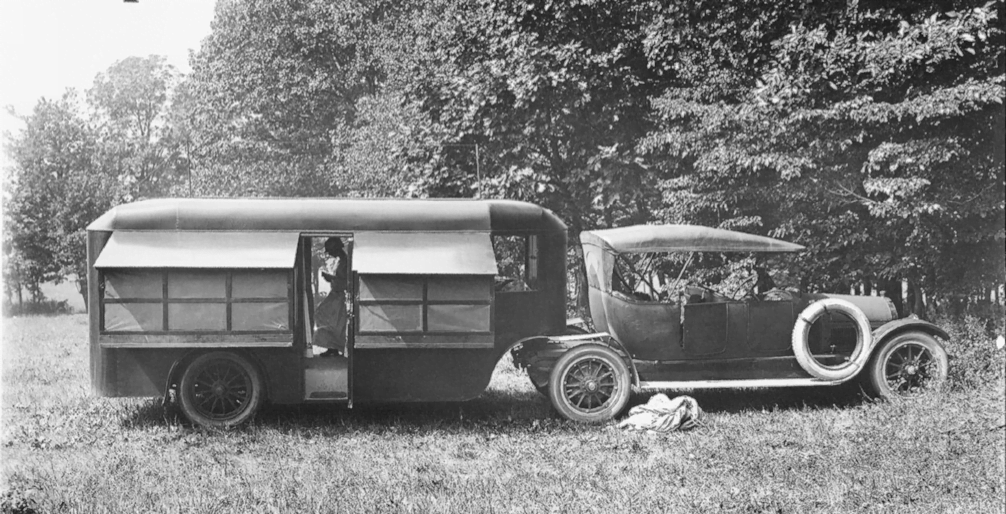
Caravan design need for change
by Collyn Rivers
Caravan Design need for change
The need for caravan design change is increasingly necessary. Australia has two main and seemingly interdependent caravan industries. One makes caravans of stability varying from a few that are excellent, to some that should not be on the market. The other caravan industry makes devices (of equally varying effectiveness) intended to increase caravan stability. Far from all involved, however, appear to understand the basic laws of physics involved. Or they assume they are somehow immune from them.
With a few rare exceptions, there is a caravan design need for change. There is also a need for caravan owners to realise to understand, or at least accept, that a conventional caravan has inherent stability issues.
So-called caravan stability aids have fundamental limitations. An example is any form of friction-only stabiliser. The limitation here is that frictional force is a constant: the sway forces it must control, however, increase with the square of the caravans) speed. A sway force which might be trivial at 25 km/h is not four times greater at 100 km/h. It is sixteen times greater. One published paper (re friction-only stabilisers) states the effect of its damping at 100 km/h ‘is less than 1%’.
Known for over 500 years
The basic understanding of the mechanics and physics involved in moving objects have been known and understood for over 500 years. Despite this, some of today’s caravans embody principles known as unsound even back then. Around 1480, and as with today’s caravans, Leonardo da Vinci (in his ‘Codex Flight’) noted that ‘a body in motion desires to maintain its course in the line from which it started’.
Long caravans, particularly those with rear-hung spare wheels, are prone to vertical and horizontal see-saw effects. Yet Galileo (around 1600) explained in detail why and how this happens. Known technically as ‘moments along a beam’ it was raised again by Leibniz in 1684.
In 1686, Isaac Newton ‘noted that a ‘body in motion would stay in the same motion unless acted upon by another force’. Despite this basic knowledge (taught in elementary school science), many caravan makers and caravan owners seem unaware of, overlook or grossly underestimate that ‘another force’. That force can be a strong side wind-gust, strong emergency swerving etc. Or the result of seriously bad caravan loading.
Overhung tow hitches cause jack-knifing
Until 1920 or so, most heavy transport trailers were towed (as are today’s caravans) via hitches overhanging the rear of the towing vehicles. This worked well initially. Increasingly powerful engines, however, soon enabled speeds exceeding 20 mph (about 32 km/h). Jack-knifing and rollovers then became increasingly common. This was less so in the UK. Trucks there were limited to 20 mph (32 km/h) until 1957 and then to 30 mph (48 km/h) in 1957. It remained at that until 2015.
In 1920, the USA’s Fruehauf transport company realised that jack-knifing’s cause was that tow hitch overhang. That overhung hitch does not just enable a central-axled trailer to yaw. It causes it to yaw. Fruehauf accordingly located the tow hitch directly above the tow vehicles rear axle/s. Eliminating that hitch overhang solved the problem. The resultant (now-stable) so-called ‘articulated’ rigs (their hitch is often called a ‘fifth wheel’) have been used for heavy goods road transport ever since.
Many Americans then used fifth-wheel hitch caravans. The first known was in 1917.
The first-known recreational fifth-wheeler: the 1917 Adams motor bungalow. Pic: Glenn Curtiss Museum.
Many later fifth-wheelers were towed by modified chauffeur-driven coupes. The owner and passengers travelled in the fifth-wheeler.
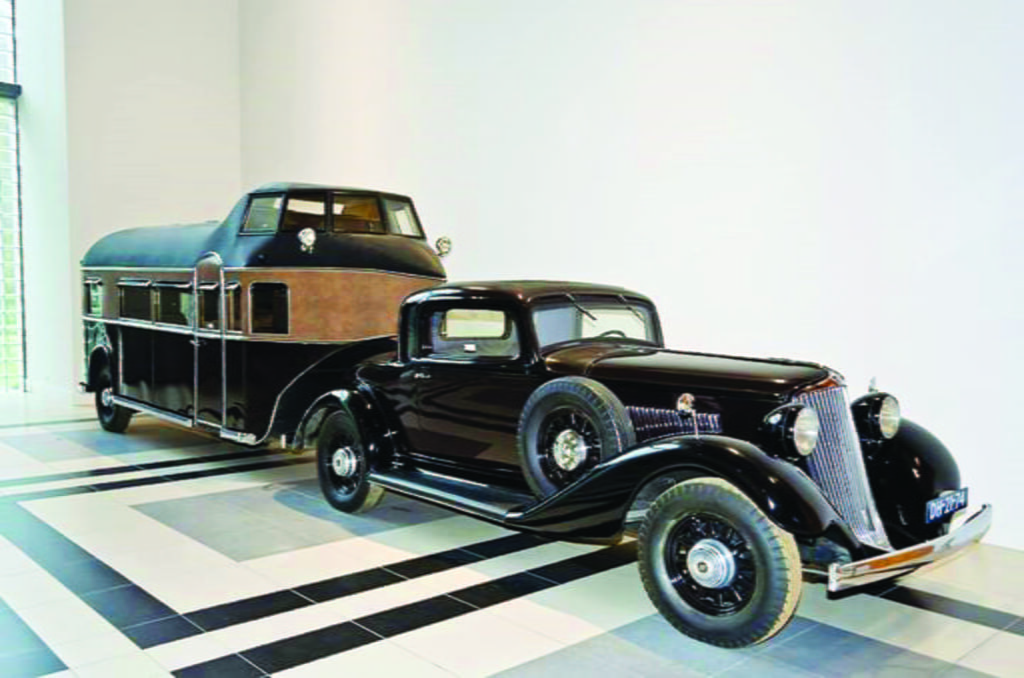
The 1932 Curtiss Aerocar. The tow vehicle is a 1932 Graham-Paige. This rig was used by financier Hugh McDonald as a mobile office for his daily journey to and from New York. It had a full kitchen and bathroom. His staff included an on-board chef. Pic: HET National Automobile Museum, Steuweg, 8 NL.
Apart from the USA, most other countries opted for caravans towed via an overhung hitch. But right from the beginning, as in the early transport industry, jack-knifing was only too common. It was reported in early caravan magazines.
Caravan design – limiting their length
For many years the main emphasis for optimising tow vehicle and caravan stability has been on weight. In particular, a laden caravan should not weigh more than its laden tow vehicle. That was and still is important.
Now, however, the major limiting factor has become caravan length. As rollover after rollover shows, it is long twin-axled caravans that are now mostly involved. Many have front-located water tanks – that result in tow ball mass varying as water is used.
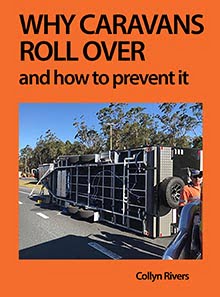
Many recent caravan rollovers are off long caravans with front-located water tanks
Long so-called ‘travel trailers’ are common in the USA. Most, however, towed by vehicles that are heavier and longer than used in Australia. Many are made by Airstream, a company that has long understood how to optimise trailer stability. The spare wheel, for example, is located under the chassis, to the front of the axles. Most US travel trailers use the heavy, but ultra-effective anti-sway Hensley hitch. This, in effect, uses a trapezoidal linkage that projects the virtual position of the tow ball closer to the tow vehicle’s rear axle.
Caravan design – the see-saw effect
A conventional caravan is like a see-saw. Its wheels form the pivot. As with a see-saw, the effect of weight on a caravan depends on how far weight is from its axle/s. An 80 kg (175 lb) adult a metre in front of the axle/s is readily balanced by a 30 kg (66 lb) child at the caravan‘s far end. Because of this effect, a 20 kg (44 lb) spare wheel on the rear of a seven-metre caravan is an effective 70 kg (155 lb) or so. Some caravans have two such spare wheels. If that caravan pitches or yaws, the effective weight of those wheels is magnified yet more. They initially strongly resist that movement, but once that (so-called inertia) is overcome, they then equally resist ceasing it.
This spare wheel ‘end-heavy’ issue is often raised on caravan forums. It attracts naive responses to the effect that all is fine – ‘the caravan has been designed accordingly’. Physics, however, does not work like that. Do some caravan makers not realise this? Or do they simply do not care about its inherently adverse effects?
Caravan stability standards
No Australian Standard currently addresses this issue. The national trailer standard, VSB1, states ‘There are no specific body structural requirements, but the trailer must be safe and fit for purpose.’ VSB1 suggests as a minimum: that the manufacturer should be able to demonstrate that the structure is capable of supporting the designed payload with a ‘safety factor of at least three for highway use and a safety factor of five for off-road use.’ It does not comment on stability. Nor do any other Australian Standards or regulations.
Nor is caravan stability mentioned in the caravan industry Association of Australia Ltd’s own RVMAP Code of Practice. It is almost entirely concerned about building the product. Page 48 of that industry’s caravan towing guide, shows a caravan that has two bicycles and a motorcycle on the rear of a caravan. It comments only that they obscure the number plate. This is an extraordinary sense of priority. https://caravantowingguide.com.au/pdf/TowingGuide2018.pdf
The SAE J2807 standard
Caravan stability is addressed in the USA’s J2807. Initiated by Toyota in 2010 this (now) SAE Standard is followed by all US and the top three Japanese vehicle makers. It sets out the performance requirements for determining tow vehicle gross combination weight rating, and trailer weight rating.
The SAE J2807 standard covers all vehicle and trailer combinations of a combined laden weight up to 5896 kg (13,000 lbs). The standard sets out tow-vehicle requirement for (combination) vehicle requirements for acceleration, hill climbing, understeer, trailer sway response and braking (at maximum legal laden weight). It also covers the tow hitch and related components. The main handling requirements relate to ‘cornering power’. It also covers the tow vehicle’s reduction inherent cornering power (of about 25%) when using a weight distributing hitch.
Factors affecting stability
A caravan and tow vehicle’s stability is co-dependent.
Assuming correct loading and tow ball mass, excess caravan length is now the major cause of caravan instability. Weight, if centralised, and not excessive, is less of an issue.
Critical speed
A reasonably stable caravan is likely to become unstable if its tow vehicle is lighter or much shorter. And/or that tow vehicle has too low air pressure in its rear tyres. Or the caravan has too low tow ball mass.
For any combination of caravan and tow vehicle (and their loading), there is a critical speed. That critical speed is unique to each rig. It is related to many factors. These particularly include tow ball mass and caravan length and loading. The lower the tow ball mass the lower that critical speed. For most Australian rigs that speed is likely to be a little over 100 km/h. For some rigs, it will be below 100 km/h.
The issue of critical speed is often misunderstood. It does not follow that the rig will become unstable at, or above that speed. If towing at or above that critical speed, however, jack-knifing is far more probable in the event of an emergency swerve (or strong side-wind gusts). There is no currently-known way of establishing a rig’s critical speed (apart from wrecking it by testing) but the risk is far less by never exceeding 100 km/h. Forum dash-cam videos show many rigs beginning to jack-knife while overtaking heavy transport vehicles. As such vehicles travel at 100 km/h wherever possible, it is all but certain that most rigs were thus well exceeding 100 km/h.
Adverse effects of a weight distributing hitch
The critical speed is lowered if a weight distributing hitch (WDH) is used. The tighter that hitch the lower that critical speed. Here’s why.
Caravan towing reality is that if you need a WDH, you are imposing loads on a tow vehicle neither designed nor intended to withstand such loads.
A WDH compensates only for vertical loads. It does so by moving some tow ball weight from the tow vehicle’s rear tyres to its front tyres. The WDH cannot, however, reduce the side forces on those tyres when a caravan yaws or starts snaking. That lessened weight reduces their ability to cope with those side forces.
That WDH also reduces the tow vehicle’s intended and vital margin of understeer (that assists keep it stable). This may prejudice its handling in emergencies. It that tow vehicle loses all understeer at speed, it oversteers. If that happens jack-knifing is all-but-inevitable.
If using a WDH never adjust it to more than 50% correction. Contrary to ongoing forum mal-advice never adjust that WDH to have the caravan and tow vehicle level. When correctly adjusted, the caravan’s nose weight should cause the rear of the tow vehicle to be about 50 mm lower.
ow-ball weight
As with an arrow, it is vital that a caravan be nose-heavy. Tow ball weight is totally related to critical speed. The lower that tow ball weight – the lower that critical speed.
Following a general (2015) reduction in tow vehicle permitted tow ball weight, many local caravan makers then recommended only 4% tow ball weight – yet retaining virtually the identical design for which they previously recommended 8-10%. One astute observer described this as ‘brochure engineering’.
If all else remains equal, the speed at which a towed caravan is likely to sway is directly related to its tow ball weight. A caravan with low tow ball weight may not sway in normal driving. If it does, however, jack-knifing is far more likely. Any number of academic papers backed up by real-life testing confirms this. One USA study showed that a caravan with 4% tow ball weight had a critical speed of only 40 mph (about 64 km/h).
Caravan design – how to increase your rig’s stability
When buying a tow vehicle, choose one that has the maximum wheelbase (i.e. the distance between the front and rear axle). Furthermore, the shorter the rear overhang, the better. Also, when fully laden, that tow vehicle should weigh at least as much as the fully laden caravan.
Caravan length too is a vital factor. The longer the caravan, the less stable it is.
Use a tow hitch with the shortest possible overhang. Avoid even excess millimetres. If necessary have a machine-shop shorten that overhang. This usually involves simply drilling a new hole. It can be owner-done – but that hole must be only just large enough to provide a tight fit for the hitch securing bolt.
Do not lubricate the tow ball – its friction assists to limit sway. AL-KO has one that deliberately increases its friction. See Should I grease a tow ball.
When towing always load the tow vehicle to its legal maximum. If the fully-laden tow vehicle weighs less than the laden caravan, never exceed 100 km/h. In stating this, RV Books does not imply that towing such a weight at 100 km/h is safe.
Ensure, by weighing on a certified weighbridge, that your laden caravan is not overweight. Ongoing police checks show that almost all are – one was reported as being 400 kg (880 lb) over its legal maximum.
Never have anything heavy at the far rear of a caravan. That many caravans have spare wheels located there is contrary to the laws of physics – not just common sense. And why two spare wheels – when tow vehicles have only one – or do not even carry a spare wheel: many have a repair kit and an inflator.
Tyre pressures matter
Tow vehicle rear tyre pressures should be increased by 50-70 kPa (7-10 psi). Never increase front tyre pressures.
For reasons unclear, many caravan makers recommend using the maximum tyre pressures the tyre can withstand. The Caravan Council of Australia (and RV Books), however, strongly recommend using the tyre maker’s advised pressures for the caravan‘s laden weight.
Friction sway control
Friction-based sway control is effective, but only at low speed. This is because frictional forces remain constant. The sway forces they seek to control, however, increase by the square of the rig’s speed. At 100 km/h that friction is a close-to-useless 1%.
This inherent limitation is recognised in the UK and EU. There, the excellent AL-KO friction tow ball handles low to medium speed sway (yaw). Electronic stability control, however, acts (if needed) at higher speeds.
The AL-KO friction tow ball is very effective at low to medium towing speed. Pic: AL-KO UK.
Forum advice often misleads
Even good caravan design is rendered unstable if laden incorrectly. Here, some caravan forum advice seriously misleads. Caravans must be laden such that most of the weight (as possible) is close to (and preferably over) their axle/s. The required tow ball mass must only be achieved this way. Never adjust tow ball weight by adding sandbags etc at the very front.
Ultimately, caravan and tow vehicle behaviour depend on hand-sized rubber oval sections’ grip on the road. That ‘grip’ on dirt roads is on loose gravel (often corrugated). It is not unlike driving on ball bearings.
Never tow at over 100 km/h. Moreover, always bear in that caravan stability requires adequate tow ball weight. Furthermore, the lower that mass, the lower the speed that caravan is likely to sway.
That not generally realised is that it not so much caravan weight that matters. It is far more an issue of caravan length. Assuming sane loading, a two-tonne 14-foot (4.26 metres) caravan (some exist) is likely to be far more stable than a two-tonne 18-foot (about 5.5 metres) caravan.
Further information
This and associated caravan design issues are covered in depth in our (now top-selling book) Why Caravans Roll Over – and how to prevent it. As with all RV Books, it is available worldwide in eBook and paperback versions. They are obtainable directly from RV Books – or via outlets such as Amazon.com etc.
Blade fuse problems in caravans – they may burn or melt
by Collyn Rivers
Blade Fuse Problems
Blade fuse problems in caravans include fuses and fuse holders burning or melting. Fire risk is high because the fuses may continue to conduct. Ongoing current flow, however, may heat the fuse holder to burning point. This article by RV Books explains why and how to overcome the risk.
The blade fuse problems in caravans and motorhomes (and particularly boats and 4WDs used on beaches and camper trailers) are mostly caused by exposure or partial exposure to damp air, dirt and water. This corrodes the fuse holder and fuse contact surfaces.
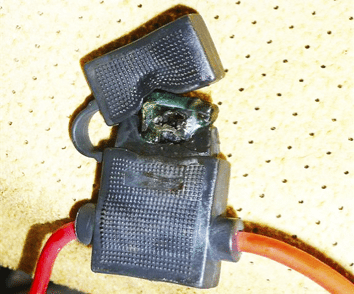
Typical burnt blade fuse and holder. The fuse and fuse holder have melded into a solid lump. Pic: redarc.com.au
Blade fuse problems in caravans – fuse holder sizes
There are two main sizes of blade fuses and blade fuse holders. Most blade fuse problems in caravans arise if the smaller size fuses and fuse holders are used at currents greater than 15 amps. Some auto-electricians suggest 10 amps. All need protecting against damp or salty water, or atmospheres.
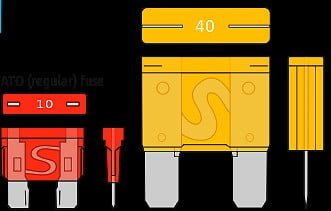
As can be seen, the larger size has substantially more contact area.
Blade fuse problems in caravans – quality issues
There can also be blade fuse problems in caravans with poor quality versions of the larger sizes fuses and holders. Some have next to no protection against even mild corrosion. This causes them to resist current flow, usually partially melting the holder but not necessarily the fuse. This results in a major risk of fire – especially if the wiring’s insulation is also burned. It may expose current-carrying copper that, then allows full battery current to flow – possibly to earth. This can and does cause fires.
Long term blade fuse problems in caravans are also indirectly caused by badly crimped cable lugs. The resultant poor contact eventually allows corrosion between the copper and the lug. Heat builds up, in turn heating up the blade fuse holder.
![Blade fuse problems in [cara_s] - they may burn or melt - electric vehicle batteries,book on batteries,electric car batteries,lithium ion batteries for electric cars,electric car battery technology,how long do electric car batteries last,electric vehicle battery life](https://rvbooks.com.au/wp-content/uploads/2023/12/crimp-lug-badly-made.jpg "Blade fuse problems in [cara_s] - they may burn or melt 115")
This cable is only barely in contact with the crimp lug. Pic: original source unknown
A correctly formed crimp creates a cold weld. To achieve this it is 100% essential to use a proper crimping tool (as shown). Never use pliers or plier-like cheap crimping tools. A good ratchet type crimping tool, as shown below, forms that cold weld (i.e. an inter-molecular bond).
![Blade fuse problems in [cara_s] - they may burn or melt - electric vehicle batteries,book on batteries,electric car batteries,lithium ion batteries for electric cars,electric car battery technology,how long do electric car batteries last,electric vehicle battery life](https://rvbooks.com.au/wp-content/uploads/2023/12/Crimping_tool_4_col_OK.jpg "Blade fuse problems in [cara_s] - they may burn or melt 116")
Use only a crimping tool like that shown: they are not cheap, but a badly crimped lug can set a caravan on fire! Pic: RV Books.
Blade fuse problems – the need for larger holders
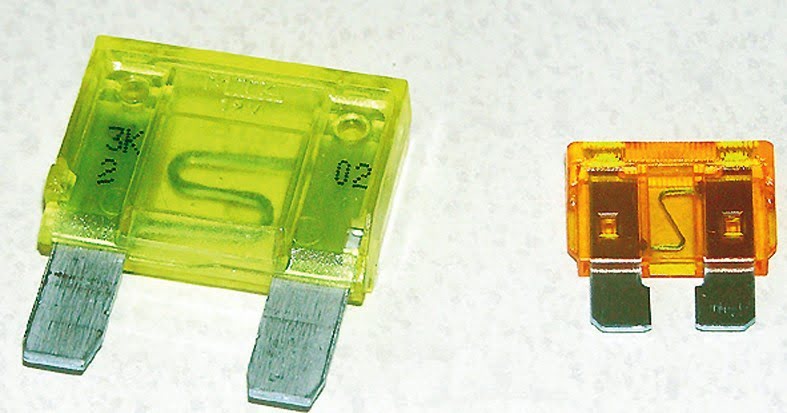
Blade fuses. That most typically used is shown on the right. Use the Maxi version (left) for fuses of 10-15 amps and over.
The above fuses typically blow within 0.1-02 of a second at 600% of their rated value, and 1.0-2.0 seconds at 350% of their rated value. This is fine for protecting correctly specified cabling. Don’t, however, use any fuse that is higher rated than necessary.
Blade fuse problems in caravans – circuit breakers preferred
Ideally, replace high current blade fuse holders and fuse by manually re-settable dc circuit breakers. Those of totally reliable quality are stocked by marine electrical suppliers. Cheaper versions are available but are very temperature sensitive. This, in particular, is not an area to cut costs via eBay specials.
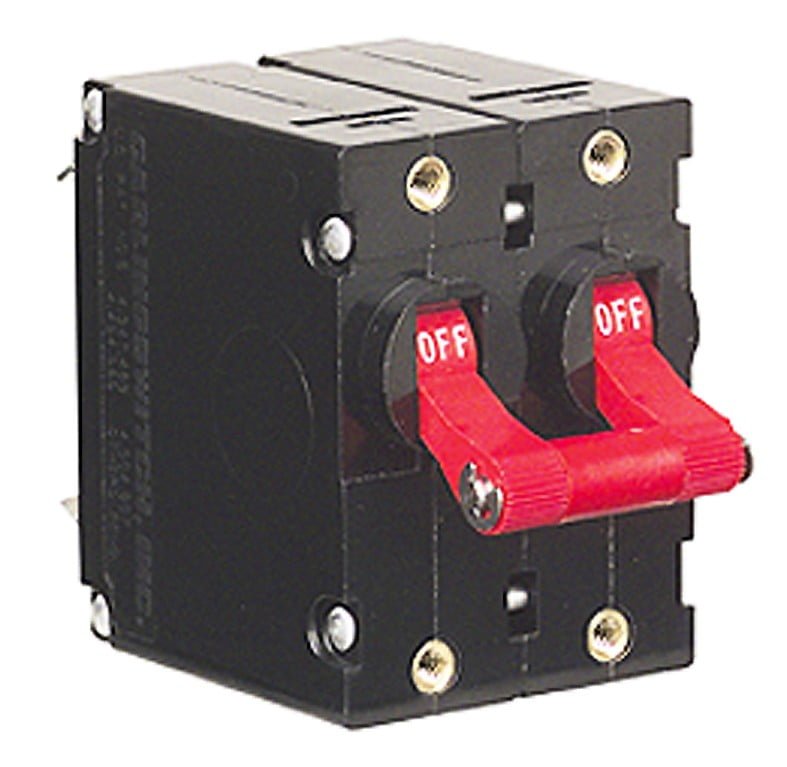
This a high-quality double pole dc circuit breaker. It protects both positive and negative cables. Pic: Carling Inc.
See also Circuit-Breakers-and-Fuses-in-RVs
Blade fuse problems in caravans – further information
Every aspect of RV electrics is covered in detail in my Caravan & Motorhome Electrics. Solar That Really Works is for cabins and RVs. Solar Success is for homes and properties. My other books are the Camper Trailer Book and the Caravan & Motorhome Book. For info more about the author Click on Bio.
Please post a LINK to this article on forums if you feel it would assist problems in this area.
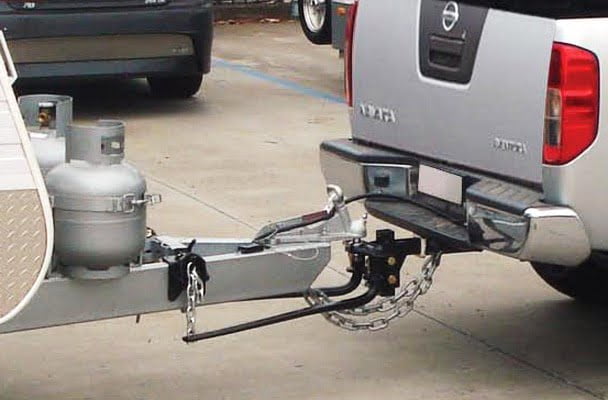
Towing Without a WDH – Weight Distributing Hitch
by Collyn Rivers
Towing Without a WDH
Towing without a WDH (weight distributing hitch) is often feasible. A WDH is not needed if a tow vehicle’s laden weight is equal to or exceeds that of the laden caravan. Nor is a WDH needed for any trailer under 4 metres. A WDH may even cause instability.
Many caravanners ask about towing without a WDH
A WDH attempts to compensate for issues better avoided. One is towing a laden caravan that exceeds the laden weight of whatever tows it. It is, for example, common to see 2500 kg (laden) dual-cab utes towing 3500 kg (7715 lb) caravans. Another is towing a caravan longer than six or so metres.
For on-road stability, a conventional caravan needs to be nose-heavy by 8-10% of its laden weight. When hitched to its tow vehicle that (typically 200-350 kg [440-770 lb]) pushes down the rear of that vehicle. In doing so, that levers up the front of the tow vehicle. This reduces the weight on the tow vehicle’s front tyres.
Where, however, that tow ball weight is comfortably within the laden tow vehicle’s payload, that front tyre weight reduction is too small to be an issue. It is, however, necessary to increase tow vehicle rear tyre pressure by 50-70 kPa (7-10 psi).
Some caravan owners fit a WDH because a sales-person advised it. Or by following misleading advise on Australian caravanners forums. Fitting a WDH when not needed, can introduce unwanted issues. Towing without a WDH is preferred unless really needed.
Weight distribuing hitch. Pic. Jayco.
How a Weight Distributing Hitch works – and its unwanted effects
A Weight Distributing Hitch is, in effect, a springy light beam. By levering up the rear of the tow vehicle, it restores weight (down-force) from the tow vehicle’s rear tyres to its front tyres. While a good and useful concept, a WDH only counteracts tow ball downforce. By reducing tow vehicle rear tyre loading, those tyres become less able to counteract the yawing caravan‘s side forces on the rear of the tow vehicle.
The overall effect of a WDH is thus to reduce the rig’s ‘cornering power’. It does so by an appreciable amount. The USA’s J2807 Standard notes that ‘cornering power’ is reduced by 25%. Furthermore, those strong side-forces on the tow vehicle’s rear tyres may even cause those tyres to steer the tow vehicle. If that happens a jack-knife is virtually inevitable.
The above does not imply that the rig inevitably misbehaves at speed – but it is more likely to if ‘hit’ by a strong enough side force – such as wind gust. Or by cornering too fast. There is, however, a correlation between tow ball mass and safe speed. The lower that mass, the lower the safe speed. There is a very strong argument for that traditional 10%-12%. In the USA it is often 14%.
Towing Without a WDH – Summary
Fitting a WDH to a rig that does not need one is not only pointless. It introduces issues that do not exist without one. Towing without a WDH is feasible if the laden caravan weighs the same or less than the laden tow vehicle. Towing without a WDH is also feasible for correctly laden caravans less than six or so metres (about 20 feet).
If the weight issue is only minor, towing without a WDH is feasible by carrying the caravan’s spare wheel in the tow vehicle.
A full explanation of Towing Without a Weight Distributing Hitch (WDH) is feasible is in our book Why Caravans Roll Over – and how to prevent it.
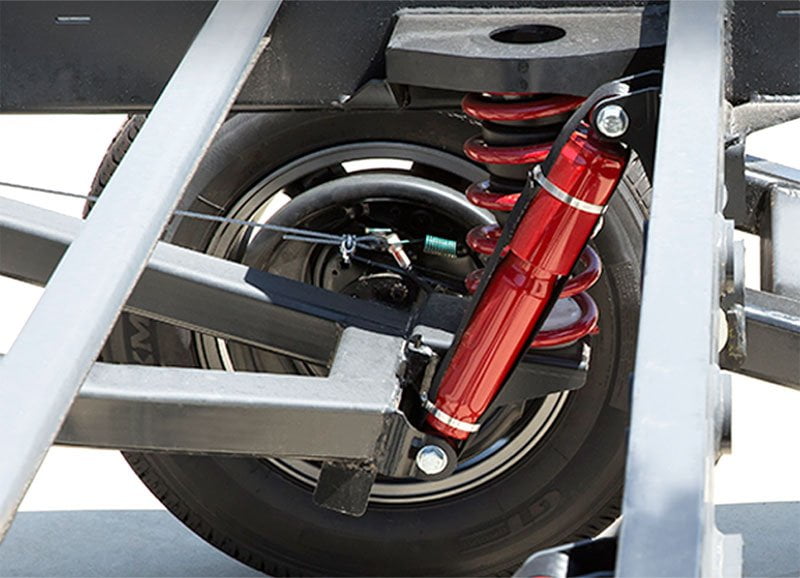
Caravan suspension – it is mostly misunderstood
by Collyn Rivers
Caravan Suspension
Caravan suspension has requirements that are very different from tow vehicles. This is only too often misunderstood. Here’s why and what it should be.
Caravan suspension basics
Were roads totally smooth, there would be no need for sprung caravan suspension. Most roads, however, are far from that. Even trains on smooth rails need springing. Caravan wheels must traverse bumps, holes and sometimes corrugation. They must do so without damaging the caravan and that carried in it.
The suspension is speed-related. Road shocks forces increase by the square of the speed. For instance, such shocks at 60 km/h are four times harder than at 30 km/h. At 100 km/h it’s over ten times as hard.
The effects are more severe than many owners suspect.
Jayco independent caravan suspension
How hard and how often
At 60 km/h, a bump one metre wide is crossed in a sixteenth of a second. It is not a gentle rise and fall. The wheel and axle are belted upward, compressing the associated spring/s. The heavier the wheels, tyres and moving bits of suspension (relative to that sprung) the greater the shock energy.
Whatever the springing form, it acts as a strong bow. It momentarily stores energy. The instant a wheel has passed over the bump, that spring instantly releases its pent-up energy. This jackhammers that wheel, tyre and axle back down. Unless slowed, it smashes wheel and tyre onto the road. The impact forces are taken via its wheel studs. Over corrugation, this happens about 1300 times per kilometre. And, likewise, per wheel.
Sprung suspension must dampen that downward release. This is typically done by friction (thus turning it into heat).
Caravan suspension – energy damping the primary need
With leaf springs, as compressing spring leaves slide (slightly) between each other, friction is caused. This only happens, however on the axles upward travel. As compression suddenly releases, there is no friction to dampen that movement: the spring leaves are no longer pressed together.
Early carriage makers knew all this by 1800 or so. They understood that, if spring movement is damped by friction, spring energy is released as heat. By binding the leaves tightly with strong leather thongs they increased inter-leaf friction. (Some vintage car owners still do). Today’s crude upper clamp only vaguely holds the leaves together.

Early carriage suspension was surprisingly sophisticated.
Less crude was the Hartford friction damper invented in 1895. This had partially rotating clamped friction disks. A later version had hydraulic action. Such methods helped. That specifically needed was to dampen downward movement more strongly than upward movement.
Coil springs and torsion bars made this essential. The solution, de Carbon’s telescopic hydraulic dampers, are used to this day.
Beam axle – or independent
The suspension needed for caravans is totally different from that for passenger cars. Caravans pivot about the tow ball. They readily absorb even major bumps by rocking. Long travel suspension is not required. It has long since ceased to be on all but off-road vehicles.
Nor do caravans benefit from independent suspension. It is used either unthinkingly – or for marketing reasons. Beam axle suspension has many advantages. For example, it provides a stable platform at all times. The wheels remain at right angles to the road at all time.
Leaf springs do not necessarily have to be used. Other forms of spring exist. A major issue, however, is a lack of well-engineered leaf spring systems for caravans. Long, parabolic leaf springs are just fine. If self-building use those from the rear for a Hilux.
Caravan suspension – little need for compromise
Human physiology passenger car suspension. That required for optimal road holding is too harsh for comfort. Humans, on the other hand, do not travel in caravans. There is thus no need to compromise. But caravan makers pointlessly ape the type of car suspension used in American cars of the mid-1930s. Passenger car suspension has since had less, but more controlled vertical travel.
Caravan suspension needs to be engineered to suit caravan needs!
(The effect on humans etc is covered in depth in my Caravan & Tow Vehicle Dynamics.)
All this was thoroughly known by the mid-1930s. Despite that, most caravan makers ignore it. Or not aware of it. Some products defy basic laws of physics. One example is friction sway damping: makers seem unaware that frictional forces remain constant but the forces they are expected to absorb increase with the square of the rig’s speed.
Caravan suspension – further information
I cover suspension in detail in Why Caravans Roll Over – and how to prevent it, and The Caravan & Motorhome Book. Camper trailer suspension, likewise in the Camper Trailer Book. My other books are Caravan & Motorhome Electrics, Solar That Really Works (for cabins and RVs). Solar Success is for homes and properties. See also Wheels Falling off Trailers.
This topic often arises on caravanners forums. If you find this interesting please consider posting this Link in on related threads.
How much solar capacity do I need?
How much solar capacity do I need
This article answers how much solar capacity do I need. It’s valid anywhere in the world that has enough sun. It can save you a lot of money.
The map below shows the amount you typically have available in Australia. Generally, solar is readily feasible where the daily amount exceeds 3.5. It is still feasible below that but needs a lot more solar capacity. The map shows the amount of sunlight in kilowatt/hours per day per square metre. This refers to any unshaded horizontal surface.
The solar industry, however, in its non-technical publications refers to one kilowatt/hour per day per square metre as 1 Peak Sun Hour. This is usually abbreviated to 1 PSH. The concept is akin to measuring rainfall in a rain gauge.
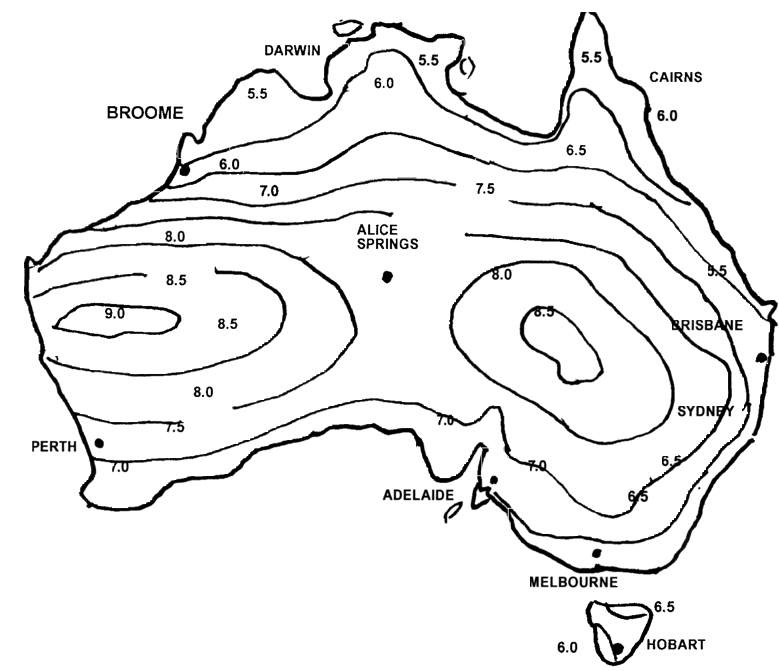
Solar irradiation in Australia. The units are kilowatt/hours per day per square metre. They are more commonly referred to as Peak Sun Hours.
How much solar capacity do I need – solar module alignment
Ideally, solar modules face due north (in the southern hemisphere) and due south (in the northern hemisphere). You do not need to take this too seriously. If you are more than 20 or so degrees out, adding about 10% more solar capacity (per every extra 10 degrees will compensate).
In terms of tilt, having the solar modules at your latitude angle results in the maximum yearly average. If you need more input in summer than winter, tilt them closer to horizontal. If you need more in winter than summer, tilt them more steeply.
Assessing current energy use
Your next stage is to assess how much electricity you need per day (and also of any rare peaks loads). You can simply look at your electricity bill and see. Then consider what you can do to reduce the draw.
Almost any existing home has 30 or more so-called wall warts. These are the little black boxes that enable you to switch appliances remotely. Many made prior to 2014 (and all cheap ones still) draw 3-6 watts even when the related appliance is switched off. That may not seem much. If, however, you 30 of them (some homes have more) that’s at least 90 to 180 watts, twenty-four hours a day (i.e. 2.16 to 4.32 kilowatt/hours a day. Worse, are items like 230 volt doorbells. One, personally experienced, drew a constant 40 watts, almost 350 kilowatt/hours a year. Yet activated a few times a week for a few seconds each time. Many a TV left on ‘standby’ all day draws far more a day than whilst being watched.
Items to replace – lighting
Replace all incandescent globes by LEDs. These provide better light at less than 25% of the same watts. LEDs last for many years: you recover far more their initially high cost over time. Be aware that ‘wattage’ no longer indicates light produced. Wattage is only a measure of the energy they draw. LEDs vary widely in this respect. Some are far more efficient than others. Their light output is shown in ‘lumens’. Their efficiency is thus lumens per watt. Because of this, LEDs that are cheaper to buy are likely to use far more long-term energy.
Items to replace – appliances
Recently made high-quality refrigerators draw far less energy. Replacing any made prior to about 2014 will save you money, in terms of how much solar capacity you need.
Air-conditioners likewise vary considerably in the amount of energy they draw. Assess their efficiency by looking for, or asking for, their CoP (Coefficient of Performance). This is the ratio of energy draw and work done. The higher the CoP the better. By and large units from 1.5 – 2.5 kW have the highest CoP. They cost more initially, but you will save over time.
Lighting for caravans – it makes every sense to install LEDs
by Collyn Rivers
Lighting for Caravans
Lighting for caravans has changed. Now, by far the most practical and least energy drawing are LEDs (light emitting diodes). This article shows why.
The best LED lighting for caravans now provides ten to twenty times as much light for the same energy as incandescent lighting. And ten times that of halogen lighting. An LED’s high efficiency is partly due to its light concentrated as a cone. Some light, however, is reflected from light coloured surfaces. If the need is to light a large space, compact fluorescents do so for similar energy use, and lower price.
LEDs work efficiently in caravans as for reading and cooking areas. They are also fine for outdoor lighting, and are good night lights. They draw so little energy there less risk of depleting an RVs battery.
Types of lighting for caravans – and their outputs
Low wattage (3-5 watt) LEDs fit the MR 11 thin dual-pin bases. Those from 5-10 or so watts fit the MR 16 dual-pin bases (used for 35 and 50-watt halogen globes). The MR 11 LED globe has pins 4.0 mm apart. It has a maximum of 35 mm diameter. The MR 16 has pins 5.3 mm apart. It has a maximum
diameter of 51 mm.
This typical five-watt MR 16 base LED produces light in a 60-degree cone – ideal for reading etc.
The MR 11 and MR 16 are fine for caravan and motorhomes. Their tiny pins do not, however, grip sufficiently over rough tracks etc. The latter requires MR 16 light fittings that secure the globes securely in place.
The GU10 style LEDs have thicker two-diameter pins. They inserted with a push and twist action. These are made in larger wattages. Many are supplied with tiny power converters. These enable the LEDs to run from 230 volts.
The GU10 based LEDs have pins that hold the globes firmly in place.
LEDs ease cabling issues
A major benefit of LEDs is that many caravans and motorhomes have 12-volt wiring that’s far too thin. This caused lights to flicker or dim when fridges cycle on/off. LEDs draw so little energy the original wiring is ample. They are also less sensitive to voltage drop.
LED strips are useful for lighting dark cupboards etc. They provide ample light yet draw next to no power.
Whilst an LED’s power rating is in watts, this gives only a rough indication of the light produced. The reason is (a) LED efficiency varies a lot from brand to brand but is substantially price related. A really good (e.g. Cree) 5 watt LED may produce several times as much light as a 5 watt eBay special. The best indication is the output in lumens (total light emitted). The more lumens per watt, the greater the efficiency. A top-quality 10 watt LED will produce as much light as a 100-watt incandescent.
The cone of light
There is a further complication. Most LEDs produce light in a cone. This may be from 15 degrees to about 140 degrees. There is none (but reflected) light outside that cone. Because of this, an LED of say 250 lumens may be just fine for a reading lamp. It is suitable where a broad spread is required. Lighting shops have working examples.
A typical RV needs four or five good quality 5-7 watt LEDs. Only a few will be needed at any one time.
LED globes are made in varying shades of white. They vary from the warm white of incandescent globes, to a hospital’s harsh white. For those seeking a ‘warmish’ light use LEDs that have a ‘colour temperature’ of 3100 degrees K (Kelvin) or at most, 4000 degrees K. Lighting store staff understand what this means.
Some people report excellent ultra-cheap LEDS from eBay. While cheap these LEDs vary hugely in quality and reliability. We have over 80 LEDs in our three-story home. All are top quality products and all but two have (2020) lasted over ten years.
Further information
LED lighting in camper trailers, caravans and motorhomes is covered in depth in the Caravan & Motorhome Book. It is also covered in the Camper Trailer Book, and Caravan & Motorhome Electrics. The latter covers every aspect of the design and installation of electrics and solar in camper trailers, caravans and motorhomes. Even auto electricians use it as a text and reference book. Solar That Really Works! covers every aspect of using solar in camper trailers, caravans and motorhomes, Solar Success is for home and property systems. For information about the author please Click on Bio.
This topic often comes up on forums. If you feel this article may assist others please consider posting this Link on the relevant thread.

RV supply cables – choices of current capacity and length
by Collyn Rivers
RV Supply Cables
This article shows the sizes and lengths of electric supply cables for RVs legally required in Australia and New Zealand.
RV supply cables – the basic requirements
Prior to 2008, some restrictions on RV supply cables ensured they were acceptable for other usages then under revision. Without those restrictions, supply cables would have been legal (and safe) for some uses, but not others. The revised requirements thus removed that risk. Furthermore, they resulted in a greater choice of approved lengths.
The new RV supply cables requirements are set out in Table 5.1 of AS/NZS 3001:2008 (as Amended in 2012). These requirements are still valid (July 2020).
The most relevant part is set out below. The lengths and sizes shown relate to typical supply cables for all RV and general use. There are, however, restrictions if used for loads such as large electric motors etc.
| Cable rating | Conductor area | Length |
|---|---|---|
| 10 amp | 1.0 mm² | 25 m |
| 10 amp | 2.5 mm² | 60 m |
| 10 amp | 4.0 mm² | 100 m |
| 15/16 amp | 1.5 mm² | 25 m |
| 15/16 amp | 2.5 mm² | 40 m |
| 15/16 amp | 4.0 mm² | 65 m |
RV supply cables (and general use). This is Table 5.1 of AS/NZS 3001:2008 as Amended in 2012. Extract reproduction by courtesy of Standards Australia.
Thou shalt not join cables together
There is an overall purpose behind specifying lengths and conductor sizes of supply cables. It is to ensure circuit breakers operate within that vital 0.4 seconds. To save a human’s life against electrocution, that short time is critical. Co-joining cables slow down the circuit breaker’s operation. That’s why joining supply cables end-to-end is so dangerous. It is also seriously illegal.
Supply cables must thus be one of the approved types and of one unbroken length.
10-15 amp adaptors
The restriction on co-joining cables applies also to 15-10 amp adaptor leads. These (illegally) enable 15 amps to be drawn through cable too thin to do so. Here again, doing so slows tripping of the associated circuit breaker. It may not trip in time to save a life. The Ampfibian 10-15 amp adaptor (described below) is legal. It restricts current flow from a 15 amp source, to 10 amps.
Never use a double adaptor to enable another caravan to share the socket outlet. This has always been dangerous. It is now illegal. If someone plugs your cable into a double adaptor, attempt removal amicably. If that fails, insist the park manager removes it for you.
The above requirements are not hard. Your supply cable must comply with the standard. You must use only one cable to connect your vehicle to the supply. If it is too short, obtain a longer one, or move the caravan closer. The only otherwise alternative is to forgo using that site’s power.
None of the above is negotiable. The requirements are clear and legally mandatory. Personal and forum ‘opinion’ is irrelevant.
How protective devices work
Supply cable rules take into account so-called Residual Current Device (RCD) and circuit breaker protection. An RCD compares the current flowing in both active and neutral leads. If imbalanced it is likely to be via a human to earth. The RCD should detect this and cut the current flow accordingly.
Circuit breakers monitor for excess current flow. They cut the current if an excess is detected. They primarily protect supply cables and appliances. Their effect is similar to fuses – but are more reliable.
10/15 amp issues
Early caravans used appliances that drew more current than now. That required caravan parks to have 15 amp socket outlets. You may, however, need to use a caravan where there are only 10 amp outlets. A 15 amp plug will not fit. It has a larger earth pin. Some people file down that pin to fit. Or make an illegal 10-15 amp cable. There cannot however be a weak link in a chain of safety. That includes not pulling 15 amps through plugs, cables and connectors designed to carry 10 amps. It’s like a 15-tonne winch with a 10-tonne cable.
You can, however, legally use a 10 amp supply cable for caravans if all related bits are also changed to 10 amps. That includes the inlet socket, RCDs and circuit breakers. Doing so thus prevents over 10 amps being drawn. Clipsal now has a 10 amp socket inlet that directly replaces the 15 amp unit.
The Amp-fibian
The Amp-fibian is a legal alternative. It is a short cable with a 10 amp inlet plug. It also has an inbuilt 10 amp circuit breaker and RCD. Plus a 15 amp outlet socket. It restricts supply to 10 amps but as most electrical appliances now draw less energy this not likely to be a problem.
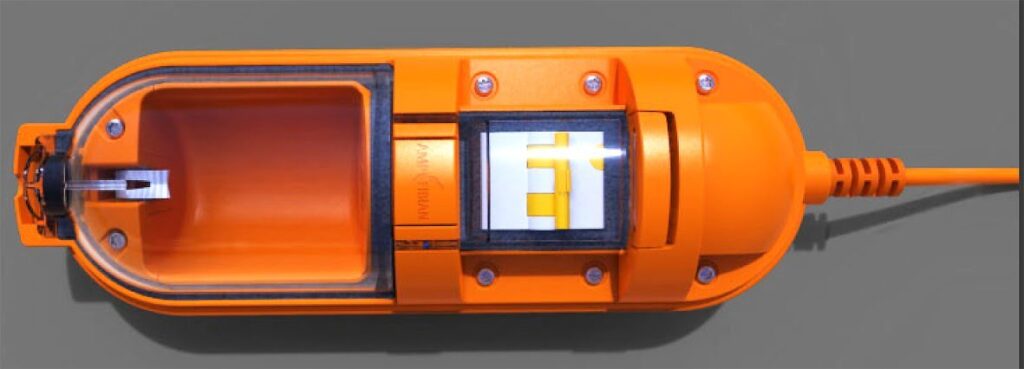
The Amp-fibian 15-10 amp adaptor. A standard 15 amp supply cable is plugged into the receptacle (left) that is then sealed by a waterproof cover.
If seeking to power an RV at home, you can use that adaptor – or have a licensed electrician install a 15 amp power outlet socket.
The RV supply cables requirements apply now also to their general use.)
RV Supply cables – tagging
Occupational Health, Safety and Welfare Regulations include provisions for protecting staff. These include regularly inspecting and testing electrical equipment and supply cable. This latter activity is known as ‘tagging’. It generally enforced by caravan parks and RV rally organisers.
That it is needed was typically shown by a caravan club meeting in 2014. There, of 212 supply cables tested, 84 (40%) failed to pass. Five had broken earth wires within the plug or socket. Twenty-four had neutral and active conductors incorrectly connected – a total give-away of having illegally made one’s own cable. (The standard re-testing is AS/NZS 3760).
[caravan park] owners and managers, and rally organisers, are responsible for employee safety. There is also a general duty of care for those staying or visiting.
None of the above legally requires users’ cables to be tagged. Some caravan parks, however, enforce it. There is currently no legal requirement for them to do so. That may, however, be conditional for insurance cover. A caravan park can, however, enforce this as a condition of entry.
For cable taggers – check local Yellow Pages (or Google).
Outdated standards
Long-retired electricians may not be aware that fundamental safety approaches have totally changed. This, particularly, is true of earthing. Source documents are: AS/NZS 3000:2018, and the RV-related AS/NZS 3001.2008 (Amended in 2012).
Legal Disclosure
The above is sourced from Standards Australia’s documents (noted above)) I have an extensive practical and theoretical background in high voltage electrical equipment and systems. I am not, however, a qualified electrical engineer, nor a licensed electrician.
Further information
Further details about supply cables for caravans etc, is in Caravan & Motorhome Electrics, Caravan & Motorhome Book, and the Camper Trailer Book. My books on solar are Solar That Really Works (for cabins and RVs) and Solar Success (for home and property systems).

Solar input available for caravans – know what’s available and increase it too
by Collyn Rivers
Solar Input Available for Caravans
Knowing the solar input available for caravans is vital, especially up north. This article shows how to know that available and increase it too.
Knowing the solar input available for caravans etc. is like measuring rainfall. It uses Peak Sun Hours instead of inches or millimetres. Imagine an open drum that ‘collects and concentrates’ sunlight (rather than rain). When ‘full’, that drum contains one Peak Sun Hour (1 PSH). It is likely to fill in one hour in Alice Springs around noon on most days. In much of Australia’s south, filling one or two ‘drums’ during mid-winter takes most of the day.
The minimum likely is about 2.5 PSH/day for all areas except Australia’s south in midwinter. There, it’s too low to be effective.
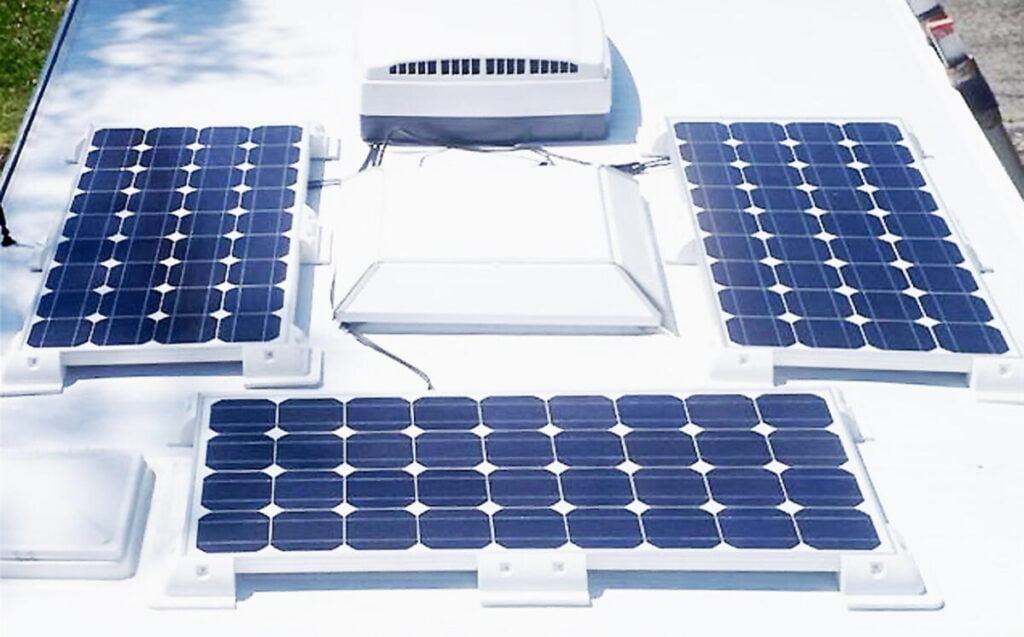
Solar modules on a motorhome. Pic: courtesy Solar Energy Products
Solar input available for caravans – Peak Sun Hours
The PSH concept has a scientific background. The term ‘Peak Sun Hour’, however, was thought up by the solar industry. It is commonly but not technically recognised. One PSH is a solar irradiance (received sunlight) that averages 1000 watts/metre² on a horizontal surface for one hour. In reality, haze etc. results in a more probable 800 watts/metre².
In practice, even the best commercial solar modules are only about 20% efficient. Most are 14-18%, furthermore, there are heat and other losses. Solar input available is about 70-120 watts/metre² of surface area.
The daily solar input is thus 70-120 watt-hours times the daily Peak Sun Hours for each metre² of solar module area. It’s about 70% of that usually claimed.
Away from the tropics, about two-thirds of that input is during the two to three hours each side of noon. Depending on the season, solar input varies from 2 PSH (down south in winter) to 7-8 PSH in central and southern areas in summer.
Northern Australia has less variation. It’s about 5.5 PSH in winter and 6.5 in PSH summer. This is due largely to a high humidity layer. This absorbs some of the otherwise input. This often fools caravanners – who assumed the opposite.
Based on NASA derived original data, this map shows the most probable (averaged) mid-summer solar output (in PSH) in Australia. This map is copyright rvbooks.com.au
Solar input available for caravans – Peak Sun Hours worldwide
Meteorological offices have solar input maps. The data, however, is in scientific units. My books Solar That Really Works, and Solar Success includes two maps that cover Australia. One is for mid-summer, the other for mid-winter. The maps are based on a ten-year running average (from NASA data). They are updated regularly. That for summer is shown above. There are daily variations. The totals provide only a general guide.
Solar input available for caravans -optimising solar output
The further north or south, the lower the sun tracks east to west. To optimise solar input, solar modules should face true north in the southern hemisphere. They should face true south for the northern. If located horizontally they’ll capture much of the day’s sun for much of the year. You can optimise input by adjusting portable solar modules every hour or two.
Solar modules do not need exact alignment. Most input is from 9 am to 3 pm when alignment is less critical. Furthermore, the sun’s effect is far from a ‘shaft of light’. It’s often diffused. Accurate alignment consequently makes little difference.
This is confirmed by the Australian Solar Radiation Data Book. That, for Adelaide during January, shows the difference between the 10º optimum and horizontal is only 0.16%. Even 20º error makes only 4% difference.
Across much of Australia, variations of plus/minus 20º, in north-facing or tilt cause under 5% difference. Where space allows, compensate by increasing (now very cheap) solar capacity.
Amorphous solar modules are less efficient, but only marginally heat affected. They are flexible, thus handy for curved roofs. They can even be glued on. If doing so, glue them on an aluminium sheet attached to the roof. Doing so eases possible repairs.
Solar input available for caravans – Multiple Power Point Tracking (MPPT)
MPPT solar regulators are often claimed to increase solar output. They cannot do that as such. What they can do is recover input otherwise lost. They ‘juggle volts and amps’ to optimise watts.
The common claim of ‘ by up to 30%’ is valid. That rarely revealed, however, is that increase is for an hour or two early and late in the day. Input then is tiny. An extra 30% (of very little) is barely worth having.
A more general approach
Until a few years ago, solar capacity was relatively expensive. It is now so cheap that, unless you need a minimal system for lighting only, have as much solar capacity as feasible. This will ensure batteries fully charge even overcast days. It will also provide adequate input in various areas and/or seasons.
Another good guide to existing RV systems solar input is this. Unless your batteries are fully charged by midday most year round there will be insufficient input up north excepting during mid-winter.
As solar capacity is now so cheap, it’s well worth having excess. The associated solar regulator precludes overcharging. What does not work is to increase battery capacity alone. Doing that’s like opening further bank accounts for the same money deposited. All it does is to increase storage losses!
Furthermore, battery charging/discharging loss is typically 20%. Increasing capacity unnecessarily is counter-productive. The more costly LiFePO4 batteries, however, are better in that respect. Their loss is about 5%.
Solar in tropical areas
As noted above, many RV owners assume that tropical solar input is greater year around. This is not so. The input during a tropical winter is typically 5-5.5 PSH/day, and 6.0-6.5 PSH/day in summer. There are also be fridge issues: in particular that not only is it hotter all day – it stays hot all night too. Fridge energy usage is usually 40% higher.
See also Article: Living with solar
Generator Backup
Given adequate solar capacity, an RV electrical system should run from solar or 95% or so of the time. There can, however, be atypical periods of overcast days. Smoke from major bushfires will reduce input to almost zero.
A need for generator back-up primarily relates to your desire for frozen food. If you replace that by vacuum-packed food, you can do without a generator. If you do need one, use it only to charge the battery/s via a high-quality charger from the generator’s 230 volts output. Never from the 12 dc outlet: that outlet is intended for running 12-volt devices directly. Its output (even if marked ‘battery charger’) is an unregulated 13.6 volts or so. That is far too low for effective charging.
Further information
This topic is not possible to fully cover in article form. If you find this one of value, there’s a huge amount more in my books.
Every aspect of solar is covered in depth in Solar That Really Works (for cabins and RVs). Solar Success covers homes and properties. My other books are Caravan & Motorhome Book, Caravan & Motorhome Electrics, and the Camper Trailer Book.

Fast battery charging from generators – cheap, effective and relatively simply
by Collyn Rivers
Fast Battery Charging from Generators
Fast battery charging from generators is cheap, effective and relatively simple. Few people, however, know how to do it. In many a campground, generators plug away for hours on end in vain attempts to fully charge their batteries. This article by RV Books’ Collyn Rivers explains how to get it right first and every time.
Most 120 and 230-volt generators also have a DC 12 volt and (typically) 8 amp output. Pic: Honda.
Almost all portable generators have a nominal 12-volt output. This outlet is primarily intended for powering 12-volt appliances directly (i.e. with no need for a battery). It typically supplies up to 8.0 amps. The ’12-volt’ output is typically 13.65 volts on light loads. Such output will partially charge a deeply discharged battery at 5-8 amps. Once the battery is 40%-50% charged, the current drops to an amp or so. Even if that outlet is marked ‘battery charger’ it may take a day or more to reach 60%-70%. It should eventually reach full charge, but may take a week or more to do so.
The simple solution
A cheap way of achieving fast battery charging from generators is via a basic 20 to 30 amp (230 volts) chain-store battery charger. You connect this to the generator’s 230 volts ac outlet. This will recharge a 100 amp hour battery from deeply discharged to about 80% within about six hours. A more costly multi-stage (dc-dc) 20 amp charger may reach 100% in even less time. Do not attempt to charge lithium batteries via a cheap charger. While normally rugged, (as with AGM batteries) they can be damaged or wrecked by over-voltage charging.
For a fuller explanation see dc-dc charging on this website.
Switch-mode technology issues
A known problem with fast battery charging from generators relates to some early so-called ‘switch-mode’ chargers and inverter/chargers. Some work well from grid power but not well (or even not all) from most 230-volt generators. The problem is not necessarily related to either unit’s quality or price: it is that a switch-mode power supply converts power by using electronic switching devices that rapidly turn on and off. Much like an engine’s flywheel, storage components (such as inductors or capacitors) supply power when the switching device is in non-generating brief states.
Switch-mode power supplies are highly efficient. They are widely used in computers and other sensitive equipment requiring a stable and efficient power supply. Switch-mode devices, however, require ‘clean’ electricity. That from basic petrol generators (the ultra-cheap eBay specials), however, is ‘dirty’.
Such generators speed up during each power stroke. They slow again on each compression stroke. The generator flywheel’s resistance to changing only partially dampens such rapid changes (they lack the size and mass to do so sufficiently). The consequent rapid speed changes cause voltage spikes on the electric output. Sensing ‘dirty’ electricity may cause a switch-mode charger’s protective circuits to limit output, or even switch itself off.
An owner faced with this (not uncommon) issue has a further problem. While the cause is the generator, each vendor may claim their product works fine (albeit not together). Each vendor tends to blame the other’s product. To avoid this, always buy both from the same vendor insisting they must work with each other.
This issue primarily affects low-priced petrol generators. It does not happen with inverter-generators such as the Honda/Yamaha type products.
In Australia, Power Protection Systems (supplier of Mastervolt etc) has a simple modification. It cleans up dirty input and tricks inverter-chargers into accepting any remaining ‘noise.’ It was designed specifically for Onan’s 3600 petrol generators and Dakar chargers, but is claimed to work with other generators.
Fast battery charging from generators – the power factor
A further issue called ‘power factor’ causes alternating-current (i.e. grid power) chargers and inverter chargers to charge at lower rates than had been expected. Power factor causes the alternating current to peak at a different time than the voltage. It’s rather like rowers sculling out of synchronisation. The same action and energy input has less effect. Power factor is expressed as between 0 and 1.0. The higher the better.

Adverse power factor is like two scullers (Ampy and Volty) rowing out of synchronisation. They do the same work as if they were together, but the boat will not go as fast. Pic: ‘Concentration’ – copyrightdreamstime.com
Most battery chargers have a power factor between 0.65 and 0.7. This necessitates using a generator that is correspondingly larger. Worse, most such chargers are only 70% efficient. A 12 volt, 30 amp (360 watts) such charger may thus need a 1000 watt generator to run it.
Switch mode chargers originally had poor power factor, but many now are 0.85-0.9 (i.e. 85%-90% efficient). Providing you avoid the cheap ‘specials’ this is largely a historical problem.
A charger that has really poor power factor can prevent an otherwise adequate-sized generator developing full power. A quick and dirty fix, that often works, is to run a 100-watt incandescent globe or soldering iron at the same time. It is not efficient but that resistive load tricks the generator into working as intended. An electrician can install power factor correcting capacitors to fix the problem, but the cost of doing so may be similar to buying a higher quality (that will power factor correction already built-in).
Further information
This article will hopefully help speeding battery charging from generators and other battery-charging problems. Many similar issues bedevil electrical, battery and solar systems in camper trailers, caravans, campervans and motorhomes.
That needed to fix them (and particularly avoiding problems in the first place) is in Caravan & Motorhome Electrics. It is also in the associated (now 4th edition) Solar That Really Works (for cabins and RVs) and/or Solar Success (for home and property systems). These books are now in eBook and paperback versions. Many auto-electricians use them as working guides. The Caravan & Motorhome Book covers every aspect of RV usage.
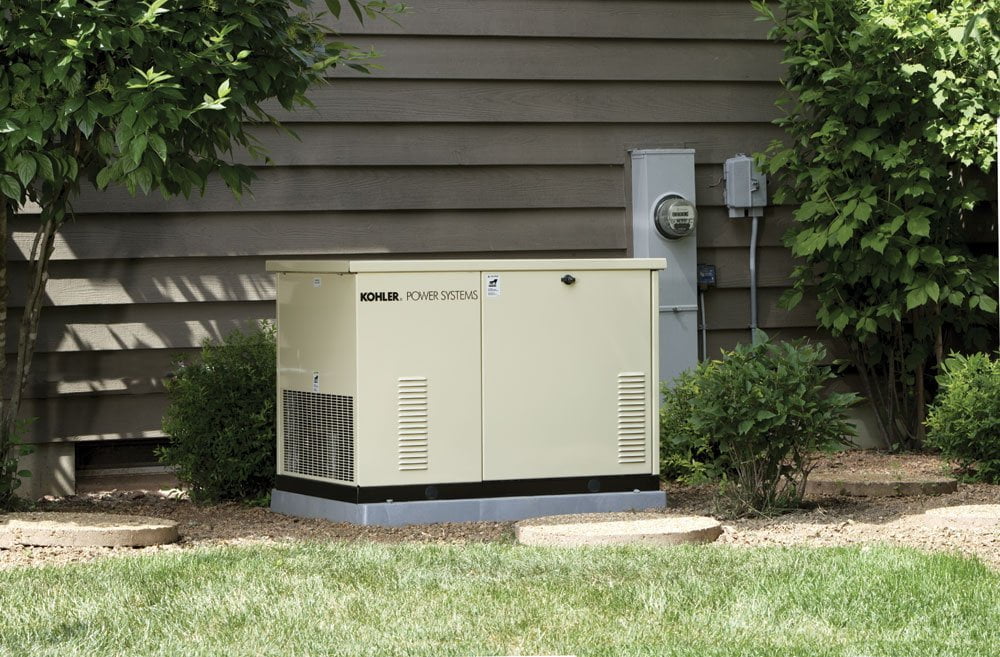
Generators for Home and Property Systems
Generators for Home and Property Systems
A backup generator is close to essential for home and property stand-alone solar. You can choose to down without but doing so may triple the cost of that system.
Generators for home and property systems are often needed as it is rarely feasible to size such a system for a 100% reliable solar supply. It is rare to have no input, but there will be days when solar input alone cannot cope.
Having solar and battery capacity for 95% of the time is readily feasible but extending that to 98% may triple the cost! That 95%, however, still leaves about 18 days a year where solar will not cope. Having a generator also provides emotional comfort.
Generators for Home and Property Systems
The most-used approach is a back-up petrol or diesel generator, but LP gas versions are also available. You need one big enough to run a few essential items directly – but primarily for battery charging. You use the generator’s 110 or 230 volts to drive a suitably scaled battery charger.
For homes and small properties, the larger Honda/Yamaha petrol-powered inverter generators used in up-market RVs are adequate for occasional use. For use to routinely charge batteries, the smaller diesel-power generators last far longer. Where noise is an issue with generators for home and property systems, Onan (Cummins) has a range of quiet units. These include generators that run on LP gas.
A few properties have a large diesel like the 25 kW Cummins Triton unit (below) scaled for massive (but rare) loads. Often essential for the larger outback properties areas but cheaper to hire a big mobile unit for a day or two for those with convenient city access.

Generators for Home and Property Systems – how to find out more
Full details of suitable petrol, diesel and LP gas generators are in our book Solar Success. This, as well as our other books: Solar That Really Works! (for boats, cabins and RVs), and Caravan & Motorhome Electrics for all aspects of the topic are now available in directly-downloadable digital form from our Bookshop. Print versions are available via all bookshops in Australia and many in New Zealand – and via email (right now) from booktopia.com.au.
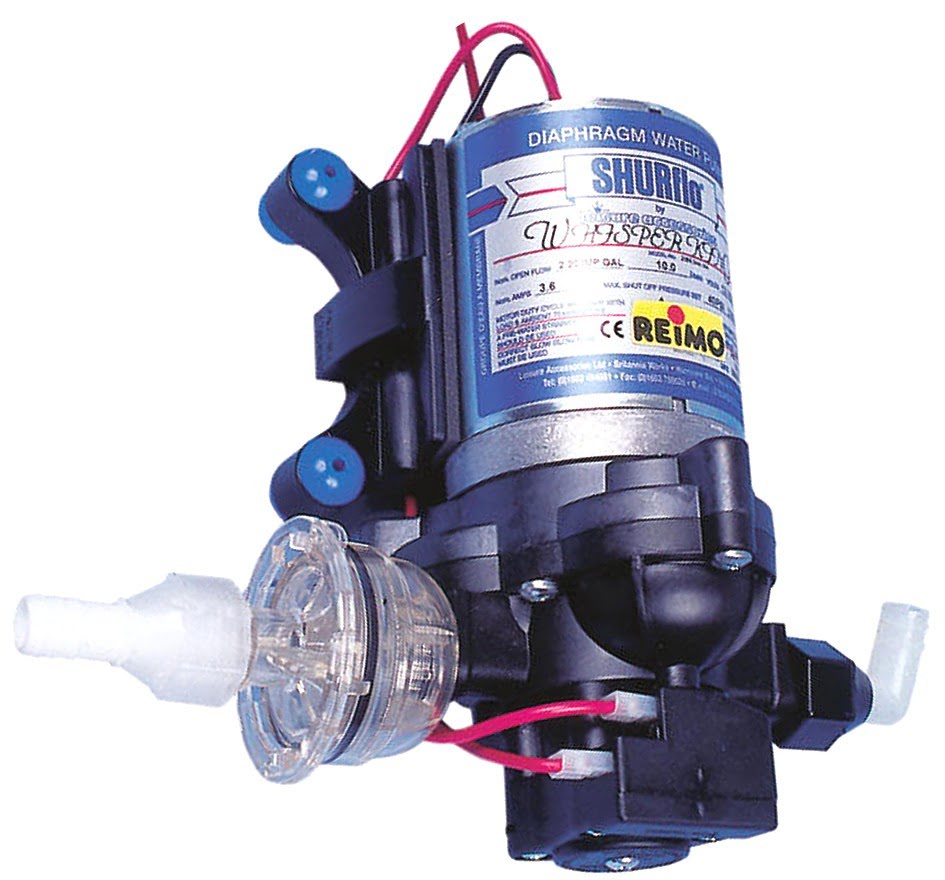
Quietening caravan water pumps – easy and cheap to do
by Collyn Rivers
Caravan Water Pumps
Quietening caravan water pumps is simple to do at no or trivial cost. This article from RV Books’ Collyn Rivers shows how.
Most caravans and motorhomes use 12-volt pumps that have a rotating cam. This cam drives a flexible diaphragm up and down, typically feeding three separate chambers. These chambers draw water as the diaphragm moves downward and close as it moves upward. This action forces water outwards through further valves. Each chamber operates at about 60 times a second. Noise is created by various parts of the action.
Quietening caravan water pumps – how and where to start
The first step in quietening caravan water pumps is to ensure the pump has a truly rigid mounting. Knock on the existing or proposed base. If it sounds like a drum it’s going to worsen pump noise. Ideally have a truly rigid base, but if not place a small piece of carpet between the pump and its base.
The pump is normally attached via screws and small rubber mountings. Use the thinnest possible hold-down bolts that will adequately hold the pump (Shurflo recommend high-tensile 2.0 mm bolts) and tighten only just sufficiently to marginally compress the rubber mountings. Do not overtighten.
Flexible piping essential
Noise is also transmitted through the flexible hose connecting the pump to the various outlets. A surprisingly effective way of quietening caravan water pumps is to reduce this transmitted noise. This is readily done by having a full loop of truly flexible hose (never use rigid copper) between the pump outlet and the rest of the system. This loop should be allowed to hang as loosely as feasible – ideally in free space. Unless able to move freely a lot of noise will still be transmitted.
Avoid right angle elbow fittings. They cause turbulent water flow and back-pressure. Both generate noise. Use smooth curves instead. Another cause of the noise is the vibration of the piping and any fitting where the hose passes through a wall. Use soft plastic foam as an insulator. Plumbing can also vibrate against walls and drawers etc
Once installed, bleed all air from the system as any trapped air causes the hose to rattle.
Start off with one already quiet
A good solution is to start with a pump that is already very quiet – such as the Shurflo WhisperKing shown below – mounted as described above.
The Shurflo WhisperKing works as described above, but is a lot quieter than most such pumps. Pic: Shurflo
Another approach is to use one of the quiet (post-2010) constant flow pumps. These circulate unused water around an internal loop in the pump body. They are much quieter but draw up to twice the current of previous models. This not a major problem in an RV, but can be in (for example) an irrigation system that supplies low pressure to drip feeds over for long periods of time. Another more recent innovation is the variable speed pump. This seems likely to become increasingly popular.
Further information
This issue, and also a solution that provides totally silent operation nearly all the time, is described, in Caravan & Motorhome Electrics, Solar that Really Works!, and Solar Success. If you liked this article you will like my books. My other books are the Caravan & Motorhome Book and the Camper Trailer Book. All are written in the same plain English down to earth manner. They provide solutions that work.

Lightning risk in RVs – how to reduce that risk
by Collyn Rivers
Lightning Risk in RVs
Lightning frightens, but lightning risk in RVs is very low. That risk however is far from random. Here’s how to reduce it yet further.
About 80% of those struck were using a land-line telephone. This risk is falling fast as people switch to risk-free mobiles. Golfers however are particularly at risk, especially if swinging a club. Also at risk is anyone using an umbrella during a storm, or walking on a beach. It’s not that hard to reduce the odds!
Some areas of Australia are especially prone to severe thunderstorms. These include the Blue Mountains, the Dandenong Ranges, the Kimberley, and the north of Australia (generally during the monsoon season). The lightning risk in RVs in these areas is very much higher than in most other areas. It is primarily for those living or travelling in such areas that this article is intended.
Lightning strike over Geelong (Victoria) in March 2012. Pic: (by Rod Howard) courtesy Geelong Advertiser.
How lightning strikes
At all times, the earth’s surface carries a typically negative charge. The upper atmosphere carries a positive charge. As a storm develops, the voltage difference builds up to many hundreds of millions of volts. Once the voltage between ground and upper atmosphere exceeds a certain level, the air ionises (i.e. electrons become freer to move). This eases the passage of a lightning strike much as straightening or surfacing a road initially eases traffic flow.
So-called ‘step leaders’ reach down toward earth and (like early pioneers, the one that gets there first tends to set the route for that which follows). On earth, objects respond by sending out positive voltage streamers. When such a streamer meets a step leader, a conductive link is formed. The resultant current flow generates so much heat that the surrounding air literally explodes – resulting in thunder claps.
Lightning risk in RVs – seek shelter if outside
The most dangerous place to be in a thunderstorm is out in the open but there is usually a fair amount of notice. A good rule is to seek shelter once a thunderstorm is within 10 kilometres. That’s about 30 seconds between seeing the lightning flash and hearing the thunderclap. Stay sheltered for at least 30 minutes after the last lightning is seen.
If you are caught out, avoid becoming a positive voltage streamer – such as a golfer in mid-swing. Do not use an umbrella. You are actually safer if soaking wet as any current is more likely to pass through the wet clothing.
If the risk seems very high, crouch down with feet together and with your head held low. Never shelter under a tree. If you have to stand, keep your feet as close together as possible. This is because a nearby strike causes voltage differences of thousands of volts per metre in the nearby ground. Having a few hundred volts difference between one foot and the other leaves you very dead. Absolutely do not lie down.
Almost any form of building is safer than being outside but keep away from walls, metal plumbing etc. Do not use the loo (water is conductive). The lightning risk in metal-bodied caravans, motorhomes and coaches is exceptionally low. A metal structure (even of metallic mesh) provides a so-called ‘Faraday cage’ within which all current flows through the external metal to earth. Within such an RV you may not even be aware of a strike.
If the storm is at least 10 km away, lower the TV antenna (disconnect it at least). Physically disconnect all external power leads. Do not, however, do either if a storm is closer.
‘Cone of protection’ is a myth
Ignore all campfire and forum Internet mythology about the ‘cone of protection’ provided by tall trees and buildings. These attract lightning strikes. Such strikes cause a voltage gradient that spreads out on the ground beneath and near the sides of a tree or building. This can kill at up to 30 metres or more from that strike’s centre. Essentially nowhere outside a building or vehicle is safe whilst lightning is around.
Whilst a vehicle’s tyres might appear to insulate the vehicle from earth, all rubber tyres now contain carbon. They are deliberately semi-conductive to limit static charge build-up. At lightning’s voltages, tyres become good conductors. In storm conditions, however, do not exit an RV holding the door handle whilst touching the ground. It’s best not to go outside anyway.
All large external metal structures attached to a caravan or motorhome (e.g. air conditioners) should be bonded to the chassis using at least 6 AWG cable.
Lightning rods
These work by dissipating ‘electrical charge’ built up where the voltage difference does not become high enough to attract a ‘step leader’. They work best if they have a point at the top. That point concentrates and assists charge dissipation. A lightning rod is well worth having in lightning-prone areas – such as the Kimberley.
Lightning risk in RVs that have fibreglass or composite bodied vehicles is reduced by having a conventional lightning conductor with a (sharp) spike. This should be well above the roof and earthed to the vehicle chassis via starter motor cable that runs externally. If you do this never use soldered joints as the massive current flow will melt them instantly. Instead have an auto-electrician crimp them for you.
Lightning seeks the straightest path. To reduce lightning risk in RVs keep any such earthing cable as straight as possible and routed well away from where people may be.
Lightning risk in RVs – further information
For those seriously interested in lightning risk in RVs, the Standards reference is AS/NZS 1768:2007.
The topic of electrics and caravans generally is covered in depth in my book Caravan & Motorhome Electrics. That of solar for cabins, camper trailers, caravans and motorhomes is in Solar That Really Works!. That for larger home and property systems is in Solar Success. My other books are the Caravan & Motorhome Book, and the Camper Trailer Book. For information about the author please Click on Bio.

Grid connect solar modules for RVs – here’s how you can use them
by Collyn Rivers
Grid Connect Solar Modules
Using grid connect solar modules for RVs is readily done but needs an MPPT regulator. This article by Collyn Rivers explains how and why it is done.
Grid connect solar modules are often sold very cheaply. Most, however, produce optimum power at voltages that cannot be handled by the 12-24 volt solar regulators used in most RVs. Using grid connect solar modules for RVs is however readily done by using an MPPT (Multiple Power Point Tracking) solar regulator. An MPPT regulator accepts a much wider voltage range. Grid connect solar modules for RVs can also be used in stand-alone solar systems. This article by Collyn Rivers (RV Books) explains how and why.
Grid connect modules are made in a huge range of voltages and sizes. Those of around 300-350 watts tend to be the best value for money. Most output about 50 volts at 60-7 amps.
Juggling volts and amps
An MPPT solar regulator ‘juggles’ incoming volts and amps to produce whatever needed to charge your solar system’s batteries deeply, speedily and safely. For RVs such as camper trailers, caravans and motorhomes this is usually a (nominal) 12 or 24 volts.
Care is needed when buying an MPPT solar regulator when using grid connect solar modules for RVs. Some accept any input voltage from as low as 9.0 volts to often well over 100 volts. But some work only from 9-36 or so volts. Others have an upper limit of about 50 volts. This will be shown in the maker’s literature.
This 400 watts Morningstar MPPT solar regulator is ideal for smaller systems. It will accept input from solar panels up to a nominal 36 volts. (The maker emphasises its suitability for use with grid-connect solar modules for RVs.) Pic: Morningstar.
MPPT regulators do not need prior setting for incoming solar voltage. They do, however, need setting for the type and voltage of the battery/s used (e.g. lead-acid, AGM, gel cell etc), and usually for the capacity (amp hours). This is usually easy to do. If in doubt ask the vendor (or most girls or boys from 9 upward).

The Australian-designed (now US-made) Outback Power MPPT units will accept up to 110 volts or so at up to 80 amps – ideal for larger systems on motorhomes converted coaches – and home stand-alone systems. Pic: Outback Power.
Can I legally install grid connect solar modules for RVs myself?
In Australia, it is legal for non-electricians to install grid connect solar panels for RVs etc, as long as the solar array’s nominal voltage does not exceed about 65 volts. The peak off-load voltage must be under 120 volts dc. This typically limits solar module output to a (nominal) 72 volts.
You are unlikely to experience other than a tingle up to 24 volts. Care is still needed, particularly if working on the RV’s roof. Anything above 50 volts or so can give quite a shock. Unless experienced in electrical work have someone who is to assist you. If the modules produce, or are series-connected, to produce above 120 volts dc, you must use a licensed electrician.
Be aware that many (probably most) ultra-cheap solar regulators are claimed to be MPPT – when they are not. Stay only with known brands.
Further information
Full details of all this, plus a great deal more is included in my books: Caravan & Motorhome Electrics, Solar That Really Works! and (for bigger systems) Solar Success. See also related articles (under Power/Solar) on this website. My other books are the Camper Trailer Book and the all-new Caravan & Motorhome Book. For information about the author please Click on Bio.
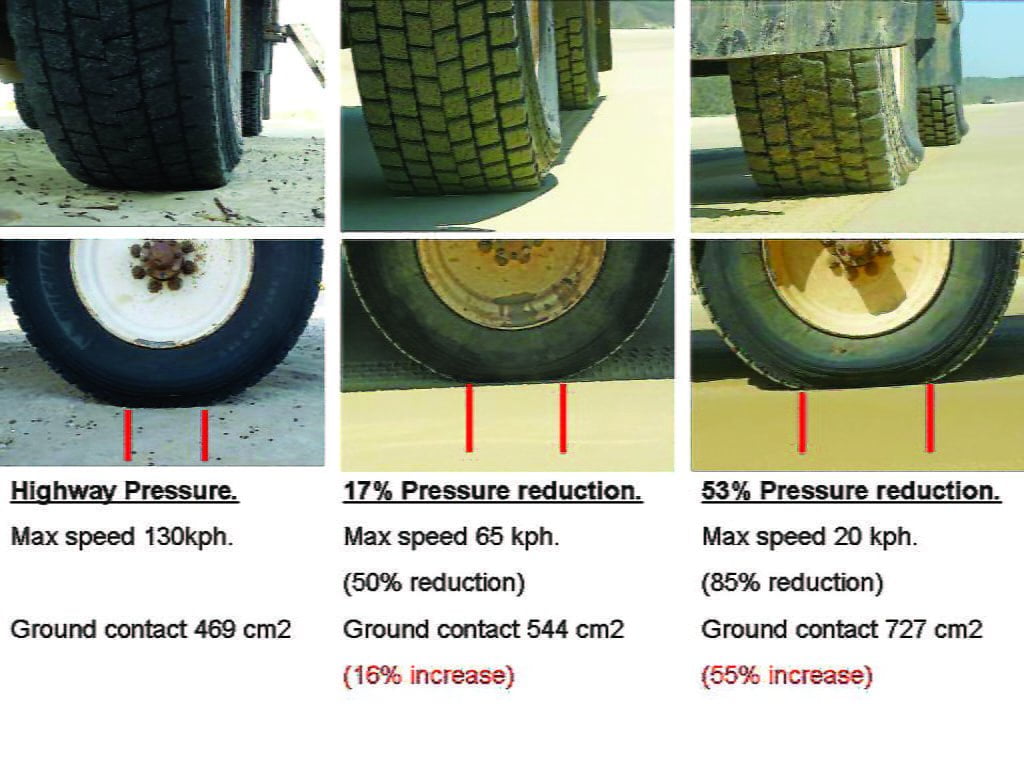
Motorhome and trailer tyres
by Collyn Rivers
Motorhome and trailer tyres
Motorhome and trailer tyres take a far greater beating than those in general use – an industry report noted that such tyres are subject to major abuse greater than any other form of use. In particular, stated the report, caravan and motorhome tyres are often grossly under-inflated and overloaded.
The best general usage motorhome and trailer tyres for use in Australia are LT (Light Truck) tyres. Be aware though that their heavier construction does not enable them to carry a heavier load. It enables them to run at or near their maximum load at all times.
The maximum load that a tyre can legally carry is a function of heat build-up. It is also speed-related. That heat build-up is greater with light truck tyres. Their thicker side-walls and tread support generate more heat as they flex. To minimise this they must be inflated to pressures higher than for the equivalent passenger tyres.

This tyre has either been grossly overloaded and/or underinflated. Pic: original source unknown.
Current trends
The current trend is toward larger rim diameters, lower tyre side-walls and greater widths. More extreme examples resemble ultra-wide bicycle tyres. There are various reasons for this. Increased rim diameter enables better brake cooling and/or creates space for larger diameter brakes. The low, wide profile provides more responsive handling and more precise steering. It also reduces side-wall flexing and hence heat build-up. As less energy is lost in heat and rolling drag reduced, less fuel is used. With these tyres, having the right tyre pressure is particularly important.
Caravan and motorhome tyres pressure also profoundly affects on-road behaviour, in particular the ratio of tyre pressures front/rear. This is too complex a topic to discuss here – but it is covered in-depth in my article Caravan and Tow Vehicle Dynamics.
Except for extreme off-road going (rock-hopping) tyres with normal on-road tread patterns are fine for dirt road use. They are actually better in the sand. I once drove a 1940 QLR seven tonne Bedford twice the length and breadth of Africa. This included two full Sahara crossings. The truck had standard 1100 by 20 London bus tyres. If interested see Last Drive Across Africa.
Pressures to use
Those caravan and motorhome tyres that are wide and of low profile run at pressures in excess of 750 kPa (over 100 psi). This is needed to maintain their profile and prevent their on-road footprint collapsing. This is (2016) still a problem in that many service stations compressors pump only to 530 kPa (77 psi). If travelling outside city areas buy a tyre compressor capable of doing this reliably with big tyres. If caught out, limit your speed to 65 km/h until you are able to have the tyre correctly inflated. Any major pressure difference seriously prejudices handling (especially in emergency situations).
Wide tyres improve on-road handling but are less effective in sand etc than high profile tyres. Tyre flotation is mainly a function of the length (not width) of the tread’s ‘footprint’. High profile tyres (such as 750 x 16s) extend that footprint length at low pressures. Low profile, wide tyres swell out sideways at low pressures but at far too high a level to be of any value in sand etc. Worse, they form a V shape that causes them to dig in.
Tyre footprints usefully lengthen as pressure is reduced. Pic: Peter Wright.
For dirt road use, lower caravan and motorhome tyres pressure by 20%-25%. Keep speed below 80 km/h to limit destructive heat build-up. Lower pressure also reduces the risk of a blow out when you hit a rock. The tyre ‘folds around’ it. (At full pressure tyres resist distortion. Rocks may punch through them on impact).
Makers’ recommend tyre pressures now allow for heat build increase in pressure of 4%-5% so they should only be adjusted when cold. They are thus slightly under-inflated but attain their correct pressure after 10-15 minutes driving. Do not lower them.
Knowing on-road weight
Correct caravan and motorhome tyre pressures are related to on-road weight. Caravan and motorhome weight varies with loading. The only reliable way to know that weight is (when fully laden and with water tanks full) to take the vehicle to a Certified Weighbridge and check individual axle loadings. If you advise the weighbridge operator beforehand that you do not need a Certified weight it usually costs less. Some do it free of charge. You must also add the weight of yourself and passenger/s plus all you intend to carry. Then ask the tyre maker’s technical department what pressure to use. (Do not attempt to guess the weight of personal effects, books, food etc – people who do tend to underestimate by at least 100 kg (220 lb), and often twice that).
Further information
This issue is also covered in depth in the 2nd edition of the author’s The Camper Trailer Book. It is also covered in depth in my Caravan & Motorhome Book.
If you liked this article Caravan & Motorhome Electrics, you are likely to also enjoy my books. Apart from the above, there are Solar That Really Works (for cabins and RVs) and Solar Success (for home and property systems). All are written from personal experience and in plain down to earth English. The author is an ex motor industry research engineer who switched careers mid-life to become a technical writer/editor and publisher.

Make caravan fridges work as claimed – here’s how to do it
by Collyn Rivers
Caravan Fridges
To make caravan fridges work as claimed, and draw less energy, is cheap, simple and easy. Many can be transformed. This article shows how.
Pic: Original source unknown
Fridges do not generate ‘cold’. They pump heat from where it is not wanted to somewhere it does not matter.
Big fridges use more energy than small ones, but not in proportion to their size. Doubling fridge volume will increase energy draw about one and a half times, not twice. Where feasible, use one large fridge – not two smaller ones.
Some cold air is lost when a fridge’s front door is opened. Top-opening fridges lose marginally less. The heat seals of door-opening fridges must be perfect, if they are not, energy usage soars. If they are over three years old, replace them.
Energy consumption
Any fridge’s energy draw relates directly to ambient temperature. All use about 5% more for every 1° C above 25° C. Set temperatures are the same. Fridges need to be +4° C, freezers -18° C (or settle for -14° to save energy).
Cool food before placing it in the fridge. Keep bought frozen goods cold in a heat-insulating bag, and put in the fridge as soon as possible. Defrost anything frozen in the fridge section. Let warm beer first cool overnight. If you keep the fridge full less cold air falls out when opened, so leave gaps for air to move, but fill empty spaces with bottled water.
Most fridges control temperature by cycling on and off. Energy draw relates to the ratio of on times to off times. A fridge that draws more energy but is on less often, or for shorter times, may use less energy per day. Many makers now produce fridges that run constantly: they vary the speed to maintain temperature. For any type of fridge only daily energy draw has any meaning.
Make caravan fridges work as claimed – from solar
It is totally feasible to make electrical caravan fridges work as claimed primarily from solar. A typical 40-110 litre chest and door opening electric fridge draws 0.7-1.0 amp-hours/day per litre of its volume. Larger ones draw slightly less per litre. This requires 150 to 200 watts of solar, and 100 to 150 amp hours battery capacity per 100 litres of fridge volume in temperate areas (up to 30º C). Above 30º C, solar capacity needs increasing by 5% for each 1º C. Alternator charging assists if driving a few hours each day. See dc-dc-charging/
Three-way fridges work well on gas, from the alternator whilst driving and 110/230 volts when available but their energy draw (12-30 amps at 12 volts) is far too high for solar. See below re ‘Climate Class’.
Unrealistic expectations
Fridges must be competently installed. Few are. Improve them by following that shown below. (Owners comparing fridges unknowingly discuss competent or otherwise installation).
No caravan fridge will cool a carton of room temperature beer in an hour or two! Buy beer cold and put it straight in the fridge. Fishers (particularly) grossly underestimate energy needed to freeze their catch. Power draws continuously, doubling or tripling consumption, yet the catch will not freeze quickly. Doing so requires a generator-powered chest freezer.
Correctly installed and sensibly used RV fridges will work as specified, but don’t get carried away by vendor’s claims. Believe the claims in technical data, not those in brochures.
Gas and three-way fridges must suit the climate in which they are used. If not they are not likely to work as you may expect.
Three-way fridges and climate class
Three-way fridges maintain cooling over tightly defined ambient temperatures. These are four (CEN standard) Climate Classes. The ‘SN’, and ‘N’ (Sub Normal, and Normal) units work up to 32° C; ‘ST’, (Sub Tropical) up to 36° C. ‘T’-rated (Tropical) up to 43° C. (T- and ST rated fridges do not work that well below 14°-18° C.) Only ‘Climate Class T’ cool satisfactorily in north and north-west Australia (or tropical areas generally).
Three-way fridges are available in Australia from Chescold, Dometic and Indel. They have an unfair reputation for poor cooling due either to buying one of the wrong Climate Class and/or poor installation. Three-way fridges meet their claims but must be installed as shown above to do so.
Make caravan fridges work as claimed – in tropical areas
When making a fridge work as claimed, it is common (but wrongly) to assume there’s more solar input in tropical areas. There is not. Solar input in the tropics in mid-summer is 20% to 30% less than many expect. High humidity causes haze and some solar energy is lost because of this.
It is also hot all day and often all night, so fridges draw up to 50% more energy, meanwhile, solar modules lose energy through heat loss.
To cope in tropical conditions, your solar system must bring batteries to float voltage in temperate areas by noon on most days
All this is thoroughly covered in my books Solar that Really Works, Solar Success and Caravan & Motorhome Electrics.
Installation
Few RV fridges are correctly installed, including many done ‘professionally’. Making caravan fridges work as claimed is usually possible: sometimes even better than claimed – and often at little or no cost. It is usually easy to do but in extreme cases, it may be necessary to totally re-install.
Here is a far from extreme example: it is of a $550,000 motorhome with a 450-litre fridge totally enclosed and unventilated, plus a 300-litre freezer. Both are in unventilated lockers with black fronts exposed to the sun. Neither cools below about 5 degrees C. Both connect to the battery via cable barely able to run LEDs. The RV maker refuses to accept responsibility – he blames the fridge maker! Fixing required a major rebuild of the kitchen area at a cost of over $10,000!
Heat must escape
Whilst seemingly obvious, a fridge must not be in direct sunlight:
One character, who has his outside in Broome’s full tropical sun, complains: “my b..y mongrel Electrolux won’t keep my %#@^& beer cold.” He’d listen to nobody (including me) explaining why – despite going through a 9 kg (20 lb) LP gas cylinder a week as a result.
The heat from a fridge must be able to exit the caravan – and not re-enter. To do this they need a cool air entry at its base level, and a hot air exit (ideally at roof level). Most need baffles to direct cold air so that it can only flow through or over the cooling fins. Baffles can be made from aluminium, plywood or even cardboard. They must be within a centimetre or two of the cooling fins. Channel rising warm air so none is trapped.
The cool air vent can be at the side or through the floor (but not above or behind an engine’s exhaust outlet). Cool air must enter below the lowest cooling fin and exit well above the highest fin.
The lower inlet is a problem off-road as dust is sucked in. Here, compromise is needed. One way is to have the vent closed off while on dirt roads (but cooling will suffer as a result).
Rising warm air is ideally vented to and through the roof: if not feasible, have a side vent well above the highest cooling fin.
Fridge level is important. Some three-way fridges tolerate 6° tilt, others only 3°, but electric fridges are less sensitive.
The vital requirements
![Make [cara] fridges work as claimed - here's how to do it - electric vehicle batteries,book on batteries,electric car batteries,lithium ion batteries for electric cars,electric car battery technology,how long do electric car batteries last,electric vehicle battery life](https://rvbooks.com.au/wp-content/uploads/2023/12/Fridge_installCombined.jpg "Make [cara] fridges work as claimed - here's how to do it 139")
Upper Left: – the baffles are too short. They need to be just below the cooling fins. Rising hot air is trapped in the dead air spaces. If not fixable (bottom centre and right), an extractor fan driven by a 5-watt solar module enhances airflow. Upper right: – the upper air vent is far too low – hot air is trapped in the fins above it, to prevent that, baffles are needed. Below: How to install fridges correctly. Baffles truly help, yet rarely used. Rising hot air is channelled to the outside. Drawing is copyright: rvbooks.com.au
A small extractor fan often assists. Some have an integrated solar panel – this works well as cooling is most needed when sunny. Fans used in large desktop computers are cheap. They run directly from a 5-10 watt solar module or the RV’s 12-volt system. Ideally use fans to extract warm air rather than pumping in cool air – but the difference is minor.

Solar-powered extractor fans (Google for suppliers)
Electrical problems with 12-volt fridges
Most 12 volt fridges have grossly inadequate cabling – many only 25% of that required. Check by seeing if the fridge cools better on 230 volts (where relevant). Cable issues are worsened by faulty fuse holders: and particularly cigarette lighter plugs and associated too small wiring. Scrap such plugs and wire the fridge to the battery by the shortest route.
To check if the cable is too small, with the fridge running, measure the voltage directly across the battery, then directly across the fridge. To ensure it keeps running, do this with the fridge door open. Many caravan fridges have close to 1.0-volt drop. Accept no more than 0.15 – 0.2-volt drop.
Using adequate cable makes an extraordinary difference to make caravan fridges work as claimed. For an electric fridge to battery distance of fewer than four metres, use 4 mm² cable (AWG/B&S 11). Over four metres use 6 mm² cable (AWG/B&S 9). If over four metres, move the battery closer.
Do NOT use the auto cable sold by auto parts and hardware stores without first reading about it below – or in more detail in Caravan & Motorhome Electrics.
Do also see DC-DC Charging – this shows how ensure the caravan battery and fridge receive their full required voltage from the vehicle alternator. This can totally transform a caravan or camper trailer fridge.
Auto cable problems
Appliance makers specify cable by its cross-section in mm². Auto cable makers (in effect) specify it by the size hole you can just push it through. They rate it by its overall diameter including insulation!
Auto cable sold as 4 mm is typically 1.8 mm², but maybe only 1.25 mm². Many caravan electric fridge makers specify 4 mm². But countless fridges are connected by totally inadequate 1.8 mm² auto cable (less than half the minimum specified). No fridges wired that way work remotely as they should and usually can. Direct comparison with other wire gauges is impossible with auto cable as conductor size varies from maker to maker. One exception is that 6 mm auto cable (typically 4.59 mm² – or 10 AWG) can be substituted for 4.0 mm² cable.
Cable current rating trap
Cable ‘ratings’ (e.g. ‘50-amp’ etc) indicate only the current that cable carries before it melts! They tell nothing about voltage drop (as that is also a function of cable length). It’s useless asking most vendors about this because few know it’s even an issue – let alone why. For caravans, locate the battery close as possible to the fridge. If alternator charged, install a dc-dc alternator charger close to that fridge’s battery.
Never use cable lighter than advised above. If you do the fridge cannot work correctly
An exact way of establishing the best cable size is shown in my books, Solar that Really Works, Solar Success and Caravan & Motorhome Electrics.
Problems with three-way fridges
Routine maintenance is required. Check the flame colour: it should be blue. If yellow (or the fridge works well on 12 volts but not on gas), the baffle inside the flue is likely coated with soot. Soot etc also drops down and affects the burner.
Wearing safety glasses and old clothing, use a powerful air compressor to clean that baffle. Do likewise around the burner. Be aware this is a filthy job. You may prefer a fridge repairer to do it – and have them check the LP gas pressure at the same time.
Whilst uncommon, an LP gas fridge may suddenly stop working. This is usually caused by a ‘vapour lock’ due to the caravan being excessively out of level. You can usually fix this by turning the fridge off, and make sure the caravan is level (within 3 degrees) – then turn the fridge back on after a few hours.
A cause of cooling issues with gas fridges in imported RVs (or imported gas fridges) is if they are made for LP gas in a different country. If so, the jets can the wrong size. If so, seek expert advice.
Use three-way fridges as their makers intend. Run them on 12 volts only whilst driving or an hour or so from the battery because they draw too much energy to run from solar.
For caravans, use heavy cabling – ideally 10 to 13.5 mm² – from the alternator to the caravan battery. Consider installing a dc-dc alternator charger close to that caravan battery. Use at least 6 mm² cables from that battery to the fridge.
Make caravan fridges work as claimed – in cars and 4WDs
Making caravan fridges work as claimed in cars and 4WDs is more of a problem. Keep them out of direct sunlight, and leave air space around the grill’s vent areas. It is fine to pack stuff close to or touching them – except for the types shown below (these must have a 50 mm air gap each side as the heat dissipates from their sides).
You can improve all types of fridges (some dramatically) by running a 6 mm² (8 AWG) cable directly from the battery to that fridge (a maximum of four metres away). Use 6 AWG if the distance exceeds four metres.
A few boat and RV fridges, such as this Australian designed and made Autofridge, dissipate heat from their side-walls. These fridges must have an air gap of 50 mm each side. Pic: Autofridge Australia.
Fridge issues generally
Do not over-pack RV fridges as space is needed to allow cool air to circulate.
Door seals leak after a few years. To check, insert a strong strip of this paper (e.g. a banknote) between the door and the seal (at various places around the door) and see if it grips. If not cool air escapes, so replace the seals every three to five years – you can buy replacements from stores such as Clarke Rubber.
Fridges with external cooling fins benefit by adding extra heat insulation. Some fridges, however, such as the Intel and Autofridge (pic above), dissipate heat from their side-walls. If possible have a cool air feed to the base of their sides. They must have an air gap (of 50 mm or so) at either side and their top.
Make caravan fridges work as claimed – summary
It is totally possible to make almost all RV fridges work as claimed (or even better) via the work described above.
Except for the very cheapest fridges, dismiss claims of inherent deficiencies. If a fridge is appropriate for its proposed use, problems are almost always due to faulty installation. For domestic fridges, and fridges in cabins, virtually all of the above is relevant.
Further reading
A great deal more on how to make fridges work as claimed is in my book Caravan & Motorhome Electrics. It even shows how to build your own fridge that leaves commercial units for dead in cooling and economy. That book includes a lot of information about running them from solar. So does Solar that Really Works!
If the fridge is large and in a large home or on a property consider also Solar Success.
There is detailed information about every aspect of caravans and motorhomes in the Caravan & Motorhome Book. For camper trailers see the now second edition Camper Trailer Book.
If you find this article useful you will find my books even more so. Each has updates at typically yearly intervals. RV Books accepts no advertising. It does not accept payment for editorial. It covers the cost of all articles solely from the sale of the associated books.
Weight Distribution Hitch limits cornering
by Collyn Rivers
WDH Cornering Issues
This article explains why a weight distribution hitch limits cornering. A weight distribution hitch is often referred to as a WDH.
A caravan‘s essential need to be front-heavy imposes a down-force (weight) on the rear of the tow vehicle. It is like pushing down the handles of a loaded wheelbarrow. It reduces the down-force (weight) on the tow vehicle’s front tyres.
If the laden caravan weighs the same (or less) than the laden tow vehicle the weight transfer effect is minor. In Australia, however, caravans increasingly (and undesirably) outweigh the tow vehicle.
A Weight Distribution Hitch (WDH) assists to restore that otherwise ‘lost’ weight. In doing so, however, a WDH inherently reduces the rigs’ cornering ability.
Furthermore, a WDH reduces the speed at which a rig may become terminally unstable if subjected (for example) to a strong side wind gust from a passing truck. The tighter the WDH is adjusted, the lower the speed at which instability may occur.
That rig is likely to be safer with that WDH, but you need to accept its limitations and downsides – and how to adjust that WDH and drive accordingly.
Adequate tow ball weight is essential
Tow ball weight is essential. It enables a towed caravan to stay in a straight line unless steered by the tow vehicle. The tow ball weight needed relates to the caravan‘s length and loading. The longer the caravan, the greater the tow ball weight required.
For correctly laden caravans (i.e. weight mainly centralised), about 10% of the caravan‘s laden weight should keep the rig stable up to 100 km/h. If the tow ball weight is less than 10%, the rig may become unstable at lower speeds, particularly in emergency swerves at speed.
That tow ball weight is imposed on a hitch that is (on average) 1.2-1.5 metres behind the tow vehicle’s rear axle. With locally-made caravans, the imposed weight maybe 250-350 kg (550-775 lb). Increasingly, however, many new tow vehicles, however, are unable to cope with that weight. It may over-stress the chassis (or rear body structure) and/or the rear suspension and tyres. This particularly affects post-2015 vehicles as, in that year; most manufacturers of vehicles used for towing reduced the chassis thickness (from 3.5 mm to 3.00 mm).
How a Weight Distribution Hitch Works
Tow ball weight pushes down the rear of the tow vehicle – thereby increasing the weight on its rear tyres. A WDH, in effect, is a semi-flexible springy beam that levers back up the rear of the tow vehicle and levers down its front. In doing so, however, it reduces the imposed load on the tow vehicles rear tyres and partially restored it on its front tyres. Reducing the load on the tow vehicle’s rear tyres reduces their ‘cornering ability’. This is why a WDH limits cornering.
The main failing (often overlooked) is that a WDH only addresses caravan down-force. It does not (and cannot) reduce the side forces imposed on the rear of the tow vehicle when the caravan yaws (sways). If, as not uncommonly, fitting the WDH extends the hitch rear overhang, it makes those yaw forces even worse.
The effect of yaw forces on the tow vehicle
The yaw forces described above are imposed on the tow vehicle’s rear tyres. The WDH, however, has reduced the weight carried by those tow vehicle’s tyres. That reduced weight reduces those tyres ability to resist the yaw forces.
If/when the rig starts yawing, those (yaw) side forces literally steer the tow vehicle by its rear tyres, and e.g. those side forces increase their slip angle. In emergency situations, this can cause the tow vehicle to oversteer. If that happens, and within a few seconds, sway forces escalate to jack-knifing. No matter how skilled this sequence cannot be driver-corrected.
The faster the rig is being driven the more serious the situation. This is because yaw forces increase with the square of the rig’s speed. In other words – the forces are four times greater at 100 km/h than at 50 km/h.
The speed at which the above happens is related to tow ball weight. The lower that weight the lower the ‘safe’ speed. This is why caravans with front-located water tanks were mostly recalled – as ‘safe tow ball weight relied on those tanks being full at all times.
WDH adjustment and front axle load restoration
For stability at speed etc all road vehicles have a margin of so-called minor understeer. If a vehicle is cornered too fast, understeer automatically causes that vehicle to take up a slightly wider radius – thus reducing the cornering forces. Understeer’s opposite (‘oversteer’) causes a vehicle to tighten its turning radius yet more and more – until that vehicle spins.
An inherent effect of a WDH is to reduce the tow vehicle’s margin of understeer. It is essential to adjust the WDH to keep that reduction within acceptable limits.
WDH adjustment
The Society of Automobile Engineers’ Standard J2807 requires that a WDH must never be used to level the rig. Doing so results in transferring excess weight to the tow vehicle’s front tyres, and reducing the weight on its rear tyres. This effect is often misunderstood (even by some WDH vendors). It reduces the essential margin of understeer.
The recommended so-called ‘50% Front Axle Load Restoration’ results in the front wheel arch of the tow vehicle being about 50 mm higher when the laden caravan is hitched up. The caravan‘s nose may be down slightly. This just fine – do not attempt to level it: those days have long gone.
How to adjust the WDH to do this is shown in https://rvbooks.com.au/page/caravan-tow ball-weight/
See also https://rvbooks.com.au/tow-vehicle-caravan-weight-ratio-explained/. It explains how to load a caravan safely.
Never use a WDH with a caravan, that when laden, weighs the same or less than whatever tows it. There is absolutely no benefit, and doing so may introduce undesirable effects.
All the above and a great deal more is explained (in plain English) in our (digital) book ‘Why Caravans Roll Over – and how to prevent it’. It is available in various formats – and costs far less than fixing a rolled caravan.
Weight distribution hitches and Land Rovers
Whilst repeatedly being queried on a local Caravan‘s forum, Land Rover’s position regarding the use of a WDH on its products is totally clear.
In Land Rover’s own wording. ‘Do not exceed the Gross Vehicle Weight (GVW), maximum rear axle weight, maximum trailer weight, or the trailer’s nose weight. Doing so can cause accelerated wear and damage to the vehicle, and adversely affect the vehicle’s stability and braking. Serious injury or death can also result from a possible loss of control leading to an accident.
The use of weight distribution hitches is not recommended. Using weight distribution hitches can potentially cause serious damage to the vehicle.’
http://www.ownerinfo.landrover.com/document/LS/2016/T22693/18742_en_GBR/proc/G1800997
In essence that which Land Rover is saying is that if you tow a sensible weight caravan you do not need a WDH. If you do use one, however, the action of that hitch adversely interacts with the Land Rover’s automatic levelling system.
Comments
RV Books cannot respond to any direct questions relating to why a weight distribution hitch limits cornering. Various other articles on this website address other issues relating to tow vehicle and caravan stability.
RV Books updates this article when deemed necessary.
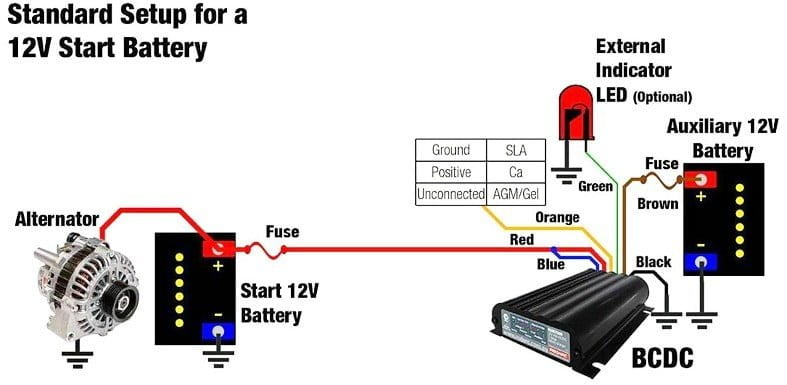
Dc-dc charging – how to speed alternator charging
by Collyn Rivers
Dc-Dc Charging
Dc-dc charging charges boat, cabins, camper trailer, caravan and motorhome batteries faster and deeper. Collyn Rivers explains how and why.

Pic: original source unknown.
A rechargeable battery is charged by applying a voltage higher than the battery already has. The higher that voltage difference the quicker such a battery charges. As a battery charges its voltage rises. If that charge voltage is constant, however, the difference between that and the charging battery falls.
Alternators charged at a more or less constant 14.2-14.4 volts until 2000. A few still do. Batteries so-charged rarely exceed 80%. As a result, many in caravans never exceed 65%. Moreover, they take hours for even that.
For some years after, many alternators were temperature controlled. They charged at 14.1-14.2 volts when cold. This reduced to about 13.2 volts once warm. Both types can be made to work well for battery charging via dc-dc alternator charging described below.
Variable voltage alternator charging was introduced around 2013. These are controlled by the engine’s central computer unit. They vary the voltage from 15.4 volts to 12.3 volts. Some drop voltage to zero.
How starter batteries are charged
A vehicle’s starter motor is designed to work with 70%-80% charged batteries. The energy required to start cold engines is tiny. It’s less than 2% of battery capacity. This is typically replaced within two minutes. It’s cheap, rugged and simple. Fine generally for starter battery charging – but not for RV use.
Dc-dc charging
Dc-dc alternator charging overcomes these problems. Working fast, deeply, yet safely, it accepts whatever voltage available. Next, it converts it to that optimally required. It bulk charges at whatever current the battery accepts. Such units thus constantly increase charge voltage as battery voltage rises. This enables charging fully, deeply and rapidly.
Such technology, used for telephone exchange batteries for decades, was later adapted for vehicles. See Battery charging and battery chargers.
Dc-dc charging truly scores with batteries distanced from the alternator. Voltage drop prejudices charging, and fridge operation. Heavy cable is necessary. Locating the dc-dc unit close to the battery ensures adequate voltage. It also extends battery life and can transform three-way fridges.
Voltage sensing relays
These systems require a VSR (voltage sensing relay). The VSR senses starter battery voltage. It directs charge to that battery for two to three minutes after starting. It allows auxiliary battery charging once the starter battery exceeds 13.6 volts. The VSR isolates the starter battery if it drops below 12.6 volts. Some dc-dc chargers have VSR functionality inbuilt.
Regenerative braking
Many hybrid vehicles use regenerative braking. Their starter battery is normally 80% charged. Braking increases alternator voltage. This boosts battery charge to 100%. The battery then provides all electrical energy required. During this, alternator output is zero or too low for charging. This causes the VSR to open. That precludes auxiliary charging for minutes each time.
Regenerative braking necessitates dc-dc charging. It is often known as bc-dc. With this, the charger senses the starter battery voltage. I cover these units in Variable voltage alternator problems with caravans/ The article also shows how to know your alternator’s type.
Bc-dc units are made by companies including Redarc and Sterling Products. Some companies now produce all such products as bc-dc. Moreover, those for use with variable voltage alternators are of Low Voltage form (see above Link).
Installation is generally similar to that below. There is, however, no voltage sensing relay. A signal lead is taken from the ignition switch. Makers give full details.
Installing dc-dc charging
Dc-dc charging ensures a battery is alternator-charged safely, deeply and fast. Ensure this locating the charger close to the main energy load and battery. That load is typically a fridge or fridge freezer.
Dc-dc charging optimises charging but you still need adequate cable. Use 10 mm² (ideally 13.5 mm²) from source to charging unit. Makers explain this – but rarely stress its need.
Most such units ensure starter battery charge priority. Recharging generally takes only two to three minutes. If inbuilt protection is not provided (excepting for bc-dc units) a VSR must be used.
Some dc-dc charging units have an inbuilt solar regulator, and/or mains battery charger. The sketch below shows a typical installation.
Installation may vary from brand to brand and type to type. The unit shown will charge an auxiliary battery from a 12-volt alternator. Furthermore, it does so at up to 40 amps.
How to install a typical dc-dc or bcdc charger. The function safeguarding starter battery voltage is inbuilt. Pic: Redarc.
Programming dc-dc charging
Different battery types require different voltage/current settings. Dc-dc chargers have programs accordingly. No programming is needed for alternator voltage. The systems accept whatever that is.
Lithium (LiFePO4) batteries have different needs. Redarc consequently has units specifically for this purpose. It stresses they be used only with LiFePO4 batteries they recommend.

The specialised Redarc LFP series of dc-dc battery chargers for (specific) LiFePO4 batteries. Pic: courtesy of Redarc.
Issues with dc-dc charging
Basic dc-dc alternator charger does not work well (or at all) with variable voltage alternators. Moreover, doing so may damage the auxiliary battery/s. See above re bc-dc charging.
Initial charging of a deeply discharged battery is generally limited to a basic dc-dc charger’s capacity. Dc-dc chargers under 20 amps may take longer to attain half charge. Thereon, charging is hugely faster. The CTEK Smartpass dc-dc charger overcomes this. Moreover, it allows direct alternator charging until dc-dc charging takes over.
This is of less issue with 30-50 amp units. With these, charging limitations are mostly alternator output, and (for some batteries) the maximum they’ll absorb. This is a lesser issue with gel cells and AGMs. It is not an issue with LiFePO4s.

Pic: CTEK ‘Smartpass’ dc-dc charger. Pic: courtesy of CTEK.
Further information:
If you like this article you’ll truly benefit from my books. All are in down to earth English. Moreover, they are technically accurate. Furthermore, batteries and battery charging is covered in depth in Caravan & Motorhome Electrics.
Solar that Really Works! covers cabins and RVs. Solar for larger homes and properties is covered in Solar Success. The Camper Trailer Book and the Caravan & Motorhome Book cover innumerable issues in depth. Click for my Bio.
See also the many articles on this website. Moreover, click here for Article index.
If you like this article, do please add this Link to any related forum query. Moreover, doing so assists others as well as RV Books!
Battery charging and battery chargers – how to do it properly
by Collyn Rivers
Battery Charging
Battery charging and battery chargers are often misunderstood – causing batteries to die before their time. This article explains why and how to avoid it.
Batteries charge by applying a voltage that is higher than that existing. The greater the voltage difference, the faster and deeper it will charge. That voltage must, however, be tightly controlled. If too high, it damages or wrecks batteries.
Historically, vehicle alternators generated 14.2-14.4 volts. Cheap battery chargers still do.
As the battery charges, its voltage rises towards the charging voltage. The voltage difference between the battery and the charger thus constantly reduces. The charging rate falls accordingly.
Battery charging and battery chargers – like filling one tank from another that’s much bigger
Charging is like filling a small tank from a huge one (of similar height) via a hose between the bottom of each. The water level in the small tank slowly rises until levels equalise. As with ponds, alternators need not know the battery state of charge. The charging battery simply rises in voltage. As it does so, charging tapers off. Eventually, voltages are equal. Charging then ceases.
Many RV batteries charge this way. They take many hours to fully charge. Most never do. Given many days continuously, however, they may even overcharge.
Starter batteries
A starter motor draws surprisingly little energy. Following engine starting, the alternator replaces it within two to three minutes. Such charging is crude but cheap and simple. It works well enough for starter batteries, but less so for RV auxiliary batteries. These are limited to slow charging. Few reach full charge.
Constant current charging
Serious battery charging is done at constantly increasing voltage. This maintains a constant rate of charge current throughout 80-90% of the charging cycle. A final stage is usually done at a constant voltage. There are variations. All, however, work much as below. Conventional lead-acid, gel cell and AGM batteries are similarly charged.
Lithium-ion batteries, however, require a different regime. This is described later in this article.
Boost stage
The initial ‘Boost’ stage constantly increases charging voltage as the battery voltage rises. Its intent is to keep charging current at the battery’s safe maximum. For a lead-acid deep cycle battery that’s typically 20% of its amp/hour capacity. For large batteries, that limit may the battery charger’s ability to do so.
Boost typically continues until the battery voltage reaches about 14.4 volts. That battery is nevertheless not yet fully charged.
Absorption stage
Battery charging is an electro-chemical process. Like many such, it is slow. The charge, in effect, is held within the water/acid electrolyte. At this stage, however, the ‘charge’ is uneven. It is concentrated in and around the battery’s plates. Evenly distributing the charge requires ‘absorption’.
Absorption is typically at voltage ensuring charge current is about half that previously. It typically requires two or so hours.
Float stage
Following Absorption, charging current reduces such that it counterbalances battery internal losses. This stage is called Floating. It is 13.2-13.6 volts for AGMs and gel cells. Conventional lead-acid batteries require 13.6-13.8 volts.
As with the Absorption stage, charging revert to Boost if battery voltage drops. This may happen if there’s a heavy load.
Keep lead acid deep cycle batteries as fully charged as possible. Their life is otherwise shortened. If an RV is unused for more than a week or two – keep its batteries on Float charge.
AGM batteries, however, hold 50%-60% of their charge for a year or more. Whilst rugged, even minor long-term overcharging damages them. Unused AGMs need to be initially fully charged – then only after every 6-12 months. Do not leave them on ‘float charge’. It may ruin them.
Equalising
Some chargers have (usually optional) ‘Equalising’. This heavily overcharges the battery for an hour or two.
The original idea was to equalise cell voltage. Technology changes, however, render it unnecessary. Most battery makers now recommend against it. Never do it AGMs, nor gel cells. Nor, in my opinion, with any battery.
Different battery types require different voltage/current settings. All good quality battery chargers are programmable accordingly. Currently, only a few have programs for LiFePO4s. See ‘Lithium-ion battery charging’ below.
Caution when buying a battery charger
Always use a high quality multi-stage battery charger. Cheap ones sooner or later wreck costly batteries. A multi-stage charger brings a battery up to charge rapidly, deeply and safely. A 10 amp multi-stage charger will thus outperform almost all ’20 amp’ conventional chargers. And many a ’25 amp’ cheapie. Good chargers start at about $250.
Lithium-ion battery charging
A lithium-ion (LiFePO4) cell is nominally 3.2 volts. A 12-volt such battery thus has four such cells. Charging is typically at constant current. It requires 13.2-13.6 volts. This charges the battery to about 80%-90%. Many users settle for about 80%.
It is vital that each LiFePO4 cell maintains equal voltage. Ensuring this requires cell management. This also prevents current draw below a preset state of charge. These systems are available from LiFePO4 vendors. They may not, however, be included with the battery. It is essential one be used.
LiFePO4 state of charge
LiFePO4 state of charge is difficult to assess by measuring voltage. A 100% charged 12 volt LiFePO4 battery maybe 13.4 volts. In typical RV use, this drops to 13.1-12.9 volts at 90% or so charge. It’s then virtually constant until 10% remaining. It then drops rapidly.
Some battery charger makers include a final voltage charge. This brings a LiFePO4 close to 100%. Many users, however, claim this shortens battery life. This may well be so. Reliable evidence, however, is not readily available. See Lithium-ion batteries in caravans for an overview.
Solar Regulators
Good (plus $275) solar regulators have multi-stage charging. The better ones include MPPT (multiple power point tracking). This recovers 10%-15% of energy otherwise lost.
Further information
See also DC-DC charging – also Speeding Battery Charging from a Generator and also Lithium-ion Batteries in Caravans
If you liked this article you will like my books on RVs and solar. Batteries and battery charging are covered in depth in Caravan & Motorhome Electrics. Solar That Really Works! is for cabins and RVs. Solar Success relates to homes and properties. See also the Caravan & Motorhome Book and the Camper Trailer Book.

LP Gas risk in caravans – deaths & brain damage still occurs
by Collyn Rivers
LP Gas Risk in Caravans
A major LP gas risk in caravans is carbon monoxide build-up. Low levels cause brain damage and death at high levels. Here’s how to eliminate the dangers. Carbon monoxide builds up as a direct result of burning LP gas in any inadequately ventilated confined space. The risk in RVs is high enough to take seriously. Since 2009 about 12 people (in Australia alone) died in caravans due to the above. In the USA it typically exceeds 1000 people a year. Far more have suffered brain damage.
The earlier so-called coal gas produced by burning coal in the virtual absence of air resulted in 10% or so carbon monoxide. It was so potentially lethal that it was used with caution. LP gas, however, has a lower carbon monoxide content. It takes longer to kill. Nevertheless, ‘some 30% of people with severe carbon monoxide poisoning are likely to die as a result’. [1]
LP Gas risk in caravans – quantified
Inhaling even relatively small amounts of the LP gas can lead to hypoxic injury, neurological damage and even death’ [2]. Carbon monoxide exposure may lead to a significantly shorter life span due to heart damage [3]. Exposures at 100 ppm (part per million) can be dangerous to human health [4]. Carbon monoxide poisoning is the most common cause of injury and death due to poisoning worldwide. [5].
About 35 ppm (parts per million) of carbon monoxide causes headache and dizziness within six to eight hours. Some 200 ppm (about 0.02%) causes a slight headache within two to three hours. Plus loss of judgment. At 800 ppm (0.08%) there are dizziness, nausea, and convulsions within 45 min. There is insensibility within two hours, and death within three.
At 1600 ppm, and still only 0.16%, there is ‘headache, tachycardia, dizziness, and nausea within 20 min. Death occurs in less than two hours. Even at 6400 ppm (0.64%) death occurs inside 20 minutes. At a far from high 12,800 ppm (1.28%), you become unconscious after 2-3 breaths and will be dead in less than three minutes’. [6]. The natural atmospheric level is about 0.1 ppm. The exhaust from a warm car’s exhaust that lacks a catalytic converter is 7000 ppm. [7]
The main causes of LP gas risk in caravans
LPG and fossil fuels require a lot of air to burn safely. Doing so in an enclosed space increases LP gas risk in caravans. It decreases the oxygen content, thus increasing carbon dioxide concentration. The amount of air required varies with the nature of that gas. Appliances mostly used in boats and caravans etc. are intended to run from propane. If used, as some do (illegally plus dangerously) with Autogas, incomplete combustion may produce more carbon monoxide.
That Autogas may not be used for any purpose than its original intent is covered in various legislations. The main one is Clause 5.1.1 of AS/NZS 5601. This states that appliances must be designed, verified and certified to use only a specified gas. No domestic appliance is so certified.
It is also forbidden under 9A (1) of the Gas Safety Act 1997. This in effect recognises that Autogas has a composition other than LP gas.
Incomplete combustion is indicated by a yellow content in the flame. As 100% burning cannot be guaranteed, space heating in Australia, and many other countries, thus requires burning to be sealed from the space heated.

LP gas (in this case it is propane) should burn with a totally blue flame. Any trace of yellow indicates incomplete combustion – and the generation of carbon monoxide.
Direct oxygen deprivation
Increasing the LP gas risk in caravans is that our breathing contaminates the air. We take in about a half a cubic metre of air every hour. Of that, we convert about 4% of into carbon dioxide. The exhaled carbon dioxide level thus rises. The available oxygen level falls. The latter is normally 21% or so. It may, however, drop to 15% before symptoms (such as fatigue) set in. Oxygen deprivation through this alone has been tragically demonstrated. ‘Illegal’ migrants have been asphyxiated inside sealed trucks.
The risk of brain damage at lower levels of exposure, where ventilation is poor, is only too real. Those over 40 or so, children, and people with heart and respiratory problems, are likely to suffer from the effects. They do so sooner and more severely as may heavy smokers.
LP Gas risk in caravans – Australian government study
As a result of ongoing deaths, a formal (Australian) initiative made people (particularly caravan users) aware of the risks. It was called the ‘Gas Appliances (Carbon Monoxide) Safety Strategy’. I prepared the formal submission for the Caravan and Motorhome Club of Australia.
That submission included: ‘Our view is not so much that the existing regulations relating to LP gas installation in RVs necessarily need changing. It more that owners do not take the known risks sufficiently seriously. That is shown often, not only on (the then) cmCA’s forum. It happened (and still does), on other forums.
I noted that ‘the major risk identified (in our opinion) is that of LP gas appliances being used in an inappropriate manner. For example, LP gas ovens left on with the door open to provide heat. Iron plates and ceramic pots placed over LP gas rings for the same purpose’. I also alluded to ongoing illegal use of LP gas catalytic heaters ‘in poorly ventilated annexes and within the RV itself.’
The submission also noted: ‘A further issue is the often alleged lack of quantitative data on reported incidents of carbon monoxide poisoning in RVs. This has created concern because warnings of the dangers are frequently met by denial. The basis of that is typically ‘that no hard data is available.’ There is, however, ample such data.
LP gas risk in caravans – Australian government action
Rules regarding LP gas risk in caravans have since been tightened in the USA, Australia and New Zealand. The previous Australia-only Gas Standard has been replaced by the joint AS/NZS two-part Standard AS 5601.2013. That RV relevant is Part 2. (Gas Installations in caravans and boats for non-propulsive purposes). Legally ‘caravans’ now includes all RVs.
As with its predecessor, AS 5601:2013 states, ‘amongst appliances that shall not be installed in a caravan is a space heater, other than a room-sealed type.’ This rules out suggesting gas oven doors be left open to heat a caravan. And similar idiotically dangerous suggestions.
(AS/NZS standards define RVs as being/: ‘a structure that is or was designed or intended to move from one place to another, whether towed or transported, which is intended for human habitation . . . and includes a self-propelled recreational vehicle.’)
Item 6.9.4 of the new Code thus calls for a permanently legible warning. This must have a minimum character height of 4.0 mm. It must be affixed ‘in a conspicuous position on or adjacent to, the ‘[gas cooking]’ appliance and shall provide at least the following information:’
WARNING
Ensure ventilation when the cooker is in use.
Do not use for space heating.
Appliances defined
It is for very good reason that using LP gas for direct space heating in caravans is illegal throughout Australia. Further, any cooking appliance used for space heating by any form of burning gas is defined as a ‘gas appliance’.
It is still occasionally argued that a ceramic pot or whatever placed over a gas ring, or an oven door left open is ‘not an appliance’. This overlooks that devices are legally defined in terms of intent. Not necessarily content. A screwdriver may thus be defined as a device for dealing with screws. Or in dangerous areas at night, as an offensive weapon. The same reasoning extends to LP gas cylinders and cans of petrol. Either, carried onto a plane, is designated a bomb.
Safe heating
Germany’s Webasto and Eberspächer companies produce (very similar) diesel-powered space heaters and space plus hot water power heaters. The Eberspächer product is also sold under the name Dometic. There are also many look-alikes. Truma has an LP gas-powered equivalent.
All draw fresh air in from outside and exhaust to the outside. These are the only form of heating that can be recommended for cabins and RVs. They are fully covered in the Caravan & Motorhome Book and The Camper Trailer Book.
Ventilation openings
The minimum free area of the permanent ventilation that must be provided is defined in Section 7.3.1 of AS/NZS 5601:2 2013. This applies also to a pop-top caravan whether the top is up or down. This must be at least 4000 mm², or that value from the formula below (whichever is larger):
V = (610 X U) +( 650 x P)
V is the minimum free area (in square mm) where:
U is the input rating for all gas appliances, including the cooker, in MJ/h (as on the rating plate) P is the number of persons for whom the ‘compartment’ is designed.
The Standard stresses this is the minimum required. It should be exceeded where feasible. It also notes that mesh or screen reduces the ‘free area’. That must be allowed for. The openings must be at opposite ends or sides of caravans. But not, however, in the rear wall of a ‘motorised caravan’ (e.g. motorhome).
New Zealand
Until 2010, the then Gas Standard (AS 5601) related only to Australia. This was primarily because Australia’s LP gas is either propane or mostly propane with a small proportion of butane. That in New Zealand is propane and up to 50% butane.
Appliances built to burn one form of LP gas can be hazardous when used to burn another. The Gas Regulator’s view was that (as with using Autogas to replace LP gas) it poses an unacceptable safety risk to New Zealand and Australian consumers. This issue is now resolved. The reference is ‘Australian RV appliances increasingly being certified for use with Universal LPG Gas to accommodate the NZ market’. It was from the NZ Office of Energy Safety, 18/09/2012.
(This ‘Universal LP gas’ issue affects only Australian gas appliances made for the NZ market).
Proffered advice and ongoing denial
The ‘advice’, commonly found on website forums to the effect: ‘it is only dangerous if you do not stay awake’ etc shows an astonishing lack of understanding. Doing that oneself is dangerous enough. To advise others to do is seriously illegal.
Were someone to die as a result of following such advice, the consequent charge can even be manslaughter. Further, those inciting others to perform an illegal act, commit a criminal offence.
This came to a head in early 2012. Three men died from carbon monoxide poisoning in a caravan in Tasmania. Despite the Coroner’s report not then published, and media reports based on speculation, many forum posts denied that LP gas was the cause.
References (general)
References to local usage are in Australian Standard AS 5601:2013. This is now in two parts. Part 1 is for domestic applications, Part 2 is for caravans and boats. ‘Caravans‘ is used there as a generic term for any transportable structure.
These Standards are hugely costly but until recently could be obtained on loan by most public libraries
Further information
See also my Safe caravan and motorhome heating. Further information on gas installation is provided in the Caravan & Motorhome Book, and The Camper Trailer Book. My other books are Caravan & Motorhome Electrics, Solar That Really Works (for cabins and RVs). And Solar Success (for homes properties). For details of the author’s background please Click on Bio.
Almost all of the above article is applicable also to New Zealand.
AS/NZS 5601(2013) Parts 1 and 2, Published by the Standards Association of Australia.
AG 601 – 1995 Gas Installation Code, published by (the Australian) The Gas Installation Code Committee.
The Annual Report of the (SA) Technical Regulator 2005-2006 (p.7).
Office of Gas Safety (Vic) – Guide to Gas Installations in Caravans & Motorhomes.
Similar guides are available from all state gas regulatory bodies.
New Zealand (facts and data) – Permanent Exemption of LPG appliances from the Trans-Tasman Mutual Recognition Arrangements. (Regulation Impact Statement for Consultation – 2008.)
References – specific
I research topics routinely prior to writing anything technical – but rarely include such references in material intended for general reading. I include references (from refereed papers from major journals etc) here to stave off ‘that’s just your opinion’ responses.
1. Varon J, Marik PE, Fromm RE Jr, Gueler A (1999). “Carbon monoxide poisoning: a review for clinicians”. The Journal of Emergency Medicine 17 (1): 87–93.
2. McDowell R, Fowles J, Phillips D (November 2005). “Deaths from poisoning in New Zealand: 2001-2002” (Free full text). The New Zealand Medical Journal 118
3. Raub JA, Mathieu-Nolf M, Hampson NB, Thom SR (April 2000). “Carbon monoxide poisoning-a public health perspective”. Toxicology 145 (1): 1–14. Raub JA, Mathieu-Nolf M, Hampson NB, Thom SR (April 2000). “Carbon monoxide poisoning-a public health perspective”. Toxicology 145 (1): 1–14
4. Henry CR, Satran D, Lindgren B, Adkinson C, Nicholson CI, Henry TD (January 2006). “Myocardial Injury and Long-term Mortality Following Moderate to Severe Carbon Monoxide Poisoning”
5. Prockop LD, Chichkova RI (Nov 2007). “Carbon monoxide intoxication: an updated review”. Journal of the Neurological Sciences 262 (1-2): 122–130.
6. Thom SR (October 2002). “Hyperbaric-oxygen therapy for acute carbon monoxide poisoning”. The New England Journal of Medicine 347 (14): 1105–1106
7. Carbon Monoxide. Washington, D.C.: National Academy of Sciences. 1977. pp. 29. ISBN 0-309-02631-8.
8. Struttmann T, Scheerer A, Prince TS, Goldstein LA (Nov 1998). “Unintentional carbon monoxide poisoning from an unlikely source”. The Journal of the American Board of Family Practice 11 (6): 481–484.
9. “OSHA Fact Sheet: Carbon Monoxide”. United States National Institute for Occupational Safety and Health. http://www.osha.gov/OshDoc/data_General_Facts/carbonmonoxide-factsheet.pdf.
10. http://dspace.rubicon-foundation.org/xmlui/bitstream/handle/123456789/7964/DHM_V38N3_breathing_ gas.pdf?sequence=1.

RV Fuel cells – great idea, but cost is too high
by Collyn Rivers
RV Fuel Cells
RV fuel cells are non-polluting and ultra-quiet. Whilst initially promising their initial and running costs still excludes general RV use.
RV fuel cells have been touted as the ideal energy source since 2005. There have been 12 years of promotional claims. But so far, however, only a few products have surfaced. The arguably best one – Truma’s LP gas VeGa – however, sadly failed to sell.
Fuel cells are part generator/part battery. They use hydrogen and oxygen to generate electricity. As hydrogen is not widely buyable, fuel cells thus derive it from fossil fuel. Any such will (theoretically) do.
Right now, three fuel cells brands suitable for RV use are (more or less) available.
EFOY
The EFOY sells globally. Those marketed for RV use produce from 130-180 amp-hour/day. That is 1600-2200 watt-hours/day. They are about the size of a jerry can. Weight is 7-8 kg (15-18 lb). As with all fuel cells they can be run 24 hours a day. The EFOY uses methanol – about one litre per 1.1 kWh. This, however, is supplied in purpose-made 5.0 and 10-litre canisters. Fuel costs about $10/litre.

The EFOY methanol-powered fuel cell. Pic: Webasto.
Locally available (claimed high quality) methanol is available in 20-litre drums. It costs a fraction of the price. Ultra high-quality fuel is, however, claimed essential. Warranty, furthermore, is invalid unless EFOY’s fuel is used.
There are also industrial and military versions.
The RV units were initially around A$3500. Around, 2012, however, that escalated. To close to $10,000! A subsequent distribution change reduced prices, They are nevertheless still $6000 upward.
Truma VeGA (now defunct)
The VeGa was originally to be delivered in 2007. This became 2008, 2009, 2010. Then ‘early 2011’. Delays, as a result of corrosion issues, were finally overcome. Sales began in 2013. The resultant price (10,000 Euros) proved too high. The unit consequently ceased selling – in 2014.

The Truma VeGA unit – alas no more. Pic: Truma.
Hydromax
The Dutch-designed Hydromax 150 is much the size as the EFOY. It runs from two water-based solutions. One is a salt. The other is malic acid. (Malic is found, improbably in fruit such as apples!).

Hydromax fuel cell
When mixed, this produces hydrogen. The hydrogen molecules are then split by a catalytic converter. That creates electrons. The only waste is water and a little malic acid. The unit produces about 12.5 amps at 12 volts. (This product seems to be no longer available.)
WATT Imperium
As with the (defunct) Truma VeGA, the US designed WATT unit runs on LP gas. A 9 kg (20 lb) cylinder is claimed to generate about 3400 amp hours at 12 volts. This is about 40 kW/hrs. The output is about 14 hWh/day.
Diesel
Diesel-powered fuel cells are being produced in Scandinavia. They are, however, currently too costly for the RV market.
Fuel cells for RVs – installation
Installing the (above) fuel cells is mostly providing ventilated space. Their exhaust is claimed, specifically, to be virtually pollution-free. It is mainly pure water or water vapour.
Small fuel cells need a battery to supply loads exceeding their maximum output. High energy capacity, however, is not required. Energy stores more efficiently in the fuel these cells run from. Starter type batteries are thus fine. So too are LiFePO4s.
Fuel cells for RVs – an economic alternative?
Often-made comparisons with petrol generators are flawed. Such generators are only fuel-efficient whilst under 50%-80% load. That works fine if that amount of energy is for battery charging. On light loads, however, they gobble fuel. Emission regulations. also, may eventually preclude generators.
Fuel cell consumption is virtually proportional to load. Their ability to provide silent, non-polluting electricity is thus a major bonus. Unless money is no issue, they are thus best used to back-up solar etc. Not (yet) as a prime energy source.
Fuel cells for RVs – medium/long-term
The Truma VeGa was a hugely costly failure. It finally worked well. But it cost far too much to sell.
Fuel cell technology nevertheless may yet change the world’s energy economy. It could be from petroleum – to hydrogen-based. This nevertheless requires massive change. Benefits, however, are equal. Hydrogen can furthermore be produced from renewable resources. It can also be readily stored.
This, moreover, is not just conjecture. General Motors suggested a US-wide hydrogen infrastructure. Its aim? To place a hydrogen pump within 3 km of 70% of the US population. Plus every 40 km on most interstate roads. The (2003) cost estimate was US$10-15 billion. A major hydrogen pipe-line has now been built in the USA’s Gulf states.
How fuel cells work

How a typical fuel cell works. Pic: courtesy of Michegan Molecular Institute, USA.
As like conventional batteries, fuel cell technology typically combines many cells. Each produces a small amount of power. Individual cells contain a positive electrode (the cathode). Plus a negative electrode (the anode). The electrodes are separated by a solid or liquid electrolyte.
Hydrogen is fed to the anode. Oxygen (from the air) is fed to the cathode. The hydrogen splits into positively charged protons and negatively charged electrons via a platinum catalyst. The protons are able to flow to the cathode via an external circuit. This thus produces usable electrical energy. The re-united protons and electrons combine with oxygen at the cathode.
Further reading
The topic of fuel cells in RVs is covered in Solar That Really Works! (for cabins and RVs). For RV electrics, see Caravan & Motorhome Electrics. See also Caravan & Motorhome Book, and the Camper Trailer Book. Solar Success <a ” href=”https://rvbooks.com.au/solar-success/”>is for homes and properties.
The cost of these books is furthermore repaid multiple times. For example – by getting the system right the first time. The author (Bio) has both engineering and writing/publishing backgrounds. The books are technically competent and in plain English.
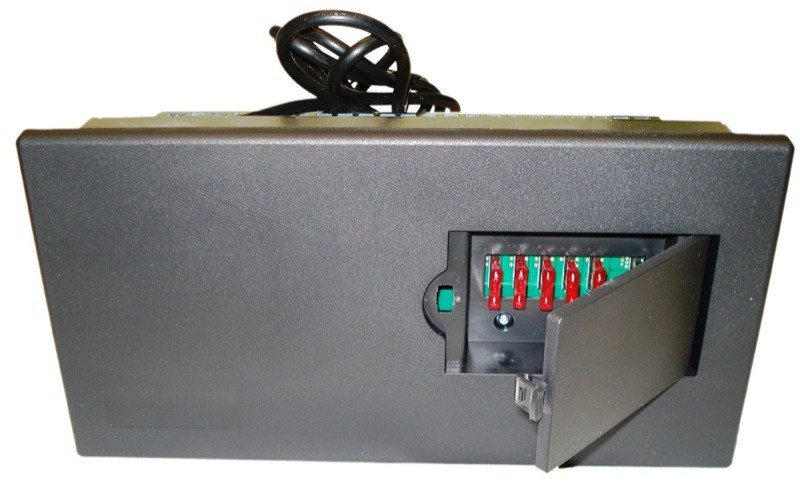
Electrical converters in RVs – they’re unsuitable for free-camping
by Collyn Rivers
Electrical Converters in RVs
Electrical converters in RVs supply 12 volts from 230-volt power. They work well from 230 volts, but not for long-term camping. Here’s how to fix the problem.
Electrical converters in RVs supply 12 volts dc from 230 volts ac in Australia/NZ, and most of Europe. These converters are intended for RV rental users, private owners for casual use, and those spending most nights in caravan parks. Their purpose, says one maker, is to ‘provide a dc power system, with optional battery backup’. Another maker describes that backup as ’emergency power’.
The ‘battery backup’ has limited capacity. It is likewise intended for limited or occasional use. Where 230 volts is available, lights and appliances are powered directly from the converter. The battery is used only when 230 volts ac is not there.
Typical up-market converter. Pic: setek.com
Electrical converters in RVs – unsuitable for free-camping
Electrical converters in RVs work well and reliably for their intended usage. That usage does not extend to free camping for more than one night. Nor do vendors suggest otherwise.
If the RV has LEDs, and uses only appliances originally installed, it should cope with one overnight stay. But rarely two. The vehicle must be driven for some hours the following day. And/or recharged every second night. This is best done from a 230 volt supply via a high output mains battery charger.
Free camping usage however requires a system run from the RV’s alternator, solar or a generator-charged battery. It uses 230 volts only to recharge batteries fast.
Limited charging
Most electrical converters in RVs charge batteries slowly. They do so because their output is typically only 13.65 volts. This is far too low for quick, let alone deep, charging. This is usually made clear in makers’ literature. One advises a deeply discharged 120 Ah battery so charged may ‘take 10 hours to attain 80% charge’. Plus ‘a further 10 hours to fully charge.’
Another advises that charging that same size battery ‘requires up to 70 hours’. Overnight usage away from 230-volt power typically discharges such battery/s by 60%-70%. The inbuilt charging system precludes fully re-charging the following night (assuming 230-volt power). This, say, vendors, safeguards the battery from being overcharged. But no high-quality charging system overcharges batteries anyway.
The above is openly revealed in converter specifications. Only buyers with technical understanding are likely to understand the implications.
RV vendors may explain how to use the system. They rarely advise, however, that usage does not include extended free-camping. The converter instruction manual is not always given to the buyer anyway.
Voltage Drop Problems
The original electrical converter cannot be modified. Replacements that charge at higher voltage also charge faster. That, however, can only partially assist.
The limitation is that most converters produce 13.6-13.65 volts. Lighting and appliances, however, need 11.8 to 12.7 volts. Converters are intended for RV owners having 230 volts most of the time. That 13.6-13.65 volts thus enables makers to use cable far thinner than needed when running from a 12-volt battery. As a result, part or all of that RV’s related cable deliberately drops up to one volt. That’s fine on 230 volts. But not when battery powered.
At least 80% of all RVs globally have these converters. In the USA it’s a probable 95%. Most RVs using such converters have that lightweight cabling: it’s much cheaper.
Replacing the converter
Electrical converters in RVs work well for their intended usage. They do not work well for extended free camping. If free camping is in mind there is little choice but to replace them.
Replacing the converter by a high-quality battery charger and dc-dc alternator charging assists. But if the RV has lightweight wiring, some needs upgrading. This includes all charging circuit and battery cabling, fridge cabling (essential), and the water pumps. If LEDs are not fitted, change whatever is. As LEDs draw far less current, the existing cable is fine.
Increasing battery capacity (alone) is pointless. The converter’s charging is inadequate for any purpose other than intended.
A high-quality battery charger charges the battery much faster. The appliances (particularly any compressor fridge), however, will not work as intended unless that cabling is upgraded.
With decent wiring in place a good solution is to install a battery management system. These include the 100% recommended dc-dc alternator charging, plus solar regulation. Many have also a 15-40 amp multi-phase charger. Plus energy monitoring.
You can alternatively use separate units. These may be a dc-dc alternator charger, and a serious multi-stage 110/2130 volts battery charger. Buy all from the same vendor to ensure they are 100% compatible.
LiFePO4 batteries assist
LifePO4 batteries in RVs produce from a typical 13.1 volts to about 12.9 volts. Whilst lightweight cabling imposes a voltage drop, that 13.1-12.9 volts is much higher than with other types of battery. These batteries also charge to at least 80% from 13.65 volts. They do so, however, very slowly. It’s better by far to scrap the converter and install a high-quality charger.
For the technically minded
A typical converter works much as shown below. Most are 110/12 volt or 230/12 volt transformers. The have a full-wave bridge rectifier and possibly smoothing capacitance.
Some include a direct 12-volt input. As shown that ‘input’, however, is a few centimetres of wire plus a diode (to prevent reverse flow). That diode nevertheless introduces up to 0.6-volt drop. This reduces alternator charging to snail’s pace. 
Typical basic converter. Pic: Copyright rvbooks.com.au
Most converters float the battery across that 13.60-13.65 volts output. They do so via a sensor, that typically limits float current to 0.8-1.5 amps. An override enables charging at higher current if the battery drops below a typical 10.5 volts). It so however at that unregulated 13.65 or so volts. This is not nearly enough for deep and rapid charging.
A few converters include multi-phase charging, but usually via fixed voltages for bulk, absorption and floating. They do not supply the constant current required for an effective bulk cycle.
Electrical converters in RVs – further information
See also Article Charge Batteries Faster and Deeper. It relates specifically to using converters for purposes for which they are not intended.
This subject is covered in depth in the author’s best selling book Caravan & Motorhome Electrics. It also covered (re solar) in Solar That Really Works (for cabins and RVs), and Solar Success (for home and property systems). My other books are the all-new Caravan & Motorhome Book and the Camper Trailer Book. For information about the author please Click on Bio.
These books have helped tens of thousands worldwide to make the right decisions. Any one of them will save you many times its cost.

Safe RV heating – use diesel or LP gas
by Collyn Rivers
Safe RV heating
This article is about safely heating caravans and motorhomes using diesel or LP gas. It explains how it works. It lists what is available. And moreover, how you can safely install it. To ensure safe RV heating correct installing is essential. Apart from carbon monoxide, there is furthermore a risk of oxygen deprivation. Furthermore, for a technical and medically-referenced explanation see Gas Risk in Caravans.
Safe RV heating
Diesel or LP gas-powered heaters draw fresh outside air into a tiny sealed furnace. The fuel burns in this furnace. Air is blown across the furnace’s hot outer skin. Flexible hose directs the heated air as required.
For safe heating, you must air-seal the furnace unit from the living area. This is essential. Fumes from burning fuel are expelled outside.

The Webasto diesel space and water heater installed in a TVan.
Several manufacturers make RV heating products. These include Eberspacher (‘Dometic’ in Australia), Webasto, Truma and Diesel Heating Australia. All are available as space heaters. Moreover, some are space plus water heaters. The smallest produce ample heat for medium-sized RVs. The next size up heats a cabin, or a large RV.
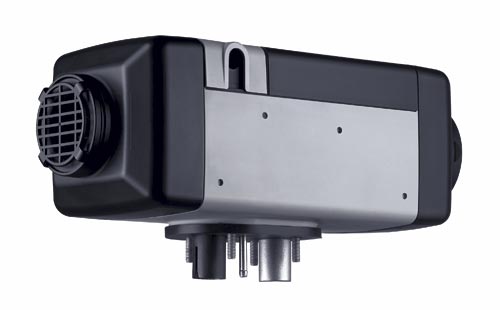
Webasto space heater. The Dometic unit is virtually identical. Truma’s is similar but taller. Pic: Webasto.
Space heater
The units are about the size of a brick. They mount with intake and exhaust outlets downward. A 12-volt pump draws from a typically 10-litre tank. Alternatively, you can tap into your vehicle’s tank. Some may have a larger separate water tank or radiator. Furthermore, most have a control panel that you locate where convenient.

The Genesis II combines space heating and water heating. Pic: Diesel Heating Australia.
I used a Webasto diesel unit in outback Australia. There, after sun-down, temperatures drop quickly. Often to below freezing. On its lowest heat setting, the heater kept the interior at 24º C. It used a litre per five hours.
The unit was slightly noisy. You can, however, reduce by adding an inlet silencer. Reports indicate all brands are much the same.

The Truma LP gas space heater. Pic: Dometic Australia.
Space/water heaters
Combined space/water heaters initially heat glycol. The hot glycol flows through an exchange unit. That unit heats water to a scalding 80º C. A tempering valve is legally required. It mixes cold and hot water. This limits the water to 50º C. Water heating water takes about five minutes.

The Webasto space/water heater. Pic: Webasto Australia
See also Gas Risk in Caravans on the Articles section of this website.
Further information
RV heating is covered in The Camper Trailer Book, Caravan & Motorhome Electrics and Caravan & Motorhome Book. Our other books are Solar That Really Works (for cabins and RVs). Furthermore, Solar Success is for home and properties.
These books help tens of thousands to make the right decisions. Moreover, any saves you many times its cost.
For information about the author: Click on Bio.
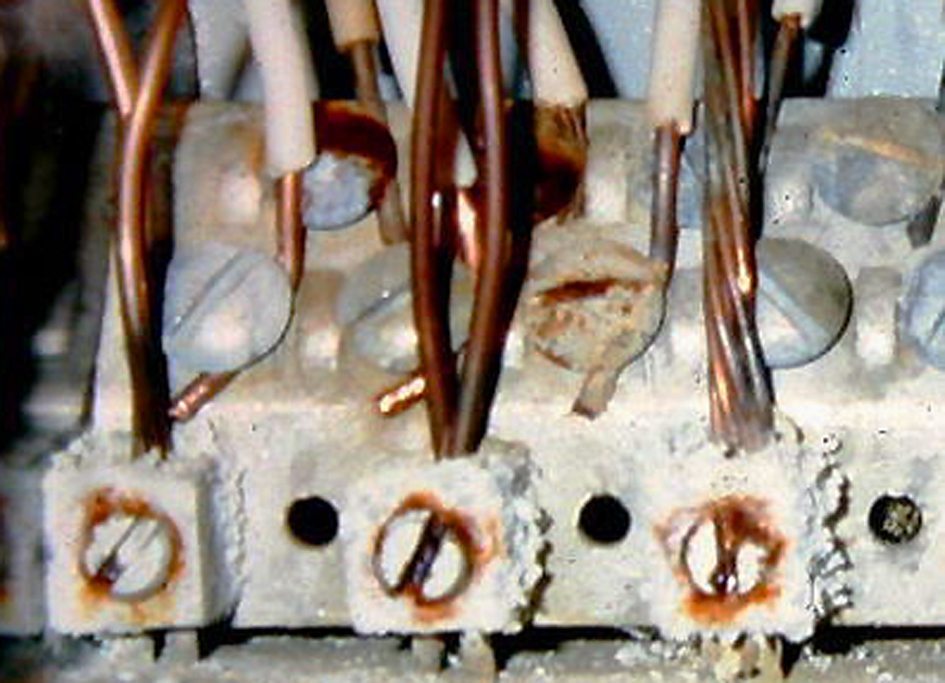
RV electrical wiring – twin-wire or chassis return – here’s why twin-wire is usually better
by Collyn Rivers
RV electrical wiring – Twin-Wire or Chassis Return
Twelve-volt RV systems require two electrically conductive paths between the battery and whatever light or appliance they energise. This can be done in two different ways. The first is to use a separate lead for each. The second way, twin-wire or chassis return is to use the RV’s metal chassis as part of one of the leads. This is primarily to save cost. Copper is very expensive – the chassis is already there.
This article strongly recommends using the twin-wire connection. This is particularly so for campervans and motorhomes. Furthermore, this article explains why. Moreover, it shows how to avoid known problems.
Twin-wire has one conductor (usually red) the positive lead. The other conductor (usually black) is for the negative lead. The two wires may be separate. Or within one sheath.
The chassis as a conductor
So-called chassis negative return uses the RV’s metal chassis as the common negative conductor. A single light wire from each appliance connects to the chassis. A heavy cable then connects the chassis to the battery’s negative terminal. A single positive wire only is thus needed most appliances. This saves the RV maker a few dollars.
Chassis negative return works well initially if the chassis connections are correctly made. Many are, however, exposed to damp. They then corrode. After a year or two connection may become intermittent. Or fail totally.
After a time negative return connections may look like this! Pic: inspectapedia.com
Avoiding RV electrical problems
Faulty connections cause many RV problems. Auto-electricians dislike them as faults may be intermittent. Not all RV makers use chassis return. Those that do, however, make such connections thoroughly. Moreover, they protect them against dirt and damp.
Chassis return RV electrical wiring is rarely an issue. It is usually done thoroughly with the chassis terminals welded to the chassis. Most problems arise with owner-added connections – usually via self-tapping screws – that rust over time.
Electrolysis
The major issues with chassis return particularly affect powered vehicles. It can cause so-called ‘electrolysis’. This is a particularly invidious form of corrosion.
Chassis return’s intention is for all negative current to flow only via that chassis and the heavy cable to battery negative. Electric current, however, attempts to flow via every metallic path. It does this mostly via the chassis. Problems occur, however, if that main earthing cable loosens. Or its connection corrodes, also if inadequately sized. Return current then seek paths of lesser resistance. This is often via the radiator and water pump. Both contain different types of metal. These are mainly attacked. As current flows through them they corrode.
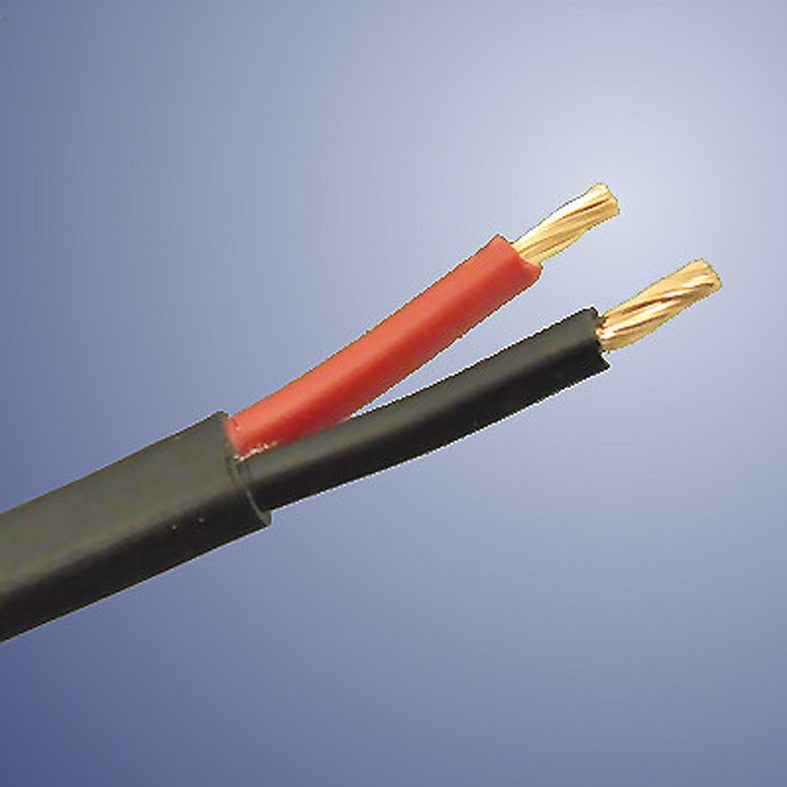
Single-core (usually black) is used for chassis earthing. Red is used for positive. A few companies, however, use black (+ve) and white (-ve). The twin-core cable shown here is used for circuits that do not use chassis return.
This issue is often caused following vehicle front end repairs. A spot-light (or worse a winch) may have originally had its negative lead strapped to the chassis. The repairer, however, may re-connect to the closest nearby metal. That can result in part of the current flowing via the radiator. Or the water pump. If that happens, corrosion is virtually inevitable.
Vehicle makers require routine service checks for electrolysis. It is done by measuring the voltage (to earth) of the radiator fluid. It should zero. For a fuller explanation ‘Electrolysis Corrosion in Vehicles’.
RV electrical wiring – further information
Caravan & Motorhome Electrics covers every aspect of designing, specifying and installing RV electrical wiring. It also covers every type of lighting and appliances, plus solar and charging systems.
Solar that Really Works does likewise re solar for cabins and RVs. Solar Success is for homes and properties. Caravan & Motorhome Book covers every aspect of RV use. For author information: Click on Bio.

Connecting caravan batteries – there’s no magic way of doing it!
by Collyn Rivers
Connecting Caravan Batteries
Connecting caravan batteries is often misunderstood. This article explains what’s possible, and why and how to do it successfully.
A typical caravan has an ongoing need for energy. And an occasional need for (high) power. Knowing the difference between energy and power truly assists.
Energy is the ability to perform work. It was originally estimated that a brewery horse could typically lift 33,000 pounds one foot in one minute. That amount of energy was thus called one horsepower. This now mostly expressed in watts. (About 750 watts is one horsepower).
Power is the rate at which energy is used to perform work. If that 750 watts is drawn for one hour, it’s expressed as 750-watt hours.
That brewery horse’s one-minute lifting is equalled, in a few hours, by a child. Horse and child exert equal energy. But the horse needs far more power.
Battery usage is similar. A starter battery is thus horse-like. It can exert high power. Starting a car engine however, takes only two/three seconds. The energy expended is tiny. It’s about that used by a 12 watt LED in ten minutes.
A deep cycle battery, contrarily, is akin to a marathon runner. Less ‘power’ but energy can be expended far longer.
Connecting caravan batteries – ensuring enough energy and power
As explained above – most caravan batteries have two main (but different) requirements.
1. Enough power to cope with high peak loads.
2. Enough energy to cope whilst away from 230 volts etc.
This can be addressed in two main (but different) ways.
Different batteries – different characteristics
Increasing battery capacity increases available power. And, virtually by definition, more energy. There are, however, downsides. You must, for example, have the ability to recharge them. That charging must be both deep and fast.
Lead-acid deep cycle batteries are heavy. Twelve-volt versions weigh about 25 kg/100 amp hour. Their life is greatly reduced by frequent deep discharging. Their plus side is (relatively) low price. Plus ready availability.
AGM batteries are a compromise. They are physically rugged – thus suited to off-road use. AGMs can supply higher power than conventional batteries. They maintain charge far longer (12 months plus in cool climates). AGM batteries, however, are even heavier than conventional batteries. Discharge needs limiting to about 50%. If exceeded, their life is thereby curtailed. And they cost a lot more. (Gel cell batteries are similar – but less often used.)
Any 12-volt LiFePO4 battery above 18 amp-hour supplies RVs peak power with ease. The energy capacity needed, however. is slightly less. This is because they can be routinely discharged to 10%-20% remaining. Another benefit is that (in RV use) they rarely drop below about 12.9 volts. They are about 35% of the weight and bulk. On the downside, they cost far more. They must also have effective individual cell management. Buy only from vendors who truly understand them. These are, however, rare.
In practice, a 300 plus amp hour AGM battery will provide the peak power required for any RV. It also has ample energy capacity. AGM batteries are thus a good choice if space and weight permits
Connecting caravan batteries
To ease handling, (or obtain higher voltage, or higher current) batteries can be connected together. There are two main ways of doing so.
Series: consecutively positive to negative. Total battery voltage is the sum of each individual battery voltage. The total current is that of the battery that produces the least current. For example, were all batteries 100 amp hour, but one 50 amp hour, the total output would be 50 amp hour.
Parallel: positive to positive, and negative to negative.
Here, all batteries must be the same voltage but can be of widely different capacity. The available current and capacity is the sum of each individual’s current and capacity.
When connecting caravan batteries in parallel, it is, for example, just fine to parallel a 12 volt 10 amp hour battery across a 12 volt 500 amp hour battery bank. The result is a 12 volt 510 amp hour battery bank.
![Connecting [cara] batteries - there's no magic way of doing it! - electric vehicle batteries,book on batteries,electric car batteries,lithium ion batteries for electric cars,electric car battery technology,how long do electric car batteries last,electric vehicle battery life](https://rvbooks.com.au/wp-content/uploads/2014/09/Battery-shed-coconut-well-reduced-jpg.jpg "Connecting [cara] batteries - there's no magic way of doing it! 162")
This battery bank (at the author’s previous all-solar powered property outside Broome, WA) had 16 batteries, each of 12 volts and 235 amp-hour. Each level has four such batteries in series. All four rows are parallel connected.The output is thus 48 volts and 950 amp-hour. That’s 45,120-watt hours (45.12 kW/h). Pic: rvbooks.com.au
Parallel connecting batteries is safe
Contrary to common belief, this is safe. Like good socialists, each (battery) will thus take according to its need, and supply according to its capacity. See Interconnecting batteries in series or parallel re advised limits.
To increase both voltage and current, you parallel identical strings of series-connected batteries. Here, the voltage is that of any one string. The amp-hour capacity is the sum of all the batteries’ capacity. Doing so, furthermore, is routine in large solar systems. They are typically 48 volts upwards.
Connecting batteries in series (end-to-end) thus increases the total voltage. Connecting batteries in parallel increases the total current.
In every case, their total energy (i.e. watt-hours) is the sum of each battery’s energy so connected.
There is no magic way of increasing it.
Connecting caravan batteries – 6 volts or 12 volts?
Most caravans and motorhomes have 12 volt systems. As batteries are heavy, some owners prefer 6-volt batteries. To obtain 12 volts they are series-connected (positive to negative) as below. This results in the same current (as each 6-volt battery) but twice the voltage.

Series connection. If each 6-volt battery is 100 amp hour (600-watt hour) two series-connected such batteries hold 100 amp hour at 12 volts (1200 watt-hour). Pic: rvbooks.com.au
If more capacity is required, further pairs of so-connected batteries are then wired in parallel as shown below. 
Here, four 6 volts 100 amp-hour batteries can hold 200 amp-hours at 12 volts (2400 watt-hours). Similar connection (but using 12-volt batteries) are used to obtain 24 volts in converted coaches with 24-volt alternators. Pic: rvbooks.com.au
A few caravans have only one 12 volt battery. Most, however, have two 12 volts, 100 amp-hour batteries. The result is 200 amp hours (2400 watt-hours.)
If four batteries, each of 100 amp-hour are parallel connected, total capacity is thus 400 amp hours (4800-watt hours). 
Typical battery bank for a largish RV. Four 12 volt 100 amp-hour batteries store 400 amp-hours at 12 volts (4800 watt-hours). Pic: rvbooks.com.au
Probable requirements
For most RVs, the highest (domestic) power need is likely to be a microwave oven. They draw about 130 amps for 5-15 minutes, typically via an inverter.
Any LiFePO4 battery used as the main RV supply will cope with ease. Such power can just be met by a 12 volt 200 amp-hour AGM battery. But 300 plus amp hour is preferable. Some owners attempt this with 200 or so amp hour deep cycle lead-acid batteries. They will supply such power for a short time, but doing so repeatedly shortens their life.
Connecting caravan batteries – Summary
The best way to increase available power for the same energy capacity is via batteries capable of doing so.
Conventional lead-acid deep cycle batteries are the least so-capable. AGMs are better. If bulk and weight are not a handicap, a 300-400 amp hour AGM bank readily provides RV energy typically needed.
The highest energy and power (by far) is from lithium-ion (LiFePO4). Any such battery will have ample to drive whatever you wish. They also have more available energy capacity. They are however costly. Furthermore, they need specialised installation and charging.
Connecting caravan batteries – further information
Batteries and their charging are complex subjects. Caravan & Motorhome Electrics explains battery charging in depth.
If you liked this article you will like my books. They are technically accurate – yet in plain English. Other books are the Caravan & Motorhome Book, the Camper Trailer Book, Solar That Really Works (for RVs), and Solar Success (for homes and properties).

Ultra-light caravans – they are rare but feasible. Here’s how to do it
by Collyn Rivers
Ultra-Light Caravans
Ultra-light caravans and fifth-wheelers are rare but feasible. Here’s how it is done using hi-tech materials. One, over 9 metres, was under 2000 kg (4400 lb).
Australia’s Glenn Portch spent 20 years experimenting and building ten ultra-light fifth-wheel caravans. His own 11.3-metre unit weighs 3200 kg (7050 lb). Its payload (of an extraordinary 1200 kg [2650 lb]) allows him to include his Harley Davidson motorcycle with ease. The last of the eight he made is 9.1 metres. It was originally under 2000 kg (4400 lb) but the buyer insisted on a granite kitchen bench-top!
Glenn’s ultra-light caravan research had no financial motive. He made them to see what was possible. The other nine were sold at close to cost price. By doing so, Glenn has shown that ultra-light caravan design is feasible.
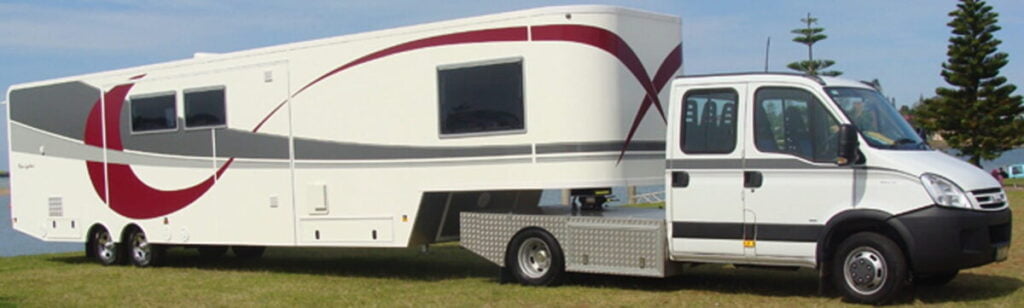
Glenn’s own ultra-light Navigator is 11.3 metres. It weighs 3200 kg (7050 lb) and its carrying capacity is 1200 kg (2650 lb). Pic: Glenn Portch
Glenn’s first engineering was in the 1980s. He sought a pair of up-market loudspeakers. Most, however, were costly, available only in black, and lacked styling. He researched extensively. Then, using the very best available components, designed and built them himself. They had gloss white enclosures with black granite overlays. A Sydney hi-fi shop owner (that I also know) asked if Glenn to build more.
Glenn and his (then) partner set out to build the world’s best. Within a few years, they exported their (Audio Definition) loudspeakers to nine countries. They had 14 local dealers. The products were not cheap. Their sound quality necessitated top-quality components. The superb cabinet finish demanded years of research and testing. They made lower-priced models too, but the top ones were $35,000 a pair. They were so successful they won many top world awards.
Ultra-light caravans – fifth wheel format
Glenn later became interested in travelling around Australia. Often in the USA – researching audio, he could see that fifth-wheeler caravans were rapidly gaining acceptance. The fifth-wheeler configuration (and its inherent towing stability) appealed to his knowledge of the physics involved. But whilst liking the concept, those available seemed unnecessarily heavy. Some absurdly so. So, once again Glenn decided to build his own. But ultra-lightly!
Ultra-light caravans – strength
Despite aluminium-framed aircraft since 1900, many caravan builders assume weight confers strength. Many a locally-made caravan‘s floor and fit-out are of heavy plywood. This adds little structural strength, yet considerable and unnecessary weight. It is seriously counterproductive. Such weight necessitates a heavier chassis, suspension and tyres to carry it. As a result, most US and Australian-built caravans are heavy, yet not necessarily strong.
A few local makers use lightweight body construction. Most, however, retain a heavy (yet not strong) chassis. They are still lighter -yet still unnecessarily overweight.
Ultra-light caravans – chassis
Before designing and building himself, Glenn approached many caravan builders. All claimed it could not be done. ‘Aluminium tends to break mate’. But, as Glenn points out, steel used incorrectly may also break. He suggests anyone truly believing aluminium used correctly breaks, to ‘bear in mind that Boeing’s aircraft are hardly based on rolled steel joists’.

A partially completed main chassis – the triangulated design is clearly seen. Pic: Glenn Portch
Some trailers have alloy chassis – but of ‘C’ section, or I beams 6-10 mm thick. Their resultant weight and poor torsional rigidity, however, defeats the point of using alloy. But promotionally it’s good.

This end view of a partly-completed ultra-light caravans chassis shows triangular bracing. Pic: Glenn Portch.
Glenn Portch’s concept employs ultra-light three-dimensional trellis-like chassis of light box-section aluminium. A composite material floor, and a similar (frameless) body bonds to that chassis. This allows slight flexing to cope with road irregularity stresses. His ultra-light caravans are thus similar to aircraft and ultra-yacht design. It enabled his aim, of about 200 kg/metre for fully equipped units, to be achieved.
Ultra-light caravans – strength
For anyone doubting the strength and durability of Glenn’s ultra-light caravans approach, consider this. The first (of eight) built had (in 2018) already exceeded 300,000 km. That’s 23 times more than the average caravan‘s 13,000 or so km a year.
Ultra-light caravans – interiors
Glenn’s overall ultra-light monocoque concept handles forces via the external skin. Internal fittings too structurally brace. Floor, shower and divisional walls, are all MonoPan. This is an ultra-strong fibre-reinforced thermoplastic skin bonded to a similar core. The outer skins provide structural strength and resist impact. An ultra-light core separates the skins, enabling major resistance to bending.
The cabinetry’s cube-lock square aluminium extrusion is held together by plastic corner locks. These are riveted and glued to the main structure. This, working in unison with the monocoque shell, further adds strength. Glenn makes the drawers out of 1.6 mm aluminium. Runners rivet them in place within the cube-lock structures.
Benchtops are 30 mm Monopan, laminated, and with Jarrah timber edging. The Monopan is finished inside and out with automotive two-pack paint. ‘It withstands weathering better than bare fibre,’ says Glenn.

This is the last and lightest built of Glenn’s builds. It is 9.1 metres – yet can be built at under 2000 kg (4400 lb). Pic: Glenn Portch.
The last and lightest
The last built (in 2015) is 31 ft (9.1 metres). It is far from an average fifth-wheeler (that typically has a 100-litre plastic water tank and cassette toilet).
This one is sumptuously fitted out. It has 380 amp-hour battery capacity, plus 450 watts of solar. The 1500 watt Trace inverter has an inbuilt 75-amp charger. There is a 219-litre compressor fridge, 400 litres of freshwater, 300 litres of grey-water, plus 220-litre black water tanks.
Without its AL-KO suspension, the chassis weighs a mere 200 kg (440 lb)! Had a traditional 19 mm plywood floor been used, that alone would add some 200 kg (440 lb). Yet have zero structural strength. Traditional construction also necessitates a heavier chassis, wheels, tyres and brakes to carry it. All add yet pointless weight.

The completed unit originally weighed under 2000 kg (4400 lb)! The buyer, however, sought heavy additions, including dining, vanity and bedside tables of solid Jarrah. Also sought was a full-size double domestic sink and 6 kg (13 lb) capacity washing machine. Plus a china toilet and macerator. There is also a hospital-grade vinyl floor that weighs as much as the 30 mm Monopan it covers!. Required too was a slide-out BBQ, beneath a 5.4-metre awning.

Gas bottles are set within the chassis rails. Pic: Glenn Portch.
Despite all this, the unladen unit weighs only 2260 kg (4980 lb). Its permitted on-road weight, however, is 3800 kg (8375 lb). This leaves an extraordinary 1540 kg (3400 lb) for water and personal effects!
Ultra-light caravans – proving them possible
Glenn is constantly asked to build ultra-light caravans for general sale. His main aim, however, was to show (and prove) what he felt possible. He did not do this for profit, but out of intellectual interest. Developing and proving the concept took over 20 years. That he has now done. He considered consulting if any manufacturer was interested. But, a now five years later, none appear to be.
Meanwhile, local caravan makers need to start thinking hard about far lighter caravans. With rare exceptions, the era of heavy tow vehicles is rapidly passing.
Now, Glenn enjoys using his own fifth-wheeler. He spends much the Australian winter up in the tableland outside Cairns.
I thank Glenn Portch for so generously sharing his knowledge. This article (originally published in 2017) has already inspired many self-builders.
Further information
For further information on fifth wheelers see https://rvbooks.com.au/fifth-wheel-caravans-are-safer/ Also https://rvbooks.com.au/caravan-and-tow-vehicle-dynamics. The topic is covered also in the Caravan & Motorhome Book. My other books are: the Camper Trailer Book, Caravan & Motorhome Electrics, Solar That Really Works (for RVs) and Solar Success (for homes and properties). For author information click on Bio.

Battery ventilation is vital – why take any risk?
by Collyn Rivers
Battery Ventilation
All lead-acid batteries, AGMs and gel cells, generate explosive gas. Even though most are sealed, makers stress that battery ventilation is vital still. Confusion exists over this. Around 2000, some battery makers began to claim that no ventilation was required. Or, ventilation is advisable but not necessarily essential. They withdrew this advice, however, shortly after. Many batteries thus have a warning notice as below.

Despite warning notices like this, many RV builders install batteries in unventilated compartments. In 2012, one threatened criminal defamation when I published that ‘battery ventilation is vital’. The company withdrew only when shown evidence the batteries they were fitting in their own products had such notices.
Explosion risk
Hydrogen lacks colour or smell. Without instrumentation, a human cannot detect it. Unsealed batteries smell whilst charging, but that odour is not hydrogen.
Many batteries have an acid/water mix called an electrolyte. If overcharged, that liquid produces explosive hydrogen. In a typical battery enclosure with about 10 litres of free air space, a 10% (explosive) concentration builds up within 60 seconds. When mixed with air, ignited hydrogen typically starts fizzling at a concentration of about 4%. If the concentration exceeds 10% a tiny spark causes it to explode.
Sealed batteries cope with low levels of overcharging. To prevent an explosion, they have normally sealed vents. These open when pressures reach dangerous levels. As long as the batteries are ventilated (and there is no source of ignition) this gas typically dissipate harmlessly.
Lead-acid battery explosion is rare. It can however blow an RV apart. One (Australian) RV maker, whose product lacked ventilation, blew out the floor of his very own, through just that.
Assuring basic ventilation is so easy it seems ridiculous not to provide it. Let alone (as some do) to argue against it.
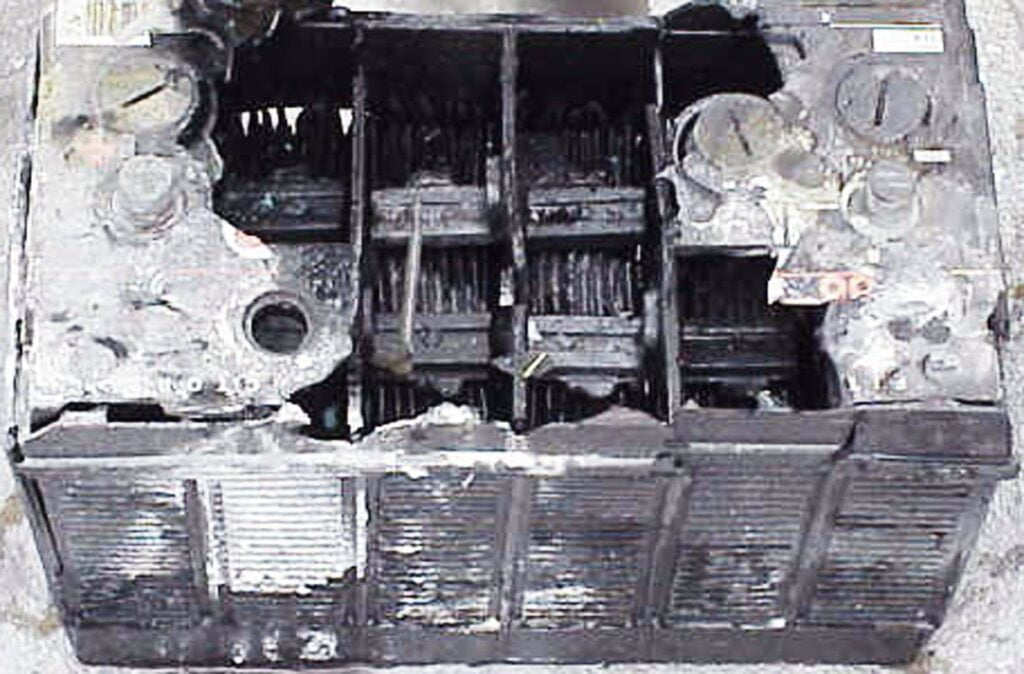
An exploded battery is an ugly sight. Pic: http://www.rayvaughan.com
Hydrogen only explodes when ignited. An almost invisible tiny spark, however, does so. Common sources include insecure terminal clamps and cables. Also, battery connectors that work-harden and crack. Sparks can also be caused by any electrical or moving device. Worn bearings may do so. Battery chargers, isolating relays etc, should never be installed in battery enclosures. Such battery ventilation is vital.
Venting details
The battery enclosure must enable fresh air to enter at its base. The (lighter) hydrogen must be able to escape to atmosphere via unrestricted outlets at the enclosure’s very top. The RV industry has no standards regarding this. General practice, however, is to provide a few 25 or so mm holes at the top. They are needed to the very bottom.
In 2003, the (then) Sustainable Energy Industry Association suggested the following minimum. The size given is for each vent (top and bottom).
Area in sq cm = 0.006 X ‘n’ X I.
Where ‘n’ – the total number of cells in the battery/s (for this purpose each cell is nominally 2.0 volts)
‘I’ = maximum charging rate in amps.
For example a caravan with two 12 volt batteries (each of 6 cells) and maximum charging rate might be 50 amps. Then A = 0.006 x 12 x 50 = 3.6 sq cm. The above is a minimum requirement. Ventilation can thus be one or two slots top and bottom. Each should be about 5 cm by 1 cm.
Naturally vented enclosures have been criticised. Decades of experience, however, indicate they are adequate. Wind, however, can generate areas of high pressure around exit vents. This can prevent gas from escaping. This is less of an issue if adequate lower vents are provided. But many an enclosure is vented only at the top. If yours is like that, cut a few holes at the very bottom.
LiFePO4 batteries
These batteries use a technology that is different from lead-acid. These batteries can and do explode. When they do, they typically emit dense white smoke. This strongly irritates and may harm the respiratory tract, mucous membranes, eyes, and skin. The electrolyte reacts with moisture to form hydrogen chloride and sulphur dioxide. Some also release bromine and chlorine. There are also fire risks if they are overcharged. This is due to the flammable properties of volatile organic substances.
So here too battery ventilation is vital. Vendors offer little advice re this. It seems prudent, however, to house them much as with lead-acid batteries. Ideally using fire-proof materials. (See also Article Lithium-ion batteries in caravans.)
Battery ventilation is vital – summary
There are no legally enforceable (RV) standards in this area. This article can thus only state that battery makers stress battery ventilation is vital. Some explain why.
There is little or no risk if batteries are housed in well-vented enclosures. With sealed batteries, the risk is not high. It exists however if they are within (say) a closed bed base that traps gas. Eliminating this risk consist of little more than cutting slots, or drilling holes. So why not do it?
Further information
For information on batteries and battery charging see: AGM batteries for caravans, Lithium-ion batteries in caravans, and Speeding battery charging from generators.
In-depth coverage of batteries and battery charging is included in my books Caravan & Motorhome Electrics, Solar that Really Works! (RV-related), and Solar Success (homes and properties). My other books are the Caravan & Motorhome Book, and the Camper Trailer Book. For information about the author please Click on Bio.
This topic often arises on RV forums. If you feel this article might assist others, please consider posting this Link to it on the relevant forum thread.
How much solar input – here’s how to find out
by Collyn Rivers
How Much Solar Input
Knowing how much solar input is coming in like measuring rainfall. It uses units called Peak Sun Hours instead of inches or millimetres.
Much as a rain gauge shows a day’s rainfall in millimetres, knowing the day’s number of Peak Sun Hours indicates how much solar input there is each day. This article, by Collyn Rivers (RV Books), explains all.
How much solar input
Imagine an open drum that ‘collects and concentrates’ sunlight (rather than rain). When full, that drum contains one Peak Sun Hour (1 PSH). It is likely to ‘fill’ in one hour in Alice Springs around noon on most days but takes longer early and later in the day. In a Melbourne mid-winter, filling one drum takes most of one day.
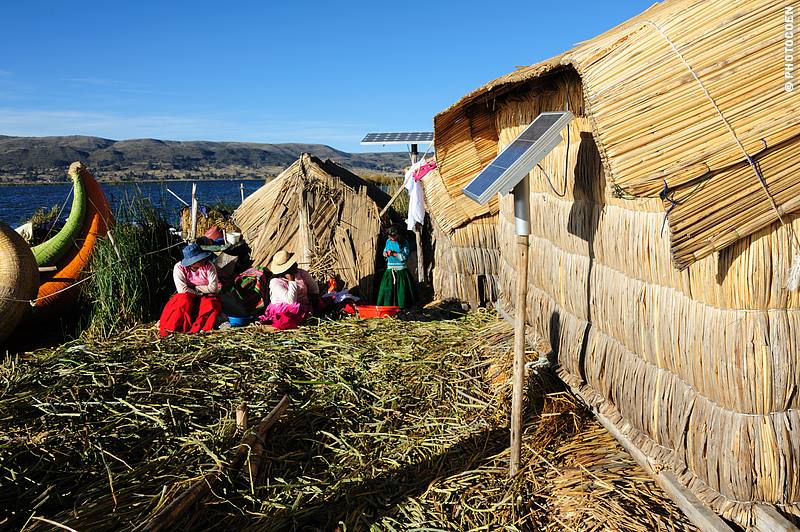
Solar is even used on the world’s highest lake (Lake Titticaca) in Peru.
A Peak Sun Hour is a solar industry unit. It is that amount of sunlight that averages 1000 watts per square metre for one hour. For example, 4 PSH/day is as if there were four hours at 1000 watts per square metre. About 75% is likely to be over the two/three hours each side of noon, and 25% over remaining daylight hours. Translating that into solar module input is (relatively) simple.
In theory, a solar module of one square metre captures 1000 watts per PSH a day. In practice, it’s far less, because solar modules are only 14-21% efficient.
Depending on latitude, season and weather, PSH in Australia varies from 2.0 (south in winter) to 7-8 (in central and southern areas in summer). Northern Australia has less variation: from 5.5 in winter to 6.5 in summer. This fools visitors assuming the opposite and wondering why there’s less than expected.
Based on NASA data, this map shows probable (averaged) mid-summer output (in Peak Sun Hours). copyright © rvbooks.com.au
How much solar input – worldwide
Meteorological offices worldwide have maps that show how much solar input – but in scientific units. My own are based on a ten year running average (from NASA data) and updated when needed. The current summer data is shown here. There are inevitable variations, but they provide a reasonable guide to how much solar input for most years.
Optimising solar output
The further north or south, the lower in the sky the sun tracks east/west. To optimise solar input, solar modules face into the sun at midday. They face due north (in the southern hemisphere) and south (in the northern), tilted at the location’s latitude angle. To establish that angle, Google your location plus ‘latitude’. In Australia’s far north, the sun tracks close to, or overhead part of the year, so close to horizontal captures the most sun. For homes, avoid having modules totally flat – or dust settles. And so do birds and small animals.
Tracking mechanisms enable solar modules to face directly into the sun. They work but are complex and costly. It is cheaper and simpler to accept the loss. Adding 10%-30% more solar capacity compensates. Further, the sun’s effect is far from a ‘shaft of light’. It is often diffused – so minor non-alignment makes little difference. Tilting or tracking increases output if/when the module is producing less than its capable maximum.
The Australian Solar Radiation Data Book has full data. It shows that for Adelaide (35º south) in January in solar input differs, between horizontal mounting and the optimum 10º tilt by only 0.16%. Even 20º error makes only 4% difference. Over a year, solar input there, with modules at the optimum 30º provides an average gain of about 8% compared with horizontal mounting. Variations of plus/minus 20º in north-facing or tilt cause less than 5% difference.
The now less common amorphous modules are less heat affected, but all others lose power when they become hot. This loss is typically by 5% for each 10º C.
Solar input for marine and RV use
Data above is for fixed locations, or those travelling mainly in summer. A different approach is needed whilst travelling extensively in Australia, or at varying times of the year.
For distance travelling, you need solar capacity that is excess much of the time. Or if preferred, using solar to complement a generator-based system (or vice versa). An effective rule is assuming 2.5 to 3.0 PSH for all areas except Hobart and Melbourne’s midwinter. There, under 2 PSH is common in June/July.
A reliable guide (for existing systems) is that, the batteries are fully charged by midday most days year-round there’s insufficient up north except in mid-winter.
What solar modules really produce
The promotional output cannot be achieved in typical use. Just why is explained below. In practice, if used with a cheap solar regulator, most solar modules produce about 70% of that seemingly claimed. A Multiple Power Point Tracking (MPPT) solar regulator lifts that to about 80%.
Your most probable input is daily PSH (for the area times 70% of what was claimed. Or with the MPPT unit, 80%-85%.
Technical explanation (why solar makers do not get sued)
Typical solar modules produce maximum power (volts times amps) at around 17.1 volts. Charging a 12-volt battery, however, requires 13.0-14.7 volts. With basic solar regulators, all between that 17.1 volts solar output and the charger’s needs is not accessible.
An MPPT regulator ‘juggles’ available volts and amps thereby optimising watts. This recovers of that otherwise unavailable. It is particularly effective when the battery is low in charge, and during early and late hours of the day. Dismiss claims of MPPT ‘increasing’ energy by 25-30%. It recovers about 10%-15% over a day of that otherwise lost. Enough to justify its use but generally less than claimed.
How much solar input in tropical areas
Many owners assume solar input in tropical areas is higher year-round. This is not so. Input during tropical winter is typically 5-5.5 PSH, and 6.0-6.5 PSH in summer. There can be major issues with fridges that run from solar because it stays hot all night as well. Energy usage is up to 40% higher.
Further information
For a full explanation see my Solar That Works (for cabins and RVs). Solar Success (for homes and properties. See also Living With Solar. Details of the author’s own (Broome) system see All Solar House.
All aspects of RV usage is in the Caravan & Motorhome Book. For RV electrics – Caravan & Motorhome Electrics. See also the Camper Trailer Book. For author info click on Bio.
If you find this article helps, adding this Link assists others on forums.

How to Reverse a Caravan
by Collyn Rivers
How to Reverse a Caravan – the basics
This How to Reverse a Caravan article will guide you through how to do it yourself. Learning how to reverse a caravan is not hard to do. Ongoing practice then assists.
How to Reverse a Caravan – if possible start with a box trailer
It is better to learn by towing a box trailer. It seems less daunting and costs less to fix if you damage it. To many first-time tow-drivers surprises, however, long caravans are easier to reverse than short ones. This is because a longer distance between trailer axle(s) and the tow hitch enables the trailer to respond more progressively.
Learning how to reverse a caravan only seems difficult at first. This is because, when reversing, the tow vehicle’s overhung hitch causes the caravan to turn in the opposite direction to that of the tow vehicle. Once that is realised (and its implications understood) all becomes clear. From thereon it just needs practising.
A good place to do so is a close-to-empty car park and well away from all other vehicles. Do everything slowly because a reversing caravan amplifies every movement of the steering wheel.
How to Reverse a Caravan – practice reversing in a straight line
Start by teaching yourself to practice in a straight line. This is likely to be harder to do than expected. Turn the steering wheel by only tiny amounts, while watching the caravan via the wing mirror. Once you have grasped that, do the same but in a slight curve. This will entail ongoing minor corrections because the turning circle self-tightens.
If possible have someone stand well behind the rear of the caravan (but not in its path). You need to able to see that person through your wing mirror. It also helps to be able to communicate via CB radio, mobile phone or hand signals – or whatever works for you.
Ask the helper to advise only what is happening that is out of your sight, e.g. distances, and when to stop if necessary – so as not reverse into a brick wall or up a kerb. It is then up you to work out what to do.
How to Reverse a Caravan – the jack-knife point
The most common initial problem is inadvertently reversing in a progressively tightening curve such that tow vehicle and trailer end up at close to a right angle. If that happens the driver must stop and drive forward, or the rig will be damaged.
This so-called jack-knife angle is different for each trailer and tow vehicle combination and can only be determined by trial and error. It is well worth checking this.
To determine your trailer’s jack-knife point find a large safe area. With a partner assisting, very slowly reverse your rig, turning the steering wheel slightly (such that the trailer turns toward your side). As you do so watch the trailer’s movement constantly via the wing mirror.
Do this a few times. Each time turn the steering wheel a little further. As you do this you will find that the tow vehicle and trailer become increasingly close to a right angle. You will also find there a safe limit to this. If you overdo the turn, the trailer’s draw-bar will jam against the rear of your tow vehicle. If you keep turning you may damage both the tow vehicle and caravan. If necessary, adjust your wing mirror so that the ground at the rear of your tow vehicle is visible.
How to reverse a caravan. A towing course is not essential but builds reversing confidence – Pic: Tow-Ed
How to Reverse a Caravan practice makes perfect
While learning how to reverse a caravan may seem daunting at first, with practice, you will be able to align your trailer to wherever it will fit. You are likely also to reduce the severity and number of steering wheel movements, making reversing quicker and smoother. After a time it becomes a natural action.
Take every opportunity to practice how to reverse a caravan where it is totally safe. You will progressively become proficient and relaxed about doing so. Alternatively, consider taking an initial lesson or three at a driving school that specialises in teaching caravan towing. All include learning how to reverse a caravan. They are readily found via Googling.
How to Reverse a Caravan reversing a fifth wheel caravan
Reversing a fifth-wheel caravan is as almost as easy as reversing a motorhome. If you are used to driving a long vehicle, it is a virtually self-obvious technique that can be acquired within minutes.
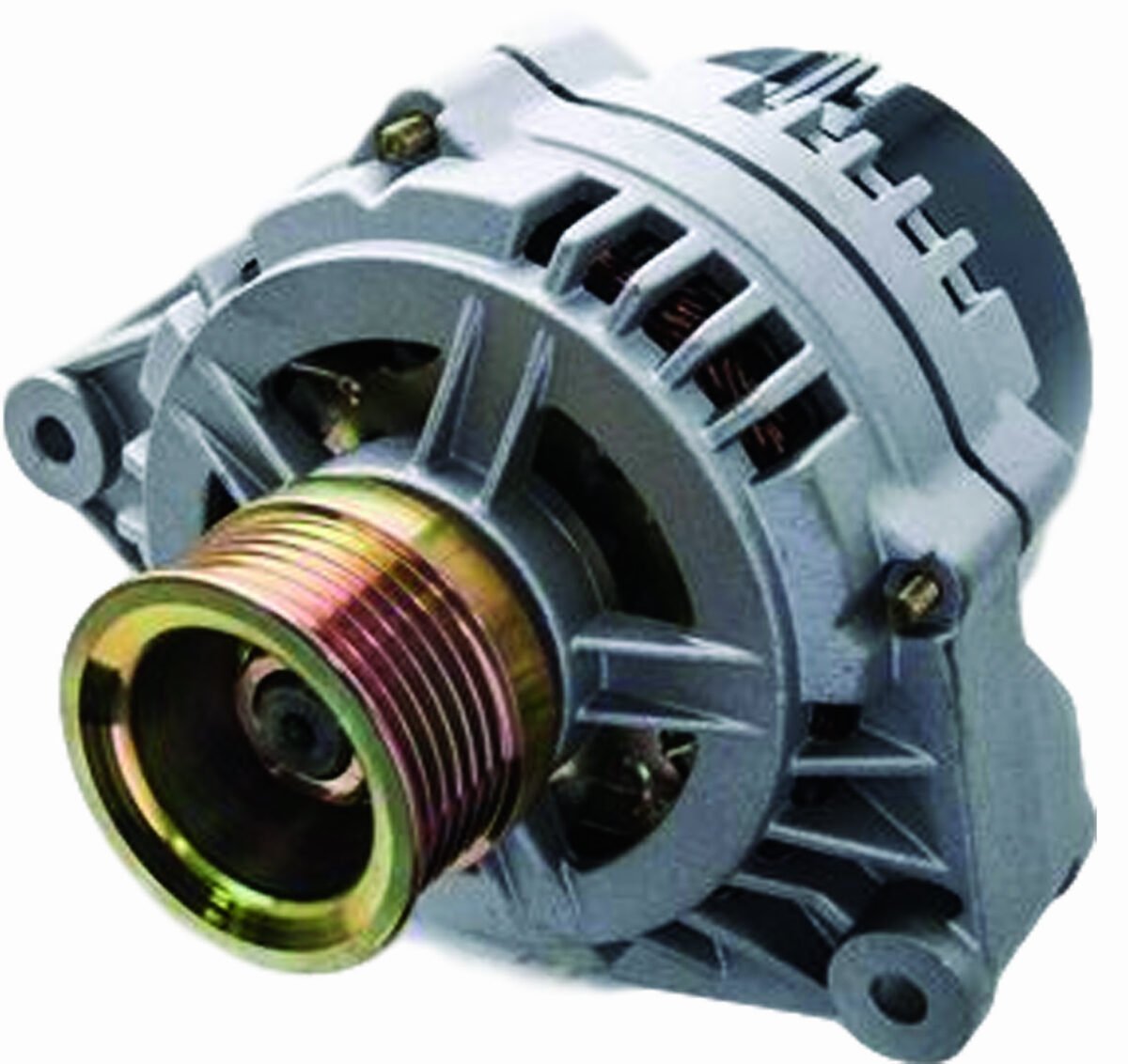
Variable voltage alternator problems with caravans – how to fix
by Collyn Rivers
Variable Voltage Alternators
Variable voltage alternator problems with caravans and motorhomes arise when charging auxiliary batteries. Here’s why and how to fix them. These alternators are, in particular, installed on many post-2013 vehicles.
Prior to the year 2000, alternators produced 14.4-14.7 volts, and a few close to 15 volts. This adequately charged caravan and motorhome auxiliary batteries. Furthermore, where it did not, voltage boosting assisted.
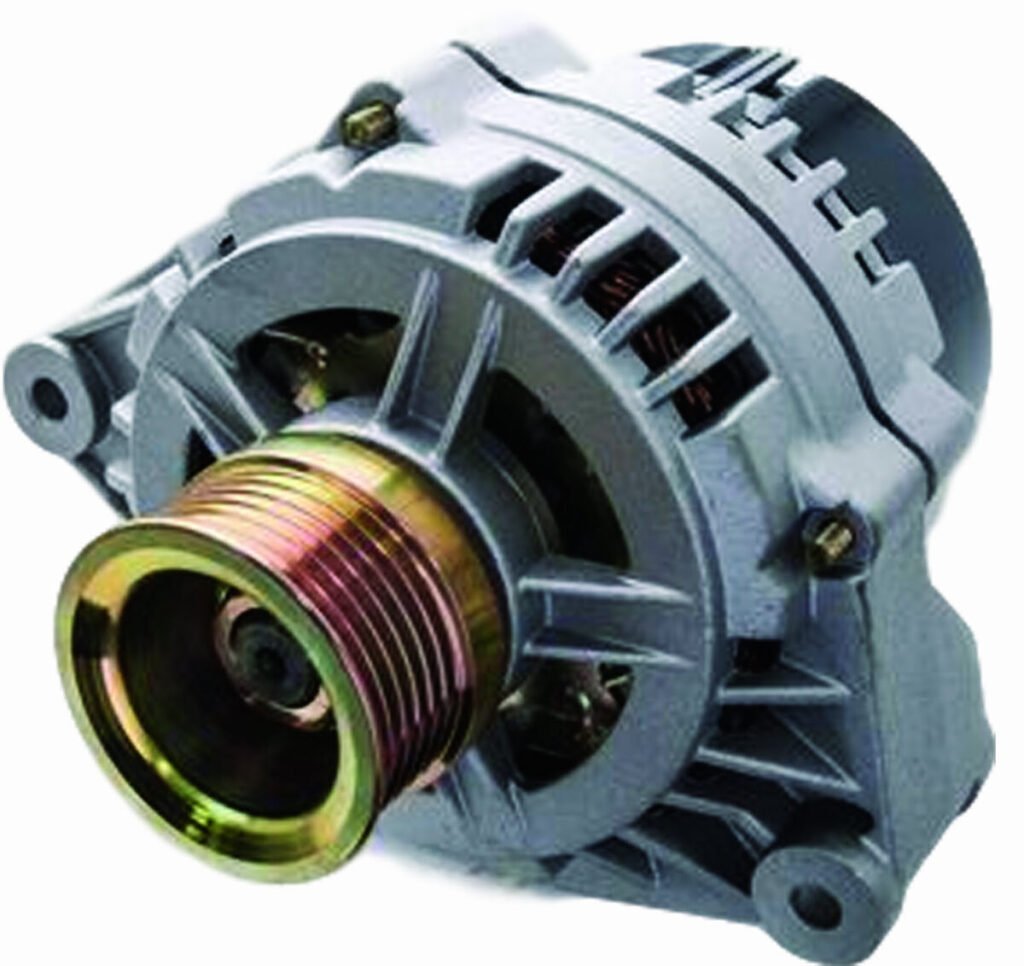
Typical smart alternator – note extra-wide belt pulley. Pic: original source unknown.
Smart alternator problems with caravans – temperature compensating
These produce about 14.2 volts when the engine is cold. This decreases to about 13.2 volts as the engine warms. Lead-acid and AGM battery charging, however, needs up to 14.4 volts. Charging such batteries directly from these alternators is thus not effective.
Dc-dc alternator charging nevertheless fixes this problem. It accepts voltage available, boosting it to the levels required. This assists high current appliances that are far from the alternator or connected via a too thin cable.
All alternators must ensure the starter battery has charge priority. This is done by a voltage-sensitive relay. The relay precludes auxiliary batteries charging until the starter battery exceeds about 13.6 volts. It also disconnects if the starter battery voltage falls below 12.6. Used as above, temperature compensating alternators are not a problem with RV batteries.
Variable voltage alternator charging problems
Common since 2013, variable voltage alternator output is controlled whilst driving by the vehicles’ main computer. The voltage varies from 12.3 volts to plus 15 volts.
That 15 volts is too high for direct battery charging. It wrecks lead-acid deep-cycle batteries, gel cell and AGM batteries. Moreover, anything below 14 volts is of little charging use. When output falls below 12.6 volts the voltage sensing relay drops out. It consequently cuts auxiliary charging two to three minutes each time.
Some dc-dc alternator chargers will still work. How to do this varies as charger manufacturers develop solutions.
Smart alternator problems – regenerative braking
A vehicle at speed has so-called kinetic energy. Conventional braking dissipates that energy as heat. Rather than losing energy, braking is done by increasing alternator voltage. This loads up the alternator such that it acts as a brake.
Doing so requires the main (starter) battery to be normally 80% charged. The recovered energy brings the battery to 100% charge. Alternator voltage then drops to about 12.3 volts (or zero) until battery capacity falls to 80%. This cycle repeats every time the vehicle brakes.
When alternator voltage drops below 12.6 volts, the voltage sensing relay drops out. This isolates auxiliary batteries for minutes each time. Worse, ongoing bursts at plus 15 volts quickly destroy them.
Fixing smart alternator problems – regenerative braking
Companies tackling this include Redarc (Australia) and Sterling (UK). Both use the starter battery’s voltage to know what the alternator is doing and optimise auxiliary charging accordingly. This also protects auxiliary batteries against excess voltage.
How to know what alternator is which
Alternators used for regenerative braking are large. In addition, they may have multiple drive belts
To establish alternator type connect a multimeter across the starter battery. You may, however, need to extend the leads. Ensure they cannot be wound up by the drive belt. Have an assistant check voltage over a range of driving. Check whilst braking for a distance downhill. This may increase output to over 15 volts. (One BCDC maker suggests to do this by fitting a lighter plug to the meter lead socket. This is not a good idea. Some vehicles have them feed them at constant voltage!)
An output that drops below 12.7 volts whilst driving identifies variable voltage alternators.
Experienced auto electricians should be able to help. See also the dual battery system selector (that indicates RV alternator types etc) at https://www.redarc.com.au/calculator/dual-battery-calculator.
Variable voltage alternator problems with caravans – summary
Variable Voltage Alternators – these drop below 12.7 volts at any time whilst driving. They require a specialised BCDC unit that senses various voltage levels etc. None operate satisfactorily with a voltage sensing relay.
Fixed Voltage Alternators & Temperature Compensating Alternators. These produce above 12.7 volts whilst driving. Most dc-dc alternator chargers and voltage sensing relays should work. Contact their makers if in doubt.
Euro emission requirements (2020)
Increasingly rigid emission limits require vehicle makers to meet emission levels. For 2020 the target is 95 g/km of CO2 for all new cars. There is however a 12 month phase-in period such that 95% of new car to comply with the target during 2020 and 100%. This corresponds to fuel consumption of about 3.8 l/100 km.
The requirements do not specify how car makers achieve. It may or may not involve the alternator. These regulations may eventually preclude all alternator use for RV auxiliary needs. If/when, however, is unknown but can readily be resolved by using a fuel cell.
Note: Many vehicles with variable voltage alternators monitor load and charge via a cable between the vehicle’s chassis or, for chassis-less vehicles, from the metal bodywork and one terminal of its battery. This cable must not be altered in any way.
Our books include Caravan & Motorhome Electrics, the Caravan & Motorhome Book, and Camper Trailer Book. Solar That Really Works is for cabins and RVs). Solar Success is for home and property systems.
If you find this article of value please Link it to any forum that may seem relevant.

Claims for dual-cab ute towing capacity mislead caravan buyers
by Collyn Rivers
Claims for dual-cab ute towing capacity
Claims for dual-cab ute towing capacity mislead caravan buyers. A dual-cab ute must weigh enough to keep a caravan steady. If not, the caravan tail wags the towing dog.
![Claims for dual-cab ute towing capacity mislead [cara] buyers - electric vehicle batteries,book on batteries,electric car batteries,lithium ion batteries for electric cars,electric car battery technology,how long do electric car batteries last,electric vehicle battery life](https://rvbooks.com.au/wp-content/uploads/2020/07/DualCabUte-1-e1628471729878-1024x449.jpg "Claims for dual-cab ute towing capacity mislead [cara] buyers 178")
Pic: CarsGuide
For close to 40 years, Australia’s trailers exceeding over a laden 750 kg (1650 lb) was 72 km/h. The Royal Automobile Club (RAC) advised trailer weights not to exceed that of the tow vehicle. The RAC’s preference was a ratio of 3:4. We now have speed limits of almost 30-40 km/h higher.
It is now common for a 2500 kg (5500 lb) dual-cab ute to tow a 3500 kg (7715 lb) caravan. That is a ratio of 3.5:2.5. Many vehicle makers specify GCM (Gross Combination Mass). This is the maximum allowed weight of tow vehicle and trailer. In most cases, makers quote the weight of a totally standard vehicle. Here are a few examples. They show that claims for dual-cab ute towing capacity mislead caravan buyers.
Examples that claims for dual-cab ute towing capacity mislead
GCM 6000 kg (13,000 lb). Claimed tow capacity 3500 kg (7700 lb). Unladen weight 2247 kg (4954 lb). Payload 952 kg (2100 lb). If towing 3500 kg (7715 lb) that plus the ute’s unladen weight (2247 kg [4950 lb]) is 5747 kg (12,690 lb). This leaves only 253 kg (558 lb) for everything carried. That includes all fuel over 10 litres, driver and passengers. That all but empty 2500 kg (5500 lb) ute is towing an up to 3500 kg (7715 lb) caravan.
GCM 5910 kg (13,030 lb). Claimed tow capacity 3500 kg (7700 lb). Unladen weight 1969 kg (4340 lb). Payload 941 kg (2075 lb). If towing 3500 kg (7715 lb) that, plus the ute’s unladen weight, is 5469 kg (12,057 lb). This leaves 441 kg (972 lb) for everything carried. It is 2401 kg (5293 lb)
towing 3500 kg (7700 lb).
GCM 6000 kg (13,000 lb). Claimed tow capacity 3500 kg (7700 lb). Unladen weight 2118 kg (4670 lb). The payload 1082 kg (2385 lb). If towing 3500 kg (7715 lb) that, plus the ute’s unladen weight is 5618 kg (12,385 lb). This leaves 382 kg (842 lb) for everything carried. It is 2500 kg (5500 lb) towing 3500 kg (7700 lb).
GCM 5885 kg (12,975 lb). Claimed tow capacity 3100 kg (6830 lb). Unladen weight 1955 kg (4310 lb). The payload is 945 kg (2080 lb). If towing 3100 kg (6835 lb) that, plus the ute’s unladen weight is 5055 kg (11,150 lb). This leaves a payload of 830 kg (1830 lb) when towing 3500 kg (7700 lb). It is 2785 kg (6140 lb) towing 3100 kg (6835 lb). Still undesirable but not as bad as above.
Few utes remain ‘standard’
That typical 250-440 kg (550-970 lb) payload may just suffice for a driver, passengers, plus fuel. Few dual-cab utes, however, remain standard. Many will have a winch (40-50 kg [88-110 lb]). A bull bar (4-45 kg [8.8-99 lb).
More realistic towing capacity for dual-cab ute towing capacity is 2500 kg (5500 lb).
See also Caravan and tow vehicle dynamics

TV interference from LEDs – here’s what causes it
by Collyn Rivers
TV interference
TV interference from LEDs is an issue worldwide. It is mostly caused by LEDs in the same home (or RV) as the TV. This can be checked by turning them off. Another indicator of TV interference from LEDs is good daytime reception until lights are turned on. In the worst cases, TV reception is unwatchable, or not even obtainable.

TV interference from LEDs typically looks like this. It can also prevent a picture appearing.
TV interference from LEDs is electromagnetic ‘noise’ – known as Radio Frequency Interference (RFI). It is an unwanted by-product of some electrical devices. It has been a problem since the beginning of radio and TV. RFI has many sources. These include pollutants on power line insulators, electric fences, garage door openers etc. Most electrical stuff prone to generate RFI has protection to specifically reduce it. Or to shield its radiation. But not all have.
TV interference from LEDs – is from 2010 on
TV interference from LEDs escalated around 2010. Its cause was a global move to a cheaper way of powering low voltage dc LEDs from 110/230 volts. The new way includes switching the current on and off at very high frequency. In so doing, however, it generates high-energy electrical noise (RFI). Good quality LEDS have filters that limit RFI to a few metres. Ultra-cheap ones, however, have inadequate or no filters. As a result, TV interference from poor quality LEDs is a global problem.
Ongoing forum reports of LEDs ‘sucking up TV signals to drive the LEDs’ are fantasy. Nor can this form of RFI affect signal strength. It does however degrade sound and/or picture quality. In extreme cases it precludes reception altogether.
The TV interference from LEDs problem
Not all antenna installers are aware that poor quality LEDs can cause this problem. They may try to fix it by installing a new antenna. Doing this helps if the TV signal strength is too low. It cannot, however, assist if an already strong TV signal contains RFI.
They may also suggest adding an antenna signal booster. This can assist – but may boost RFI as well.
Where the TV signal is already strong, re-aligning the antenna to point away from the source of LED radiation assists.
Self-caused TV interference
To check whether RFI is self-caused, turn off everything electrical except the TV. Then, progressively turn things back on to see if any item causes it. If it does, check a few times. The first may just be a coincidence.
If (in RVs etc) 110-230 volt power is via an inverter, that unit is often the cause. Check by seeing if RFI ceases when the TV is connected to a 230-volt grid supply.
If RFI is only night-time related, cheap LEDs are most likely the cause. One brand sold by a major Australian hardware chain is (allegedly) notorious for this. High-quality LEDs are not cheap, but this is the only simple solution. It can also be done by replacing the tiny associated converter by its transformer-type equivalent. This fixes the issue, but costs more than a few really good LEDS!
It can also be done by adding cheap ferrite cores but needs amateur radio or similar experience.
In essence, apart from a possible antenna issue, there is no realistically affordable way of removing/reducing RFI noise from the signal received. That TV interfering RFI must be eliminated at the source.
TV interference caused by others
Matters become complicated if the cause is not yours. A neighbour causing it may welcome a fix as affects them too. But if that neighbour refuses to act, there’s little one can do (apart from offering to pay all costs yourself).
TV interference from LEDs – mostly from ultra-cheap ones
LEDs most likely to cause problems are ultra-cheap imports.
Also an issue is ‘specials’ sold by hardware stores and on eBay. The only solution is to replace them with good quality units from a reputable local supplier.
Techo talk
The RFI is typically 30 MHz – 300 MHz (and sometimes higher).
Those most commonly offending are the cheap 12 and 24 volt MR16 (also known as GU5.3). These run from 230 volts via a tiny inbuilt or associated switch-mode power supply. Some low price 230 volt GU10, E27 and B22 units are also a problem.
Apart from TV, the so-called RFI may affect 87.5-108.0 MHz FM radio, particularly 174 -230 MHz Digital Audio Broadcasting.
About our books
This article is by RV Books founder Collyn Rivers. Collyn’s books cover all aspects of RV usage – including solar. They are the Caravan & Motorhome Book, the Camper Trailer Book, and Caravan & Motorhome Electrics. Solar That Really Works (is for RVs). Solar Success (is for homes and properties). For information about the author please click on Bio.

RV forum common sense – a rare commodity?
by Collyn Rivers
RV forum common sense
RV forum common sense can be fine but used about things technical it’s likely to be based on misleading opinions that contradict the basic laws of physics.
Engineering utilises long proven knowledge. This may be (for example) about voltage drop along an electric cable (Ohm’s Law). It may be about the deflection of a spring under load (Hooke’s Law). Or the forces exerted by a caravan yawing or pitching (Newton) etc. All are based on long proven work and often centuries of proven practice.
Some caravanners and even caravan makers seem at times also to assume they are immune to such laws. A major example is friction sway control. It works well at low speed – but is close to useless at 100 km/h. Why? It’s truly basic. Frictional force remains constant. Sway forces, however increase with the square of the rig’s speed.
Where opinion may come in is (e.g.) the safety factor required. Here decisions may well be financial as well as engineering based. It arises, for example, with bridges.
RV forum common sense can often be fine. It works well too when camping. But rarely with technical issues. Here, financial (not engineering) issues may predominate.
While I was a motor industry research engineer (before safety became fashionable) minor engineering changes could substantially reduce brake fade. The management decision, however, was to keep braking performance as is but to reduce brake drum size to retain the existing braking performance. Engineers provided facts. The decision was based on marketing and accounting opinion.
Fridges
RV forum opinions can regress to absurdity. One post advised a fridge was not cooling adequately. It later disclosed the fridge drew 10 amps via 10 metres of 1.5 mm² cable. My response was that the fridge was losing over one volt along that cable. Further, it may not be the only problem. And that it could not work properly until all was fixed. This resulted in posts to the effect that my response was only an ‘opinion’. And that ‘Fred says it’s nonsense’ etc.
My post was not an opinion. The relationship between voltage, current and resistance has been known since 1827. I responded accordingly – mentioning Ohms Law. This literally resulted in ‘what would that fella Ohm know about it? I’m a plumber and I can tell you the real world’s different mate’!
An ongoing issue is caravan stability. Here, almost everything is known as factually. But many argue that, in their opinion, Australia’s now hundreds of roll-overs a year is still too low to matter. Matter to whom?
Caravan common sense
An often heard example of caravan ‘common sense’ is: ‘people need exercise to be healthy. ‘It’s just common sense that lead-acid batteries need exercise.’
Lead-acid battery reality is the opposite! Lead-acid battery heaven is a maintained full charge and no load. If kept as a lead-acid version of a Labrador, that battery may live twenty years. But who needs a pet battery?
Supply cables
It may seem caravan common sense to join power cables as long as the connectors are kept dry. It’s not. Nor is this an opinion.
Caravan ‘common sense’ assumes a long gone primary reliance on earthing. That still matters, but there is now a better way. It is to monitor current flow in the neutral and active conductors. If all is well that should be equal. If not, current can only be flowing to earth via an undesired path. That may be via Uncle Fred changing a live light globe and breaking its glass. The unit (and RCD) detects imbalance and cuts power to that circuit.
Circuit breakers that detect excess current must act within 0.4 seconds. A human heart usually withstands that, but not longer. A circuit breakers speed, however, relates to the current flowing. And that’s related to cable size and length.
Australian and New Zealand supply cables are now such that contact breakers cut current at that cable’s maximum current rating within 0.4 seconds. If you join cables together you extend that reaction time. For acceptable cable lengths see: Supply Cables for Caravans.
Raising electrical issues on RV forums usually results in: ‘I’ve been doing that for fifty years mate – the #@%^$ electricity regulators don’t know what they’re talking about.’ Others then reinforce such terminally silly (and dangerous) opinions. Time and again such threads are locked. Or deleted.
Gas safety
Here, some respondents ‘opinions’ if followed, would cause brain damage and even kill. See my Gas Risk in Caravans. That article is fully referenced from world authorities in this field. Despite that, it receives ‘it’s only their opinion’ responses.
It is hard for non-technical people to know who to believe in essentially technical matters. Some distrust of ‘learning’ (even if backed by ample practical experience).
Some claim that readers know who to believe. Forum after RV forum, however shows this is not so. An ongoing giveaway is misuse of technical units. If you see ‘kph’ instead of km/h, or battery capacity of 100 amps – instead of 100 amp hours (or 100 Ah), stop reading. Misuse of technical units is a sure giveaway.
Another relates to energy being changed from one form to another without incurring loss. This is even more so where energy gain is claimed. A classic example is the MPPT (Multiple Power Point Tracking) solar regulator. It is commonly claimed to increase solar input. It cannot do so – it reduces losses in the system (by a typical 10%-15%).
Another claim is that LiFePO4 batteries have zero charge/discharge loss. It’s small – but zero is impossible. In this universe at least. If unsure why – Google ‘entropy’.
Further reading
Resultant arguing (and abuse) puts technical respondents’ reputations at risk. Even more, can be a moderator who shuts down threads that retain seriously dangerous advice. Because of this, most technical people have ceased doing so. I post on a couple of RV forums, but primarily post (or update) related articles on this website.
About the author
Collyn Rivers is an ex-motor industry research engineer. He switched careers in mid-life to become a technical author and publisher. He also has extensive practical experience with RVs. (Bio). All of his books are written in plain English.
They include the Caravan & Motorhome Book, and Caravan & Motorhome Electrics. Solar That Really Works (for RVs) and Solar Success (for homes & properties).
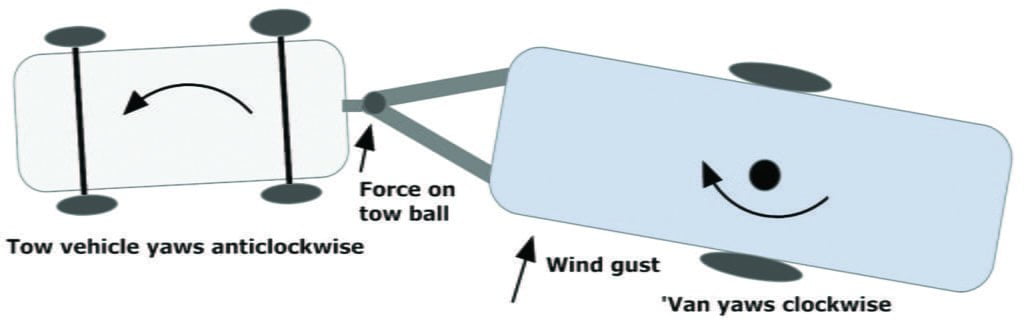
Trailer Dynamics Simply Explained
by Collyn Rivers
Trailer Dynamics
That caravans roll-over yet most vehicles don’t show trailer dynamics is not understood or is ignored. Trailer dynamics simply explained tells why. The main cause is that hitch extending from the tow vehicle’s rear. It not only allows but causes both tow vehicle and caravan to sway (yaw). Worse – if one yaw’s clockwise it causes the other to sway anti-clockwise. The further the tow ball behind the tow vehicle’s rear axle, the greater that effect.
As a caravan sways, the tow vehicle is caused (by that hitch) to yaw in the opposite direction. Pic: copyright 2014 https://rvbooks.com.au
At low levels, this yaw usually dies out after two or three swings. It’s annoying but harmless. With some rigs, however, it may build up more and more. If this happens above a critical speed (specific to each rig) it may result in jack-knifing, and furthermore – a roll-over. In 2018 one of Australia’s five caravan insurers (alone) reported over 135.

A sad ending. Pic: source unknown.)
Why Caravans Roll Over
This problem, and its main cause, was first known in 1914. Trucks back towed overhung hitched trailers – that subsequently rolled over. The cause (that overhung hitch) was quickly recognised. By 1920 most commercial trailers had the hitch directly over the tow vehicle’s rear axle/s. Most still do.

With no overhang, the trailer pivots around its hitch. It barely affects the tow vehicle. Pic: copyright https://rvbooks.com.au.
Early (about 1917) fifth-wheeler Adams Motor Bungalow. Pic: Glenn H Curtiss Museum (USA).
The inherently more stable fifth-wheeler caravans stem from this era (1912-1920).
As caravans yawed (and worse), people devised ways of preventing it. But they did not address the known causes. On the contrary – they invented various (patentable) add-ons intended to dampen yaw. Still used to this day, they reduce low-speed discomfort. They cannot, however, cope with major yaw forces that may result in rollovers. This is particularly with mainly long and heavy caravans. The reason is that most are frictional devices. Whilst effective at low speeds, the friction remains constant. Sway forces, however, increase with the of rigs speed. At 100 km/h, friction sway devices are only about 1% effective.
Europe’s caravan makers accept the causes: they keep caravan weight low. Their towing laws ensure caravans are about 20% lighter than whatever tows them. Safety is further helped by the general EU 80 km/h towing limit.
The Australian and US approach retain those add-ons, plus a so-called Weight Distributing Hitch. There are also effective electronic stability aids.
Mass, weight and inertia
For an explanation of trailer dynamics, a few technical terms have to be used. The major ones are weight and mass.
Whilst not an issue with things like cooking, weight and mass are different. With caravans and their tow vehicles, that difference is vital.
Mass is a measure of the amount of material in something. It remains exactly the same no matter where it is (including in space).
Weight is the effect gravity has on mass whilst on Earth. It pulls mass downward and that force is regarded and measured as ‘weight’. A given mass actually weighs less on a mountain top.
In space, a mass that weighs 10 kg (22 lb) on Earth has no weight. But if thrown that mass acts as if on Earth. It weighs nothing. But its thrown mass is still equivalent to a 10 kg (22 lb) weight.
For weighing stationary caravans and tow vehicles, mass and weight are the same. But once moving, mass attempts to follow a straight line. This only changes when an equal and opposite force deflects, slows or stops it. This effect is called inertia. (As with politicians, inertia resists change.)
Tow ball mass
Like thrown billiard cues, to keep straight caravans must be front-heavy. Caravan makers and owners have long seen about 10% of the caravan weight is sufficient. In reality, however, short centre-heavy caravans are fine with less. At a typical four metres or so, camper trailers’ tow ball weights vary from 3%-22.5%. It is rare to find one that is unstable.
Many caravan makers, however, now quote tow ball weight as that unladen. And with water tanks empty. Few now recommend laden nose weight, possibly because 10% can no longer be borne by many current tow vehicles. And the trend is to yet less.

Pic: https://rvbooks.com.au
As with a see-saw, the effect of weight depends on where it is relative to its pivot (here the axle). A, B and C (plus and minus) are all one metre apart. +D is half a metre from +C. A weight of 100 kg (220 lb) at +C and -C has an ‘effective weight’ (mass) twice that at +/-B. At +D it is two and a half times that at +B.
The above is a very short (4.0 metre/13 foot) caravan. Were it 7.5 metres the effect of weight (mass) at the tow ball is about 300 kg (660 lb) for every 100 kg (220 lb) there. Despite that many caravans have twin gas cylinders and batteries so located. Plus two spare wheels and even a tool-box at the far rear.
The effect of mass and where it is located matters when a caravan pitches or yaws. The weights’ forces (mass) then increase not only by their distance from the axle/s. They increase while pitching and/or yawing.

The effect of weight along the length of a caravan. Concept and Pic: rvbooks.com.au
With the weight central the bar swings and stops with ease. Moving that same weight outward the bar causes the bar to be increasingly hard to swing. And to stop swinging. The same thing happens if you simulate pitching. Also, the faster you move the bar, the harder it becomes. Caravans behave like this!
Weight distributing hitches
tow ball weight on an overhung hitch acts like pushing down handles of a wheel-barrow. It causes the front to lift, thus reducing weight on its front tyre/s.
On a tow vehicle, the front wheels need to steer, such weight loss needs rectifying. The WDH (weight distribution hitch) used on large caravans levers up the rear of the tow vehicle. By using the tow vehicle’s rear axle and wheels as a pivot, the WDH levers the front wheels down.
Whilst partially remedying one problem, the WDH, however, introduces another. It cannot reduce the yaw forces caused by that tow ball mass on an overhung hitch. Front end weight is partially restored, but the WDH inherently reduces the tow vehicle’s straight line and cornering ability by about 25%. It also rapidly and cyclically changes front/rear footprint grip when a caravan pitches. If yawing at the time this can escalate and cause the rig to jack-knife.

The purpose of a WDH is to reduce the effect of hitch overhang. This hitch undesirably extends it. Pic: Original source unknown.
A WDH is like a truss used to support a hernia. It’s better to remove that hernia (the ‘need’ for that truss). Reducing caravan end-weight is a far better way. It has long been the major European approach. There, caravans are typically 1200-1600 kg (2650-3525 lb), (about 60% of most local product). They are end light, enabling tow ball weight of only 60-80 kg (130-175 lb). They have no need for a WDH. Nor do they have provision for one. There are long such caravans and similarly lighter per metre than the current local product. They are typically towed by cars (less so by 4WDs).
Right now, a WDH is necessary with end-heavy caravans over (say) 5.5 metres (18 ft), and a laden weight of 1800 kg (4000 lb). A saner approach is to design, scale and load caravans so no WDH is required.
Trailer dynamics – yawing
A long front-heavy caravan resists changing direction. This causes it to feel ultra-stable whilst moving in a straight line. This usefully resists wind gusts, and changes in road camber etc.
A major downside that the so-called inertia that normally keeps that ultra-stable becomes its very undoing. It may overwhelm the tow vehicle’s ability to make an emergency turn. As with a big container ship, it resists moving other than straight ahead. But a major disturbance (like a ‘perfect storm’ wave can (and sometimes does) roll one over.
Caravans of similar length and weight, but different mass distribution, have very different yaw inertia. An end-heavy caravan has far more yaw inertia than a similar length caravan with centralised mass.
Optimum tow ball mass
Those working in this ongoing field of research, backed up by real-life testing agree that optimum tow ball mass (for local product) is 8% to 12%. It is 6%-8% for typical EU product.
In practice, many caravan makers ignore this. Many quote only the unladen tow ball mass. One, of plus 2.5 tonnes unladen is under 4.0%.

This 5.3 metre Phoenix (of the 1990s) has the axles set well back. Note the truss-braced chassis. Pic: Barry Davidson.
Good trailer dynamics necessitate mass centralised (as far as possible) over the caravan‘s axle/s. It also requires the axle/s to be set toward the rear (as with the Phoenix above). This is aided by keeping end weight ultra-light. It necessitates using light composite materials.
Excess yaw inertia is a bigger problem than excess caravan weight as such. It is becoming increasingly necessary as available tow vehicles are increasingly lighter and, furthermore, less able to support high tow ball mass.
Trailer dynamics – sway (yaw) limiters
Particularly with low tow ball loading, a caravan is likely to yaw slightly at low speed. This is annoying but harmless providing it ceases of its own accord within two or three such cycles. Sway (yaw) limiters may dampen it to almost zero. They are often included on new EU caravans.
There are two main types. Firstly, friction mechanisms dissipate yaw energy as heat. Secondly sprung cams (or similar) that ‘lock’ caravan and tow vehicle in a straight line. The rig then normally corners by distorting by tyres’ footprints. The cams release only when turning sharply.
While reasonably effective at low/medium speed, all such add-ons are less so at speed. Further, when a sprung cam’s limitations are exceeded it suddenly releases unwanted energy into an already dangerous situation. (It seems akin to having a King Brown as a guard-snake).
The major potential problem, however, is that all such devices mask serious inherent instability.

This Reese dual-cam sway control ‘locks’ the caravan to the tow vehicle. It releases only on sharp turns and high-level yaw.
Electronic sway control
Some 4WDs have so-called inbuilt ‘sway correction’. It automatically and asymmetrically brakes the tow vehicle (left/right) to partially counteract trailer’s sway. The X3 BMW can interlink this to a towed vehicle.
AL-KO’s ESC (Electronic Sway Control) detects and attempts to correct caravan yawing by caravan braking. It is a ‘detected emergency’ system’ that actuates only if the caravan exceeds a lateral acceleration. Or 0.4 g or four repeated successions exceeding 0.2 g. That 0.4 g is the very highest cornering force sustainable with a truly stable rig. It cannot be achieved if a WDH is in use. The limit then is about 0.3 g.
How the AL-KO ESC works. Pic: AL-KO Europe
The effect is akin to a cyclone suddenly encountering cooler water – it loses its energy source. The AL-KO ESC does not correct yawing at less than dangerous levels. Forum reports that ‘my caravan became more stable at all speeds once the AL-KO unit was fitted’ are thus nonsensical.
The AL-KO unit can be retrofitted to trailers that have AL-KO brakes. It has proven effective in Europe, but it’s unclear if it copes with a long end-heavy caravan yawing strongly at high speed. It is generally similar to the IDC system from Germany.
The Tuson/Dexter DSC system (USA) applies braking asymmetrically (i.e. out-of phase with the yaw). It detects yaw in a different manner and acts at lower levels.
As noted above, any ‘sway correcting’ system may mask underlying instability. Their makers advise they must not be used to correct existing instability. Furthermore, they cannot overcome the laws of physics.
Weight of tow vehicle
Ideally, the laden caravan should weigh no more than about 80% of that of the laden tow vehicle (and that is typical in the UK and EU where the towing speed limit is 80 km/h).
There is currently a major issue with some dual-cab utes, that whilst rated at 3500 kg (7715 lb) tow capacity, they can only do so if that ute is semi-laden. This can lead to a 3500 kg (7715 lb) caravan being towed by a 2500 kg (5500 lb) tow vehicle. See: claims-for-dual-cab-ute-towing-capacity-mislead/
Critical speed
Every caravan tow vehicle combination has a critical speed. If that is reached, and particularly if exceeded the rig may experience rapidly escalating up yaw that cannot be corrected. The cause is complex – and explained in my article Caravan & Tow Vehicle Dynamics. It is described in detail in my book Why Caravans Roll Over – and how to prevent it.
Extensive test data suggest the critical speed for long end-heavy ‘vans may be too close to Australian speed limits for comfort (and some now probably under it). The towing speed limit in the UK and Europe is typically 80 km/h – despite generally more stable and weight balanced rigs.
No need for independent suspension
There is little or no need for independent suspension on trailers (it is far from common on 4WDs rear axles). It enables the 100 mm or so otherwise needed vertical travel space of a beam axle to be used for water storage etc. It has no other real benefit.
That independent suspension is wrongly seen as somehow ‘better’ is partly due to a lack of high-quality leaf spring suspension systems. Car suspension is designed around human physiological constraints.
These constraints do not apply to caravans. As AL-KO proves worldwide there is not the slightest need for long travel suspension for caravans.
If building one’s own, use the rear springs and shock absorbers of a post-2006 Hilux.
If independent suspension has to be used, check out the twin beam axles (used by Track Trailer and Vista).
Tyre behaviour
Pneumatic tyres do not behave as do solid tyres. Their behaviour can be simulated by holding an inflated balloon firmly by its sides and pressed it onto a hard surface. Rotating its sides slightly causes the balloon to distort and apply, via its side-walls, a force across its elastic surface footprint.
Were the balloon a steered wheel, the revolving distorted footprint would cause the vehicle to turn in a radius that is less than that of the distorted footprint. This difference is generally known (but misleadingly) as the slip angle.
The slip angle concept.
Unlike friction generally, a pneumatic tyre’s cornering power is not proportional to its loading. (It’s about 0.8 of it.) This causes major issues when a vehicle is pitching and/or yawing. Slip angles vary accordingly. Pitching and yawing primarily affects the tow vehicle’s rear tyres. It introduces high-speed steering irregularities. Beyond a certain point, all grip is lost and the tyre/s slide out of control.
Tow vehicles
The greater the weight of the tow vehicle, relative to the caravan, the better. This is becoming a major issue as tow vehicles become increasingly lighter. The laden tow vehicle should be at least as heavy as the laden caravan, ideally 30% or greater.
Also important is the minimal distance from the centre line of tow vehicle rear axle to tow ball. The average (in Australia) is 1.24 metre from tow ball to centre line of the tow vehicle’s rear axle.
The tow hitch itself should have a minimum length: some extend by unnecessarily and undesirably. The further the tow ball is behind the vehicle’s axle, the greater the extent and severity of snaking. This also reduces the critical speed where chaotic behaviour may (not necessary will) be triggered. Many caravan accidents involved semi-laden dual cab tow vehicles with extensive rear overhang.
Speed
This is a vital factor. The higher a caravan‘s inertia, the lower the critical speed. That critical speed may well be below the legal limit for high yaw inertia caravans. Or too close to it for comfort. Ideally, keep the speed below 100 km/h (80 km/h is strongly recommended for long end-heavy caravans).
This problem mostly affects end-heavy caravans, particularly long ones. It can also affect shorter caravans towed at speed on motorways. Light caravans (sanely laden) up to a probable five metres are at less risk, particularly if there is a centre kitchen.
Owner actions
Load caravans such that anything heavy is above or as close to the axle/s as possible. Do not have washing machines, heavy toolboxes, spare wheels etc at the extreme rear.
Minor yawing at low speed should die of its own accord. If however, yaw begins at above the critical speed, it is rarely recoverable by driver action. This is because any steering ‘correction’ tends to increase the disturbing forces.
Trailer dynamics – conclusions
Vehicle stability was well understood by the late 1930s, and refined thereon. Most work on trailer dynamics began in the late 1970s. There are many published papers (backed up by practical real-life testing) but hard to follow without a background in this area. The main leader is the UK’s University of Bath (financed by Bailey Caravans).
Further information
A major bibliography is included in my major Caravan & Tow Vehicle Dynamics.
For a UK-oriented view see the (very readable) Understanding the Dynamics of Towing, by Simon P Barlow.
If you find this article of value or interest please buy one or more of our books. Caravan & Motorhome Book, the Camper Trailer Book, Caravan & Motorhome Electrics, Solar That Really Works (for cabins and RVs) and Solar Success (for home and property systems). For author information Click on Bio.
This topic often arises on RV forums. If you feel it may assist others please consider placing this Link on the appropriate forum thread.
This article and associated drawings are copyright RV Books, Mitchells Island, NSW 2430 (Australia). They may not be copied nor reproduced in any manner, nor changed in any way or form, without the Express Written Permission of the copyright holder.

All solar house – self-building an off-grid all solar house
by Collyn Rivers
All Solar House
My wife and I self-built our all solar house in Australia’s far north in 2001. While we no longer live there, it is still (2020) beautiful and practicable. Living with solar alone is 100% possible. Here’s how and why.
The upper third of the 10-acre block. The solar array for our all solar house is bottom left of the photograph. Pic: rvbooks.com.au
Apart from bore water, the 10 acres (of Cable Beach frontage) had no services. Using hi-tech materials and techniques, however, enabled me and my wife to self-build a beautiful and totally practicable living space. Plus extensive irrigation.
The land at Ngungnunkurukan (known as Coconut Well), is 21 kilometres north of Broome – one of the world’s most isolated towns. Broome’s nearest city is in Indonesia. It nearest in Australia (Darwin and Perth), are both over 2000 km away. The 12,000 or so population is over 50% indigenous.
The land directly adjoins the route of one of three major Aboriginal songlines traversing Australia. Moreover, it also has major rock formations significant to the local Yarwu community.
Original bush and sand dunes front directly onto a tidal lagoon. Furthermore, the Indian Ocean is a mere 400 metres away.
Protecting the culture
Knowing the significance, we followed the traditional owners’ wish to protect rocks and significant trees. And, at the same time, to restrict access to a sacred part of the site. That part was welcomed! It’s a breeding area for King Brown snakes.
We attempted, also, to avoid heavy earth-moving machinery being close to that area. In addition, Broome Shire and the local fire authority allowed obligatory fire trails to detour around such areas.
Cyclone Rosita
We moved onto the land in April 2000. Cyclone Rosita struck ten days later. We buried our ultra-strong OKA off-road truck to its chassis and also strapped a table across its windscreen. This gave shelter against the subsequent 180 km/h plus wind.
Whilst scary, that cyclonic wind caused us to upgrade the engineering. Furthermore, we added a virtually indestructible cyclone shelter. It’s rarely needed but provides visitors with a truly strong bedroom.
All solar house – our main requirements
Our main requirements were light and space. And visually, to link the ocean in front to the virgin bush at sides and rear. The original concept was good. Nevertheless, as an engineer myself, it was clear the designer’s structure was far from adequate. It was subsequently and brilliantly re-designed by Garry Bartlett of B&J Building Consultants (in Broome). B&J also fabricated the massive steel mainframe.

Despite its complexity, the all-steel framework was erected in one (12 hours) day. The diagonal steel tubes add strength. They also double as water drainage for the gutters. The Pindan soil really is this colour. Pic: rvbooks.com.au
Bridge-like construction
The house’s superstructure is closer to an arched steel bridge than a house. It’s structural engineering – not traditional building. It is almost entirely concrete, steel and glass. There is not a single mud-brick, straw bale, or any but non-structural timber in it!

The main area – looking north. Pic: rvbooks.com.au
It is also rare in having a ceiling 4.3 metres high at its centre. Apart from its roof, the exterior is almost entirely cyclone-proof toughened glass sliding doors. Each has slide-open stainless steel security mesh. There are no full-height internal walls, only a couple of 2.0 metre (6 foot) high partitions.
Double curvature roof
The all solar house’s main strength is its double curvature roof! This is fabricated from heavy gauge Colorbond steel. It is secured by 14 gauge Tek screws. In addition, it has cyclone washers at every channel. Furthermore, the purlins are welded to massive curved RSJs (rolled steel joists). A similar Colorbond ceiling likewise attaches directly to the purlins’ undersides. The whole forms an immensely strong, but nevertheless light, beam.
The roof is tied down by forty steel posts. Each is 100 by 100 mm square. The posts are bolted to a 600 by 600 mm reinforced concrete perimeter beam. Diagonally located 150 mm diameter (and 20 mm thick) steel tubes provide further support. They also double as rainwater down-pipes.
The RSJs sections (each over 2000 kg [4400 lb]) were rolled to the desired double curvature in Perth. They were then trucked the 2100 km to Broome and welded into complete sections. Then trucked 4200 km to Perth and back for galvanising. Roofing sections were rolled to the same curvature.
Precision construction
The all-steel structure demanded tolerances of only a few millimetres. This is closer to watch-making than builders’ typical plus or minus a centimetre. Or three. The 400 mm perimeter (40) beam’s needed placing within two to three millimetres. Surprisingly, it worked. Furthermore, the 150 m² structure is within five mm² across diagonals.
Building the all solar house
When it came actually building, we found that no local builders were willing to assist. They seemingly felt it was closer to bridge-building than house building. This was not, however, a major problem. I (Collyn) was originally an engineer. My therapist wife (Maarit) acquired welding and production-engineering certificates at Broome TAFE. She also (and usefully) became a certified venomous snake handler.
We had contractors pour the 300 mm thick concrete floor. B&J assembled the huge steel frame – assisted by a 200-tonne crane. Even at that capacity the crane consequently worked hard. It had to position the massive steel beams at its full extension of over 40 metres away. We had contractors install the Colorbond roof and ceiling. Likewise, internal plumbing and 230-volt ac wiring.
To enable mainly solar to power even the construction, I arranged that first. I designed an initial 2000 watt system that I located on the roof of an existing shed. It had about 45 kilowatts of battery storage and an inverter that could cope with an 11-kilowatt peak draw. The array was later expanded and moved closer. It still (2020) provides a reliable 3.4 kW – and about 18 kWh/day most year-round.
Building started building in earnest in August 2000. We moved into the (semi-completed) but already all solar house by Christmas.

There are no full-height internal walls. The floor is ochre-coloured polished concrete. Pic: rvbooks.com.au
Powering the all solar house

The main solar array. A further bank (of six modules) was added just after this 2005 pic was taken. Pic: copyright rvbooks.com.au
The solar system initially puzzled contractors. They knew the closest power lines were 20 km away. But here was 230 volts at considerable wattage. It was initially hard to persuade them it was from solar.

This SAE 11 kW surge inverter installed in 2001 works well to this day. Pic: rvbooks.com.au
The original batteries were flogged to death by a caretaker. They were consequently replaced by sixteen 12-volt gel cell batteries. Each was 235 amp-hour. An 80 amp Outback Power regulator controls charging.

Sixteen 12-volt (235 amp-hour) gel-cell batteries were connected in series-parallel. They provide 940 amp-hours (45 kWh). Pic: rvbooks.com.au
Naturally cooled
Indian-ocean cooled air is drawn into the house via its usually open but fly-screened doors. The air is subsequently extracted via roof vents. Air-conditioning was deemed unnecessary. A cool ocean breeze usually develops by midday year-around.
A very efficient Fisher & Paykel fridge copes well. Cooking is via LP gas (using 40-litre cylinders). Water heating is solar only. It even works well in winter.
As LEDs were not available back then, lighting was all via compact fluorescents. Ample power was available to drive them. Had we built later, however, we would have used LEDs throughout the property.
Water
Despite excellent bore water, the house uses rainwater – even for toilet flushing. The 280 square metre roof has two deep and wide stainless steel gutters. These are inset between the roof and the ceiling for cyclone protection. Water flows via diagonal bracing tubes to sunken 200 mm pipes. These fill a 14,250-litre holding tank that captures torrential seasonal rain. The fall is so heavy the tank fills inside an hour. The water is then pumped to the main 100,000-litre tank.
Water is supplied to the house by a pressure pump and 500-litre water pressure tank. The pump replenishes the pressure tank once or twice daily. It is silent and efficient, moreover running only twice a day for a few minutes each time.
Swimming pool for an all solar house
Quotes for the pool’s circulation system were around $60,000. Finding them based on traditional technology, we designed and built our own. It cost a mere $7500 (in 2002.) This, as with all the house and property, runs from solar alone.

Lorentz Badu pump after seven years. It runs on 40 volts dc and pumps about 35,000 litres a day using four dedicated 120 watt solar modules. (The apparent rust is the Kimberley’s Pindan sand that stains everything it touches.
Lorentz Badu pump after seven years. It runs on 40 volts dc, pumping about 35,000 litres a day from four 120 watt solar modules. (The apparent rust is the Kimberley’s Pindan sand. It stains everything it touches).
A 480-watt solar array directly drives a Lorentz 48-volt brush-less DC motor pump. No batteries are needed. The pump accepts a wide range of voltage, so no solar regulator is needed. As a result, water circulates all day under the Kimberley’s typical all-day sun.
No chloride is used. Irrigation water first passes through the pool. It effectively replaces about 10% each day.

Crystal clear water. A 48-volt dc pump is powered by the four 120 watt solar modules seen here. It runs all-day. The house’s inset gutters can be seen here. The protruding section (left) is an ultra-strong cyclone shelter. (Full details of this pool are in Solar Success.)
Crystal-clear water
The crystal-clear bore water is among the world’s purest. It comes from the King Leopold Ranges – 700 km north-west. The land in between is totally untouched. We used only 2% of our allocation, 98% consequently pours into the ocean.
Sewerage is septic. We would have preferred a more ecologically viable system but, notwithstanding, Shire regulations prevented it.
Broome Shire otherwise cooperated totally. It rejected the original plans as cyclone protection was inadequate. But that confirmation was nevertheless welcome. I’d calculated that too. The upgraded specifications were done by the then-mayor – he was a structural engineer.
Not all worked as hope. One downside, for example, was the kitchen. Built locally, it’s very poorly made. ‘Call yourself a cabinet maker’, said Maarit to one. ‘You’re not even a half-competent bush carpenter.’

My Finnish wife Maarit – in blacksmith mode. Pic: Broome TAFE
A time to move
The all-solar house worked well for us for ten years. Whilst there I wrote and successfully published five books. I also spent four years at Broome’s tiny university campus, auditing the Aboriginal Studies course. Meanwhile, Maarit acquired two more university degrees. She subsequently obtained her Master’s degree.
We later needed to be closer to our rapidly expanding Sydney family. Reluctantly, we sold the property in 2010. A visit in 2019 however, showed that, apart from new batteries, all still worked well.
Our home (in Church Point) has subsequently become an all solar house too. It has a 6.4 kW system with Tesla 14 kWh battery back-up. On most days it produces far more than we use. The surplus is fed into the grid under a two-year contract at 20 cents per kW/h.
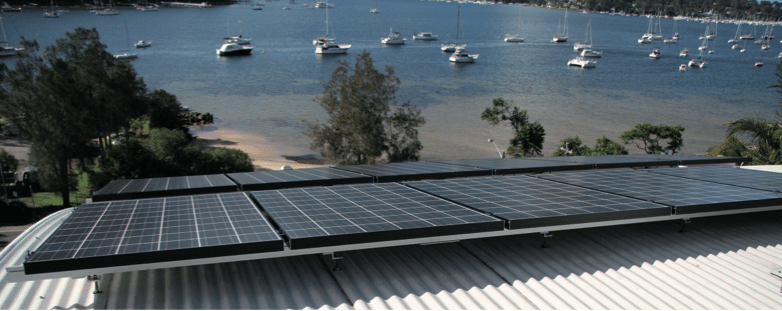
A 6.4 kW solar system supplies all the three-story home’s needs plus. Pic: rvbooks.com.au
Further details
Fuller details of the Broome’s solar, swimming pool, water pumping are in my book Solar Success.
It is totally feasible to build an all solar house. That book shows specifically in detail how to get it right first time.
Solar That Really Works specifically cover cabins and all RVs. Caravan & Motorhome Electrics specifically covers this. Caravan & Motorhome Book gained excellent reviews. To quote Caravan World: ‘Collyn Rivers has put his encyclopedic knowledge into print . . . there is virtually no issue he hasn’t covered.’
Click here for a full index of my articles in this and other areas. Bio.
Is Caravan Independent Suspension Essential? – the answer is no.
by Collyn Rivers
Is Caravan Independent Suspension Necessary?
Is Caravan Independent Suspension Necessary? Or is a marketing issue? It is not an engineering issue. As this article explains, caravan beam axles are generally better.
Until 1930 or so most cars had beam axles (typically leaf sprung). A US-led wish for softer suspension, however, caused an unexpected effect.
As one or other wheel of a softly sprung beam front axle rises or falls over undulations it causes the often fast-spinning wheel to rise and fall in an arc. That wheel acts as does a gyroscope. It attempts to swing sideways. As the front wheels are connected by a horizontal track rod, if one rises in an arc it causes the other turn likewise. If not adequately dampened, this so-called gyroscopic precession builds up alarmingly. The front wheels swing violently from lock to lock. They also tramp up and down. This is related to speed – and became increasingly serious as cars became faster.
It was realised that this issue is inherent with beam axle located steered wheels. It was also realised that it can only be fully overcome by having the wheels rise and fall vertically. And independently. US engineers seemed unaware that Lancia had been using independent front suspension for a long time. A few other had too: Lanchester around 1900, and Morgan a year or two later.
As with a caravan‘s, beam axled car rear wheels are subject to similar forces. As they are not free to swivel, however, there are no unwanted effects. Hence many to this day (particularly 4WDs) retain beam rear axles.
Is Caravan Independent Suspension Necessary
Caravan Independent suspension. Pic. Jayco.
For reasons that relate mostly to marketing, Australian caravanners are led to believe that caravan independent suspension is essential. The opposite is closer to reality. For caravans the type mostly used (trailing or leading arms) has a major downside.
Conventional caravans are towed by a centrally-mounted hitch that is about 400 mm above ground. When one caravan wheel traverses a bump (or depression) the front of the caravan rocks around that hitch. The caravan‘s springs may deflect – but not by much. This is readily seen by looking in the rear-view mirror as a caravan crosses rough going.
Effect on the centre of gravity
The major issue now is that the centre of gravity is at much the same height as with as a beam-axled caravan. That trailing arm suspension, however, introduces a considerable lever effect (Moment Arm) adding to that sway. This effect is even more so at the extreme rear. A pair of high slung spare wheels weighing (say) 80 kg (175 lb) has an effective mass of many times that weight. (The effect when swaying is not unlike a camel bending both legs on the same side.)
Further, a caravan with trailing arm suspension does not roll as such. It rolls around a diagonal axis that is at tow ball level (and centred) at the very front that causes it to sway around the ground level at its wheels. The centrally located hitch also causes it to adopt a duck-like waggle as it sways.
Because of this effect side forces cause a trailing arm suspended caravan to sway to a far greater extent. This may not be noticed in normal driving but becomes only too apparent in excess cornering speed, an emergency swerve, or air pressure forces from a passing truck.
Apart from trivial tyre depression a beam axle caravan‘s chassis always remains vertical to the surface. When a side force is applied the sprung mass rolls around an axis that is about the same height as the tow ball. There is thus very little lever effect (Moment Arm) to increase the effect of roll forces.
The Al-KO trailing arm suspension introduces a similar effect but as it has far less movement the sway is minimised. Such sway can be avoided by using the horizontal arms (as on the front of most cars) – or by using two pivoted full-width beams as in the Track Trailer TVan. But all take up needed central space.
The ideal suspension
The ideal beam axle caravan suspension needs to be similar in concept to that of the front of the superb 4.2 litre TD Nissan Patrol: a few DIY camper trailers actually use that (with a light beam axle). It is essentially a properly located hollow section (or I beam) axle with well-damped coil springs or airbags.
Sadly, however, little work is done in Australia to develop properly engineered beam axle suspension. Most use far too short stiff leaf springs intended mainly for garden trailers. There is one exception but its spring leaves are really too short for caravan use.
As a result, many locally-made caravans have soft long-travel suspension that mainly deflects when least needed i.e. whilst swaying. Many have dual shock absorbers per wheel – yet towed by 4WDs that cope adequately with only one per wheel.
Building your own ideal suspension
The simplest way is to use the rear leaf springs from a Nissan Patrol or Hilux, minus a leaf or two, and a proprietary hollow section steel beam axle (or I beam). Use also the associated shock absorbers. The spring deflection should be such that (prior to the shock absorbers being fitted) the laden caravan should bounce on its springs at about twice a second. Given the correct weight distribution etc. you will find it tows like a dream.
My Caravan & Motorhome Book goes into this at greater depth.
If you find this of interest please Link to it on appropriate forums – and do please tell your friends to read it.

Caravan fridge problems – how to fix the most common faults
by Collyn Rivers
Caravan Fridge Problems
Caravan fridge problems are due to poor ventilation, inadequate cable size and/or insufficient power to drive them. Here’s how to fix them.
Pic: Original source currently unknown.
Q. My caravan fridge works fine whilst on 230 volts, but not on 12 volts when we free camp. How can I can tell for sure if the fridge is faulty?
A. You can be 100% sure if you remove the fridge. Then see how it performs standing alone in a garage at much the same temperature.
Poor installation
Q. A friend says you emphasise in your book (Caravan & Motorhome Electrics that most caravan fridge problems are due to faulty installation. How has this come about?
A: A probable 95% of caravan fridge problems are because they are poorly installed. There are two main types of caravan motorhome fridges: 12/230 volt compressor, and 12/230 volt/ LP gas (so-called) ‘three-way’ fridges. Both suffer from poor installation. Some RV makers and many self installers do not understand how fridges actually work.
Fridges do not make cold. They are simply pumps that moves heat from where it is not wanted – to where it does not matter. You must have a cool air inlet at their base. You also need to direct that cool air through the fridges cooling fins. Rising hot air must easily exit.
Ventilation is vital
Ventilation is totally vital for three-way fridges. This only too often insufficient. Some have none at all. Unless ventilation is provided as specified (and illustrated in Caravan & Motorhome Electrics) they have no chance of working correctly, on either electricity or gas. See below if the fridge works on gas and 230 volts, but not 12 volts.
Many caravans now have access to 230 volts, so they use this most of the time. Here, cable size can usually be relied on to be fine. Use much heavier cable if it runs on 12 volt solar/battery power. The required cable, however, is costly – so is rarely used. Current draw on 12 volts is very high. It is only feasible from a vehicle alternator, and short lunchtime stops from battery power.
Q. I know caravan fridge 12 volt fridge cable is usually too small. How heavy must it be?
A: This depends on the distance from the battery – it should not exceed two to three metres. Errors are caused by there being several ways of specifying cable size.
When specifying cable size, makers of electrical stuff either quote the cross-sectional area in square millimetres, in AWG or B&S. The latter are identical for all practical purposes. For most electric compressor fridges, the minimum is 4 mm² (AWG 10), but 6 mm² ( AWG 8) is preferable. Three-way fridges draw from 12-30 amps. These really need 8 mm² (AWG 7) unless the distance is less than two metres (when 6 mm² is fine).
Auto cable size
Q. I hear there is a problem with the auto cable sold in auto parts and hardware stores.
A. Auto cable is usually just fine. But, for reasons that defy sanity, auto cable makers use similar ‘numbers’ as above (e.g., 4 mm, 6 mm) to imply something totally different.
Auto cable ‘4 mm’ is not 4.0 mm² – it is the overall diameter of the cable including its insulation. That rating is the size hole you can push the cable through!
Worse, auto cable insulation thickness and type varies from maker to maker. Most 4 mm auto cable is anywhere from 1.8 mm²-2.0 mm². Most 6 mm auto cable is 4.6 mm². The reason why so many fridges are affected is because that 4 mm² and 6 mm² cable are the sizes most commonly specified. Be aware that even if you ask for (say) 4 mm² cable what you almost always sold is 1.8-2.0 mm² auto cable. Many people fall into this trap as few vendors know there’s a difference. (The square mm size is, however, usually shown in the cable’s specification.)
Caravan fridge – current ratings
Q. My three-way caravan fridge draws 25 amps. It is connected to the tow vehicle battery by ten metres (total for twin conductor) of 35 amp cable – yet barely works. A friend has your Caravan & Motorhome Book (that has a lot about caravan fridge problems). He says the cable is much too small. How can this possibly be? It’s already three and a half times the necessary current rating!
A. Current ‘rating’ is mostly misunderstood. It is not a current carrying recommendation but a fire rating that relates only to the current the cable can carry before its insulation begins to melt. The rating has absolutely nothing to with voltage drop. The most commonly used ’35-amp’ cable can be as small as 4 mm auto cable (1.8 mm²)! Ten metres of this introduces a massive three volts drop. That fridge will barely work at all. The minimum you need is 10 mm², over seven times the size.
You need to locate that battery in the caravan, charged from the alternator by a caravan-located dc-dc charger. See: dc-dc charging. Still use proper size cable. (You owe your friend, and that fridge, one considerable apology!)
About the author
Collyn Rivers is an ex motor industry research engineer who switched careers in mid-life to write and publish technically correct books in plain English. They cover the caravan, motorhome and solar areas.
The ‘overall’ ones are the Caravan & Motorhome Book, and the second edition Camper Trailer Book. Electrical issues are covered in Caravan & Motorhome Electrics, solar in Solar That Really Works (for cabins and RVs) and Solar Success (for home and property systems).

Caravan wheel placement
by Collyn Rivers
Caravan wheel placement
Caravan wheel placement is a vital issue affecting on-road stability. This article explains why, and the position along the chassis with which they should best be located.
A conventional caravan is always a compromise. This is because it is towed via hitch at some distance behind the tow vehicle’s rear wheels. If that vehicle sways clockwise, that hitch overhang causes (not just permits) the caravan to sway anti-clockwise. If the caravan sways clockwise, it causes the tow vehicle to sway anticlockwise. It is essentially an unstable concept, but safe within limits.
The major constraint of caravan wheel placement is the basic laws of physics. These include two major distances. One is the tow vehicle’s wheelbase (distance between the front and rear axle). The other is the caravan‘s so-called radius of gyration.
Caravan wheel placement – the radius of gyration
The radius of gyration is a distance. With a trailer, it is that distance from its tow hitch to that point along it was all its (laden) mass concentrated in one place. The greater distance the better. For optimal caravan wheel placement, the axle/s should be just behind that location.
As, like an arrow, to be stable when moving, a trailer must be nose heavy (here by about 8-10%). For ideal caravan wheel placement, they should be as far back as feasible. This is readily possible by centralising weight either side of those axles. Moreover, by minimising all other weight, particularly at its extreme rear.
Locating heavy spare wheels on a caravan‘s extreme rear indicates one of two things. Whoever designed does not under basic physics. Or does – but ignores it. And why two spare wheels – when the tow vehicle has one (and with some- just a repair kit and inflator).
Measuring the radius of gyration
This is readily done, but as far as is known, no caravan maker in Australia does so. That required is a frictionless turntable, the rotation of which is constrained by springs. The caravan is then centralised on that turntable and twisted by (say) 30 degrees and released. The time it takes to return to the starting position is a measure of that radius of gyration. The longer it takes, the greater that radius.
You can readily simulate caravan wheel placement by holding a bottle of wine in each fully extended hand – and twisting at varying speeds. (Either red or white is just fine).
Correct caravan wheel placement can also be done arithmetically. Like a loaf of sliced bread, the caravan is (theoretically) ‘sliced’ along its length. The ‘weight’ of each slice is then measured.
The tow vehicle’s radius of gyration is limited by the lateral distortion of its front and rear tyres. Moreover, also by how far they are apart. Here, the greater the better. Most vehicles used for towing (in Australia) are about three metres. In this respect, one of the best tow cars ever made is that least probable. It was the DS Citroen. It had virtually a wheel at each corner.

DS Citroen towing an Airstream Caravan – here again notice the ideal caravan wheel placement. Pic. source unknown
Only one local caravan maker appears to have realised the need for correct caravan wheel placement. He was Barry Davidson. He did so for his 1990s Phoenix range. They have a legendary reputation for excellent towing stability.
An example of the now-legendary Barry Davidson-designed late 1990s Phoenix. Note the ideal caravan wheel placement. Pic: Caboolture Caravans.
Inverters for caravans – and motor homes too
by Collyn Rivers
Inverters for caravans
Buying inverters for caravans can confuse. Prices vary for products that may seem identical but are not. Here’s what to buy.
Inverters vary in efficiency, ability to run any type of load, over-load capacity and safety. Modified square wave inverters are the cheapest but not all appliances will run from them. They can damage equipment such as laser printers. Sine-wave inverters run anything they are big enough to power. Unless you truly know what you are doing buy a sine wave unit. Good inverters for cost more, but they being efficient, they need less energy.
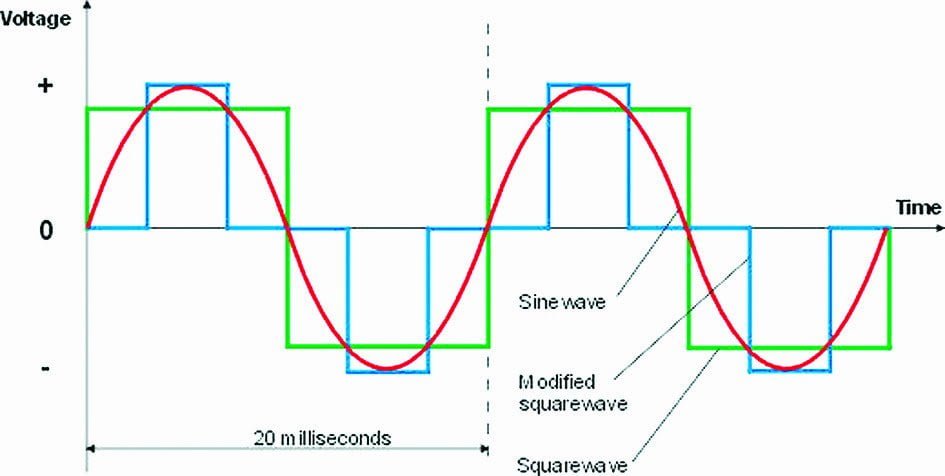
High-quality sine wave units are >90% efficient. They run equipment without risk of damage. Often called ‘pure’ sine wave inverters they introduce minor distortion, but too little to matter. The output is usually cleaner than mains power.
Inverters for caravans – transformer or switch-mode?
There are two main inverter technologies. One uses heavy iron-cored (doughnut-shaped) transformers. The other uses lighter and cheaper switch-mode technology. Each can be designed to produce modified square wave or sine wave output, but surge capacity is very different.
![Inverters for [cara_s] - and motor homes too - electric vehicle batteries,book on batteries,electric car batteries,lithium ion batteries for electric cars,electric car battery technology,how long do electric car batteries last,electric vehicle battery life](https://rvbooks.com.au/wp-content/uploads/2016/03/inverter-graph2.jpg "Inverters for [cara_s] - and motor homes too 208")
This graph of a 3000-watt inverter shows it can output 7500 watts for 10 seconds,
4600 watts for 5 minutes and 4000 watts for 15 minutes.
Inverters for caravans – transformer type
Like camels, transformer inverters carry up to three times their full load for a few seconds. They may carry 50% more for a few minutes, and 10% or so more for 15-20 minutes. This ability is inbuilt – it’s not an overload. If that ability is exceeded they shut down to cool off.
A good 800-watt transformer type inverter runs a TV/DVD that draw 75-150 watts. It powers the odd kitchen appliance, like a coffee grinder, at the same time.
Inverters for caravans – switch-mode
These are less camel-like. Switch mode inverters are relatively cheap, light and compact and ultra-efficient. Their downside is almost zero surge capacity. Few even maintain rated output. Most maintain 80%, but some a mere 40% or 50%. They are valuable where space and weight is limited – and no overload capacity required. Caution is necessary when buying.
Inverters for caravans – temperature versus output
High-quality inverters are rated at an ambient 40º C and will run continuously at that. Cheap ones are likely rated at 25º C, causing them to seem more powerful and better value than they are. Outside winter, a quality 500-watt inverter may outperform an 800-watt cheap one. Be careful when buying. Some vendors quote output at low temperatures.
Inverters for caravans – standby current draw
TVs, DVD players, phone chargers etc often remain on overnight. For these, choose an inverter with low ‘quiescent’ current – i.e. that needed to run itself. This varies, but switch mode units have the least. Info is in makers’ technical data, but rarely sales brochures.
Inverters for caravans – electrical isolation
Many low-priced inverters have an ‘auto-transformer’. These have one side of the 230-volt output winding connected to the battery. This can be dangerous. Good quality inverters are electrically-isolated. They cost more but are much safer. Electronics supplier (Jaycar) sells only double insulated, electrically isolated units.
Inverters for caravans – buying
Switch mode inverters are smaller, lighter, more efficient and cheaper. They have less surge capacity and may need a 2000 watt such unit to start a 500-watt motor.
Transformer based inverters are larger and heavier. They cost more to buy and ship. Some are less efficient but have a high surge capacity. They suit loads that require a high surge current.
A microwave oven’s ‘rating’ (e.g. 800 watts) is a measure of the heat it generates. It is not its draw in watts. Most are only 50% efficient. An ‘800-watt’ microwave oven is thus likely to draw about 1200 watts.
If you can afford and accept size and weight, a transformer sine-wave inverter is a good choice. Otherwise buy a quality switch mode sine wave unit big enough to start and drive known load/s. Do your sums before buying: that needed can be five times the rating of the former.
With inverters, you get what you pay for. Buy a top known brand from a reputable supplier. Be wary of ‘badge engineering. There, identical units under different names may have varying levels of distribution. Each takes a profit!
Inverters for caravans – connecting appliances

This 2000 watt inverter has two 230 volt ac outlets. Appliances plug directly into these outlets. Inverters of this type must not be connected into fixed mains wiring. Pic: Projecta.
Some inverters have power socket outlets. Appliances plug directly into those outlets. These inverters must not be connected to fixed mains wiring. It is illegal and may prevent safety circuits from working.
Inverters intended for connecting to RV fixed wiring have no socket outlets. They are intended for direct connection (by a licensed electrician) to mains wiring. Such inverters rely on that system’s protection.
The complex rules (for RVs etc) are in AS/NZS 3000:2018, and in AS/NZS 3001:2008 (as Amended in late 2012)
Inverters for caravans – current draw
Even small inverters draw high current at full load. A 2000 watt, 12-volt unit may draw 400 amps on surges. This is much the same as a 4WD’s starter motor. If more than 1500 watts is required, it is better to use a 24-volt system. Above 3500-4000 watts requires 48 volts. Heavy cable must be used, and cable runs kept to a metre or so from the inverter to the battery.
Caravan and motorhome electrics, particularly inverters for RVs is a complex subject. Caravan & Motorhome Electrics covers it in depth. Solar That Really Works! covers all needed for solar in cabins and RVs. Solar Success is likewise for home and property systems. Every aspect of buying, use and even self-building is the Caravan & Motorhome Book. The Camper Trailer Book is likewise in its area.
Buying one or both books repays multiple times by your getting things right the first time. This is helped by my (Bio) joint engineering and writing/publishing background of over 60 years. This ensures my books are technically competent, and in plain English.

Caravan weight safe to tow – depends on what tows it
by Collyn Rivers
Caravan weight safe to tow
The maximum caravan weight safe to tow depends on what tows it. This article by Collyn Rivers explains why – and how to know what it is.
In earlier times, what caravans were considered safe to tow was based on their weight relative to that of the towing vehicle. That, however, was in an era when most new caravans were four or so metres long, weighed 1200-1500 kg (2650-3300 lb), and rarely towed above 80 km/h. Where that length and weight still applies, such trailer/tow vehicle weight ratio remains fine. It is true, for example of (sanely laden) camper trailers.
With caravans longer than 4 metres, the limiting weight largely relates to where the weight is distributed. If over 6 metres that weight distribution is critical. This applies both to design and loading.
Caravan weight safe to tow – why this matters
Here’s how to feel for yourself how and why this matters.
Hang any suitable bar (a broom handle will do at a pinch) by a rope. Add a couple of weights as shown below.
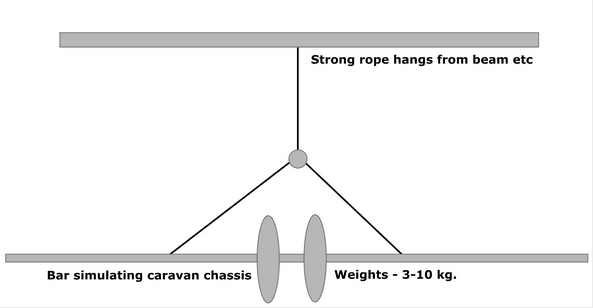
This bar simulates a caravan with the weight close to its centre. Hold the bar and turn it – like a caravan swaying. You will find that, even with heavy weights, it turns and stops turning with ease. Pics: rvbooks.com.au
Now try it with the weights like this:

This simulates an end heavy caravan exactly the same weight. Hold and turn it as before. You will find it surprisingly hard to start and stop.
The further apart the weights, the harder it is to start and stop moving. Also, (as with a tow vehicle and caravan) the lighter you are, relative to the length of the bar and position of the weights, the harder it is to stop and start moving. Take care if you try this with heavier weights. The force may push you over! The same applies if you use a longer bar. Try it also with a heavier weight at the rear.
If you do not access to a barbell and weights you can do this by holding a bottle of wine in each hand – then turn while turning rapidly fully extended both arms sideways. Do this on a still revolving chair and you may have a surprise. (Any wine will do, but drink it afterwards).
Moments along a beam
The above is known technically as ‘Moments Along a Beam’.

The ‘effect’ of weight on a pivoted beam (and a caravan chassis) relates to its distance from the pivot (axle). Pic: original source unknown.
Unless weight is more or less central, a short heavy van is safer to tow than a long van of the same weight. The see-saw effect also shows it is not good to have anything heavy at either end. Locate tool-boxes, batteries, spare wheels etc as close to the axle/s. Never at the far ends.
You have some control over this. The heavier whatever you load, the closer it needs to be to the axles. Never load anything heavy up-front and ‘balance’ that by weight at the rear.
Because of these effects, a long caravan needs a much heavier tow vehicle than a short caravan of the same weight. Some locally made ‘vans are (in my opinion) far too long to be towed safely by anything short of the big Fords etc.
Relates also to caravan length
You should have no problem towing a correctly laden 3.5-metre caravan by a laden tow vehicle the same weight. But you are pushing your luck with a 6 to 6.5-metre local product. I would only tow it with a vehicle at least 30% heavier.
If seeking a caravan longer than 7 metres I seriously advise readers to consider the dynamically more stable fifth-wheel caravan format.
For a warning and explanation of why many caravans are overweight see Caravan tare weight issues/
A more technical explanation is at: Caravan and tow-vehicle dynamics/
Information on tow ball mass is at: Caravan nose weight/
See also Why Caravans Roll Over – also Reducing caravan sway. For info on fifth-wheelers see Fifth-wheel caravans are safer/
If you find this article helpful you will find my books even more so. They include the Camper Trailer Book, Caravan & Motorhome Electrics, Solar That Really Works for RVs), Solar Success (for home and property systems), and the all-new Caravan & Motorhome Book. For information about the author – see Bio.
Please add a Link from this article and/or any of the above to any related forum query. This assists and warns others.
Need for a WDH – avoid using one if possible
by Collyn Rivers
Need for a WDH
Long end-heavy caravans have a need for a Weight Distributing Hitch (WDH). For all trailers, though, it inherently reduces tow vehicle stability. Here’s how and why.
Typical WDH (weight distributing hitch) Pic: Jayco.
Need for a WDH – Tow Ball Mass
Within limits, caravans must be nose heavy. For light European-style caravans with (desirable) centralised mass and loading, the improvement becomes less when nose mass rises above 6-7 per cent of the total weight. These caravans neither have a WDH nor provision for one.
Locally made caravans, however, have become longer and heavier (some exceed 4.0 tonne). They need a high nose mass of at least 10% at all times. Such nose weight (up to 350 kg [770 lb]) however is imposed on a hitch that overhangs the tow vehicle’s rear axle. The effect is like pushing down on the handles of a wheelbarrow. It levers up the front wheels of the tow vehicle. This (in effect) lessens the grip of the (steering) front tyres.
To counteract this, a WDH (a springy semi-flexible beam) attached between caravan and tow vehicle, levers the front wheels back down. This wholly or partly restores the weight. But whilst partially fixing that frontal weight problem it inherently introduces another.
The WDH issue
Only too often overlooked, whilst a WDH assists the front end weight issue, it cannot compensate for yaw (snaking) forces.

The beginning of a jack-knife. Side forces on a tow ball cannot be corrected by a WDH. Pic: copyright rvbooks.com.au
Worse – by reducing the imposed nose weight on the tow vehicle’s rear tyres – it reduces their ability to counteract those yaw forces. That, in turn, causes them to run wide – in effect introducing the unstable result shown above.
Need for a WDH – how tyres behave
The area of a tyre in contact with the road (called its ‘footprint’) is about the size of a human hand. When the steering wheel is turned, the front wheel-rims exert a side force on the tyre walls. That, in turn, distorts their footprints, causing the vehicle to take up the desired direction. For the same reason, any side force will cause a tyre to have a steering effect. This includes rear tyres when subjected to yaw forces.
Here’s how a tyre behaves when steered – or subjected to a side force.
A correctly cornering rig follows the dotted line shown below – i.e. it runs very slightly wide. That running-wide effect is known as understeer. It automatically reduces the risk of jack-knifing. The red dotted line shows what happens if understeer is too great.

Pic: original source unknown.
When a heavy caravan yaws, the WDH’s reduction of rear tyre loading reduces their ability to resist the imposed yaw forces. This disturbs their required ratio of grip and slip angle action front/rear. If the rear slip angle exceeds a critical level the result is so-called oversteer. It may build-up to that shown below – dotted red line – where those (rear) tyres may lose all grip

If the rear tyres increasingly cause the vehicle to self-tighten the turn (oversteer), the result may result in final jack-knifing. Pic: original source unknown.
Caravan jack-knife in the UK – Pic: original source unknown.
Need for a WDH – adjusting a WDH
It has been known since the late 1970s that using a WDH to compensate for loss of tow vehicle front end weight prejudices the tow vehicle’s desired handling. If the WDH is adjusted to fully compensate it introduces a loss of cornering ability of 25-30%.
In physics terms, it reduces it from about 0.4 g down to about 0.3 g. (the ‘g’ refers to the force of gravity). A rough guide to this is that many local road authorities have ‘Recommended cornering Speed’ signs. cornering at that speed usually corresponds to about 0.2 g.
Despite this, until recently recommendations have been to adjust a WDH to fully counteract caravan nose ball weight. Now, however, following recommendations (in a major study – SAE J2807), the world’s major maker of WDHs (Cequent – Hayman Reese) advises adjusting to correct tow ball mass by 50% only. This typically results in the caravan‘s nose being lower by about 50 mm. This is desirable anyway as airflow under the front of a caravan tends to cause it to undesirably lift.
Need for a WDH – tyre pressures when towing
Regardless of using a WDH or not, when towing increase the tow vehicle’s rear tyre pressure by about 50-70 kPa (7-10 psi). This virtually restores the previous steering characteristics. Do not vary the tow vehicle’s front tyre pressure: that should be whatever the vehicle maker advises.
Need for a WDH – summary
The above issues have long been well understood. They have been substantially addressed in the EU, and also followed by EU caravan firms now building caravans in Australia. They are also covered in associated articles on this website. Be aware that a WDH should only be used where necessary. This typically where the laden caravan is heavier than the laden tow vehicle. Also for most caravans over 5.5 metres (approx. 18 feet).
Need for a WDH – further information
The general topic is covered (more technically and in-depth) in my article Caravan and Tow Vehicle Dynamics. See also Reducing caravan sway, also Making caravans stable
See also the excellent UK/EU related: caravanchronicles.com/guides/understanding-the-dynamics-of-towing/
If you found this article of value, my books will prove even more so. They include Caravan & Motorhome Electrics, Solar That Really Works (for RVs), Solar Success (for home and property systems), and The Camper Trailer Book. The author’s Caravan & Motorhome Book covers every aspect of the subject matter.
To assist others please consider posting a Link to this article on related forum queries
* Darling J., Tilley D., and Gao B., 2008. An experimental investigation of car-trailer high-speed stability. Dept of Mechanical Engineering, University of Bath, UK.
Caravan tare weight issues – some declared weights may not be correct
by Collyn Rivers
Caravan Tare Weight
Caravan tare weight issues mainly arise about what’s included and what’s not. Water is not, nor may be optional extras. This article reveals all.
Legally, caravan tare weight is called Tare Mass. For the purposes of this article you can regard ‘Mass’ as the same as weight. It refers to it accordingly.
A typical Compliance Plate. Tare Mass here is 2280 kg. The ATM (see below) is 2680 kg.
Tare Weight issues arise
A caravan‘s Tare Weight is what it weighs when it leaves the factory. It should include everything specified at the time of ordering. This weight must show on a Compliance Plate attached to the caravan chassis. The caravan‘s weight ex-dealer, is often higher.
Most caravan makers produce standard products. It is dealers who may provide and install all optional extras, even if order specified. Such options include air conditioning, solar, batteries, etc.
Personal allowance
A caravan maker typically allows 250 kg (550 lb) for single axle caravans under 1500 kg, and about 300 kg for larger/heavier single axle caravans. Caravans with two axles typically have 400 kg.
Few buyers know that Tare Weight excludes the (1 kg/litre) of water. There may be several tanks, totally 80 to 350 or more litres. It includes the weight of one 9 litre gas cylinder – but not its (approx 9 kg [20 lb]) of gas. While less common now, Tare Weight may even exclude drawers and mattresses.
The Caravan Industry Association of Australia, warns: ‘items fitted to the caravan after it leaves the manufacturer’s factory are not considered to be part of the Tare Mass.’ The industry does not keep this secret, but vendors will rarely tell you this when you order.
Aggregate Trailer Mass (ATM)
The ATM is the caravan maker’s specified maximum weight (uncoupled), with full allowed load. It is a rating assessed by the caravan maker. The ATM is based on chassis strength, tyre and axle loadings etc. You must not exceed this weight. The difference between Tare Weight and ATM is the Personal Allowance. It is all that can be added.
The personal allowance is an industry recommendation. For single axle caravans under 1500 kg, it is 250 kg. For dual axle caravans it is 350 to 450 kg. It applies also to fifth wheel caravans. There is no legal requirement except ‘fitness for purpose’.
Caravan Buyers Guide informs ‘that may well include ‘gas, water, food, drink, personal items, pots and pans, crockery, cutlery, clothing and any accessories added by the owner of the caravan after purchase.’
Gross Vehicle Mass (GVM)
This is the loaded caravan weight when coupled to the tow vehicle. It excludes the weight on tow vehicle. The GVM is legally a maximum rating set by the caravan maker.
How to avoid caravan tare weight issues
To avoid caravan weight issues, insist a legal contract includes options within Tare Mass. Unless you do, extras are legally within the ‘personal allowance’. Ensure the contract specifies every optional extra. Require all to be included in the Tare Mass. Ensure the contract requires the caravan be weighed in your presence. Do this on a Certified public weighbridge. Furthermore, compare that weight against claimed Tare Mass. There will be minor discrepancies – but within 1% or so. Resolve any discrepancy before you finalise paying.
Resolving caravan tare weight issues
When you buy through a dealer, that dealer must legally resolve issues. The dealer may attempt to pass this off to the maker. It is your choice to agree or not. Take attempts to deny responsibility to the Dept of Consumer Affairs in your state.
If the tow vehicle can cope with adding weight, consider increasing ATM. This may need strengthening suspension, increasing tyre and brake size etc. Moreover, increasing ATM over 2000 kg (4400 lb) requires you to fit power brakes. To do this you need a Certified Engineer’s approval.
The above applies to all trailers below 4500 kg (9920 lb) – including fifth-wheel caravans.
If you find this article interesting, you will find my books even more so. These include the Caravan & Motorhome Book, the Camper Trailer Book, and Caravan & Motorhome Electrics. For solar see my Solar That Really Works! for RVs. See Solar Success for homes and property systems.
Our book sales make these (free) articles possible.
For information about me – please Click on Bio.
Please add a Link from this article to any related forum query. This assists others.
Weight distribution hitch setup – how much correction is needed
by Collyn Rivers
Weight Distribution Hitch Setup
Correct weight distribution hitch setup compensates caravan tow vehicle front end lift. It introduces instability, however, if set too tight. Here’s why.
Typical WDH (weight distributing hitch) Pic: Jayco.
Conventional caravans are towed via a hitch that overhangs the tow vehicle’s rear axle. If that caravan sways, it causes the tow vehicle also to sway (and vice versa). This effect is reduced by having the caravan nose-heavy.
For caravans with centralised mass and loading, ‘the improvement becomes less significant when the nose mass rises above 6-7 per cent of the total weight’, says University of Bath’s Professor Josh Darling¹. Australian caravans, however, are typically 40% or so heavier (per metre) than almost all UK/EU products. Our long and heavy caravans need 10%. Imposing such heavy tow ball mass on that overhung hitch, however, causes the rear of the tow vehicle to drop as the rear springs compress. It also levers up the front of the tow vehicle.
To address this issue, a separate industry developed weight distribution hitches. But these act much like a truss to support a hernia. It is better by far to eliminate the need for such devices. Or, at least to limit their weight correction.
Weight distribution hitch setup
A WDH (in effect) is a springy semi-flexible beam between the caravan and its tow vehicle. It levers back up the tow vehicle’s rear tyres – and its front wheels back down.
A common and seriously-misleading Caravanners Forum recommendation is to adjust a WDH to fully counteract the caravan‘s nose ball weight. Doing so, however, reduces the weight on the tow vehicle’s rear tyres. This reduces their ‘cornering power’. A WDH cannot decrease the caravan‘s still existing sideways yawing forces. Worse, however, is that the WDH has now reduced their ability to resist those forces. If the tow vehicle’s rear tyres exceed a critical level (typically of 8 degrees) they suddenly lose all grip. If that happens the rig will (irreversibly) jack-knife.
This is a situation that, no matter how skilled, the driver cannot correct. This is because the sway sequence is random-like, so the driver cannot forecast the correction required. In this situation, the best the driver can do is to hold the central and, if possible, apply the caravan only. Never the tow vehicle brakes. The commonly-given advise, to accelerate, is inherently dangerous. It works well at low speed – but may cause the rig to reach a ‘critical speed’ where the rig is likely to jack-knife.
The beginning of a caravan jack-knife. Pic: copyright – rvbooks.com.au
Do not attempt to level the rig
A WDH reduces the tow vehicle’s desirable margin of under-steer – i.e. it causes it to be less stable directionally. It also reduces its cornering ability by 25% plus (see also below). Because of this, tightening a WDH to fully correct the effect of tow ball mass is seriously counterproductive. Never adjust the caravan and tow vehicle such they are totally level.
To adjust a WDH, adjust the lowered jockey wheel until the caravan is level. Now measure (and note) the front of the caravan chassis’s height from the ground. Then, with the tow vehicle laden and the equivalent weight of driver and passengers on board, lower the caravan onto the tow ball. Again measure the caravan‘s front chassis height from the ground. Adjust WDH bar spring tension so as to correct no more than 50% of that height difference.
Another way of adjusting is to measure the height of the tow vehicle’s front mudguard. When adjusted correctly, it increases that height by about 50 mm. This is likely to cause the front of the caravan to be about 50 mm lower than when level.
The SAE standard, ‘Performance Requirements for Determining Tow-Vehicle Gross Combination Weight Rating and Trailer Weight Rating’, (J2807) quantifies this. The standard used only 50% correction in its main WDH stability testing. It nevertheless found even that amount reduced the cornering ability by 25%. It was from 0.4 g to 0.3 g. A rough concept of such forces is that road authority posted recommended cornering speeds are usually set at about 0.2.
At one time, Hayman Reese in Australia recommended 100% correction. Chief Engineer (Rick McCoy) of its US parent (Cequent), however, has long recommended only 50% correction be used. The Australian company does not appear to use percentage terms, but its current recommendations seem now to accord with its parent company.
Correcting tow ball mass by 50% typically results in the caravan‘s nose being lower by about 50 mm.
Caravan jack-knife in the UK – Pic: original source unknown
Tyre pressures when towing
When towing, increase the tow vehicle’s rear tyre pressure and reduce the tow vehicle’s front tyre pressure to retain understeer.
One well-known paper² states: ‘Reduced front tyre pressures on the tow vehicle can return the combination vehicle to car-alone [desirable] understeer, thereby completely negating the understeer lost to hitch load, with or without load levelling’. Many caravan owners find it successful. I can only legally suggest (not recommend), that this be considered. The suggested increase is to raise tow vehicle rear tyre pressures by 50-70 kPa (7-10 psi). Never increase tow vehicle front tyre pressure.
Inflate caravan tyres to whatever tyre makers advise for the weight borne (many are hugely under-inflated). Stability is assisted by using Light Truck Tyres. These do necessarily carry more weight but have stiffer side-walls. Here too (for dual axle ‘vans) increase the rear pair of tyres by 35-45 kPa.
The EU approach
The above issue is well understood (and covered in associated articles on this website). It has long been recognised in the EU. There, few caravans have a need a WDH. With most, it is not even possible to fit one.
Weight distribution hitch setup – References
That a WDH introduces unexpected issues was originally noted by Richard Klein, Donald Johnston and Henry Szostak in 1978. The two main ones are SAE 780012 ‘Effects of Trailer Hookup Practices on Passenger Car Handling and Braking, and in 1981, ‘Development of Maximum Allowable Hitch Load Boundaries for Trailer Towing’.
Richard’s work strongly influenced the SAE J2807 Recommendations re FALR (Front Axle Load Restoration). Cequent (the world’s largest WDH maker) now recommends that a WDH only correct 50% FALR.
- 1. Klein, R, Johnston, D, Szostak, H. ‘Effects of Trailer Hookup Practices on Passenger Car Handling and Braking.’ Society of Automotive Engineers Inc. SAE 780012 March 1978.
- 2. Darling J., Tilley D., and Gao B., 2008. ‘An experimental investigation of car-trailer high-speed stability’, Dept of Mechanical Engineering, University of Bath, UK.
- See also https://rvbooks.com.au/reducing-caravan-sway/ also https://rvbooks.com.au/making-caravans-stable/
The general topic is covered (more technically and in-depth) in Caravan and tow vehicle dynamics.
See also the excellent: (UK) caravanchronicles.com/guides/understanding-the-dynamics-of-towing/
If you found this article of value, my books will prove even more so. They include Caravan & Motorhome Electrics, Solar That Really Works (for RVs), Solar Success (for home and property systems), and The Camper Trailer Book. The author’s Caravan & Motorhome Book covers every aspect of the subject matter. All our books are now available in eBook and paperback versions.
The author is an ex-General Motors research engineer with a particular, and now plus 60 years, interest and writing and publishing in this area. See About the author.
LiFePO4 jump starters really do work – they power other things too
by Collyn Rivers
LiFePO4 Jump Starters
Despite their very small batteries LiFePO4 jump starters really do work. This article by Collyn Rivers explains how and why. A lot of power (the rate at which energy is used) is needed. The amount of energy (the ability to perform work) required, however, is surprisingly small. In the days of vintage cars, a strong 55 kg (120 lb) women could hand crank start a 4.5 litre Bentley with relative ease.
Pic: courtesy of kangaroo-jump-start
LiFePO4 jump starters really do work
There is a good reason why LiFePO4 jump starters really do work. The power required to start a 4WD engine in good working order is 400 to 600 amps. This may seem a lot, but it’s rarely for more than three seconds.
The actual energy drawn in doing so is tiny. It is (say) 600 amps for (at most) five seconds. That 600 amps for five seconds is a mere 0.8 amp. An 18 amp-hour lead acid battery thus has sufficient energy. It cannot, however, release that energy at the power level required.
Even an 18 amp-hour LiFEPO4 battery, however, can (and will) release well over 1000 amps. They can readily be discharged at 400-600 amps. Because of this, they can start a big 4WD many times.
LiFePO4 jump starters really do work – for emergency back-up use
Eighteen or so amp-hours (at a LiFePO4’s typical 13 volts) is not a huge amount of energy. It’s about 230-watt hours. Nevertheless, in an emergency, half of its capacity can be used to run a mobile phone or iPod for several days. It will then still restart a big engine a few times.
Everything you need to know (and more) about RV electrics is in: Caravan & Motorhome Electrics. Collyn’s other RV books are Caravan & Motorhome Book, and the Camper Trailer Book. His books on solar are Solar That Really Works (for RVs). Solar Success is for home and property systems.
To quote Caravan World: ‘Collyn Rivers has put his encyclopedic knowledge into print . . . there is virtually no issue he hasn’t covered.’ Bio.
Reducing caravan sway – here’s how to minimise the causes
by Collyn Rivers
Reducing Caravan Sway
Reducing caravan sway (yaw) necessitates minimising its causes – and only then adding devices promoted as reducing it. This article shows why and how.
A caravan‘s sway is caused by its tow hitch being located well behind the tow vehicle’s rear axle. When the tow vehicle yaws in one direction that overhung hitch causes (not just allows) the tow vehicle to sway in the other direction. Likewise, caravan sway causes tow vehicle sway.
When a caravan yaws in one direction that overhung hitch causes (not just allows) the tow vehicle to yaw in the other direction. Pic: rvbooks.com.au
Sway energy is dampened by tow ball friction, tow vehicle rear-tyre tread distortion and wind resistance. Swaying that ceases within two to three cycles is annoying. Such sway, however, is mostly harmless. As long as it ceases within those two to three cycles friction sway damping device will assist.
If, however, swaying (without an anti-sway device) does not cease within two to three cycles, its cause must be found and fixed before adding any sway damping device.
In this connection, a survey (on caravanners forum) shows that just over half of all caravanners grease their tow balls. This may save long-term tow ball wear – but substantially reduces what is otherwise useful damping. A far better approach is to use AL-KO’s friction-added tow ball.
![Reducing [cara] sway - here's how to minimise the causes - electric vehicle batteries,book on batteries,electric car batteries,lithium ion batteries for electric cars,electric car battery technology,how long do electric car batteries last,electric vehicle battery life](https://rvbooks.com.au/wp-content/uploads/2020/07/Hitch-AL-KO-681x1024.jpg "Reducing [cara] sway - here's how to minimise the causes 226")
The AL-KO friction damper assists to reduce caravan sway.
Friction anti-sway devices have a fundamental limitation.
Friction is a constant force. Caravan sway forces, however, increase by the square of the speed. Thus, while effective to about 60 km/h (37.5 mph) at 100 km/h (62.5 mph) most have a frictional and practical effect of less than 1%. They are thus effective at low speed but close to useless at high speed.
UK/EU caravan makers know and accept this. Their approach is to use friction damping for low/medium speed damping. This is reinforced by AL-KO/Dexter electronic stability control system at higher speeds (towing speed limits in the UK, and most of the EU, however, is only 80 km/h). USA drivers tow at higher speeds but usually with far heavier and longer tow vehicles.
The friction damping plus AL-KO Dexter approach will work well with most Australian-made caravans. All such devices, however, ultimately depend on the maintained grip of hand-sized patches of rubber (i.e. your tow vehicle and caravan‘s tyre footprints) to control 2000-3500 kg (4400-7715 lb) of a possibly violently-swaying caravan.
The sway forces concerned increase with the square of the speed. For example, the forces at 100 km/h are 16 times higher, than at 25 km/h. The makers test them at 60 mph (96 km/h). If towing at 110 km/h, as many Australians do, the forces are thus about 31% greater (not 14%).
Reducing caravan sway – practical ways that work
Average tow hitch overhang (distance from the rear axle to the tow ball) of Australian vehicles is 1.24 metres. If your tow hitch has excess overhang, have a machine shop drill a new hole accordingly. Even a centimetre is worth saving. Utes with extended chassis and/or tow hitches are thus at major risk.
Ensure adequate tow ball mass. That recommended for typical Australian caravans is 8%-10%. That for the typical 40% less weight (per metre) UK/EU caravans is 6%-7%. As of 2020, many local caravan makers recommend as low 4%. This inevitably reduces the speed at which a caravan is likely to sway. And also reduces the chance of being able to recover from it.
It helps to have a (laden) tow vehicle heavier than the laden caravan. Be aware, however, that with caravans, it is their length, and where weight is distributed along that length that primarily affects the tendency to sway. Furthermore, the longer the caravan, the lower its safe towing speed.
With long caravans (i.e.) over about six metres (approx 20 ft) have all heavy items as close as possible to the axles. Never load anything heavy at their extreme rear. It is not clever to have spare wheels on a caravan‘s rear wall. Their actual weight there maybe 40 kg (88 lb) or so. Their effective weight, however, is plus 120 kg (265 lb). If your caravan has them there, relocate them in a slide-out cradle underneath the caravan‘s floor.
![Reducing [cara] sway - here's how to minimise the causes - electric vehicle batteries,book on batteries,electric car batteries,lithium ion batteries for electric cars,electric car battery technology,how long do electric car batteries last,electric vehicle battery life](https://rvbooks.com.au/wp-content/uploads/2024/09/Under_chassis_spare_wheel_carrier-e1726197415230.jpg "Reducing [cara] sway - here's how to minimise the causes 227") Caravan underfloor wheel carrier. Pic: AL-KO (UK).
Caravan underfloor wheel carrier. Pic: AL-KO (UK).
Tyre pressures
Increase (for towing) the tow vehicle’s rear tyres pressure by 5-7 psi (30-50 kPa). Some caravanners (dangerously) increase the tow vehicle’s front tyre pressure as well as the rear. Never do this as doing so seriously reduces stability. Use the (front) tyre pressure that the vehicle maker recommends for normal driving. Never higher.
Load all heavy items as close as possible to the caravan‘s axle/s. Never at the far ends. Or (and preferably) in the tow vehicle. Always load that tow vehicle to its legal maximum – the heavier it is the better.
Reducing caravan sway – tyres
Caravan sway is primarily reduced by the frictional grip and part molecular grip of the tow vehicle’s rear tyres. Also, but to a lesser extent, that of the caravan‘s tyres. That grip is enhanced by stiffer tyre side-walls. It assists to use Light Truck tyres (also known as ‘C’ rated) for both tow vehicle and caravan. These tyres will cause a slightly harsher ride, but that’s a small price to pay for safety.
The effect of a weight distributing hitch (WDH)
A weight distributing hitch is an (optional) semi-flexible springy beam between caravan and tow vehicle. Its purpose is to restore some part of the imposed tow weight on the tow vehicle’s rear tyres – to its front tyres.
While necessary where the caravan is heavier than the tow vehicle any WDH inherently reduces the tow vehicle’s ‘cornering power’. The amount by which it does so is related to its extent of adjustment. USA makers now advise correcting only 50% of the tow vehicle’s front end lift. That recommendation is also in the SAE Standard J2807. In practice, this usually corresponds to the front end of the caravan becoming about 50 mm (approx. two inches) lower. Ignore caravan forum ‘advice’ that the rig should be levelled.
Reducing caravan sway – design
A typical Australian-built caravan is now typically 6-6.5 metres. It weighs (empty) 2100-2200 kg (4625-4850 lb). Laden mass is typically 2500-3500 kg (5500-7715 lb). Some, however, are 4000 kg (8800 lb) plus. While excess length is even more of a (stability) issue, Excess weight is now a major issue for the newer generation of tow vehicles.
Until 2016 or so, most locally-made caravans had a recommended (and desirable) tow ball mass of about 10% of the laden caravan‘s weight. Some still have. Many tow vehicle makers, however, have reduced their permitted tow ball loading. It is now typically 250 kg (550 lb) or less. Then, inexplicably without making any apparent physical changes, some local caravan makers then reduced recommended tow ball mass to as low as 4.2%.
Low tow ball mass increases the probability of non-self-correcting sway. RV Books can (legally) only suggest owners follow the makers’ recommendations. It certainly does not, however, endorse such recommendations.
A vehicle’s ‘towing capacity’ does not relate to its ability to support a trailer. It relates to its ability to restart on a hill, etc. It’s about engine torque, gearing, its ability to support the tow ball weight, the strength of drive shafts etc. In effect, it is what that vehicle can pull where – on the end of a rope.
Reducing caravan sway – loading – Avoid locating heavy stuff behind the axle/s.
Avoid travelling with filled water tanks unless they are close to centrally mounted. Or unless the caravan builder advises otherwise.
If feasible, re-house rear-mounted spare wheel/s under the chassis – ideally ahead of the axle/s. This is not an opinion. It is an issue of basic physics. Likewise, never locate a tool-box or cycle-rack at the rear of a caravan. If feasible have them in or on the tow vehicle.
Re-house A-frame mounted LP gas bottles in ventilated side lockers.
Re-house batteries close to or over the axle/s.
Do not attempt to tow a caravan by an extended-chassis ute. Ideally, nor by a dual-cab ute. This is not least because of the known risk of imposed tow ball weight bending them. Many, such as that shown below, end up like this after attempting to use the Old Telegraph Track near the top of Cape York.
![Reducing [cara] sway - here's how to minimise the causes - electric vehicle batteries,book on batteries,electric car batteries,lithium ion batteries for electric cars,electric car battery technology,how long do electric car batteries last,electric vehicle battery life](https://rvbooks.com.au/wp-content/uploads/2020/07/Bent-dual-cabs-1-1024x768.jpg "Reducing [cara] sway - here's how to minimise the causes 228")
Dual-cab ute’s bent chassis due to excess tow ball weight. Pic: rvbooks.com.au
Reducing caravan sway – basic sway control
Consider adding ‘sway control’ devices only after everything possible has been done by following the weight distribution (loading) advice above. If you do so, reducing caravan sway is usually possible such that it is minor and self corrects after a couple of such sways. If this is done an anti-sway device will then usually all but eliminate sway.
Anti-sway devices
The AL-KO tow ball housing has pressure loaded friction pads. It is simple and effective. But, as noted above, sway force energy increases at speed, yet pad friction remains constant, it is thus less effective at high speed. It is best limited to short, light caravans. There are also other friction devices. These are not necessarily better or worse. Some have clearly been designed to avoid infringing prior patents.
![Reducing [cara] sway - here's how to minimise the causes - electric vehicle batteries,book on batteries,electric car batteries,lithium ion batteries for electric cars,electric car battery technology,how long do electric car batteries last,electric vehicle battery life](https://rvbooks.com.au/wp-content/uploads/2016/01/tow-ball-AL-KO.jpg "Reducing [cara] sway - here's how to minimise the causes 229")
The AL-KO sway reducing friction tow hitch. Depressing the handle forces friction pads against the side of the tow ball. Pic: AL-KO Europe.
There are also sprung loaded cam mechanisms. These mechanisms ‘lock-up the tow ball’. Tow vehicle and caravan are thus literally held in a straight line. Normal cornering is enabled by tyre side-wall and footprint distortion. Tight radius cornering exerts forces that cause the cams to release. The device is thus ‘all or none’. Further, when emergency-swerves forces exceed the sprung cam’s ability to remain closed, pent-up energy is released when/where least needed.

The Hayman Reese dual cam sway control system. Pic: Reese USA.
Reducing caravan sway – the (US) Hensely hitch
While hardly known to most non-USA Caravans, the Hensely hitch, in effect, cancels out the effect of caravan sway. It does so by a trapezoid hitch linkage that projects the pivot point of the trailer forward such that it is effectively close the tow vehicle’s rear axle. By not allowing the caravan to pivot side-to-side, trailer sway is virtually eliminated. The unit’s downside is its weight (of over 40 kg (about 100 lbs). This not an issue in the USA as many owners tow with what in Australia are mega-trucks.
The unit was designed and patented in the USA by Norman Gallatin but was used in a substantially modified form by Hensley. A lighter version is made. As far as is known there is currently no Hensely dealer in Australia.
Reducing caravan sway – electronic stability control
Sway, with well-designed and correctly loaded caravans is normally controllable. An emergency swerve at speed, however, may result in forces that far exceed your rig’s ability to self-correct. If that happens above a critical speed (specific to each rig and its loading), recovery is virtually impossible. Moreover, the rig has literally become a chaotic system. Its ongoing actions cannot consequently be realistically determined.
Recent products sense sway level and brake the caravan’s wheels (only). These assists straightening the caravan (and tow vehicle). More importantly, they reduce the speed below that critical. There are two main approaches:
Tucson-Dexter’s operates at minor levels of sway. If exceeded, it brakes the caravan wheel/s opposite to the sway direction. While effectively eliminating minor sway, this unit masks inherent stability. That should be first addressed and corrected. The maker responsibly warns that the unit cannot overcome the laws of physics – but this is often ignored.
The IDC, and AL-KO ESC, are emergency systems. AL_KO’s unit operates only at a high level of ‘sway force’ (about 0.4 g), or four repeated at 0.2 g). If exceeded it applies 75% of full braking to (braked) caravan wheels in 1 to 3-second bursts. It is limited to caravans under 2500 kg (5500 lb).
![Reducing [cara] sway - here's how to minimise the causes - electric vehicle batteries,book on batteries,electric car batteries,lithium ion batteries for electric cars,electric car battery technology,how long do electric car batteries last,electric vehicle battery life](https://rvbooks.com.au/wp-content/uploads/2016/01/AL-KO_ESC-988x1024.jpg "Reducing [cara] sway - here's how to minimise the causes 231")
The AL-KO ESC system works like this Pic: AL-KO Europe.
These products are, however, being fitted to long, high and end-heavy caravans (often) towed by much lighter vehicles.
The forces associated with 5-7 tonnes of caravan and tow vehicle swaying at (say) 100 km/h are huge. These devices rely on the caravan tyres’ small rubber footprints to brake the forces. No such system is effective on dirt roads (where many roll-overs occur). RV Books consequently regards these units as last-resort ‘parachutes’ for use on hard-surfaced roads. Not substitutes for safe design.
Reducing caravan sway – the very best solution
Early goods carrying trailers towed via overhung hitches swayed badly. Many overturned. By 1920 (US) Fruehauf trailer maker realised how and why. Moving that hitch to directly over the tow vehicle axle solved the problem. The resultant fifth-wheel trailers rarely sway at all. This format is thus by far the most preferable for long heavy caravans.
See: Fifth-wheel Caravans are Safer/. For an technical explanation of caravan and tow vehicle behaviour see: Caravan & Tow Vehicle Dynamics . See also Caravan Weight Safe to Tow, and Why Caravans Roll Over. There are also other articles on all aspects of caravan on-road behaviour on this website.
Collyn’s Books
If you found this article of value my books will prove even more so. To quote Caravan World magazine: ‘Collyn Rivers has put his encyclopedic knowledge into print . . . there is virtually no issue he hasn’t covered.’
Collyn’s all-new Caravan & Motorhome Book covers caravan towing in depth. His other books are the Camper Trailer Book, Caravan & Motorhome Electrics, Solar That Really Works (for RVs) and Solar Success (for home and property systems). For information about the author: Click on Bio.
To assist others please consider posting a Link to this article on related forum queries.

What off-road really means
by Collyn Rivers
What off-road really means
What off-road really means is terrain that necessitates a serious 4WD – but many RV vendors may define it as anything lacking a centre white line. Compounding this, many RV vendors make claims about what can go where that are close to absurd.
What off-road really means for motorhomes
By and large Australia’s major dirt tracks are now well maintained. The major dirt roads, such as the Oodnadatta and Birdsville tracks can be travelled by motorhomes based on truck chassis. Avida, for example, suggests: ’don’t be afraid to do these things . . . common sense applies.’
It sensibly advises not to cross flooded water courses. It advises to watch out for your rear overhang when crossing a dry river bed. Also test the sand for strength before venturing on to a beach. In essence it sees travelling on Australia’s better maintained major dirt roads as ‘off-road’, specifically naming the Birdville track as an example.
Most truly experienced agree that at least 95% of all Australian dirt roads and tracks are in that category. The remaining 5%, however, truly do require a properly equipped 4WD – such as an OKA or its equivalent. For most people, it makes more sense to hire a 4WD for the rare such usage.
The need for ground clearance
For any vehicle intended for driving of-road (no matter what off-road means to you) that most important is ample ground clearance. Many vehicles have suspension that is rugged enough to cope, but unless substantially modified, few have adequate ground clearance (250 mm is the suggested minimum but 300 mm is preferable). The Trakkadu (below) is a reasonable compromise.
Whilst fine otherwise, this rules out many SUVs – unless they have variable height suspension (a few do).

The VW-based Trakkadu can travel virtually all of Australia’s major dirt routes. Pic: Trakka.
What off-road really means for caravans
What off-road really means needs taking seriously with caravans. There are a few rugged enough to withstand ongoing dirt road usage, but many are so heavy (3.5-4 tonne) that at least a 4WD Ford 250 or 350 is needed to tow them. Both can be extremely hard to debog.
Whilst many ‘off road’ caravans are sold very few are seen on the longer and rugged tracks (such as the 1000 km Tanami). Extreme caution is needed when seeking advice from most vendor sales staff. One, at a recent (Rose Hill) RV exhibition seriously suggested his 3.5 tonne caravan could be towed with ease by a Toyoto Land Cruiser along the Canning Stock Route. It’s far from easy by a Toyota Land Cruiser alone!
One of the best off-road caravans ever made was the 1990s Barry Davidson Phoenix. Many are still in use and command a high price. Pic:caravanrepair.com.au
What RV makers mean by off-road varies a great deal. Several warn buyers to be wary of any claim of suitability for ‘limited’ off-road usage. “There is no such thing as a ‘semi off-road caravan’ says Steve Budden (of Australian Off Road), ‘to go off-road is to venture off the black top. . . there is no discrimination in off road travel when purchasing a trailer. There is no ‘soft road category’ in trailers. Your trailer has to be set up completely to handle all dirt road travel or you will ruin your holiday completely.’
What off-road really means for camper trailers
The RVs most used for off road travelling are camper trailers. Here, price is a good guide. Those most likely to prove satisfactory cost $30,000-$50,000. Those above this price range are larger and more comfortable but may weigh up to two tonne. If using a light 4WD stay with units (such as the Ultimate or Track Trailer Tvan) that are under 1000 kg (2200 lb). Even those create a lot of drag in soft sand.
Any of the above will cope with a probable 95% plus of Australia’s off road tracks.
The superbly-made Ultimate is a fully off road unit light enough to be towed by the small 4WDs. Pic: Ultimate.
The main exceptions are the Simpson Desert crossings, the Old Telegraph Track and Creb tracks (also the last 150 km to the tip of Cape York), and the Canning Stock Route (WA). These require a truly serious 4WD and, whilst some do, it is advised not to tow a trailer along over the Simpson, nor along the Canning.
Even for on-road use, never even consider buying a caravan or camper trailer that lacks shock absorbers.
Their absence implies that the springs are too stiff to break (but the rest of the trailer and/or contents will instead). Or the builder lacks even basic knowledge of vehicle suspension. See https://rvbooks.com.au/caravan-suspension/

Collyn’s 1940 QLR Bedford at the southern end of the Sahara (about 2500 km south of Algiers) Pic. Anthony Fleming.
Further information
Author/engineer Collyn Rivers has truly extensive off-road experience. It includes taking a 1940 7-tonne Bedford QLR twice the length and breadth of Africa (including two full trans-Sahara crossings). Also virtually every major dirt track in Australia and over twelve across Australia via dirt tracks most of the way.
He was at one time a research test engineer with Vauxhall/Bedford (UK). Click bio for more details.
If you found this article interesting you will like Collyn’s books. These are currently the all new Caravan & Motorhome Book, the Camper Trailer Book, Caravan & Motorhome Electrics, Solar That Really Works! (for cabins & RVs), and Solar Success (for homes and property systems). For information about the author – Bio.
Do please also add a Link from this article to any related forum query. Doing so can assist others.
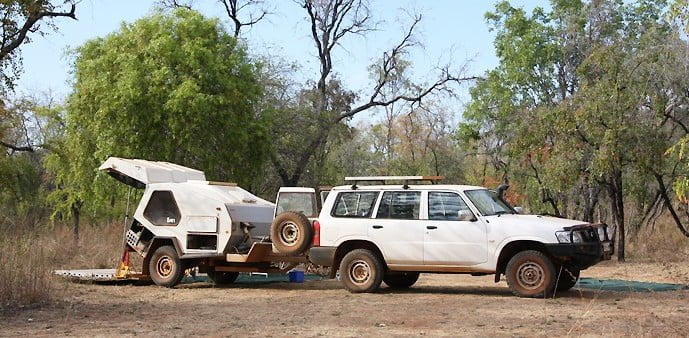
Free camp safely in Australia – this article shows how
by Collyn Rivers
Free Camp Safely
RV users free camp (known as boondocking in the USA) safely in Australia to avoid often crowded [caravan park]s, some 500 km apart. Many self-contained RVs need only a safe space overnight. This article shows how to free camp safely in Australia.
The author’s Nissan Patrol and TVan in camp in Australia’s far north Kimberley. The closest town is over 650 km (400 miles) away. Pic: copyright: rvbooks.com.au
Free camp safely in Australia – the golden rules
Whilst more of a nuisance than a risk, bored drunks in cars may hassle those free camping alone. Avoid this by never free camping closer than 40 -50 km of any town (particularly on Friday nights or weekends). Physical attacks are fortunately rare. It travelling alone, however, it is safer to use an RV offering internal access to the driving cab. Always park such that you directly facing the exit. Pack up everything before going to bed. This enables you to drive straight out if subsequently necessary. Lock all external doors. Always leave the ignition key in the same accessible place.
Where feasible camp out of sight of passing vehicles. On many outback roads, there are areas where road builders have huge soil mounds. It is often possible to camp totally unseen from the road. In any such site, it’s best not to light a fire. Doing so lights up the top of nearby trees, thereby drawing attention to your presence.
Always set off early in the morning. To free camp safely in Australia, start to look for an overnight camp long before sun-down. It is close to impossible to spot safe campsites after dark. Try to find alternatives, e.g, a [caravan park] or known rest area, even away from your intended route. See below re this.
Official rest areas
Most major routes have official free sites for overnight camping. Many have barbecue facilities and usually a toilet. Most rest areas limit stays to overnight (some allow up to three days).

Rest area at Granite Creek (Queensland). Pic: Explore Australia.
Australia’s many national parks and huge state forests allow overnight camping. Most have an overnight charge. Several free-camping guides list thousands of possible free campsites.
Communications
Mobile phone coverage is good along most of Australia’s east coast. It is also good within a 20-50 km(12.5 – 31 miles) radius of most small towns. It exists along most major highways but there are still gaps. Apart from close to Aboriginal communities, mobile phone coverage is all but non-existent inland.
The only 100% reliable outback communication is via a satellite phone. These work anywhere but need unobstructed line-of-sight to a communications satellite. The units are costly but can be rented. Do not use them as chat phones as call costs are high. They are, however, a potential life-saver. For free camping safely in Australia, they are essential in the more remote areas.

Author’s Australian-built OKA crossing the crocodile-infested Wenlock in far north Queensland. The dome on the roof is the antenna of an early (1993) Westinghouse satellite phone. Pic: Copyright rvbooks.com.au
Water
Water is scarce in much of Australia outside the major towns. Most rest areas have bore water but it’s essential to carry your own. Have at least two litres person a day for drinking (ideally three litres in hot, dry areas). Excellent water is available however in strong 12-15 litre containers. It is stocked by almost all supermarkets, outback stores and fuel stations.
Not getting lost
There is a real risk of becoming lost if straying away from a remote campsite. Be ultra-careful. To anyone but an Aboriginal person, much of the Australian bush will seem identical. Take this seriously (particularly with children). Bush may be so dense it may consequently take rescue authorities time to locate you. If planning to bushwalk, consider buying or renting a Personal Locator Beacon. Or an Emergency Position Indicating Radio Beacon – see http://www.epirb.com
Weapons
Overseas visitors should be totally aware that Australia has no ‘gun culture’. Carrying any form of an offensive weapon is a truly serious offence. Carrying one that is concealed is even more so. Do so and you may end up in prison.
Knowing more?
How to free camp safely in Australia is specifically covered in my Caravan & Motorhome Book. This book is potentially a lifesaver for overseas visitors. Few realise just how isolated many areas are. The Kimberley alone (top of Western Australia) is the size of France.
See also the Camper Trailer Book, Caravan & Motorhome Electrics. Solar That Really Works is for cabins and RVs. Solar Success for homes and property systems. For information about the author Click on Bio.
Lithium batteries for caravans
by Collyn Rivers
Lithium Batteries
Lithium batteries for caravans and motorhomes pack a lot of energy but need specialised knowledge to use safely and reliably. This article is all about lithium batteries for caravans and motorhomes – their safety and usage. It includes how and why. And how to install and use them.
Lithium batteries for caravans and motorhomes work well for those who free camp. They also lighten overweight RVs. All supply high peak power yet can also be used as deep cycle batteries. Their chemistry and working are very different from traditional batteries. They are almost a different species.
Energy and power are not the same
Energy enables work to be done. Power relates to how fast energy is used.
Many vendors claim a 12 volt 100 amp-hour lithium has more energy than an equivalent AGM. This cannot be. Their energy capacity is identical. Both can thus do the same amount of work. A lithium battery, however, can charge and release energy much faster.
The ability to release high power enables a small lithium battery to start a 4WD. It can do so many times. Doing necessitates high power. The energy needed, however, is tiny. It’s about that drawn by a 5 watt LED in an hour. But supplying 5 watts (at 12 volts) in the required second or two demands high power. Conventional batteries cannot match lithium’s ability to do so. An 18 Ah LiFePO4 can act as a small deep-cycle battery. It can also supply starter battery current.
Unless truly high power is needed, lithium’s ability to do so confers no benefit. If weight is no issue, a sealed lead-acid or AGM battery bank suffices for RV use. An AGM is preferable for frequent microwave oven use. Or powering a big winch.
Unless needed, high power has no value.
Pic: http://www.technomadia.com/lithium
Lithium batteries – battery types
Lithium bacobalt oxide (LiCoO2) batteries store the most energy but proved fire-prone. Lithium-iron batteries (LiFePO4) have different chemistry.
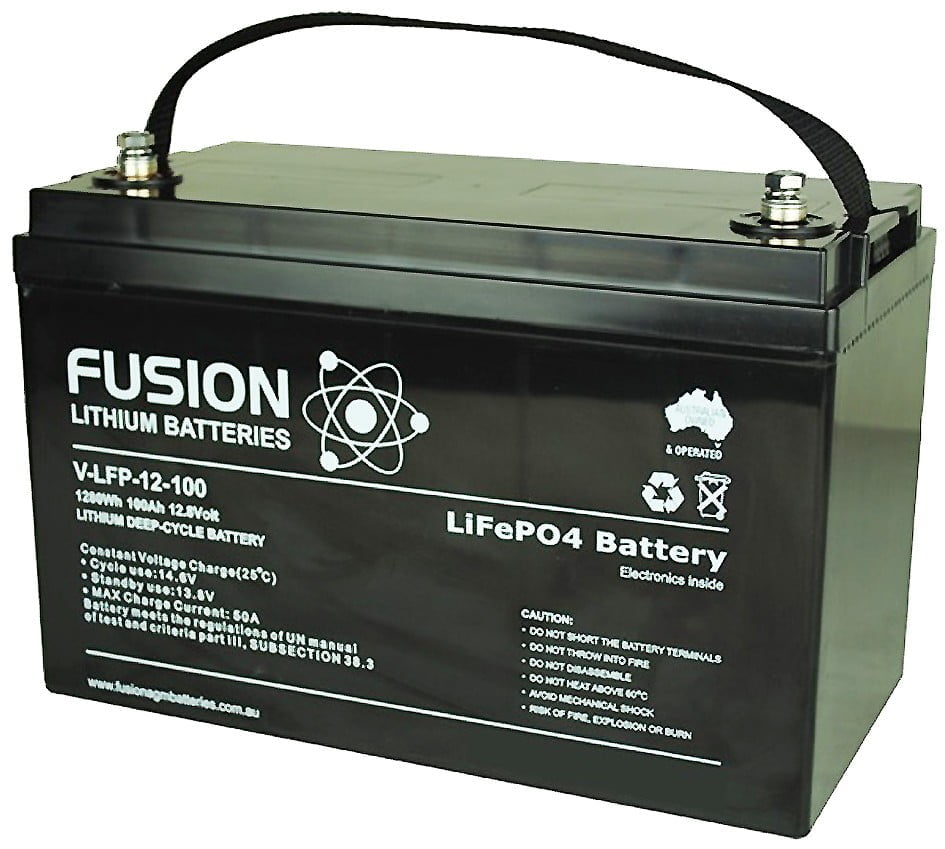
This LiFePO4 battery is claimed chargeable from two-stage battery chargers. Its battery management system (see below) is inbuilt.
LiFePO4 batteries can ignite but must exceed 1000º C to do so. They are close to fire-proof.
These batteries store about 105-watt hours/kg. This is three times more than other batteries of similar capacity. They are claimed to be non-toxic.

This graph shows the typical (per cell) voltage during discharge. That most probable for an RV is slightly above the blue line. The red line does not apply to RV use.
A LiFePO4’s voltage remains almost constant. It is typically 13.1-12.9 volts in RV use. It drops steeply at 10% or so remaining. The batteries’ almost constant voltage eliminates low voltage issues.
Battery management in caravans and motorhomes
LiFePO4s suffer damage or ruin if fully discharged. Over-discharge must be limited. Furthermore, the upper safety limit of a LiFePO4 cell is 4.2 volts. If exceeded that cell heats up. It may ignite or even explode. Another risk is of cells reversing polarity. Controlling charging and discharging voltage and current is essential. This is done by a management system. Or the battery charger.
The battery management system essential for lithium batteries is not necessarily supplied. Unless of what you are doing, buy only those with the system inbuilt. Advise the vendor of the intended use. Obtain written assurance of suitability for that use.
Such chargers include under/over-voltage protection, cell balancing and solar input.
LiFePO4 cell management is essential. It is nevertheless not always supplied.
Safety
LiFePO4s release massive current. Never short-circuit them. Wear safety glasses and protective clothing when working on batteries. It is essential with lithium.
Install circuit breakers close to the battery. Rate these for the current your may carry. This safeguards against burning if cabling is overloaded.
Unless charged/discharged at massive levels, lithium batteries rarely vent gas. Vendors claim emissions are neither toxic nor explosive. Nevertheless, ventilate to limit heat build-up. Most have a recommended working range of -18 degrees to + 40 degrees C. They are damaged by exceeding 40 degrees C.
Charging & monitoring
Not all LiFePO4 users agree about charging. Most advise limiting discharge to about 10% remaining. Some advise not to fully charge. That charging to 90% is safer. They do so at about 13.6 volts. Many DIY users do If discharged to 10%, usable capacity is 70%-75%. Deeper charging provides close to full capacity. Doing so, however, requires accurate control.
LiFePO4’s charging efficiency excels. Vendor claims of 92.5-95% seem realistic. Lead-acid’s is about 80%. of AGM’s is about 85%.
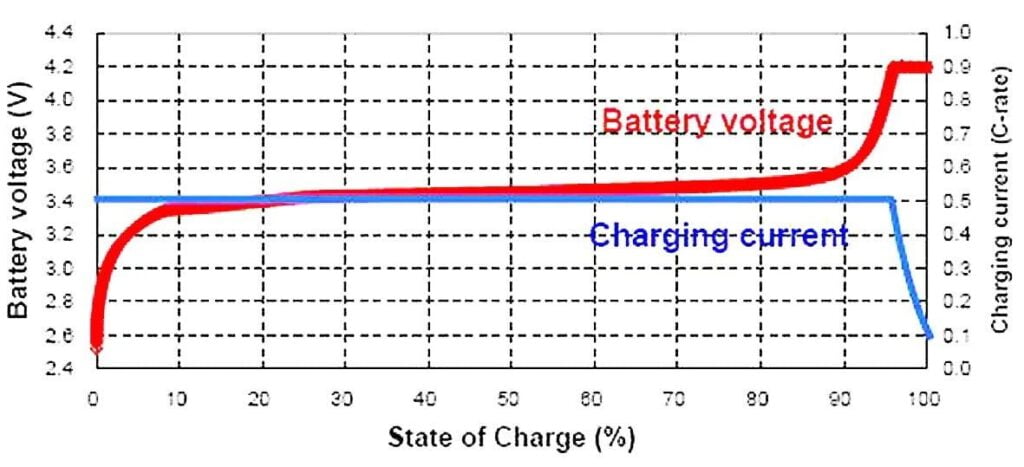
This graph shows the relationship between charging voltage, current and LiFePO4 state of charge.
Usable lifespan
Their makers regard battery termination when capacity is 80% of new. Conventional battery life is shortened by ongoing deep discharges. LiFePO4 lifespan is virtually unaffected. Vendors claim 2000 cycles if discharged to 20% remaining. And by more limiting charging to 90%. Not all chargers enable this.
Extensive LiFePO4 usage began in 2012. Claimed lifespan is based on speeded-up cycling. There can be no real-life data until 2022. Anecdotal evidence indicates it is probably 8-10 years.
Charging
Some vendors advise using a two-stage charger. Many users disagree. They claim dedicated chargers are safer. Also claimed is ‘normal alternator charging’ is fine. This cannot be. There have been no ‘normal’ alternators since 2000. Most alternator outputs vary from 12.7 volts-14.7 volts. Some vary from plus 15-volts – 12.3 volts. Or even zero.
Many makers produce specifically LiFePO4 alternator chargers. Some provide general chargers with a LiFePO4 option.
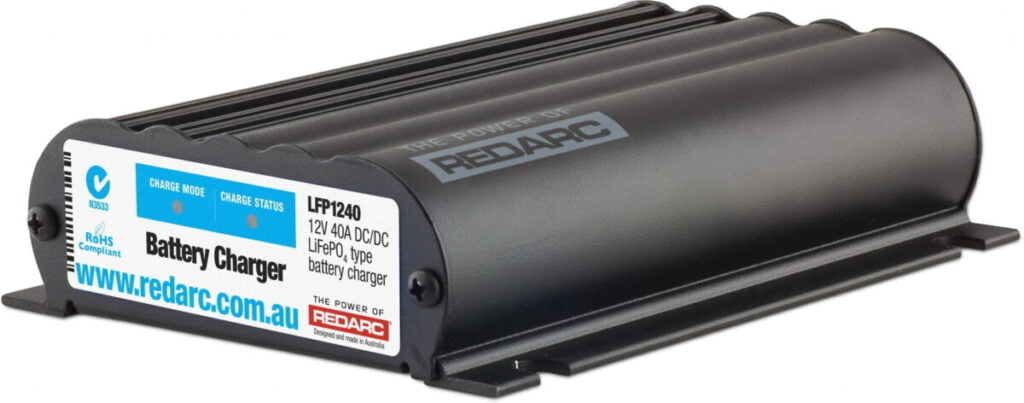
The (Australian designed and made) Redarc LFP 1240 alternator. It charges a LiFePO4 12 volt battery at 40 amps. It also accepts input from solar modules. Pic: Redarc.
LiFePO4 alternator chargers should be located close to the battery bank. Not close to the alternator.
These chargers may supply 40 amps or more. Replace existing charging cables by those of about 13.5 mm². If the battery is in a trailer, take the feed via an Anderson plug and socket. Use 13.5 mm² cables to the charger and battery. Unless done, you restrict charging current.
Storage
The still common advice to use a 50% charge for storing stems from a report many years ago. Most makers now advise 40% charge and to store in a cool place.
Lithium batteries for caravans and motorhomes – buying
Currently, all lithium-ion batteries are imports. Some have several levels of distribution. Each adds a profit margin. Prices for identical batteries (but with different brand names) vary hugely. It pays to shop around.
Lithium batteries may fall in price but a major fall is improbable. This is because lithium sources are limited.
Lithium batteries – the DIY approach
Commercial LiFePO4 batteries are costly. Experimenters cheaper individual (3.2 volts) cells. They assemble them into packs. They then add battery management. Also energy monitoring. Don’t attempt this unless you experienced. There is a risk of wrecking cells.
Keep a sense of proportion about lithium batteries
Lithium technology is a major advance. Battery energy storage from 1870 to 1970, however, barely changed. Lithium is a worthwhile increase. That really needed, however, is far more. Extensive research shows this to be feasible.
The most probable breakthrough is cheaper fuel cells. Such cells already store are around 12,000 Wh/kg. A LiFePO4’s is one hundred times less.
Should I use lithium batteries in caravans and motorhomes?
When buyers can obtain truly direct drop-in replacements, LiFePO4 batteries in RVs makes every sense. In the meantime, RV Books advises caution. Buy only from a truly reputable vendor.
Should I use lithium batteries in caravans and motorhomes? – updates
See also: https://rvbooks.com.au/lifepo4-jump-starters-really-do-work-2/
Collyn Rivers’ main books in this area are the Caravan & Motorhome Book, the Camper Trailer Book, Caravan & Motorhome Electrics, Solar That Really Works! and Solar Success. All cover battery charging in depth. For information about the author please Click on Bio.
If you feel this article assist others, please post this Link on related forums.

How to tell caravan battery charge – energy monitoring explained
by Collyn Rivers
Caravan Battery Charge
Knowing how you can to tell caravan battery charge is not easy. If you get this wrong, good batteries are scrapped and bad ones retained. Here’s why, and how you can tell.
Measuring caravan battery charge is particularly complex for deep-cycle lead-acid batteries. These have a long time lag (24 hours plus) between heavy loads and subsequent voltage. Even then, measurement maybe only within 10%. Instant voltage measurement has no meaning. As a result, perfectly good batteries are replaced. Worn-out ones are retained. Not knowing how to tell caravan deep cycle battery charge is the main problem. It is less so with AGM and starter batteries. And easy with lithium batteries.![How to tell [cara] battery charge - energy monitoring explained - electric vehicle batteries,book on batteries,electric car batteries,lithium ion batteries for electric cars,electric car battery technology,how long do electric car batteries last,electric vehicle battery life](https://rvbooks.com.au/wp-content/uploads/2021/06/Collyn-in-his-office-e1623805495530.jpg "How to tell [cara] battery charge - energy monitoring explained 244")
Pic (of the author) copyright rvbooks.com.au
How to tell caravan battery charge – why the time lag?
An electrochemical reaction between lead plates and an electrolyte enables lead-acid batteries to store energy. The electrolyte is sulphuric acid diluted by water. In effect, that electrolyte stores energy. Its specific gravity (density relative to distilled water) varies with a battery’s state of charge.
Specific gravity reflects voltage across a well-rested battery. That of a deep cycle battery that has just supplied high current is lower close to its plates. Voltage is often measured across those plates. The charge needs a day or more to evenly redistribute, so only then can measuring be meaningful.
An almost worn-out battery may show close to full voltage as charging begins. That being measured, however, is battery charger voltage. It is high because the battery cannot absorb it.
This table below shows approximate relationships between voltage and remaining charge. 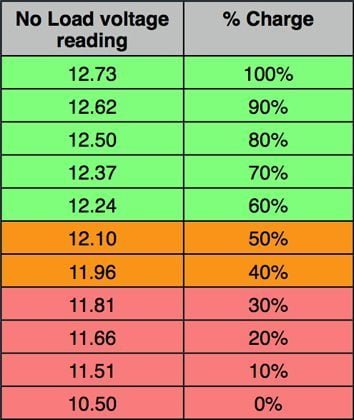
A lead-acid deep cycle battery’s typical rested voltage. Pic: original unknown.
Starter batteries have many and thinner plates. This enables them to supply high currents and to recharge rapidly. Yet, before voltage truly reflects their charge even these need a few minutes rest.
How to tell caravan battery charge – lithium-ion batteries
Lithium-ion batteries have a similar problem, but for a different cause. In typical RV use these fall only 0.1 volt from 90% to 10% charge (typically 13.0 to 12.9 volts).
Fully discharging these batteries may damage or even wreck them. In addition, they need accurate control of charging voltage and minimum state of charge. Furthermore, individual cell monitoring and balancing are mandatory.
How to tell caravan battery charge – energy monitoring
For all but starter batteries there’s only one reliable way of knowing battery state of charge. It does not give an exact measure but its close enough for RV use. It works much as you track money. Count what comes in. Deduct what goes out (and the bank’s charge for storage). That left is what you have. Ensuring it’s always in credit equally assures battery happiness. It’s like fuel gauges that show instant usage – as well as totals.


Typical energy monitors. Pix: Victron Energy, Xantrex.


Such energy monitoring is built into most dc-dc alternator chargers. It is also included in up-market solar regulators. Some also have remote monitors. The best known is the Xantrex.
Energy monitors are readily installed. Furthermore, they are easy to programme. Moreover, energy monitor accuracy is typically plus/minus 5%. They recalibrate automatically.
How to tell caravan battery charge – further information
See Caravan & Motorhome Electrics for more. For solar energy monitoring see Solar That Really Works. Solar Success is for home and property systems.
Every aspect of RV usage is covered in the Caravan & Motorhome Book. For camper trailers see the Camper Trailer Book.

Best Way to RV Around Australia
by Collyn Rivers
Best Way to RV Around Australia
There are many ways to explore Australia in an RV. You can go around the outside, base yourself in one place and take short trips in different directions, or criss-cross through the centre. There are many ways. These include ‘figures of eight’, zigzags and routes based on watching or taking part in events around Australia. The Best Way to Drive an RV Around Australia explains all you need to know. It explains what it costs, what the weather is like, which way to go. And are the locals friendly (they are!).
Best Way to RV Around Australia – follow the wind
Australia is a big country.
The most popular (and shortest) route around its edge is 13,800 or so kilometres (8,625 miles). Allowing for diversions (such as Tasmania or Alice Springs and Uluru), this distance can double.
This ‘rim’ route is best done anti-clockwise. Ideally, start down south in spring or summer (from Melbourne or Sydney). From there, head north following the sun northwards before winter sets in.
When you head west from North Queensland, your RV will be assisted by strong and constant east-to-west trade winds across the entire top of Australia. You will benefit likewise by west-to-east winds across the 1400 kilometre (875 miles) Nullarbor Plain on the way back. These winds are typically 50- 60 km/h. Fuel consumption can be up to 50% higher if driving at speed into this wind – and far less than usual if that wind is behind you.
Highway One
If you’re intending that quick run around the outside of Australia, Highway One ranges from six-lane highways to single-lane roads. It is sealed most of the way except for about 550 km of the Savannah Way between Normanton and Borroloola (North Queensland).
Fuel is typically available every 350 km or so, including the 700 km between Broome and Port Headland (Western Australia) – where the only fuel station (and basic campsite) is halfway between the two towns. As with many of Australia’s major highways, this route has rest areas with toilet facilities every 100 kilometres or so (62.5 miles) in the more remote areas.
Even on this main route, travellers need to be self-sufficient. There are rest areas but it is not uncommon to be 500-1000 km from the nearest cabins – let alone a motel.
You are unlikely to be alone – there are typically three to ten RVs there most nights (some 100,000 people a year do this trip). Excellent and constantly updated guides are available on places to stay along the highway. There are many towns along the way. Most have (an often costly) [caravan park] if you need greater comfort and more facilities.
The best way to drive an RV around Australia is Highway One. A major downside, however, is that it carries a great deal of heavy transport. There are many two to three trailer ‘road trains’ that weigh 50 or more tones – and travel at 100 km/h. Furthermore, Highway One is not scenic for much of the way.
Where feasible (assuming time is not a constraint) check out the following alternatives. Ideally, travel with a 4WD and off-road caravan or camper trailer. Seek local advice re road conditions.
Be aware that some roads in the north and north-west may be closed during the wet season (typically November- April).
Going north-south or east-west
There is an excellent road from south to north across the centre of Australia from Adelaide to Darwin via Alice Springs. Keep in mind that Australia is a big country!
Uluru (Ayers Rock) is a 550-kilometre side trip each way from Alice Springs (along a dirt track if you use the Merinee Loop road).

Almost all dirt roads have these corrugations. They will damage passenger cars and standard caravans.
Going from east to west is approximately 6,500 kilometres each way and is feasible with a caravan if you have the right experience and the right towing combination.
In considering the best way to drive an RV around Australia, there are a number of possible starts and finish points on each coast. One major route – from far north Queensland, via Alice Springs, to Halls Creek in Western Australia – is scenic around Alice Springs but otherwise flat and uninteresting. It is dirt and often heavily corrugated dirt for much of the way but is progressively being bitumenised. This route should only be attempted with a caravan built for this purpose and a four-wheel-drive tow vehicle. This route should also not be attempted at any time except winter – as inland temperatures can approach 50 degrees C.
There is one alternative (dirt) road in the Kimberley (the Gibb River Road), but a four-wheel-drive tow vehicle is necessary to access the few camping sites along it.
Beware of the distance
Be aware there are long distances between towns in many parts of Australia.
Up north, along most of Western Australia’s coastline, and along the 1400 kilometre (875 miles) Nullarbor Plain that connects East to West, towns are few, small and a long way apart. When you do reach a remote town, it may have only a single and often basic motel. In some places, the only habitation is a roadhouse. A roadhouse is a fuel stop with often truly basic accommodation.
Try not to cover more than 200 kilometres a day. Driving with a caravan in tow is more tiring than driving a vehicle alone. A camper trailer, however, is barely noticeable.
Most Australian caravan owners start their journeys early in the morning. They try to reach their destination by 3 pm or so, including time for rest stops. Towing a caravan in the dark along an unknown road when you’re tired is not a good combination. It also close to impossible to see a possible free campsite when dark.
Travel When It’s Quiet
Australia’s east coast is crowded during Christmas (summer) and Easter. Any areas mentioned in the Lonely Planet Guide in the past ten years are likely to be busy. On the east coast, however, there are many little-used inland roads that run more or less parallel to the coast. Furthermore, these can be worth exploring.
Find out the school term dates of the state in which you will be travelling (school term dates vary by state) and (if you need [caravan park] accommodation) book well in advance during school holidays. Many are fully booked months in advance. This is particularly true of Broome (Western Australia).
Check out the dates of major events in each state or town (such as agricultural shows, car or horse race meetings and music festivals) and, depending on your preference, work your travel schedule into or around these events.
Plan For All Seasons
Australia’s climate varies hugely from north to south and from summer to winter. The southerly areas are mostly comfortable in summer, but cold (0-15 degrees C) down south in winter. There is also a wet season up north, typically from November to March, with some risk of cyclones and impassable roads due to creek or river flooding. Unless you are accustomed to the heat and high humidity it’s best to plan the trip so as to avoid the top end in the wet season. (It stays hot all night too). Never try to cross watercourses unless you know they are safe. Across the entire upper half of Australia, any will (not just may) have one or more crocodiles. Consider water depth and speed carefully and have a local show you how to drive across creeks.
Be flexible with your travel plans if bad weather intervenes – some of the more enjoyable travel experiences can be the unplanned ones. You have your accommodation with you, so why not use it?
Keep in mind that the outback can reach temperatures below freezing at night in winter. Plan your heating and clothing accordingly.
Bush fires and cyclones
Bush fires are an increasing threat during Australian summers. Read, watch or listen to local news reports when bush fires threaten and follow total fire bans.
Cyclones are mostly from November – April. They mainly affect only the upper third of Australia. It is very hot and humid during this period. The best way by far is not being up North during that time of year.
Food and Water
Away from the coast, much of Australia has a desert climate. It can be very hot and dry. It is essential to carry a least two/three litres a day per person of drinking water on your travels. Four to five litres per person per day is ideal.
The quality of water supplies varies across Australia, especially in the outback. The best type of water to carry is that sold in 12-15 litre plastic containers. These are stocked by virtually all supermarkets and fuel stations Australia-wide, and also stores in Aboriginal communities. Basic food and drink supplies are available at all roadhouses, and even the smallest town will have a food store.
Unless deemed necessary (as on less-trafficked outback roads), do not tow a caravan with full water tanks – they increase van weight and can affect van stability.
Leave The Caravan Behind To Explore
If travelling with a caravan you do not take it everywhere you go. Consider carrying a tent in the tow vehicle, and when the going gets tough, leave the van behind in a [caravan park] (usually at a nominal charge) and go camping. This is particularly or so in and around Alice Springs (Australia’s Centre). Many caravan owners park leave their ‘vans in the town’s [caravan park]s –then tour the area in their 4WD tow vehicles.
Another alternative is to rent a 4WD camper for remote areas or join a guided group tour. There are many group tours for those wishing to visit Kakadu and Lichfield Parks (near Darwin), Cape Leveque north of Broome, the vast Kimberley in general and the Cape York Peninsula.
Cape York is a 2500 kilometre plus round trip along what used to be a seriously corrugated road.
Fuel
As noted previously, fuel stops on made up roads in the more remote parts of Australia can be up to 375 kilometres (235 miles) apart. Unmade roads, however, may not have fuel stops for 700-800 kilometres.
The cost of fuel in Australia, at (in 2020) typically $1.50 a litre ($5 a US gallon) is higher than in the USA but much less than in Europe. The cost up north and north-west is usually a third or so higher in the few major towns, but can be close to double in outback areas.
Fuel is therefore a major expense, but it can be reduced by keeping under 80 km/h, by reducing weight. In particular, never use cruise control in hilly areas (it attempts to maintain speed regardless).
Keeping safe in outback areas
In the event of problems, never leave your vehicle. You are more likely to die by going to look for help than by staying put. Use the shade under your vehicle(s) if you need to and wait for help.
If your drive wheels even begin to bog in the sand never allow them to spin. Clear all sand from under and in front of the vehicle and reduce tyre pressures by half (to about 110 kPa – 16 psi). Do not drive at more than 30 km/h (18 mph) until the tyre pressure is restored.
Particularly in the upper parts of Australia be prepared for strong side wind gusts caused by oncoming large trucks and road trains. Most travel at up to 100 km/h.
Do not swerve for wildlife if you have a van in tow, your life may become threatened instead of theirs.
It is advisable not to free camp within about 50 kilometres of any town, (particularly on a Friday or Saturday night) as kids tend to drive out of town to party. They are usually quite harmless but can be worrying if you are camping alone.
Never go bushwalking alone, and always carry a compass and a detailed map. To all but country dwellers, much of the bush looks the same. It is very easy to get lost, carry a mobile phone as they provide emergency services of your approximate location,
Be alert for dangerous wildlife, carry a first aid kit at all times and know how to get help in an emergency.
Never even think about attempting to kill a snake
Only a very few snakes are aggressive. If confronted by one, initially stay very still and then slowly back away. Outback doctors will confirm that virtually all who get bitten are male and usually drunk – and pointlessly trying to kill it.
• Talk to the locals about road conditions
• Ask local Aboriginals about their (now) 65,000-year-old culture. In Broome, be aware that many (mostly female) Aboriginal people have university degrees.
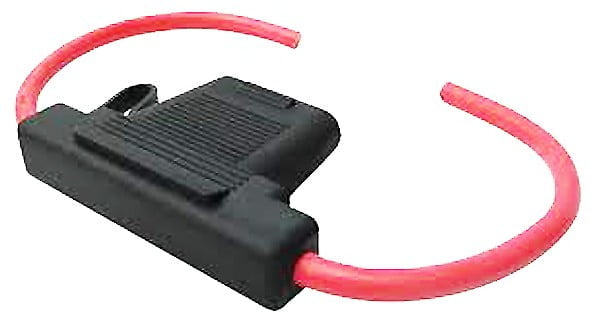
Caravan Fuses and Circuit Breakers – how to know which to use
by Collyn Rivers
Caravan Fuses and Circuit Breakers
Circuit breakers and fuses in caravans both cut the current, but in different ways. Here’s how to know which best suits circuits and appliances protected. Those for 230 volt grid or inverter supplied circuits must be specified and installed by a certified electrician – who will install caravan circuit breakers etc anyway. Circuit breakers and fuses for RVs (for 12/24 volt circuits) can be self-installed by those familiar with such work.
The problem with fuses
A fuse is a short piece of wire that heats up and melts when current flow exceeds the fuse’s melting point. Caravan fuses are cheap and simple. They respond very fast to excess current. Fuses usefully safeguard sensitive and costly electronics – such as computers. Many such devices have fuses inbuilt.
A fuse’s downside is that it will not cut the current quickly. This is a drawback with water pumps, fridges and electric motors etc. Some draw up to five times their working current whilst starting. A fuse must thus be oversized to cope. Whilst slow blow fuses overcome this, few RV owners know they exist. Let alone know why they are needed. Further, only the most costly can be relied on to blow at their intended current. Another failing is that a fuse must be replaced by when it blows. If that which caused it to blow remains, the replacement also will blow. On the plus side, caravan fuses are cheap. They are stocked by most hardware stores.
A further issue with fuses is that there are known problems with some blade fuses and fuse holders. These are mostly over 10 amps or so. See Blade Fuse Problems in Caravans. Fuses and fuse holders tend to corrode. This causes heat to be generated to the point where they may melt. They may catch fire – yet not necessarily blowing the fuse.
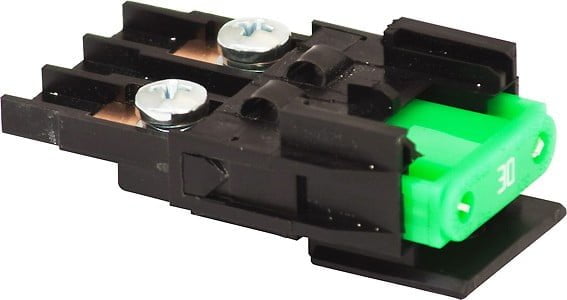
RV fuses and circuit breakers – how circuit breakers work
Circuit breakers are a type of switch that turns off when they detect excess current. They are then manually reset. Some automatically reset, however these are best avoided – because the cause of such tripping may still remain.
The better-made caravan circuit breakers operate more reliably at their rated current. This is a plus with loads with a high starting current. They also double as manual on/off switches.

Fusible link – the material above and below the fusible link dampens the explosive forces if/when the fuse link blows. Pic: Blue Seas.
Circuit breakers should be located close to the battery as possible. This protects the cable in the event of short circuits downstream from the circuit breaker. In some instances, caravan fuses are used in place of circuit breakers, but usually to save cost. It is not a good electrical practice to do so. If funds are really low, so-called fusible links (below) can be substituted for circuit breakers. This can be done in (say) the feed to a large inverter that may carry 200 amps or more.
High current fusible links go off like fireworks if/when they blow. They need locating so that any such debris is contained.

This high-quality circuit breaker doubles as an on/off switch. Pic: 12-volt shop.
Caravan fuses and circuit breakers – which to use and why
An RV may have multiple cables that each feed a specific item – e.g, fridge, water pump, TV, computer etc. Here, the current flowing through that cable is reasonably constant, and thus readily known. This is the usage where suitably rated caravan fuses work fine. Each fuse is installed as close to the battery as feasible – yet accessible. It needs to so located as it thus also protects the supply cable if it is shorted out.
Many caravans and motorhomes have several main cable feeds. Each serves a number of different items that may or may not be used simultaneously. Here, the fuse rating must cope with the maximum load. It may blow slowly (or not at all) if a fault occurs when only one item is switched on. Circuit breakers, that accommodate the cable’s total load, need locating as above. This protects the supply cable, but as the breaker must cope with the total load it may not act fast enough to adequately safeguard. Any connected appliance thus also needs an appropriately rated fuse. Locate that fuse as close as possible to the appliance.
A typical caravan or motorhome is thus likely to need one or more circuit breakers as close as feasible to the battery. Plus an individual fuse adjacent to each appliance.
There are major differences in circuit breaker quality. Good ones are not cheap but well worth the price.Make sure the ones you buy are designed for 12/24 volt dc. The best are stocked by marine suppliers, but there are many other sources.
Other information
If you liked this article, you will also like my books. All are technically correct yet written in everyday down-to-earth plain English.
Full details of every aspect of RV electrics and their installation is covered in my Caravan & Motorhome Electrics. Solar That Really Works covers solar in RVs. Solar Success covers home and property systems.
Caravan & Motorhome Book is a comprehensive guide to every aspect of caravans and motorhomes. Likewise, all related issues are covered in the Camper Trailer Book. For information about the author please Click on Bio.
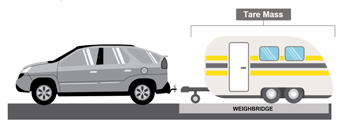
Do Not Trust Caravan Declared Mass
by Collyn Rivers
Caravan Declared Mass
A caravan‘s Tare Mass is legally its weight when ‘ready for service’ as it leaves its maker. That weight, recorded on a Compliance plate is often incorrect. This article explains why RV Books states: Do Not Trust Caravan Declared Mass.
Pic: https://roadsafety.transport.nsw.gov.au/
Most caravan makers produce basic units. The weight of that basic unit is usually declared as its tare mass. This may not, however, be its tare mass when sold. This because caravan makers have dealers install all ‘optional extras’. Jayco is a rare exception. The company installs all optional extras – then weighs each product. Their declared tare mass is correct.
Dealers rarely (if ever) then update the tare mass. The caravan may thus be heavier than declared. That reduces the weight that it may legally carry.
Do Not Trust Tare Mass – it affects its payload.
The most a caravan may legally weigh on a public road is called its Aggregate Trailer Mass (ATM). It is the caravans true tare mass plus its payload.
A caravan‘s payload includes water, LP gas, extra batteries, food and all personal belongings. Set by the caravan maker, payload is usually the most the caravan‘s tyres and suspension legally allows
With rare exceptions, declared tare mass is unlikely correct. The law, however, relates to what the tare mass actually is.
How much payload is provided?
There is no legally required caravan payload. Makers typically provide you with 250 kg (550 lb) for caravans under 1500 kg (3300 lb). Those heavier may have 250-350 kg (550-775 lb). A few makers provide the payload you require. This may cease as forthcoming rules require caravan makers to register their products. You cannot then later modify them.
When ordering a caravan insist the vendor establishes its weight. Include the exact options and accessories you’ve ordered. Plus the weight of water, LP gas etc. Insist the result be included in the purchase contract. And that meeting such weight is a condition of purchase. Prior to final payment, insist on the caravan being weighed in your presence. Check that the batteries, gas bottles, mattresses and drawers etc. have not been removed for weighing.
Weighbridge scales have known margins of error. The errors are, however, within plus/minus 10 kg (22 lb). If the caravan exceeds its declared tare mass by much more than that. Do not take delivery until it is somehow reduced.
Do Not Trust Declared Mass
Never trust the tare mass on the caravan‘s compliance plate. Until its true tare mass is known you do not know that caravan‘s actual payload You can only establish via a certified weighbridge. Include in the buying contract that you will not finalise paying until you have checked that weight.
Weighbridges in Australia are displayed at: https://www.industry.gov.au/national-measurement-institute/trade-and-industry/weighbridges-used-trade/find-public-weighbridge
Many owners underestimate their caravan‘s weight. Furthermore, police report that almost 80% (of RVs checked) are overweight. Moreover, one was over by 400 kg! See https://rvbooks.com.au/overweight-rvs-a-police-point-of-view/
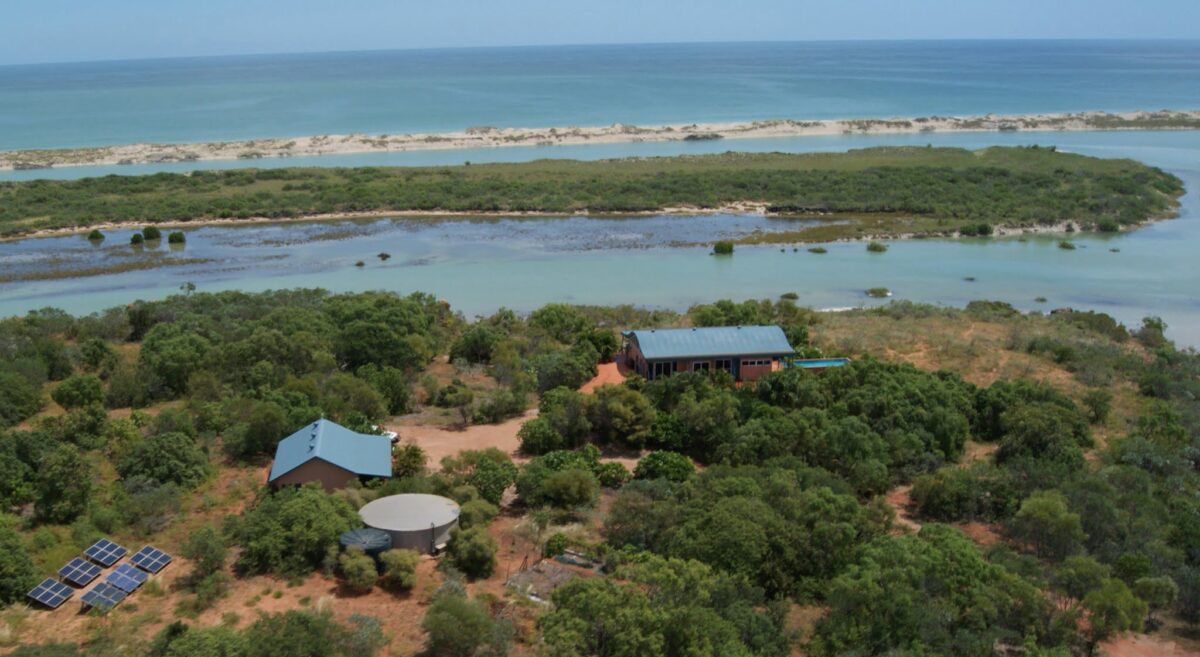
Living with solar – how make it all work
by Collyn Rivers
Living with Solar
Living with solar successfully requires being totally aware of the energy you use. Here’s a general guide to how to make it all work.
Minimise energy usage first. You can often slash such usage by half – or even more. This requires you to pay for some changes. Doing this, however, and the cost of solar you need is hugely reduced.
Our first (home) all solar house north of Broome (WA), gave invaluable experience. It’s up to 17 kWh/day adequately coped with our under 8 kWh/day usage. Building and living with it for 10 years showed that feasible.
Our all-solar 10-acre property on the Indian Ocean north of Broome, Western Australia. Pic: rvbooks.com.au
Our major living with solar achievement, however, relates to moving to Sydney. We bought a solidly-built and relatively new house overlooking Pittwater, that was 100% grid supplied. Planning to install solar, we found previous electricity draw was 31 kWh/day. In this and similar situations, do nothing initially solar-wise
We first tracked down and slashed this high usage. An instant-boiling (and ice-cold) water unit used only a few times day drew over 5 kWh hours each day. Six heated towel rails used 3 kW/h a day. Over 80 halogen lights drew 50 watts each. These were replaced by five and seven watts LEDs (that gave much the same light. A 20-year old fridge drew 7 kWh/day was replaced by one that draws 2 kWh/day. The garden lighting was all incandescent (drawing 1.5 kWh each night) was replaced by LEDs that draw only 150 Wh a night.
An extraordinary find was an old electric door-bell. Despite being used only a few times a week (for a second or two each time) the 230-volt transformer driving it drew a constant 40 watts (almost 1 kWh/day). We replaced it by an old-fashioned manual brass bell.
Within a month we slashed usage to 10 kWh/day, then to 7 kWh/day two months later. It cost well under $5000 to do so. Only then did we install grid-connect solar (initially a 2.4 kW system). Without those initial changes, generating over 30 kWh of solar a day was totally non-affordable.
Usage now (2020) is about 11 kWh/day in winter and a mere 4 kWh/day in summer. Our now 6.6 kW solar input hugely exceeds that most of the time. We initially used the grid network as a ‘virtual battery’. Since then we have added a 14 kWh Tesla battery and hardly ever draw grid power. In summer we export 30 kW/h a day at a two-year contracted 20 cents per kWh. Our electricity bills rarely exceed the fixed service charge. Mostly, the supplier pays us.
How to slash usage – change usage habits
Turn off all appliances at their wall sockets, never by a remote control alone. This particularly applies to anything made prior to 2014 that has a small power unit built into its plug. It applies also to many electrical appliances bought (or via eBay) from overseas. Unless turned off at the wall switch, each little power unit continues to draw power. Such power varies from a watt or so – to as high as 10 watts. While each may seem trivial, the average home has up 30 or so of these. At even 3 watts each, that’s over 2 kWh/day.
Do not leave lights on unnecessarily. Do not leave an un-watched TV with its sound turned down. Turn it off (at the wall!). Use less water when showering. Buy only energy-efficient appliances.
Do not use an instant boiling/cooling water system. Boiling water takes only a minute or two in an electric jug. Have a cooled jug of water in the fridge.
How to slash usage – items to change
Consider selling any fridge made prior to 2014. Replace by one that has a high Energy Star rating. Never have two or more smaller fridges. Have just one of similar overall capacity. A (say) 750-litre fridge draws about half the power of three (each of 250 litres) fridges. This is because the single large one has far less surface area.
Change all lighting to LED. This is readily done as LEDs are now made to fit existing fittings. Do not buy cheap LEDs. These produce less light per watt than the more costly ones. They also have a much shorter life.
Living with solar – how much do I need
Right now, grid connect solar works best for those working from home. That which comes in during the day is used that day. Some install batteries to feed the home at night. You are unlikely to gain financially by doing so, but it ensures you still have 230 volts during power outages.
Maintenance
Solar does not usually require maintenance. The modules may need occasional cleaning in some outback areas. This is particularly so after a long dusty outback summer. Dry winds cause static charges that attract dust. Brief light rain may not, however, wash it off. It may turn the dust into mud that subsequently dries hard.
Fix dust and static issues by washing the modules with water and detergent. Then rinse with a full bucket of clean water to which you have added just one teaspoon of detergent (it has anti-static properties). Use a squeegy to remove surface water – and then let the modules dry naturally.
Never wipe dry solar modules – let alone polish them. Doing either or both generates dust-attracting static charges. Static build-up can be reduced by earthing the solar module metal frames.
Apart from the above, solar modules need no maintenance. It is difficult to assess their usable life-span, Some, however, made in the 1980s still produce about 80% of their original output. Total failure is very rare.
Reliability when living with solar
A well designed and installed stand-alone system is usually more reliable than the grid network. Furthermore, the output is cleaner, and the voltage barely varies.
Energy monitoring – an essential
Energy monitoring is essential when living with solar. Many new owners maintain a daily log of energy in and energy out, plus the highest and lowest voltage. Most owners (who have a battery-backed system) eventually settle for daily checking the battery bank’s percentage charge. The latter is all that is routinely needed. Anything needing attention causes significant variations.
Easy to install and easy to read. The Xantrex battery monitor. Pic: xantrex.
Solar is not hard to install. Our book Solar Success specifically explains how for homes and properties. Solar That Really Works! does likewise for boats, cabins and RVs. See also the Caravan & Motorhome Book, Caravan & Motorhome Electrics, and the Camper Trailer Book. To know about the author Click on Bio.
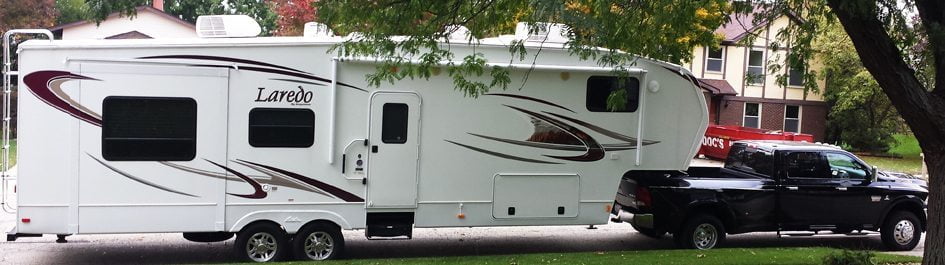
Imported RV electrics
by Collyn Rivers
Imported RV electrics issues
The electrical systems of privately imported RVs cannot be trusted to be fully compliant. Their owners often wrongly believe they are. They cannot legally be sold unless remedied. This article explains why privately imported RV electrics issues need expert checking if you are considering buying.
Lovely rig – but not electrically (and otherwise) compliant in Australia.
Current legislation enables intending owners to buy, import and use RVs that have 110-volt wiring and appliances. The original buyer can have an electrician install a 230-110 volt transformer. Plus basic safety components. This does not, however, make it 100% electrically compliant. For reasons unclear, the original buyer can use that RV. It cannot, however, be legally sold. Nor even offered for sale. Not all owners realise this. As a result, many non-compliant RVs have been sold. This leaves sellers (and buyers) in a tricky legal position.
This particularly affects imports (not just private) prior to 2010. Some commercially imported (in Queensland) had forged or flawed compliance papers. See Imported RVs. This is known by regulatory authorities. Many require electrical certification upon re-registering. That is not possible, however, unless made 100% compliant.
Imported RV electrics – the basic issues
Many private imports have a 230-110 volt transformer mentioned above. Original cabling, outlets and 110-volt appliances, however, remain. This RV may be connected to a 230 volt supply. But only by the original buyer.
Within Australia, it is illegal to sell any 110 volt items likely to be used domestically. In this context ‘domestically’ includes RVs. Because of this, using a 230-110 volt transformer cannot provide electrical compliance. In some states, doing so is a criminal offence.
The original private importer can thus legally use a non-fully compliant RV. That importer cannot legally resell it privately (in Australia) unless made 100% compliant. It can be sold to a dealer. The dealer is then legally obliged to ensure 100% compliance.
Obtaining compliance is costly. It may not be financially feasible. A dealer may thus declare insolvency to avoid payment. Then restart the next day under a new name. (That is known to have happened). You cannot use or resell that RV until it’s compliant. You cannot even give it away. Unless compliant it must literally be destroyed.
Imported RV electrics – fixing the problems
Ensuring full electrical compliance necessitates total rewiring. It requires double pole circuit breakers and socket outlets. It requires an RCD and a compliant inlet socket.
Many such RVs have a 110-volt to 12-volt ‘converter’. This will need replacing by a 230-volt to 12-volt converter. There are, however, better alternatives. Caravan & Motorhome Electrics shows why and how.
Private RV imports have many other non-compliant features (particularly over-width). Thoroughly check before buying. If overwidth it may not be possible to remedy it.
These issues often surface if re-registering in another state or jurisdiction.
Imported RV electrics – legislation summary
Each Australian state and territory individually administers the legal (electrical) provisions
These are of the Electricity (Consumer Safety) Act 2004 and the Electricity (Consumer Safety) Regulation 2006. They include the sale of mains supplied electrical appliances and equipment. Approval schemes in the various states are substantially similar.
Certification by NSW Fair Trading relates only to electrical safety. That does not, however, imply that a certified article is endorsed. In Queensland, the issue is handled by the Electrical Safety Office of the Department of Justice and Attorney-General. South Australia’s is by the Office of the Technical Regulator. Tasmania’s is by Workplace Standards of the Tasmanian Department of Justice. Western Australia’s is by EnergySafety. In the NT – it is by NT Worksafe. In the ACT by its Planning and Land Authority.
Victoria’s is complicated. There, EnergySafe Victoria declares an RV to not be an ‘electrical installation’. It does not define what it is. It implies an RV is an ‘electrical appliance’. These do not installation certification. They must, however, comply with Australian Standards. Unless made 100% compliant, an import still cannot so comply.
The Electricity (Consumer Safety) Act 2004 provides for the prohibition of any article that is unsafe. Or likely to become unsafe. It may compel remedial action (including recall). Legislation concerning sale and approval of electrical articles exists in all Australian states and jurisdictions.
Declared articles
Imported RV electrics issues relate to the electrical installation. Also, all that is run from it. All electrical goods sold in Australia must meet specific requirements. That, in NSW, is the Electricity (Consumer Safety) Act 2004. Such Acts cover electrical items known as ‘Declared Articles’. The Acts and listings of such articles vary from state to state. That of NSW is typical of all states. It includes almost every electrical item used in RVs. Privately imported RVs are almost certain to have Declared Articles. They can legally be used by the original buyer. None may legally be resold.
The associated definitions and use of ‘sell’ are extensive. They include auction or exchange, offer, agree or attempt to sell, advertise, expose, send, forward or deliver for sale. They further include: cause or permit to be sold or offered for sale, hire or cause to be hired, and display for sale or hire. This puts the reseller of any non-compliant RV at risk.
Imported RV electrics – the safety issues
The legal requirements are based on known safety issues.
Electrical systems in US and Canadian RVs differ substantially from those locally. An imported RV cannot be made compliant by simple changes.
Local requirements are in AS/NZS 3000: 2018 and AS/NZS 3001:2008 (as Amended in 2012). The latter is the main one concerning RVs.
Electrically isolated transformers are legal in some circumstances, e.g. 110-volt scientific equipment. Generally, anything electrically connected to such a transformer must be approved and certified. Moreover, contrary to some vendor claims – no 110 volts 60 Hz ‘Declared Article’ has such approval.
Isolated transformers are intended to power only one Class 1 device at a time. (A Class I device has its metal chassis or enclosure connected to earth.) It is unsafe to so power two or more Class 1 appliances simultaneously. Such usage is forbidden by AS/NZS 3000:2007 as Amended in 2012. Section 7.4.3. Furthermore, that item states ’all live parts of a separated circuit shall be reliably and effectively separated from all other circuits, including other separated circuits and earth.’
That many so-equipped RVs may have several such Class A appliances may be overlooked by regulators. Insurers, however, are aware of it. They may thus reject claims resulting from a related incident. A Senior Electrical Inspector confirmed this.
Disclaimers:
I am not a licensed electrician. I do, however, have extensive experience in electrical systems design and engineering. The text of this article was checked and approved by a senior Electrical Safety Inspector (in his private capacity). This article takes in his suggested changes and clarifications.
Amendments may be made to the Electricity (Consumer Safety) Act 2004, or the Electricity (Consumer Safety) Regulation 2006 at any time. The information contained in these notes may thus become out-dated. For more detail see Section 3 of the Electricity (Consumer Safety) Act 2004.
Imported RV electrics – further information
Electrical requirements for compliance are explained in Caravan & Motorhome Electrics. See also Imported RVs.
The main and overriding electrical standards involved are AS/NZS 3000:2018. See also the RV-related AS/NZS 30001:2008 as Amended in 2012.
The main structural and on-road issues are covered in Caravan and Motorhome Compliance.
My other books include the Caravan & Motorhome Book, Caravan & Motorhome Electrics, the Camper Trailer Book, Solar That Really Works (for cabins and RVs) and Solar Success (for homes and properties). About the Author – Bio.
Please consider buying one or more. It is only via the sale of these books that enables us to provide articles like this.
Fifth wheelers are safer – here’s why they are
by Collyn Rivers
Fifth Wheelers are Safer
Fifth wheelers are safer than conventional caravans. They are fundamentally far more stable on-road and far less likely to overturn. Furthermore, up to two metres more is usable space. They thus have more living area.
That fifth-wheel trailers are safer and stable was realised in the early 1920s following ongoing accidents with centre-axled ‘pig’ trailers. This caused the transport industry (led by Fruehof) virtually worldwide to switch to the fifth-wheel configuration.
The first known fifth wheeler – the Adams Bungalow circa 1918. (Pic: courtesy the Glenn Curtis Museum).
Why fifth wheelers are safer
A fifth-wheel caravan‘s on-road behaviour is totally different from that of a conventional caravan. The reason why fifth wheelers are safer, however, is fundamental.
Conventional caravans are towed via an overhung hitch. If the caravan snakes in one direction that overhung hitch causes (not just allows) the tow vehicle to snake in the opposite direction. And vice versa. It is a fundamentally unstable configuration. This undesirable effect can be reasonably tamed with short centre-heavy caravans. But less so with long and/or end-heavy caravans.
Snaking can also be almost totally overcome by using a Hensely hitch. These use a trapezoid linkage that, in effect projects the virtual tow ball further toward the tow vehicle’s rear axle. They are commonly used in the USA. Their main downside is their weight. A ‘light’ version is available but still too heavy for most Australian-used tow vehicles.
Weight Distributing Hitches(WDHs)
The essential overhung mass (up to 350 kg [770 lb]) of the nose of a conventional caravan is imposed on the rear of the tow vehicle. This causes the front of its tow vehicle to lift. That reduces the grip of its front tyres.
This lifting effect can be counteracted by a ‘weight distributing hitch (WDH)’. This, in effect, ‘levers up’ the rear of the laden tow vehicle. The WDH thus restores part (or all) of the undesirable front end lift. It does, however, introduce major stability issues. By reducing the weight on the tow vehicle’s rear tyres it also reduces their ‘cornering power’. This (to put it mildly) introduces undesirable dynamic issues.
The physics of towing (simplified)

Any trailer towed via an overhung hitch is inherently unstable. It can, however, be made reasonably stable by competent design, loading and usage. Pic: rvbooks.com.au
A conventional caravan is coupled to its tow vehicle via hitch well over a metre behind at tow vehicle’s rear wheels. If either caravan or tow vehicle (or both) are subject to a side force (e.g. change in road camber, wind gusts etc), they swing in opposite directions. The rig ‘snakes’. At minor levels, this may dampen out after two or three swings. If, however, a side force is excessive above a critical speed, the rig is impossible to correct. If/when that happens the rig almost always jack-knifes. Double Pendulum illustrated.
A major growing industry builds product intended to limit sway. Some assist, but none fully precludes it. (see Caravan & Tow Vehicle Dynamics).

The fifth wheeler is inherently stable. Pic: rvbooks.com.au
In physics terms, the overhung hitch of a tow vehicle pulling a conventional caravan introduces a mechanical 180º ‘phase change.’ It is that which results in inherent instability.
A fifth-wheel caravan, however, has its hitch located above the tow vehicle’s rear axle/s. If the trailer swings, it does not impose any undesirable force on its tow vehicle. It behaves predictably – much like the pendulum of a grandfather clock. That’s why fifth wheelers are safer. They are inherently stable and predictable.
Fifth wheelers are safer – rear axle location
For optimal stability, a fifth-wheel caravan needs its axle/s as far to the rear as possible. This results in a lot of its weight being carried by the tow vehicle. The amount is not critical but typically 15%-25%. As many suitable tow vehicles can carry 750-1000 kg (1650-2200 lb), tow ball weight is not an issue with lightweight construction. It becomes one, however, when customers and manufacturers seek bigger units at low cost.
A decade or so ago, Australia had many fifth-wheel caravan makers. Sadly, a lot of varying quality were imported from the USA and Canada. Many were and still are massively heavy. The only way to prevent them from flattening the typically used big Ford, Dodge or Chevy tow vehicle is to locate the trailers’ axles close to their centre. This causes an ongoing ‘rocking horse’ pitching. The resultant forces push the tow vehicle to and fro. This uncomfortable effect can be masked (but not 100% corrected) by using air-sprung hitches.

Glenn Portch’s 11.3 metre (37 foot), 3200 kg (7050 lb) Navigator. Pic: Glenn Portch.
A different and saner approach is exemplified (in Australia) by Glenn Porch’s long, ultra-light units. The one shown above, of 11.3 metres, has twin axles set right at the rear. It weighs 3200 kg (7050 lb) and has a legal payload of 1300 kg (2850 lb). It can be pulled by a light tug. Glenn produced these mainly out of personal interest. He has advised that he has no interest in making any more. But if you ever see one for sale – buy it. See also: Ultra-light-caravans/
How fifth wheelers ‘feel’ on tow
The on-road ‘feel’ of a towed fifth wheeler is much as a motorhome. Cornering is similar except that the trailer’s rear follows a tighter radius. The turning circle is much smaller. Many can turn such that the tow vehicle is at a right angle to the fifth wheeler. They are also easier to reverse. They are barely affected by strong side wind gusts and only rarely snake. If/when they do they usually self-correct. Again, another reason why fifth wheelers are safer.
Weight restrictions
In Australia, the overall weight of a fifth wheeler and towing vehicle is limited to the GCM (Gross Combined Mass) of the tow vehicle. If the GCM is 4.5 tonnes and the tow vehicle weighs 2.0 tonnes, then the maximum weight of the fully laden trailer must not exceed 2.5 tonnes.
Whilst it is common to have 20%-25% of a fifth wheeler’s weight carried by the towing vehicle, that weight must not exceed the legal carrying capacity of that vehicle. In particular, it must not exceed the carrying capacity of that vehicle’s tyres. Nor of its individual axle loading. If necessary, the nose weight may be reduced, but 15% is usually recommended.
A curious quirk in Australian legislation requires a driving licence appropriate only to the Gross Vehicle Mass of the tow vehicle. As with caravans, a combination weighing seven tonnes may be legally driven by holders of a car licence. The equivalent limit for a truck is 4.5 tonne.
The case against fifth wheelers
Whilst fifth wheelers are safer, they need a dedicated tow vehicle. Their high nose weight (and lack of storage space) reduces that vehicle’s ability for general use. If the fifth wheeler is light enough however, dual cab Ivecos etc pull them with ease. The fifth wheel buyer needs to be weight-conscious. But that can be beneficial.
Intending buyers need to be wary of ultra-large and heavy (low-price) US units. Many are intended for permanent trailer park living and have only rudimentary suspension.
Further information on caravans and fifth wheelers
Caravan-tow vehicle stability is complex. For in-depth coverage refer to my major article Caravan Dynamics. Also the more technical Caravan and Tow Vehicle Dynamics. Every aspect of fifth wheeler design and usage etc is included in my Caravan & Motorhome Book. My other books include the Camper Trailer Book, Caravan & Motorhome Electrics, Solar That Really Works (for RVs) and Solar Success (for home and property systems). For information about the author please Click on Bio.

Driving across Africa – in 1956/60 the very last time it was possible
by Collyn Rivers
Driving Across Africa
Between 1959 and 1961 Collyn Rivers and Antony Fleming drove a Bedford QLR off-road truck twice the length and breadth of Africa studying road surface conditions. (This included two Sahara crossings.) Africa back then was in political turmoil. That vehicle is the last known to have completed the journey through Africa’s centre.
To celebrate the 50th anniversary of their adventure, Antony Fleming (later the founder of Fleming Yachts) produced this video of the trip using the original but now surgically cleaned colour film. Antony wrote, produced and did the voice-over for this 43-minute video. This video has been viewed over 1.6 million times on YouTube.
What follows is, more or less, the same story from a different perspective.
This is Collyn Rivers’ version of the adventure written well before Antony produced his video.
The Last Trans-Africa Drive
This article records the very last drive across Africa (via its centre) and back believed to have been possible. During the QLR Bedford’s return, country after country politically exploded behind it. The Sahara, was officially closed to all except the military on the 28th April 1961. Our exit from it was that night.
How the Trip Began
During 1954, whilst working for de Havilland, I’d designed and built a unit that vibrated a cube of 100 electronic components in a controllable manner. It replicated the various range of forces known to be encountered in air-to air guided missiles. I later used that background at Vauxhall/Bedford Research in an attempt to replicate poor quality road surfaces under controlled conditions. This was seriously needed as existing testing involved vehicles circling tracks of simulated roughness. This had too many uncontrolled variables. It also subjected test drivers to unacceptable kidney and other damage. The simulator concept was workable (and eventually used) but hindered by none by the then none but anecdotal knowledge of Africa’s roads and tracks – where Bedford was seeking to increase truck sales. There was also a non-concealable agenda. I had an ambition to travel throughout Africa whilst it was still (just) politically feasible to do so. The astute department head felt it was an excellent idea, but not one that the company could financially support. He did however assist to liberate a totally unused and very rare Bedford QLR 4×4 truck that I bought for a nominal one hundred pounds.

The modified QLR on trial in the UK – seen here climbing a 45 degree slope with ease.
Mobil Oil offered to provide seriously needed political assistance plus fuel and oil for the entire expedition. The British Army supplied about 100 kg of experimental dehydrated food that proved excellent. Many other organisations assisted. All this was welcomed as I had next to no money left over for the trip. Finding no like-minded soul within Vauxhall/Bedford I persuaded my long term friend, Anthony Fleming, to join me. Anthony was an ex de Havilland engineering apprentice but, following a stint as a mica miner was then (despite being only 23) a police inspector in Mombasa (Kenya). Also with us, initially, was Rex Yates, an ex de Havilland trade apprentice.

En-route in southern Spain: Left to right: Anthony, Collyn and Rex.
The QL Bedford
The QL Bedford was designed, just prior to WW2, as a versatile off-road military vehicle able to carry three tonnes virtually anywhere. With a fully laden weight of seven tonnes, the QL was gradually coerced into motion by a 3.5 litre petrol engine designed in the early 1930s by Chevrolet. This provided a rarely attained (and governed) top speed of 32 miles/hour (about 50 km/h). Whilst a fully laden QL makes an overladen oxen-drawn timber wagon seem like a Ferrari, it had the extraordinarily low bottom gear ratio of (104:1). Even a minor gradient would slow it to walking pace but, given enough time, a QL could virtually climb the side of a house. Ours was the rare QLR version. It was built in early 1940 as an emergency aircraft runway control centre but was never used. It had a superbly made coach body that was ideal for our intended purpose. The QLR had a massive centre-mounted winch and a 12 volt, 600 amp dynamo the size of a large garbage bin. Both, plus a huge air compressor, and front and rear axles were driven by separate power shafts from the huge centre mounted transfer box. The spacious but very heavy metal body was heat-insulated, with opening windows protected by sliding bullet-proof shutters. We converted the rear into crude living quarters.

One of the QLR’s endearing features was a machine-gun hatch over the passenger’s seat. This provided access to the living section whilst on the move. One climbed through the hatch, up and over the cab, and down through a second roof hatch into the separately sprung rear coach body.
The QLR originally had two 180 litre fuel tanks and we added three more the same size, plus five 20 litre jerry cans. The resultant 1000 litres (about 1.2 tonne) provided a safe 3500 km range for the Saharan crossings – and the ability to cross Europe without refuelling. We carried 700 litres of water of water (another 700 kg). Cooking was via a couple of paraffin-fuelled Tilley pressure stoves. Internal lighting was 12 volt electric.
Initial Planning
The planned route was through Europe to Gibraltar, across to Tangiers, along the North African coast to Algiers, and then south via the Atlas Mountains and across the Sahara to Kano (Nigeria), and then south east across to Maidugari. From there we were to travel through French Equatorial Africa, the Belgian Congo, Northern and Southern Rhodesia, and South Africa down to Cape Town. This had to be changed to the South African border (at Bulawayo) because of virtually impossible visa requirements. The return route was via Northern Rhodesia, across to Tanganyika to Dar es Salaam, and then to Mombassa on Kenya’s east coast. From there toward the Sudanese border, then back track to cross Africa east-to west just north of the equator, then to Kano, and back across the Sahara.
Our biggest problems were political – not mechanical or geographic. There was a war in Algeria through which we had no choice but to travel. Thref=here were serious independence struggles in the Belgian Congo, and uprisings in Rhodesia. Further, the Mau Mau were only too active in Kenya, and there were minor skirmishes in the French and British Cameroons. But we were in our twenties back then – hence still immortal. We worried mostly about whether the food could be made edible (it was) and whether Anthony’s reasonable (and my less so) French would be as despised in the French-speaking parts of Africa as mine was in Paris.
Gallic Intransigence
Our only realistic route into the Sahara (then vaguely controlled by the French) was through the middle of the conflict between France and the fellagha – es partisans de l’indépendance de l’Algérie (Algerian freedom fighters). It was initially of some concern but, by then, had turned into a full-scale war. Obtaining permission involved two months in the Paris Surrete battling French bureaucracy was not helped by my grossly mangling their language. But hugely assisted by Mobil Oil’s political clout, they eventually relented. It was permitted conditional on our driving in Algeria only during the (curfew) permitted 9.00 am and 4.00 pm. We had also to travelling in army conveys when ordered. We had to stay within police or army compounds at all other times.
Whilst in Algiers we stayed within the heavily guarded main Mobil depot. The Parisian flics however less than grasped the (Newtonian) consequences of 75 kW and 110 or so Nm pulling 7.0 tonne over the Atlas mountains. This was the only route south and thus vital to both sides. A short way up the first of innumerable mountain passes, with cries of ‘Merde alors – le camion anglais est un ^&%$*&% escargo!’ (loosely translatable as: ‘Odure! the truck of England is a ^&%$*&% snail’) the French Foreign Legion left us to our fate. They did however invite us to dine in their officers’ mess, in their forecast improbable event that we actually made it. A day and a half crossing 150 km of fellagha-populated mountain at 3-5 km/hr on the up bits, with trigger-happy 18-year old French conscripts in machine-gun concrete bunkers every kilometre or so is not one that we’d willingly repeat. We heard gunfire but were never attacked by the fellagha who eventually won – gaining independence.
We made it to the military camps each night, where we had memorable dinners with French Foreign Legion officers who had previously abandoned us. We stayed for a few days in a small semi-safe town to pull the cylinder head off to grind in the exhaust valves and their seatings (which turned out to become an ongoing chore) and eventually reached the Saharan oasis of Ghardaia without undue incident. There, we were obliged to have the QLR inspected and certified for solo desert travel; and to have our Saharan driving permits validated. (These permits are valid only for the declared vehicle and driver/s.

The last bitumen for 3000 km – leaving the oasis of In Salah.
Serious Sahara
With formalities cleared, we entered the Sahara: the largest desert in the world. It is larger than the whole of mainland USA, has spectacular gorges and a high mountain range (the Hoggar) near its centre. Most is stony desert. There are areas of massive dunes and a difficult 700 kilometre stretch of soft sand on the southern part.

Peace at last – nightfall in the northern Sahara – about 1000 km from Algiers
The first partial crossing (to Tamanrasset – about 2500 kilometres south of Algiers, and 60% across) was by caterpillar-track equipped Citroens in 1922. To quote the leader: ‘apre des difficultes sans nombre’ (after difficulties without number).

The caterpillar-track Citroen was based on a standard production car that had 1452 cc (developing 20 bhp @ 2 100 rpm) and a 3-speed gearbox driving the twin rear tracks.
Apart for rare explorers, complete crossings only began to take place after WW2. It later became bituminised all the way to Tamanrasset but the road was destroyed by land mines a few years ago. Apart from its huge size, it is unlike Australia’s Simpson desert (which my wife Maarit and I crossed in our Australian-made OKA, in 1998). The Simpson’s hard going is some 200 km of 300 or so of relatively small dunes (that need to be crossed). The Sahara (the word means ‘desert) has a vast number of hugely larger dunes, but the route (at times there is no track as such) mostly winds its way between them. The southern part however has extensive expanses of sand that are just passable early in the morning (using very low tyre pressures), but virtually impassible after noon. It also has very soft bulldust-like patches kilometres across that are not driveable except by a rubber caterpillar tracked vehicle.
The art, as we learned mostly on the return trip, is to detour around these soft areas – rather than attempting to go through them. As this may require deviating from the route by 50 km or more, to hopefully find firmer going, there is an essential need for careful navigation. With few oases a long way apart, the Sahara is sparsely populated. We did however encounter two groups of Arab traders, each travelling the 10,000 plus km return journey (from Lake Chad almost into Algiers), with a hundred or so camels. They serviced various oases with spices and (very much prized) salt along the way. They told us that each return trip took up to three years!

We encountered two Arab traders – who mainly sold salt and spices. They would take over two years to travel the 10,000 km round trip.
Camels apart, there was little other traffic: a few heavily armed French Foreign Legion patrols, and about a dozen convoys a month, each of three or four vehicles. Only army-authorised 4WD trucks, such as ours, were allowed to travel alone. La Societe Algerienne des Transports Tropicaux ran a heavy passenger carrying truck between Ghardaia and Tamanrasset once every 14 days or so. Apart from that there were six to ten private vehicles each year attempting the overland crossing – mainly Land Rovers travelling in convoy.

There was also the rare encounter with that little-known motoring oddity – the Citroen 2CV 4WD Sahara.With Gallic logic, it had an engine and a transmission system at each end with coupled controls.
The Saharan crossing was only permitted between 16 October and 28 April, and rains across the whole of central Africa make most tracks impassably flooded from July until December but, as we found out the hard way, can occur at almost any time.
Finding the Way
There was a clearly defined route (but not always a track as such) as far as Tamanrasset. But once past there, there was no track as such – but a ‘preferred direction of travel’ delineated by thin black posts about 10 km apart.

Southern Saharan route marker – not the easiest to see from 10 km away.
It points out the general direction – here there is no track. One headed, navigating by magnetic compass (and sun compass), in what you hoped was the general direction. The next drum could usually be spotted, via binoculars from the QLR’s handy gun turret, when about half-way between the two. This was a tricky part of the crossing as it was also frequently necessary to veer several kilometres to the left or right to skirt soft sand. It was thus vital to remember whether one had veered off to the left or to the right of the presumed line between the route markers.

Bogged in mid-Sahara – I ‘supervise’ as Rex and a hitch-hiking Toureg dig it out.
Sans Visas
With the Sahara behind us, our major problem was convincing border guards of our bona fides. Visas were required for all of the 50-plus jurisdictions we were travelling through. These visas could only be obtained by already having a visa for the area immediately following the one for which the visa was sought (to prove you had somewhere legally to go). The problem was that no visa was valid for more than a few months. As each then took weeks to obtain, having 50 sequentially-valid visas for a journey of unknown time was impossible. An enterprising Parisian ex-diplomat I’d previously met in London suggested the solution – a version of which he’d successfully used himself. He knew we would have official Mobil Oil signage on the truck, plus letters from Mobil Oil verifying the purposes of the expedition. Also that we would have papers legally guaranteeing the truck would be returned to the UK at the conclusion of the survey, and valid and Africa-wide vehicle insurance cover etc. Our visas however would inevitably became out of date. Noting that we already had ‘Trans-Africa Survey Expedition’ letter heading, he suggested that we obtain an impressive ‘Trans-African Survey Expedition’ rubber stamp, a bright red ink pad, and a portable typewriter.
Following that diplomatic advice’, before each border crossing we’d type and stamp an impressive looking letter (usually in Africa’s then lingua franca of extremely bad French) asking that the ‘bearers of great distinction be accorded le passage priorite’. These were signed ‘Sir Washington Irving’, ‘Lord Alstair Clutterbuck’ or whatever seemed impressive at the time. Those, plus the huge red stamps and the Mobil insignia on the truck, so impressed border officials that almost all ignored that the visas had expired months before. Where it didn’t a packet or two of Gauloises (hideously strong French cigarettes) carried for this purpose only once failed to suffice. It did so spectacularly in a frenzy of Gallic intransigence) that resulted in a 2000 km detour, but was resolved by the officials suddenly relenting following the third or so bottle of Beaujolais.
Citroen Presse
Close to Bangui and still in the vast Afrique Equatoriale Francaise, about 1500 km of that detour we found the track blocked by a (then) 30 year old Citroen 10 truck that had broken its chassis. Its African owner/drivers had been stuck there for two days without food or water – and were reluctantly preparing to abandon the remains (their only possession). With time no great object, we made and shared a meal whilst working out what to do. We used a tree and the QLR’s powerful winch to align the truck’s two halves, using bits of tree to wedge them to correct height. We then reunited them using about a metre of 12.5 mm (half-inch) that we were carrying in case we needed it for the (then underestimated) QLR. This took the better part of two days, due mainly to the need for drilling sixteen big holes through that steel and the truck’s chassis. This had to be done with one of those hand drills which, older engineering-oriented readers may recollect, were only too aptly known as ‘gut busters’. We then bolted the Citroen together, repaired broken brake rods and more or less straightened out the bent drive shaft. The now delighted Citroen owners, whose only wealth now vaguely assured, invited us to stay in their village a few hundred kilometres south. There, the tribe put on a party with alcohol made from things I still prefer not to think about. An embarrassing invite associated with the (French-speaking) head man’s daughters was tactfully handled by Tony explaining that alas ‘we were too fatigued to do their extraordinary beauty full justice’.

The morning after the party – the still happy Citroen’s main owner is in the foreground.
Africa Unspoiled
Then and, I gather, in a few areas still now, central Africa was pleasantly primitive. A substantial population, as yet unbothered by missionaries, were still almost or completely unclothed. They lived substantially as they probably had been for tens of thousands of years in small self supporting communities with equally small schools where the kids learned to speak French (French colonisation in central Africa was surprisingly benign). In these areas we never once felt remotely in danger.

Tribal African musicians on their way to a gig (Afrique Equitoriale Francaise).
Deep in central Africa (back then at least), almost every African we met was kindly and courteous to an extreme. We felt far less secure in the allegedly ‘civilised’ areas.
I still clearly remember the beating of drums at night coming over the top of the currious noises and sometime alarming sounds in the jungle at night. We’d often wake up in the morning to find every move watched avidly by scores of tiny kids.

Some of the bridges were a bit scary!
Leaving French Equatorial Africa required that two thousand kilometre detour, but now armed with the essential signature, we shipped the QLR across the Congo river on an African-built barge of tree-trunks kept more or less afloat by rusty oil drums.

Crossing the Congo river (fortunately at a narrow point).
The Mission Belt
We continued (south-east) down and across the then Belgian Congo. Then, via the only north-south route, we skirted the full length of the Ruwenzori mountains (often known as the ‘Mountains of the Moon’).

We had a minor problem once when the track gave way beneath the QLR’s seven or so tonne. The truck came very close to rolling over. (Collyn is using our Tifor to winch it upright).
This was full-on mission belt territory, of varying and conflicting persuasions. The often incongruously wealthy missions were sited every 10 or 20 km along the route. Here, native Africans were obliged to wear clothing more suited to Victorian London than the (then Belgian) Congo’s 38-40 degrees C (approx 100 degrees F) and over 95% humidity.

A typical mission in the then Belgian Congo (1960) – there were about twenty of these along a 300 or so kilometre stretch. Most were in the process of being abandoned.
There was none of the spontaneous gaiety and openness that had characterised the ‘less civilised’ areas, although African-organised choir singing was very different to that normally heard. This area and time was truthfully and wonderfully captured in Barbara Kingsolver’s aptly name book, The Poisonwood Bible. This area, and our return through part of it, was the most potentially dangerous part of the trip. Under the long and despotic rule of the Belgian government, the white colonial population had overbearing attitudes toward the indigenous people. One example was that Europeans had right of way on the ultra narrow single lane tracks. Their enforcement of this in the rainy season resulted in bitter resentment. We descended from the mountains to the then called Elisabethville. This, now known as Lubumbashi, had since 1957, been a fully autonomous city whose Nationalist Alliance de Bakongo had demanded immediate independence from Belgium. This resulted in the growing nationalist movement led by Patrice Lumumba that shortly after resulted in the Congolese civil war. Most of the 100,000 or so white population had fled – or were actively doing so. We were there just prior the actual onset of serious fighting and had intended to stay for a week or so – but anti-Belgian feeling was so strong (in the city at least) that even with an obviously UK vehicle we felt it too dangerous to stay.
Saving a Semi
Just prior to leaving the Congo (about 300 km from the still Elizabethville) we were cautiously descending a steep mountain range. Rounding a bend, we found the track blocked by an African-driven truck and trailer (from Kenya) that had overturned and totally blocked the road. The truck had slid partially over a steep embankment (with a couple of hundred metres vertical drop). At considerable risk, various local Congolese had unloaded the trailer’s fortunately light cargo, but they could not retrieve the truck, let alone the trailer without a big winch – which we had. We anchored the QLR with steel ropes and the ground anchors (that we carried), and with considerable caution began to winch the truck more securely onto the track. At this point there arrived a gun-armed and furious Cadillac driving Belgian.
Since white people were barely ever seen driving trucks (let alone helping Africans) he failed to register our presence. He furiously berated the unfortunate locals, demanding, at virtual gun point, they cut the cable (thus losing the trailer) to let him pass. He was ‘summarily dealt with’ by ex police inspector Anthony – who was handy at that sort of thing. With the Belgian having suddenly ‘rethought his position’, we managed to retrieve the truck (but not alas the trailer) and headed off. Anthony commented (in his quietly reserved English public school way), ‘that bounder may think twice before he tries that one again’. This incident could easily have resulted in the death of that Belgian. The days had gone when white fellas routinely pointed guns at Africans. The Belgian police and army had long since fled, leaving virtual anarchy behind them. (We had to re-enter the Congo on our return route, via Uganda. We were not threatened, but were travelled as quickly as a QLR allows.)
Rhodesia and South Africa
Our time in the then Southern Rhodesia was relatively uneventful. But curious attitudes prevailed. Our arrangement with Mobil was to visit their headquarters in most countries – where we’d also fully refuel. At one such (in what was then Salisbury) we were told repeatedly that some Africans made good drivers, and a few of the really bright ones could ‘even’ become mechanics. All except menial office jobs however were deemed unthinkable. Most such jobs were already taken anyway by those of Indian descent, but these too seemed confined to trade and non-managerial office work. Despite the above, upon entering Uganda, (about 1000 km north and to the east) we were met at the border by Mobil Oil’s local African manager. He was of the same tribal background as Africans in Salisbury. He had the identical managerial job, with about the same number of staff, in a different branch of the very same company. To put it mildly it surprised me, but I was there to study road surfaces not politics or racial attitudes. Forty years later I seriously wondered why – and completed four years of Aboriginal Studies at the tiny and mostly Aboriginal-studented Broome campus of Notre Dame University.
A Break in Kenya
We spent an idyllic few weeks in Tony’s previous town of Mombasa. We eat in the local markets, and swam in the phosphorescent Indian ocean at night under a full moon.

Sometimes we’d borrow a boat to sail on the harbour.
We often watched and listened to the dhows drifting in after their long voyages from the East: their slow-beating drums marking the successful completion of the passage. From Mombasa, we headed north, through what were a decade or two later to become game reserves, to stay for a week or two with Anthony’s father. He was a retired RAF group captain who lived on the slopes of Mt Kenya – complete with peacocks on the lawns. His (also ex RAF) companion had a Cessna in a hanger used for supply trips into Nairobi for supplies (but was sadly killed six months later whilst rescuing people fleeing from the Sudan).
Beating the Rains
Travelling south for a bit, we then headed west, hoping to cross Uganda, part of the Congo and the (then) British and French Cameroons before the rains made the tracks impassable. This was prior to seriously organised game smuggling. Central Africa back then was swarming with wildlife.

Here, elephants gather to enjoy an evening drink.
Once, from a high Ugandian escarpment, we saw herds of elephants stretching as far as the eye could see in either direction.

In Uganda, we saw this river swarming with hippopotami. In retrospect foolishly, we walked amongst them when they came out of the river to sleep at night. We saw no lions, but heard many.
We didn’t totally miss the rains. Much of the time we could only move by using four-wheel drive with heavy tyre chains on all four of our huge 11.00 by 20 tyres. It was heavy going and we got bogged a few times.

The ever cheerful Anthony fitting the heavy steel tyre chains. Three more wheels to go!
We eventually arrived back in Kano in Nigeria (at the northern end of the Sahara) where we gave the QLR a thorough overhaul before its second Saharan crossing. We did this work in the local Mobil Oil depot where we had a bit of a fright when the QLR’s engine burst into flames about 30 metres from the depot’s main petrol storage tank. This was rapidly extinguished by the African staff, using more and larger fire extinguishers than we previously knew existed.
Jeepers Creepers
In Kano, we encountered two forlorn Americans attempting to drive a forward-control Jeep ‘around the world’. This endeavour had not been helped by them not knowing that, by double declutching, it was possible to change into the non-synchromesh first gear whilst on the move. Constant use of second gear (of a four speed gear box), when first was sorely needed, had taken its toll. But this was far from their only problem. By less than half way through their journey, the Jeep had broken virtually one of everything – except for the drive to the front wheels and the power winch. It was stranded unless flown or towed out.
‘Would you allow us to travel with you across the Sahara – there’s a Jeep agent in Algiers, (some 6000 km south!) they asked. ‘Travelling with you’ turned out to be a euphemism for escorting, and at times pulling and winching this barely mobile machine across most of the Sahara. For reasons that now escape us (except temporary madness or too many Bourbans sans Coke) we agreed. One of the Americans’ so-called perks was a free supply of Coca Cola wherever in the world that company had a depot (which back then was most of it). Kano, whilst lacking a badly needed Jeep agent, had long since been Coca-Colonised. Half a dozen cases of the stuff, all in glass bottles, were loaded into the QLR. Most broke within a few hours, flooding the truck with a syrupy glug, which then dried out to leave a sticky deposit that’s probably there to this day. Anthony and I didn’t even like the stuff! Apart from the physical consequences of seven/eight tonnes of laden QLR towing a plus five-tonne Jeep through soft sand with a 3.5 litre engine of 58 brake horse power (but that extraordinary 101:1 bottom low-range gear) the Saharan return crossing was, by contrast, uneventful.

A picture that forward control Jeep enthusiasts would prefer not shown! The Toureg on the roof of the QLR is Akhakmadu. See text below).
We had to stop for a couple of days, about 1000 km from the next closest human beings, to assuage the motor’s now increasing appetite for exhaust valves, the re-grinding in of which had by now become routine every 10,000 km. Various bits of QLR engine lying around so freaked the two Jeep drivers that they temporarily ceased their (then) personal re-enactment of the American Civil War (presumably to contemplate their assumed imminent demise). Part of this crossing was enlivened by a young Toureg named Akhakmadu. He was hitching the 1200 km from Agades to his home in Tamanrasset. He was delightful company and saved us a lot of digging by showing us that sand that looked hard usually wasn’t – and vice versa. He also told us that the sand formed a crust in the early hours of the morning that lasted until around noon.
We then stopped for the day. He also taught us more about dates and date palms than we actually wanted to know, together with some very rude Saharan French epithets that still come in handy from time to time. He can be seen perched on the roof of the QLR in the above picture. There were no major political problems during our return across the desert. Paris had accepted that the Algerian situation was a lost cause. The local French airborne forces and many local French however were in open and armed rebellion against metropolitan France re this.
Departing from Africa
We came within 1000 km of Algiers, and there left the Jeep to complete the journey using its remaining front wheel drive to reach that city – and the unfortunate Jeep agent who was to screw the thing back together again. Now minus the Jeep, we travelled via minor tracks right across Algeria to the then-French Foreign legion town of Colomb-Bechar (now Bechar) on the Moroccan border. There, I obtained a pair of French Foreign Legion officer’s baggy dress trousers – and still wear them to the occasional party fifty years later. From Colomb-Bechar we headed toward the North African coast and through Morocco to Ceuta and by ferry across the Straits of Gibraltar to Spain.

Once back in Spain we took on enough fuel to detour to Monte Carlo (for the French Grand Prix – and the launch of the Peugeot 404) and thence over the Maritime Alps, and eventually to London.
The last ever trip
We arrived (back in Dover) late on the 28th of April 1960. Africa by then had virtually exploded behind us. As that date was also the last time for decades that the Sahara was open for traffic the QLR was almost certainly the last vehicle to date to complete this route. The Sahara is again far too dangerous for travel – as is much of central Africa. The only route now is via the east coast.
The Jeep
There was a curious sequel to this saga. Around 1965, extensive world-wide magazine promotion showed the self-same Jeep, with copy boasting about the great American know-how that had allegedly enabled that seriously troubled machine to circumnavigate the globe without breakdown.

(In early 2013, Anthony (now owner of the world famous Fleming Yachts and living in California) located one of the Jeep’s drivers. He revealed that the Jeep, having broken down no less than 78 times on that journey, was as equally amazed by the subsequent Jeep promotion as we were. He raised such a storm that not only was the promotion halted, but the (forward control) Jeep ceased production. Curiously, it now has an iconic (ironic?) following in the USA.
A Great Truck
Apart from eating exhaust valves as if they were carrot sticks, the QLR performed superbly. It hardly put a tyre wrong in over 60,000 km, of which only 15,000 or so was on surfaced roads. The QLR traversed tens of thousands of kilometres of tracks that make the Gibb River Road and the top end of Cape York seem like bitumen highways.
On the way back, it travelled virtually the whole width of Africa in low-range four-wheel-drive, ploughing through deep mud. It survived the return Saharan crossing, at times pulling over five tonnes behind it through soft sand. It was one tough truck. Years later I realised the cause of its exhaust valves appetite. Seemingly the cooling system needed to run (at what was then) quite high pressure to limit water cavitation around the valve guides. We had experienced problems with the radiator cap valve even whilst in the UK and, later adapted a Schrader tyre valve to hopefully do the job. It now seems likely that the header tank pressure was too low and consequent cavitation around the valve guides prevented adequate water cooling.
Given a bigger engine (preferably diesel) and appropriate gearing, the now 60-year old generic QL would be an excellent machine even today. The Bedford ‘R-type’ was its later civilian and armed forces successor. It was less unsophisticated (at least having synchromesh) and a lot more power. I felt however it lacked the very real personality of the QL. In many ways the Australian designed and built OKA is more the QL’s spiritual successor. The QLR came to a curious end. It was bought, for a nominal price, and without previous sighting, by an English aristocrat (I suspect he’d thought it was a great deal smaller) to transport guest shooters around his country seat in Leicestershire.
Apart from other curious habits, upper-class Poms like to shoot unfortunate birds bred for the purpose, who are flown across their path (but only at certain times of the year). I last saw the QLR being driven behind the good Lord’s Rolls Royce, by his thoroughly bemused and somewhat snooty chauffeur – only too audibly encountering a non synchro-mesh gearbox and a close to negative power/weight ratio for the first time. It was a good trip and along the way I gained a fair (albeit mainly subjective) understanding of the nature of track surfaces and, in particular, corrugations. For a time I seriously believed I’d established the latter’s cause – until I found papers reporting similar phenomena on bullock cart tracks in the early 1800s, and on the vertical steel guide bars of some elevators. Meantime GM had taken a different approach to vehicle testing but the info I had gained was passed to them for what it was worth.
The African experience was such that I found it close to impossible to settle down in Britain. Following a time in Libya, I booked a sea passage to New Zealand, but fell in love with Sydney on the stop-over, and did not get back on. I sadly never saw or heard of the QLR again. In Australia, following some years designing and building engineering and scientific equipment, I started what became, eight years later, the world’s largest circulation electronics magazine (Electronic Today International) ending up with editions in six different countries. I eventually left to start my own writing and publishing company.
Following a year or so driving around Australia we settled deep in Aboriginal territory (north of Broome, in the Kimberley) for 11 years. There, we physically self-built a home and large workshop on 10 acres of Indian Ocean frontage. It had no facilities except unlimited crystal clear bore water. The whole property is all-solar. We built the solar system first so it was even built using little energy other than solar. See All-Solar House.
My first edition of my ‘Campervan and Motorhome Book‘, finished in 2001 covers much of what I had learned on that trip. Later editions included my wife (Maarit) and my twelve plus return trips across Australia via mainly dirt tracks – from Broome to the east coast and back in our OKA, plus three in our 4.2 litre Nissan Patrol and Tvan. We also circumnavigated Australia. We now live in a now all-solar home in Church Point, overlooking Pittwater (30 km north of Sydney). I remain a writer and publisher (and have very much ‘walked the walk’). Maarit is a psychologist specialising in working with seriously traumatised young children.
——————————————————————————
NOTE: The names of many African cities and countries have been changed since their becoming independent. I use their earlier names throughout this article, not out of a lack of respect, but because this is a historical article some readers are likely to be more familiar with them than the ones used today. To celebrate its 50th anniversary of that trip, Anthony Fleming (later the founder of Fleming Yachts) is also a superb documentary maker. He produced a truly superb DVD of the trip using the original but now surgically cleaned colour film – scanned at an extraordinary 3000 pixels. (It will soon be available for sale).
Where is Antony Now?
After returning from the African trip, Tony found a job in Hongkong where he stumbled into the yacht building industry through a contact he met at the yacht club. In 1985 Tony founded Fleming Yachts and moved to Taiwan to work with a Taiwanese boat building company to build powerboats to his design and specifications. Thirty-four years later, the company is still successfully building boats which have an excellent reputation but Tony has retired from active participation. He now devotes his time to cruising aboard one of his boats (74,000 nautical miles in 10 years) plus travelling literally to the ends of the earth. He has developed a considerable following for the professional videos he creates documenting his travels.
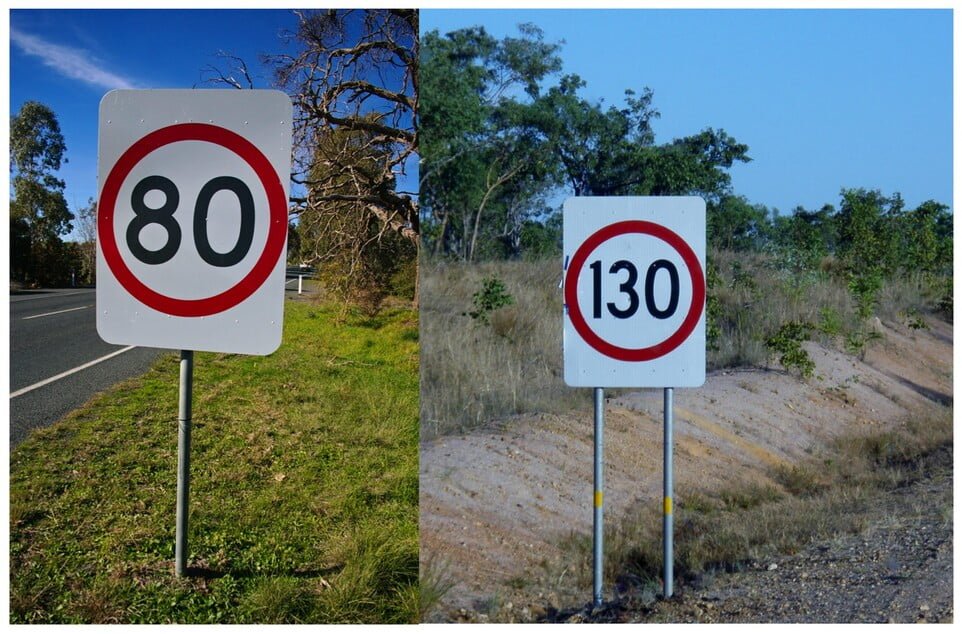
Australian Road Rules Confuse
by Collyn Rivers
Australian Road Rules Confuse
Australia has different road rules for each state and jurisdiction. As a direct result, Australian Road Rules confuse drivers, cyclist and pedestrians. It would make sense to have just one set of national towing rules.
Light trailers
There is a different ‘light trailer’ benchmarking around the country. To set their light trailer towing rules, New South Wales, Victoria and Western Australia use the weight of the tow vehicle. This a Gross Vehicle Mass of up to 4500 kg (9920 lb). The Australian Capital Territory, Queensland and the Northern Territory use the trailer’s weight. South Australia uses both trailer and tow vehicle weight. Tasmania uses Gross Trailer Mass (not Aggregate Trailer Mass) of up to 3500 kg (7700 lb).
Australian Road Rules Confuse – mixed towing speed signals
There is no Australia-wide re whether trailer towing speed should be less than non-towing. Or what maximum towing speed should be. Western Australia’s towing speed limit is 100 km/h. For all other jurisdictions, it’s the posted limit. That for parts of the Northern Territory is 130 km/h. This is far too high for towing caravans. Here, Australian Road Rules not just confuse drivers. That 130 km/h virtually invites jack-knifing.
Towing dynamics are well understood. So why have a 30 km/h variation?
Should learners and P-Platers Tow Trailers?
In Tasmania, neither learner nor provisional drivers may tow a trailer. South Australia and the Northern Territory has no towing restrictions for a learner or provisional driver. Elsewhere it’s a mix of the two. Even experienced drivers find towing challenging. Tasmania’s rule thus makes sense.
Maximum Towing Weights – Are Unclear
State and territory towing weight terminology is not only inconsistent. There are eight maker-stipulated tow weight restrictions one must not exceed.
Five rules relate to tow-vehicles. Gross Vehicle Mass, Gross Combination Mass, maximum towing capacity, maximum tow bar mass and maximum tow ball mass.
Three more rules relate to trailers. These are Aggregate Trailer Mass, Gross Trailer Mass and maximum coupling load. Other limits, such as tyre and axle weights generally apply.
Australian Road Rules Confuse – there are no uniform terms
There are not just non-uniform rules. There is no uniform terminology. Legislative wording relating to weight varies from state to state. Terms used include ‘carrying capacity’, ‘coupling’, ‘towing apparatus’, ‘maximum trailer mass’. Also ‘towing mass’, ‘towing limits’. Plus ‘any component in the vehicle/trailer combination’. Some terms are not defined. Where they are, not all are clear.
Many rules use the ‘aggregate’ to mean ‘maximum’. ‘Aggregate’ in everyday English refers to crushed stone. It makes more sense to use the alternative ‘Maximum Trailer Mass’. Not Aggregate Trailer Mass or Gross Trailer Mass. Doing so avoids confusion.
Why have Aggregate Trailer Mass (ATM) and Gross Trailer Mass GTM? Few owners know a trailer must not be coupled to the tow vehicle to measure the ATM. Yet connected to measure the GTM.
Tare mass definitions mislead caravan owners. Furthermore, many are grossly incorrect.
Many towing guides have weight-related errors. Some confuse actual and maximum weights. If they can’t get it right, what chance have users?
RV Books suggest towing weights should be explained via simple diagrams. Like these.
We need to agree on what the weights are. How they are defined. And how owners can check them. Also for insurers to provide one free weighbridge check a year per policy. This could encourage weighbridge use.
Towing Equipment – needed or not
Australia’s states and territories have small but significant variations in towing equipment. Here, Australian Road Rules confuse yet further.
Vehicle Standards Bulletin 1, and Australian Standards stipulate towing equipment trailer makers must install. But once a trailer is sold the buyer must ensure all exist. And work.
Safety chains (sometimes cables are permitted) are required throughout Australia. But whether they crossover, cannot touch the ground etc, legally varies. Their need to be long enough for turning is barely mentioned. That rated shackles are not obligatory is absurd.
In NSW only, tow vehicles must have a device to warn the driver if the trailer battery charge is not adequate to fulfil breakaway requirements.
Legislative terminology varies with Weight Distributing Hitches (WDHs).
New South Wales and Queensland say they ‘can be used when towing large caravans‘. Western Australia states ‘a load-distributing device may also be needed’ when towing heavy loads. Both overlook these hitches solve one issue, but introduce another. Also that their use to tow overly heavy loads needs discouraging. Our book Why Caravans Roll Over – and how to prevent that explains why.
Number Plates – Hard to See
Road rules regarding car and truck number plate size, position and content, are similar throughout Australia. But with trailer number plates, their visibility requirements depend on where you live!
In New South Wales and Tasmania, number plates must be readable within an arc of 45 degrees. That arc is above and to either side of the vehicle. The Northern Territory requires them readable over a 15-degree arc from above for vehicles less than 4.5-tonne GVM. And a 45-degree arc otherwise.
The ‘arc visibility’ rules create problems for a number plate beneath the cut-away of an ‘off-road’ trailer. Or if partially obscured by spare wheels and jerry-cans etc.
Victoria has no ‘arc visibility’ rules.
Long Vehicle Variations
A tow vehicle and trailer combination over 7.5 metres is legally a ‘long vehicle.’ Amongst other rules, long vehicles (unless overtaking) must travel at least 60 metres behind another long vehicle on a single lane highway that is not in a built-up area.
In New South Wales, however, a ‘built-up area’ is a ‘road without street lights’. Western Australia’s and the Northern Territory’s minimum distance between long vehicles is 200 metres. In Tasmania, the minimum distance is 60 metres. But, if in a ‘road train area’, it is 200 metres.
Conclusion – Australian Road Rules Confuse
This article is not intended to criticise road authorities. Their job includes setting and enforcing rules.
Australia’s federal structure hampers developing uniform rules that are simple, clear and safe. This is particularly so with towing legislation. The lack of uniformity causes unnecessary issues for people driving interstate. And even more so for overseas visitors hiring RVs.
Towing rules are localised yet towing physics is universal. Escalating caravan rollovers suggest towing principles are poorly understood. Furthermore, this may have disastrous consequences.
Media articles on caravan safety highlight that drivers must understand and comply with towing obligations. Such obligations vary, however. They depend on where their RV is registered. And wherever they drive.
Worse, a driver seeking to tow a caravan around Australia must locate, read, understand and comply with over twenty related legislative instruments, guides and inspection bulletins. This is unfair and unsafe.
A single set of national towing rules is required. Moreover, it would ensure driving easier and safer for all.

How to free camp legally in Australia
by Collyn Rivers
“No camping” – but what’s camping?
We’ve all seen signs that say ‘no camping’ but what does ‘camping’ mean?
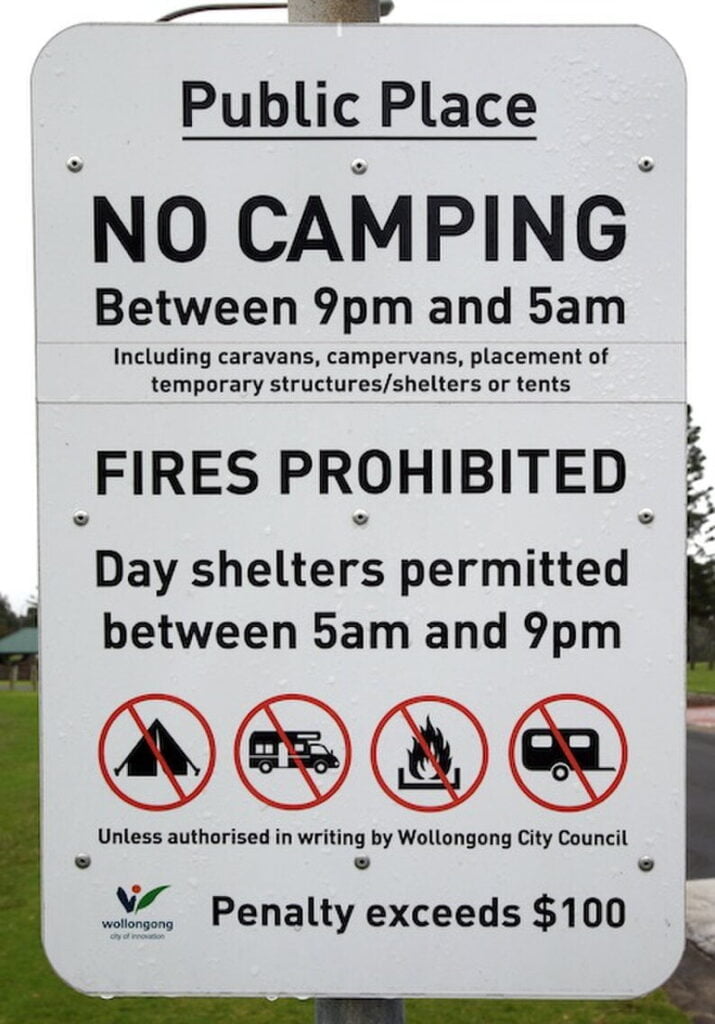
How to free camp legally in Australia is complicated as there are no overall definitions. In NSW alone, over ten authorities regulate camping on their land. In New South Wales alone, over ten government authorities regulate camping on their land. Even the definition of camping is inconsistent across the related Acts.
Apart from state governments, local government authorities establish rules or bylaws to regulate activities – including camping. There are over 500 such authorities across Australia. Those that regulate camping may each have their own definition. Private landowners can also define what they mean by ‘camping’. They may allow or prohibit it.
How to free camp legally in Australia – legislation
In essence whether or not you are ‘camping’ depends on whether or not you are following whatever Act, regulation or by-law that the authority concerned uses to regulate camping. A government authority sign (in your proposed camping area) should refer you to the relevant legislation to see what definition applies.
Some towns welcome free camping, others, that have a council-run camping area may ban it.
How to free camp legally in Australia issues are clearer if you erect a tent. They are less clear, however, if you stay overnight in urban areas in your caravan or motorhome. In these situations, the local council’s Health Department rules. They usually prohibit your overnight occupied parking in defined areas. In practice, you are unlikely to be disturbed if you stay overnight in a quiet back-street (not overlooked by any residence), Do not raise a pop-top roof, or let anything drain onto the road.
Do not free camp near [caravan park]s
Do not free camp anywhere near an established [caravan park]. Nor to cheat [caravan park] owners by using their facilities without paying. Some people do.
Buy a bag or two of firewood during the day (many fuel stations stock them. It is usually scarce anywhere near camp sites.
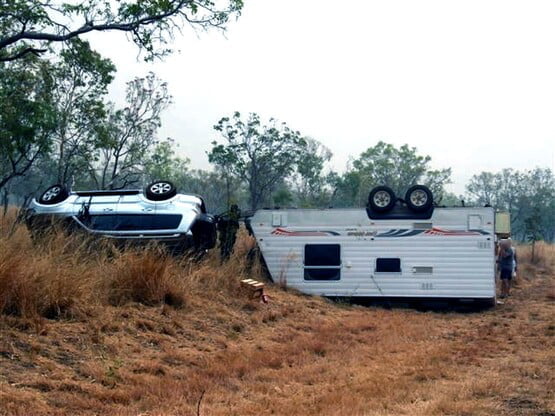
RV Industry Changes Needed
by Collyn Rivers
RV industry changes needed
On the surface, the Australian RV industry is healthy. But underneath all is far from well. A great deal needs changing. There are lots to do. RV Books explains the RV industry changes needed.
Pic: NT Police
In Australia, RV registrations are growing at about 5% a year. [caravan park]s fill in peak season. Caravan and camping shows are busy. But all is not as it seems.
The industry’s main current issues
- Many consumers are unhappy about the quality of their RVs (see here and here)
- Heavy or overweight Australian caravans are common on our roads. One RV service company estimates that 90% are overweight. Police checks show over 80% of all checked are overweight. One was by over 400 kg (880 lb).
- Tow vehicles are lighter to meet emissions requirements.
- Combining a light one with a heavy caravan, however, is a recipe for a rollover.
- Towing rules vary between each state and territory.
- RV owners are confused about RV weight definitions. This is compounded by multiple industry definitions. Many have little meaning.
- RV sales talk often takes priority over safety. It has ill-defined terms such as ‘off-road’.
- RV ‘reviews’ are included as part of RV media advertising/promotional packages.
- There are no statutory minimum payloads for caravans. Those for motorhomes are inadequate.
- Despite legal rules, RV compliance plates vary in content. They often contain errors.
- There is confusion about RV ‘self-containment’. This includes what it is. And where it applies.
- Town councils and [caravan park]s combine to disallow ‘free camping’.
Caravan rollovers escalate yearly
Each is an avoidable tragedy. Many end the RV dreams of those involved. Or worse.
The causes of rollovers are now well established. So are ways to reduce them. All is explained in both plain English (plus engineering) terms in our book: Why Caravans Roll Over – and how to prevent it.
RV Books believes caravan accidents can be significantly reduced by driver education. It needs better co-ordination between RV makers, road and industry authorities and RV clubs. All need a strong focus on towing dynamics and road safety.
RV industry changes needed to do to make their products safer
Caravan manufacturers need to make lighter ‘vans of uniformly high quality. To weigh every van made and attach full and accurate compliance plates. Manufacturers should install a weighbridge or scales.
Dealers should weigh every RV sold. And use educational tools for buyers.
RV vendors to advise effective payload after all accessories are fitted. To include payload allowances in sales contracts. To clarify maximum weight allowances. Vendors to stress the dangers of towing a caravan by a vehicle that is lighter. This particularly so for caravans over five metres. RV Books advises limiting laden caravan weight. It should not exceed 80% of the laden tow vehicle’s weight. So does the Caravan Council of Australia. Why Caravans Roll Over – and how to prevent it explains all.
Summary
- RV owners need to understand and follow their weight, loading and towing equipment obligations. Also any applicable ‘long vehicle’ road rules. They should not add extra weight (particularly at a caravan‘s rear. Load tow vehicles their legal maximum. But not more. This particularly so with dual-cab utes.
- State and territory road authorities should consider a single set of national towing rules. This should include driver license endorsement for towing. This could combine computer-based tow theory and RV road rules.
- Vehicle engineers to create a dedicated set of construction rules for caravans. Not just ‘trailers’. Simplify trailer weight and compliance plate requirements. Quantify sales terms. e.g. ‘off-road’ and ‘fully insulated’. Clarify the risks and limitations of weight distributing hitches. Make smoke detectors mandatory. Set realistic payloads.
- Industry organisations to encourage and actively monitor safe, high-quality RV manufacturing processes. Promote safe towing through free road checks. Provide, consumer-friendly educational material and courses. Offer online services such as tow vehicle matching.
- Insurance companies to promote RV driver self-education. They could offer discounts to those attending towing courses. Also, offer free or subsidised weighbridge checks.
- RV media to advise readers that ‘reviews’ are paid for. Overly heavy caravan weight noted in reviews. Suitable tow vehicles proposed for trailers reviewed.
RV Books will meanwhile assist with RV driver education etc via its books and articles.
10 Tips for RVing Around Australia
by Collyn Rivers
10 Tips for RVing Around Australia
What does it cost, what is the weather like and which way to go. There are many ways to explore Australia in an RV. You can go around the outside, base yourself in one place and take short trips in different directions, or criss-cross through the centre. You can do ‘figures of eight’, zigzags and routes based on watching or taking part in events around Australia. Here’s ten tips for RVing around Australia.
Be prepared for corrugations!
10 Tips for RVing Around Australia – Tip 1 is to exploit the wind
That most popular is to follow the shortest route around Australia’s coastline. It is 13,800 or so kilometres (8,625 miles). Allowing for diversions (such as Tasmania or Alice Springs and Uluru), this distance may double.
With wind speeds as high as 60 km/h, and particularly if you are towing a caravan, fuel usage will be much higher. To minimise this, the coastal route is best done anti-clockwise. Start down south in spring or summer (from Melbourne or Sydney) and head north – following the sun before winter sets in.
If you head west from Cairns or thereabouts, you will have strong and constant east-to-west trade winds across the top of the country behind you. You’ll also benefit at the bottom of Australia from west-to-east winds across the 1400 kilometre (875 miles) Nullarbor Plain on the way home.
10 Tips for RVing Around Australia – Tip 2 is to follow Highway One
For travelling around much of coast Australia, Highway One ranges from six-lane highways to single-lane roads. It is sealed most of the way except (in mid-2020) for a short section of the Roper Highway, a 206 km (about 130 miles) road in the Northern Territory of Australia.
Fuel is typically available every 350 km or so along Highway One, except between North-Western Australia between Broome and Port Headland – where it is a little over 400 km.
Highways One has rest areas with toilet facilities every 100 kilometres or so (62.5 miles) in the more remote areas. Most travellers consider it safe to stay overnight in these rest areas. Many do. You are unlikely to be alone. There are typically three to ten RVs there most nights (some 100,000 people a year do this trip).
Excellent and constantly updated guides are available on places to stay along the highway. Most towns have a [caravan park], but some are basic.
Highway One’s major downside is that it carries a great deal of heavy transport. Furthermore, it is not scenic for much of the way. Where feasible (assuming time is not a constraint) check out alternatives. Unless travelling with a 4WD and off-road caravan or camper trailer, seek local advice re road conditions. Some roads in the north and north-west are often closed during the wet season. This is historically November to April, but climate change has already resulted in non-seasonable rain and some flooding in a few areas.
10 Tips for RVing Around Australia – Tip 3 is to go North-South or East-West
There is an excellent road from south to north across the centre of Australia. It runs from Adelaide to Darwin via Alice Springs. Keep in mind that Uluru (Ayers Rock) is a 550 kilometre (about 345 miles) side trip each way from Alice Springs (and along a dirt track if you use the Merinee Loop road).
Going from east to west is approximately 6,500 kilometres (about 4060 miles) each way. Driving it is feasible with a caravan if you have the right experience. It really needs an ‘off-road’ caravan towed by a 4WD. There are several ‘start and finish’ points on each coast.
One major route is from far north Queensland, via Alice Springs, to Halls Creek in Western Australia. The route is scenic around Alice Springs, but otherwise flat and uninteresting. It is corrugated dirt for much of the way but progressively being bitumenised. This route (in 2020) really needs a caravan built for this purpose and a 4WD tow vehicle. This route is best attempted from April to September – as inland summer temperatures can approach 50 degrees C.
The Gibb River Road in North Western Australia’s vast Kimberley is truly scenic. It is dirt surfaced and has one usually shallow river crossing. A four-wheel drive is necessary to access most of the few camp-sites.
Tip 4 – Beware of Distance
Those who have not visited Australia before need to be aware that long distances separate many towns. This is particularly so along most of Western Australia’s coastline, and the 1400 kilometre (875 miles) Nullarbor Plain (that connects east to west).
Of our ten tips for RVing around Australia, a major one is this. When you do reach a remote town, it may have only a single, and often basic, motel. In some places, the only habitation is a road-house: a fuel stop with often truly basic accommodation.
When driving, try not to cover more than 200 kilometres a day. Driving with a caravan in tow is more tiring than driving a solo vehicle.
Most Australian caravan owners start their journeys early in the morning. They attempt to reach their destination by early afternoon, including time for rest stops. Towing a caravan in the dark along an unknown road when you’re tired is not a good combination.
Another of our ten tips for RVing around Australia is that spotting a potential campsite at night is all but impossible. If feasible, check to see if there is a settlement (such as an Aboriginal community) where you could stay. Most welcome travellers.
Tip 5 – Go When It’s Quiet
Australia’s east coast (particularly in Queensland) is crowded during Christmas (it’s in mid-summer in Australia) and Easter. Any areas mentioned in the Lonely Planet Guide in the past ten years are likely to be booked out. There are, however, many lesser-used inland roads that run more or less parallel to the coast. These can be worth exploring.
Find out the school term dates of the state in which you will be travelling (these dates vary by state) and book [caravan park] accommodation well in advance during school holidays. Most coastal [caravan park]s are fully booked months in advance. This is particularly true of Broome (WA).
Check out the dates of major events in each state or town (such as agricultural shows, car or horse race meetings and music festivals) and, depending on your preference, work your travel schedule into or around these events.
Tip 6 – Plan For All Seasons
Australia’s climate varies hugely from north to south, and from summer to winter. The southerly areas are usually comfortable in summer, but cold (0-15 degrees C) during winter. While outback Australia is usually hot during the day, in winter some parts reach temperatures below freezing at night. Plan your heating and clothing accordingly.
There is a wet season up north, typically from November to March, with some risk of cyclones and impassable roads due to creek or river flooding. Unless you are accustomed to 30 degrees C heat, and high humidity it’s best to avoid Australia’s top end in the wet season.
Never cross water-courses unless you know they are safe. Many have a strong flow of water across them. Consider water depth and speed carefully and learn how to drive across shallow water creeks.
Be flexible with your travel plans if bad weather intervenes. Some of the more enjoyable travel experiences can be unplanned ones. You have your accommodation with you, so why not use it?
Bush fires are an increasing threat during Australian summers. Read, watch or listen to local news reports when bush fires threaten and follow total fire bans.

Tip 7 – Always Have Water (and Food)
This is a major of our ten tips for RVing around Australia.
Much of Australia has a desert climate. It can be very hot and dry. It is essential to carry a least two/three litres a day per person of drinking water on your travels. Four to five litres per person per day is ideal.
The quality of water supplies varies across Australia, especially in the outback. The best type of water to carry is that sold in 12-15 litre plastic containers. These are stocked by virtually all supermarkets and fuel stations Australia-wide, and also stores in Aboriginal communities. Basic food and drink supplies are available at all road-houses, and even the smallest town will have a food store.
Unless deemed necessary (as on less-trafficked outback roads, do not tow a caravan with full water tanks – they increase van weight and can affect van stability.
Tip 8 – Leave The Caravan Behind When it Gets Bumpy
Just because you have a caravan in tow does not mean you have to take it everywhere you go. Consider carrying a tent in the tow vehicle, and when the going gets tough, leave the van behind in a [caravan park] (usually at a nominal charge) and go camping. Alternatively, just have day trips.
Another alternative is to rent a 4WD camper for remote areas or join a guided group tour. Group tours are recommended for those wishing to visit Kakadu and Lichfield Parks (near Darwin), Cape Leveque north of Broome, the vast Kimberley in general and the Cape York Peninsula. Cape York is a 2500 kilometre plus round trip along a seriously corrugated road (about two and half million corrugations).
Tip 9 – Think Fuel
Fuel stops on made-up roads in the more remote parts of Australia can be up to 375 kilometres (235 miles) apart. Unmade roads may not have fuel stops for 700-800 kilometres.
The cost of fuel in Australia, at typically $1.50 a litre ($5 a US gallon) is higher than in the USA but much less than in Europe. The cost up north is usually a third or so higher in the few major towns, but can be close to double in outback areas.
Fuel is, therefore, a major expense, but it can be reduced by not driving fast, by reducing weight, by not using cruise control in hilly areas and by having prevailing winds behind you (see Tip 1).
Tip 10 – Wolf Creek It Isn’t (but safety is still important)
Here are the most important safety rules for travelling in outback areas:
- In the event of problems, never leave your vehicle. You are more likely to die by going to look for help than by staying put. Use the shade under your vehicle(s) if you need to and wait for help
- If you get bogged in sand, clear all sand from under and in front of the vehicle and reduce tyre pressures by half (to about 110 kPa – 16 psi). Do not drive at more than 30 km/h (18 mph) until the tyre pressure is restored
- Be prepared for strong side wind gusts caused by oncoming large trucks and road trains
- Do not swerve for wildlife – with a van in tow, your life may become threatened instead of theirs
- It is advisable not to free camp within about 50 kilometres of any town, (particularly on a Friday or Saturday night) as kids tend to drive out of town to party. They are usually quite harmless but can be worrying if you are camping alone
- Do not go bush-walking alone and always carry a compass and a detailed map. To all but country-dwellers, much of the bush looks the same. It is very easy to get lost, carry a mobile phone as they provide emergency services of your approximate location, be alert for dangerous wildlife, carry a first aid kit at all times and know how to get help in an emergency. Never attempt to kill a snake. Only a very few are aggressive. If confronted by one, initially stay very still and then very slowly back away. Outback doctors will confirm that virtually all who get bitten are male and usually drunk
- Talk to the locals about road conditions
- Drive to the road conditions.
Interconnecting batteries in parallel or series – here’s how and why
by Collyn Rivers
Interconnecting Batteries
Interconnecting batteries in parallel or series is feasible but you need to know how it works. And its limitations. Interconnecting your batteries in series increases the voltage. Your current remains as before. Interconnecting your batteries in parallel increases the current. Your voltage remains as before. No matter how connected, your stored energy remains the same.
Batteries consist of cells (each of about two volts when fully charged). A 12-volt battery has six such cells. The cells are connected end-to-end.
Series connection increases battery voltage. Most car and caravan batteries are twelve volts. Some big motorhomes, however, have 24-volt systems. These typically have two 12-volt batteries in series. Many large solar systems use 48-volt storage – of banks of four 12-volt batteries in series.
Parallel connection increases battery capacity (i.e. the amount of energy it can store). It is often used to limit individual battery weight. For example, a 12-volt 240 amp-hour lead-acid battery weighs about 65 kg (145 lb). To ease handling, it’s common to parallel-connect two 12-volt deep-cycle 120 amp-hour batteries.
Large solar systems typically parallel-connect banks of four 12-volt batteries to store energy at 48 volts.
That shown above is a bank of 16 batteries (each of 12-volt). They are connected in series/parallel. This provides 48 volts at approximately 960 amp-hours. Pic: author’s previous all solar house north of Broome.
Interconnecting batteries in parallel or series – the pros and cons
Each way of interconnecting has advantages and disadvantages. These, however, are not the same advantages and disadvantages. Nevertheless, if you need over twelve volts, and/or substantial capacity, you must increase voltage, current or both.
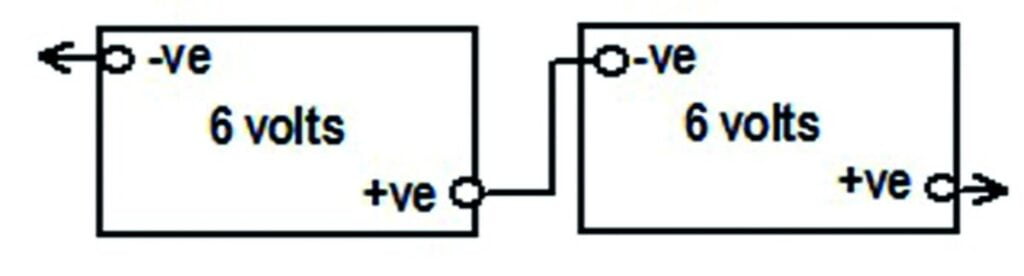
Batteries – series connection
Connecting two batteries end-to-end results in the total voltage being the sum of each battery. The available current and voltage are that of the ‘weakest’ cell.
A few motorhomes have 24-volt systems. They use 12-volt series-connected batteries. Never tap one or other battery to obtain 12 volts. If you do, the battery less drawn is fully-charged sooner. This inhibits the other battery fully charging. The only remedy is disconnecting and charging each separately.
You can, however, obtain that 12 volts via an ‘equaliser’ – or a 24-volt to 12-volts This is done in boats. Many have 24 volts winches, but 12-volts for all else. See 12-volts-dc-from-24-volts-dc/
Batteries parallel-connected
Paralleled batteries have socialist tendencies. Each takes according to its needs. Each gives according to its means. That more highly charged discharges into that less charged. This continues until their voltage is equal. Paralleled batteries (or paralleled strings of series-connected batteries) must all be the same voltage. They may, however, be of widely varying capacity.

Battery makers are rarely opposed to parallel connection. A few, however, set limits. General Electric says ‘there are no major problems with parallel charging.’ Exide, however, is more cautious. It advises ‘up to ten batteries may be interconnected without problem as long as certain precautions are followed’.
No Golden Way
Contrary to occasional forum ‘advice’, there is ‘golden way’ of interconnecting batteries to increase their energy. Any combination of the same batteries always provides you with the same total energy.
There is no problem parallel charging batteries of the same type and voltage, but of different capacities. They look after themselves. ‘Each draws a proportionate share of the available charge. All reach about the same level of charge at roughly the same time,’ (says Ample Power Company). They discharge in much the same way.
Ample Power company emphasises to connect paralleled batteries via equal length and size cables.
What happens when a battery fails?
Traditional starter batteries tend to fail instantly. Over time, active material shed from their plates piles up in the bottom of each cell. Furthermore, that loss is rapid if the battery is regularly over-discharged. If/when shed material rises high enough to short-circuit the plates, the battery fails instantly.
Lead-acid deep cycle batteries dislike being left uncharged. If that is done, dendrite (a tree–like structure) forms during recharge. This causes a virtual ‘short circuit’ across the cell. This too kills the battery.
The main risk is of hydrogen being created. But, providing the battery compartment is ventilated, that risk is unlikely.
Summary
Use parallel connection if large capacity is needed. Use parallel-connected pairs of series-connected batteries, for higher voltage large capacity systems.
Many big property stand-alone solar systems run at 48 volts. Most parallel-connect strings of four series-connected 12-volt batteries.
The above applies to all batteries: conventional lead-acid, AGM and lithium. Do not interconnect batteries of different chemical types.
See also Lithium batteries in caravans
Further information
If you liked this article you will like my books. Batteries and their charging are fully covered Caravan & Motorhome Electrics. That for solar in cabins and RVs is in Solar That Really Works. That home and property systems are in Solar Success. My other books are the Camper Trailer Book, and Caravan & Motorhome Book. For information about the author Click on Bio.
References
• Ample Power Company 1990. Parallel Batteries, Seattle, Washington.
• General Electric 1979. The Sealed Lead Battery Handbook, Publication BBD-OEM-237, GEC, Gainesville, Florida.
• Linden. D 1984. Handbook of Batteries and Fuel Cells, 2nd Ed McGraw-Hill, New York.
• Barak M 1980. Electrochemical Power Sources: Primary and Secondary Batteries, 1st ed. IEEE UK and New York.

Microwave for RV oven power draw – it’s more than many users think
by Collyn Rivers
Microwave oven power draw
Microwave for RV power draw is far greater than many users think. In this article, RV Books’ Collyn Rivers explains why – and how. This is a particular problem in caravans and motorhomes. Their deep-cycle lead-acid batteries cannot sustain the energy draw they require. AGM and lithium batteries are thus better suited.
A typical caravan or motorhome’s microwave oven is rated at 800 watts, but in terms of heat produced, not power draw). As most are only 50% efficient, that 800-watt microwave oven’s power draw is about 1200 watts.
Inverter loss
Microwave for RV power draw is also increased by losses within the inverter used to drive it. Inverters vary in efficiency. Some old ones are only 75% efficient, and thus best taken to the tip. The better current ones are 85%-90% efficient. Because of inverter losses, total microwave oven draw may thus be 1330 to 1600 watts. If run from 12 volts that’s 110-133 amps.
This 850 watt Dometic microwave oven draws about 1350 watts. Pic: Dometic
The amount of energy a microwave oven uses is proportional to its heat setting, and also to time. If run for 15 minutes at full heat, a 12 volt (800 watts) such oven will, via an inverter, draw 25 to 33 amp-hours. This may not seem much if you have a 150 amp-hour lead-acid battery, but it cannot do so for long. When high current is drawn, battery voltage consequently falls. It may fall too low to sustain that load. That may happen even with a battery still that’s still well charged. It may recover after resting but will not accept such high draw for long. The battery’s remaining capacity, however, is still there. It can readily be accessed used – but at a lower current draw.
Battery type and size
To power a microwave for RV, you really need at least a 250 amp-hour (12 volts) preferably AGM battery. Or about 100 amp hour of lithium (LiFePO4) batteries. It can be done from 150 – 200 amp hour deep cycle lead-acid batteries, but not for long at a time. Such high draw also shortens lead-acid battery life.
Ideally, confine extensive caravan and motorhome microwave use to the grid or generator power.
Every aspect of electrics in RVs is covered in Caravan & Motorhome Electrics. That on solar in RVs is in Solar That Really Works. Solar Success is for home and property systems. Caravan & Motorhome Book covers every aspect of RV usage. The Camper Trailer Book provides in-depth coverage of that area.