Battery charging and battery chargers are often misunderstood – causing batteries to die before their time. This article explains why and how to avoid it.
Battery charging and battery chargers – how to do it properly
read more

Battery charging and battery chargers are often misunderstood – causing batteries to die before their time. This article explains why and how to avoid it.
Fuel cells for RVs are non-polluting and ultra-quiet. Whilst initially promising their initial and running costs still excludes general RV use.
Electrical converters in RVs supply 12 volts from 230 volt power. They work well from 230 volts, but not for long-term camping. Here’s how to fix the problem.
Twelve-volt caravan systems may be twin-wire or chassis return. Twin-wire is usually best. This article explains why – and which to choose to avoid problems.
Variable voltage alternator problems with caravans and motor homes arise when charging auxiliary batteries. Here’s why and how to fix them. These alternators are, in particular, installed on many post-2013 vehicles.
TV interference from LEDs is an issue worldwide. It is mostly caused by LEDs in the same home (or RV) as the TV. This can be checked by turning them off. Another indicator of TV interference from LEDs is good daytime reception until lights are turned on. In the worst cases, TV reception is unwatchable, or not even obtainable.
Caravan fridge problems are due to poor ventilation, inadequate cable size and/or insufficient power to drive them. Here’s how to fix them.
Buying inverters for caravans can confuse. Prices vary for products that may seem identical but are not. Here’s what to buy.
Despite their very small batteries LiFePO4 jump starters really do work. This article by Collyn Rivers explains how and why. A lot of power (the rate at which energy is used) is needed. The amount of energy (the ability to perform work) required, however is surprisingly small. In the days of vintage cars, a strongish 55 kg (120 lb) girl could hand crank start a 4.5 litre Bentley with relative ease.
Circuit breakers and fuses in caravans both cut the current, but in different ways. Here’s how to know which best suits circuits and appliances protected. Those for 230 volt grid or inverter supplied circuits must be specified and installed by a certified electrician – who will install circuit breakers etc anyway. Circuit breakers and fuses for RVs (for 12/24 volt circuits) can be self-installed by those familiar with such work.
Solar that Really Works! covers the design, installation and use of solar in cabins, camper trailers, caravans, fifth wheelers, campervans and motor homes.

The book retailers set their own prices which can vary substantially. We'll aim to keep a selection of the better prices above.
Any bookshop, whether online or bricks and mortar, can order copies of Solar That Really Works! Just ask.
ISBN: 978-0-6483190-3-0
Explains in detail every aspect of tow vehicle and caravan stability. This is what you need to know to be safe on or off the road.
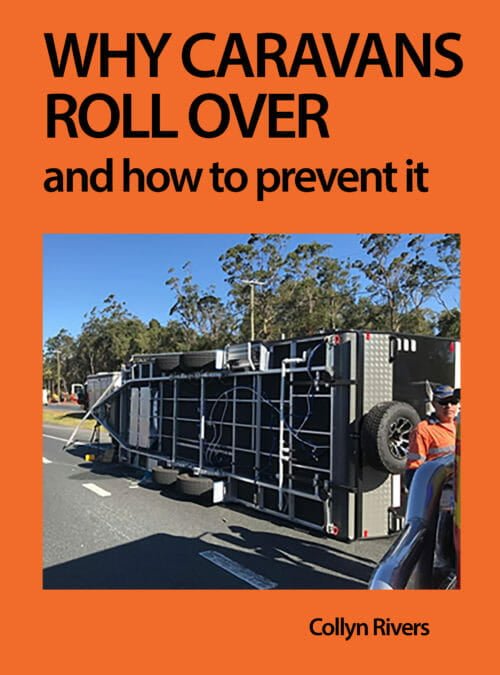
The book retailers set their own prices which can vary substantially. We'll aim to keep a selection of the better prices above.
Any bookshop, whether online or bricks and mortar, can order copies of Why Caravans Roll Over. Just ask.
ISBN: 978-0-6483190-6-1
The essential handbook for anyone with an RV of any kind. Everything you need to know to make the electrics in your rig work for you.

The book retailers set their own prices which can vary substantially. We'll aim to keep a selection of the better prices above.
Any bookshop, whether online or bricks and mortar, can order copies of Caravan & Motorhome Electrics. Just ask.
ISBN: 978-0-6483190-8-5
The Caravan & Motorhome Book covers every conceivable aspect of campervan and motorhome usage. If you own a camper van or motor home, you'll want this book.

The book retailers set their own prices which can vary substantially. We'll aim to keep a selection of the better prices above.
Any bookshop, whether online or bricks and mortar, can order copies of The Caravan & Motorhome Book. Just ask.
ISBN: 978-0-6483190-5-4.
Solar that Really Works! covers the design, installation and use of solar in cabins, camper trailers, caravans, fifth wheelers, campervans and motor homes.
The book retailers set their own prices which can vary substantially. We'll aim to keep a selection of the better prices above.
Any bookshop, whether online or bricks and mortar, can order copies of Solar That Really Works! Just ask.
ISBN: 978-0-6483190-3-0
Explains in detail every aspect of tow vehicle and caravan stability. This is what you need to know to be safe on or off the road.
The book retailers set their own prices which can vary substantially. We'll aim to keep a selection of the better prices above.
Any bookshop, whether online or bricks and mortar, can order copies of Why Caravans Roll Over. Just ask.
ISBN: 978-0-6483190-6-1
Solar that Really Works! covers the design, installation and use of solar in cabins, camper trailers, caravans, fifth wheelers, campervans and motor homes.
The book retailers set their own prices which can vary substantially. We'll aim to keep a selection of the better prices above.
Any bookshop, whether online or bricks and mortar, can order copies of Solar That Really Works! Just ask.
ISBN: 978-0-6483190-3-0
Explains in detail every aspect of tow vehicle and caravan stability. This is what you need to know to be safe on or off the road.
The book retailers set their own prices which can vary substantially. We'll aim to keep a selection of the better prices above.
Any bookshop, whether online or bricks and mortar, can order copies of Why Caravans Roll Over. Just ask.
ISBN: 978-0-6483190-6-1
The essential handbook for anyone with an RV of any kind. Everything you need to know to make the electrics in your rig work for you.
The book retailers set their own prices which can vary substantially. We'll aim to keep a selection of the better prices above.
Any bookshop, whether online or bricks and mortar, can order copies of Caravan & Motorhome Electrics. Just ask.
ISBN: 978-0-6483190-8-5
The Caravan & Motorhome Book covers every conceivable aspect of campervan and motorhome usage. If you own a camper van or motor home, you'll want this book.
The book retailers set their own prices which can vary substantially. We'll aim to keep a selection of the better prices above.
Any bookshop, whether online or bricks and mortar, can order copies of The Caravan & Motorhome Book. Just ask.
ISBN: 978-0-6483190-5-4.